












































Ethics in Cyber Security: Responsible Hacking & Privacy
Explore cybersecurity ethics, responsible hacking, and privacy protection. Learn to navigate the digital world responsibly while keeping sensitive data safely.
"You might not even be aware that your personal information is already out there—hacked, stolen, or exploited." Imagine finding out that the client database of a large company was recently hacked. Millions of identities were revealed. Credit cards are empty. Private lives have fallen into confusion. Cybersecurity is now urgent, intimate, and terrifying rather than abstract.
Every click, download, and swipe in the hyperconnected world of today involves a risk. However, despite the rapid advancement of technology, our ethical frameworks are unable to keep up. Cybersecurity involves more than simply firewalls and passwords; it includes accountability, trust, and personal responsibility.
This is where the intersection of ethics, responsible hacking, and privacy becomes more than theory—it’s a mission.
Understanding Cybersecurity and Its Importance
The process of defending networks, systems, and data against online threats is at the core of cybersecurity. The idea may appear quite technical, but it has a profoundly human consequence. Financial records, personal data, and even national security can all be compromised by a single breach.


Common cyber threats include:
-
Hacking: Unauthorized access to computer systems with the intent to steal, alter, or destroy private data.
-
Phishing: People are tricked into providing financial or personal information online by phoney emails or messages.
-
Malware and Ransomware: Malicious software that locks files for ransom, compromises computers, or steals data.
-
Social Engineering: Manipulating someone into disclosing private information or taking activities that jeopardize security.
Its Importance:
Since digital technologies are used in nearly every aspect of modern life, cybersecurity is crucial. Organizational operations, financial stability, and private information all depend on secure networks. Cybersecurity deficiencies can result in:
-
Financial Losses: Millions of dollars can be lost by people and businesses as a result of fraud, theft, or hacking.
-
Reputation Damage: Globally, data breaches severely undermine the trust that businesses have with their clients.
-
Legal Consequences: There are severe consequences for breaking data protection regulations.
-
National Security Risks: Critical infrastructure cyberattacks have the potential to endanger entire nations and vital public services.
-
Operational Disruption: Business activities can be stopped by poor cybersecurity, leading to delays, inefficiencies, and monetary losses.
-
Personal Privacy Threats: Daily lives may be impacted by the theft, exposure, or misuse of sensitive personal information.
Consider the 2017 Equifax data breach, which exposed sensitive information of over 147 million people. Such incidents demonstrate that robust cybersecurity practices are not just technical necessities—they are essential for safeguarding trust, privacy, and societal stability.
Ethics in Cybersecurity
The moral precepts that direct behavior in the digital world are referred to as ethics in cybersecurity. In contrast to technological regulations, ethics emphasize accountability, integrity, and respect in all digital activities.
Even if a hacker had extraordinary technological skills, they could be abused and do harm to people, companies, and society if there is no solid ethical framework in place. Knowing the importance of cybersecurity makes it clear why moral behavior is essential for preserving safety and trust in digital contexts as well as for safeguarding data.
Key Principles of Cybersecurity Ethics include:
1. Honesty and Transparency
Rather than taking advantage of vulnerabilities in security for one's own or one's employer's benefit, always report them.
2. Respect for Privacy
Be cautious while handling sensitive or personal information, and make sure it is only utilized with proper authorization.
3. Responsibility and Accountability
Recognize that whatever you do online can affect other people and organizations in the real world.
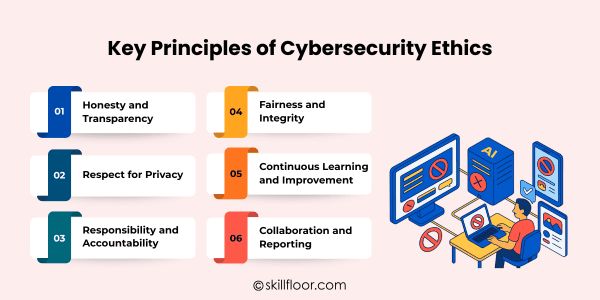
4. Fairness and Integrity
Stay clear of manipulating, misleading, or damaging users, systems, or data in order to gain unfair or self-serving advantages.
5. Continuous Learning and Improvement
Maintain current skills and apply knowledge to effectively safeguard users, systems, and digital data.
6. Collaboration and Reporting


Collaborate morally with others to improve security and communicate problems as soon as possible to avoid possible harm.
A professional cybersecurity specialist is distinguished from a malicious hacker by their ethics. Ethics guide behavior, build trust, safeguard data, and ensure technology is used responsibly—without causing harm, chaos, or exploiting others online.
Responsible Hacking / Ethical Hacking
Fear is generally the first emotion people feel when they hear the word "hacker." The ethical hacker, digital protector, and white-hat hero, on the other hand, belong to a distinct breed.
What is Responsible Hacking?
Ethical hacking, another name for responsible hacking, is testing systems for weaknesses with express consent. Its objective is to find vulnerabilities before malevolent hackers may take advantage of them. The important thing is to protect rather than destroy.
Strict guidelines and limitations are adhered to by ethical hackers. They openly share their discoveries, which frequently aid businesses in bolstering security. They protect sensitive data, foster trust, and avert possible financial and reputational harm by proactively fixing problems.
Consider it similar to hiring a locksmith to check your doors' security before a burglar tries. Hackers who practice ethics:
-
Determine system vulnerabilities before hackers do.
-
Perform penetration tests with stringent authorization and scope.
-
Responsible reporting of defects frequently results in praise and rewards.
-
To strengthen defenses in advance, simulate possible cyberattacks.
-
Assure adherence to company and legal cybersecurity regulations.
-
To stop breaches in the future, teach teams and organizations best practices.
Ethical hackers can be categorized as:
-
White Hat Hackers: Competent experts that work with companies to find weaknesses and improve system security while always acting morally and legally.
-
Grey Hat Hackers: People who conscientiously report problems but investigate system flaws without express authorization frequently cross ethical and legal lines.
-
Black Hat Hackers: Malicious actors who act unethically and criminally by taking advantage of security holes for their own gain, financial gain, or publicity.
Penetration testing, vulnerability assessments, and participation in bug bounty programs are typical techniques used in ethical hacking. Students can develop these skills and understand ethical standards by enrolling in ethical hacking courses. Additionally, certifications like the OSCP (Offensive Security Certified Professional) and CEH (Certified Ethical Hacker) further validate expertise and ethical behavior in the field.
Real-World Examples
-
Bug Bounty Programs: Businesses such as Google and Microsoft compensate ethical hackers for identifying serious flaws. Google paid hackers more than $10 million in 2023 via its bounty program.
-
Government Collaborations: Governments may upgrade their national cybersecurity infrastructure with the help of ethical hackers. For example, Google's Vulnerability Reward Program has assisted in fixing thousands of security vulnerabilities, averting potentially significant data breaches.
Privacy in the Digital Age
In today's digital environment, the right to privacy is crucial. Emails, pictures, health information, and location are examples of personal data that is continuously gathered, stored, and, in the absence of adequate security, may be misused.
Common Privacy Threats:
-
Data Mining: Collecting personal information without explicit consent.
-
Surveillance: Unauthorized monitoring of digital activity.
-
Identity Theft: Using stolen information for fraudulent purposes.
-
Phishing Attacks: Tricking individuals into revealing sensitive information through deceptive emails or messages.
Why Privacy Matters
-
By controlling your personal data, you can safeguard your autonomy.
-
Businesses that disregard privacy risk penalties, harm to their brand, and legal action.
-
Users are becoming more conscious: according to a Pew Research study, 81% of Americans believe there are more hazards than benefits associated with businesses collecting personal data.
-
Long-term financial and personal harm can result from breaches, impacting everything from credit scores to career prospects.
Practical Steps to Protect Privacy
1. Encryption
Protect sensitive information while it's being transmitted and stored by turning it into unintelligible code so that only those with permission can access it.
2. Two-Factor Authentication
By requiring several verification procedures, you can add an additional layer of security and make it much harder for unauthorized users to access your account.
3. Data Minimization
To reduce exposure to possible privacy breaches, gather just necessary personal information, keep it securely, and periodically review data.
4. Privacy-by-Design
Rather than treating privacy as an afterthought, incorporate it into the fundamental architecture of systems and applications.
5. Regular Software Updates
Update all systems, devices, and apps to address security flaws that could allow hackers to access personal information.
6. Strong, Unique Passwords
To lower the chance of unwanted access, create unique, complicated passwords for each account that combine letters, numbers, and symbols.
Security and privacy can be challenging to balance. While inadequate standards may expose sensitive data, too stringent security measures may restrict usefulness. Finding this balance is greatly aided by ethical considerations.
Navigating the Gray Areas: Ethics vs. Law vs. Security
The most difficult problems are moral rather than technological. Cybersecurity experts are always juggling:
-
Legal Obligations: Following corporate policies, laws, and regulations while making sure that every action complies with risk mitigation and compliance criteria.
-
Ethical Duty: Utilizing cyber security technologies sensibly to preserve integrity, protect users, and preserve transparency without jeopardizing trust or privacy.
-
Practical Security: To protect data while avoiding needless limitations or overreach, access, usability, and protection methods must be balanced.
-
Professional Accountability: Maintaining current knowledge and abilities to report vulnerabilities, make ethical decisions, and stop harm in a rapidly changing digital environment.
Decision-Making Framework for Ethical Cybersecurity
-
Ask Permission: Make sure all actions are approved and compliant with the law in advance, and never test systems without explicit agreement.
-
Assess Impact: Before taking action, take into account any potential harm or misuse to shield users and organizations from unforeseen consequences.
-
Document Actions: To encourage accountability, openness, and trust in cybersecurity operations, keep thorough records of every action.
-
Prioritize Human Welfare: Make sure that technological choices benefit people in a responsible manner, preventing abuse or exploitation while strengthening security.
-
Stay Updated: To make morally sound cybersecurity decisions, stay up to date on the latest risks, laws, and best practices.
-
Collaborate and Consult: Collaborate closely with stakeholders, legal teams, and coworkers to validate actions and maintain ethical standards.
By implementing these strategies, cybersecurity aims to create a safer digital society rather than only preventing crises.
The Future of Cyber Ethics: A Call to Action
Every day, emerging technologies like AI, IoT, and quantum computing present fresh moral dilemmas. Moral choices made now will establish the standard for the future. Delaying the adoption of ethical practices puts professionals at risk of losing opportunities and their reputation.
Why Acting Now Matters
-
Regulations change more slowly than cyberthreats. Foresight in ethics turns into a competitive advantage.
-
Businesses that prioritize ethics and privacy are more dependable, resilient, and creative.
-
Establishing a reputation for ethical responsibility as a professional can help you advance in your career.
-
Systems, data, and reputations are more susceptible to attacks while action is postponed.
-
Long-term reputation with partners, companies, and clients is increased by early adoption of ethical cybersecurity practices.
-
Active participation in security and privacy promotes leadership prospects and has an impact on the development of industry standards.
Being a part of the solution in a world in need of assistance is more important than simply avoiding mistakes.
Taking cybersecurity seriously requires more than just technology; it also involves people, accountability, and trust. Every online action you take has the potential to protect someone's privacy, prevent harm, and build faith in the digital world. By engaging in ethical hacking, safeguarding data, and upholding privacy, you become part of a community that prioritizes safety and justice. The choices you make now will shape your career and influence everyone's online safety. Take the initiative, act responsibly, and make a meaningful impact in the digital world.
Digital Marketing Courses in Other Locations in India
Ahmedabad | Aurangabad | Bangalore | Bhilai | Bhopal | Bhubaneshwar | Chandigarh | Chennai | Cochin | Coimbatore | Dehra Dun | Delhi | Faridabad | Ghaziabad | Gorakhpur | Guntur | Gurgaon | Guwahati | Hyderabad | Jaipur | Kanpur | Khammam | Kolkata | Lucknow | Madurai | Mumbai | Mysore | Nagpur | Noida | Patna | Pondicherry | Pune | Ranchi | Shimoga | Surat | Thane | Thiruvananthapuram | Tiruchirappalli | Tirupati | Vadodara | Visakhapatnam | Warangal | Jalandhar | Jodhpur | Indore | Durgapur | Jamshedpur | Dhanbad | Kota | Karnal | Udaipur | Amritsar | calicut | Nashik | Ludhiana | varanasi | thrissur | Mangalore | Raipur |