












































Digital Marketing Analytics: A Beginner’s Guide
Master digital marketing analytics with this easy beginner’s guide. Learn key metrics, tools, and strategies to turn data into growth and boost your campaigns.

"Are you unknowingly losing out on good clients?" Running marketing without accurate data is like throwing arrows while wearing a blindfold in the modern world, when every click, view, and engagement matters.
Businesses may monitor, comprehend, and enhance their online activities with the help of digital marketing analytics. Analytics provides you with the data you need to make more informed decisions, from observing client behavior to determining whether advertisements actually generate sales. Don't worry if you're new to this; we'll walk you through every step.
What is Digital Marketing Analytics?
The process of gathering, quantifying, and evaluating data from online marketing channels is the fundamental component of digital marketing analytics. It involves more than simply numbers; it involves transforming data into insights that can be put to use.
Through the use of data analytics and digital marketing, companies can quickly determine what is and is not working. It assists in spotting trends in consumer behavior, enhancing engagement, optimizing advertising, and eventually making more informed choices that result in increased conversions and improved return on investment.


For example:
-
How many people visited your website last month?
-
Which blog post brought the most traffic?
-
Did your email campaign actually lead to sales?
-
Which social media platform drove the most visitors to your site?
By providing answers to these questions, you can get a comprehensive image of how well your marketing is performing, including what works and what doesn't, as well as where you should concentrate your efforts to get better results.
The Importance of Digital Marketing Analytics
Digital marketing analytics ensures that every strategy fulfills its intended digital marketing goals by assisting organizations in making more informed decisions, enhancing campaigns, and achieving quantifiable outcomes.
1. Understand Customer Behavior
You may better personalize content and offers for more engagement and conversions by analyzing client interactions to uncover preferences and patterns.
2. Measure Campaign Performance
By monitoring important data, you may maximize return on investment by determining which initiatives are successful and which require modification.
3. Optimize Marketing Strategies
Ads, emails, and content can all be continuously improved with digital marketing and analytics to produce more effective outcomes.
4. Improve ROI
Businesses can make informed budgetary decisions and make sure resources are allocated to the most effective channels by using data-driven insights.
5. Identify Growth Opportunities
Analytics helps make strategic decisions that increase audience reach and corporate success by highlighting trends, gaps, and new markets.
6. Enhance Customer Experience
By comprehending user experiences, you may enhance overall contentment, content relevancy, and website navigation, creating enduring client loyalty.
Types of Digital Marketing Analytics
Let us take a look at the types of digital marketing analytics.
Helps businesses enhance site performance for better visitor experiences and outcomes by tracking website traffic, user activity, page views, and engagement.
2. Social Media Analytics
Improves content strategy, audience connection, and engagement across social media platforms by tracking likes, shares, comments, and follower growth.
3. Search Engine Optimization (SEO) Analytics
Monitors backlinks, organic traffic, and keyword rank to increase visibility, draw in relevant visitors, and boost search engine optimization.


4. Pay-Per-Click (PPC) Analytics
Keeps track of ad impressions, clicks, cost per click, and conversions in order to optimize return on investment and effectively fine-tune paid advertising campaigns.
5. Content Analytics
Determines what appeals to your audience and encourages significant interaction by analyzing blog entries, videos, and other content performances.
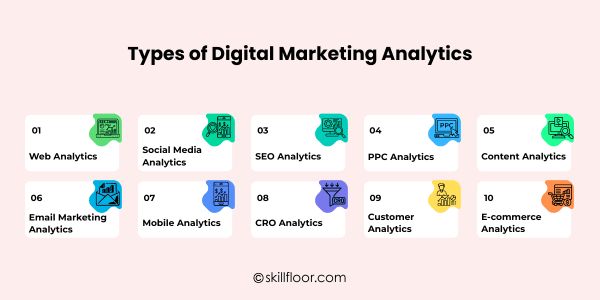
6. Email Marketing Analytics
Keeps track of open rates, click-throughs, and conversions to determine which emails are most effective in increasing engagement and sales for your campaigns.
7. Mobile Analytics
Evaluates user interactions, device behavior, and app usage to maximize mobile experiences and guarantee increased smartphone engagement using data analytics insights.
8. Conversion Rate Optimization (CRO) Analytics
Increases the proportion of visitors who complete desired actions by concentrating on user journeys, goal completions, and funnel performance.
9. Customer Analytics
Enhances client satisfaction and retention by analyzing demographics, behavior, and preferences to better understand consumers and customize marketing tactics.
10. E-commerce Analytics
Monitors revenue, sales, cart abandonment, and product performance in order to maximize online store performance and raise overall profitability.
Key Metrics for Digital Marketing Analytics
Tracking the right metrics helps you understand performance, measure success, and make data-driven decisions for all marketing channels.
1. Website Traffic
Evaluates the overall popularity of a website and the level of interest of its audience by counting the number of visits, sessions, and page views.
2. Bounce Rate
The proportion of visitors that go after only seeing one page, which suggests low engagement or a misalignment of the audience's demands with the content.
3. Conversion Rate
Monitors the number of visitors who perform specified actions, such purchases or sign-ups, clearly demonstrating the success of marketing campaigns.
Reveals engagement levels and content performance across channels by tracking the frequency with which users click links, advertisements, or call-to-action buttons.
5. Return on Investment (ROI)
Determines which tactics yield the best outcomes by calculating the cash benefit from marketing efforts relative to expenses.
6. Customer Lifetime Value (CLV)
Makes judgments about client retention, loyalty, and long-term marketing expenditures by estimating the total income a customer will provide over time.
7. Engagement Metrics
Consists of likes, shares, comments, and interactions on websites, email, and social media that show audience interest and the relevance of the material.
Actionable Metrics vs. Vanity Metrics
Actionable metrics should be the main focus. Despite their impressive appearance, vanity metrics can be deceptive. The distinction between vanity and useful metrics must be understood in order to succeed in marketing.
So, let’s break it down now.
The effectiveness of your marketing campaigns is shown by actionable metrics. They are linked to tangible outcomes, which help you concentrate on what's significant, make better choices, and lead your team to objectives that advance your company.
Examples of actionable metrics:
-
Return on ad spend
-
Click-through rate
-
Bounce rate
-
Customer acquisition cost
-
Conversion rate Customer lifetime value
-
Social media engagement rate
Although vanity metrics can have an alluring appearance, they rarely provide significant commercial outcomes. They may be deceptive, shallow, and fail to give context or promote genuine progress.
Examples of vanity metrics:
-
Total website traffic
-
Social media followers
-
Page views
-
Impressions
-
Email open rate
-
Likes and shares
An Overview of Digital Marketing Analytics Tools
Businesses may analyze, assess, and enhance campaigns with the support of digital marketing analytics tools, which offer useful information to help them make better decisions and maximize performance:
Helps marketers analyze performance and efficiently adjust content, campaigns, and the whole website experience by tracking website traffic, user activity, and conversions.
2. Google Data Studio
Enables the creation of interactive dashboards and visual reports by integrating various data sources to produce more lucid insights and well-informed marketing choices.
3. SEMrush
Effectively enhances organic search visibility and online marketing strategy by keeping an eye on SEO performance, keyword rankings, rival strategies, and backlinks.
4. HubSpot
Provides social media, email marketing, CRM, and analytics tools on a single platform, making it easier to monitor campaigns and successfully engage consumers.
5. Facebook Insights
Enables marketers to optimize content for improved social media performance by providing comprehensive statistics on post interaction, reach, and audience demographics.
6. Hotjar
Enhances website usability, engagement, and conversion rates by visualizing user behavior using heatmaps, session recordings, and surveys.
How and Where to Collect Marketing Data
Gathering information from various sources—including your website, mobile apps, email campaigns, social media platforms, paid advertisements, and offline interactions—is known as marketing data collection. This process becomes more organized and efficient when using monitoring technologies such as Google Analytics, CRM systems, advertising platforms like Google Ads or Meta, and heatmaps.
Today, many marketers use server-side tracking to enhance both privacy and accuracy. Unlike traditional client-side methods, server-side tracking transmits data directly from the server to the analytics platform. This approach is more reliable in light of ad blockers, tracking restrictions, and increasing data regulations, helping companies maintain trustworthy and usable data for making informed marketing decisions.
Current and Emerging Trends in Digital Marketing Analytics
Analytics for digital marketing is still developing quickly. Even a digital marketing course can teach you how to leverage these trends, helping businesses improve client experiences, optimize campaigns, and make wiser decisions:
-
AI & Machine Learning – Predict customer behavior and automate insights.
-
Predictive Analytics – Forecast outcomes and trends using historical data.
-
Data Privacy & Compliance – GDPR and CCPA compliance is essential.
-
Real-Time Analytics – Adjust campaigns on the fly for better results.
-
Cross-Channel Attribution – Track customer journeys across all platforms.
-
Automation & Dashboards – Quick insights with less manual effort.
Challenges in Digital Marketing Analytics and How to Solve Them
|
Challenge |
Solution |
|
Data Accuracy |
Use trusted tools, audit frequently |
|
Data Overload |
Focus on KPIs, use dashboards |
|
Cross-Channel Attribution |
Multi-touch attribution models |
|
Integration Issues |
Connect via APIs or integrated tools |
|
Privacy & Compliance |
Use anonymized, privacy-friendly methods |
|
Lack of Skills |
Invest in training or use user-friendly analytics software |
FAQs About Digital Marketing Analytics
Q1: How often should I check my marketing analytics?
A: It depends on your campaigns. Weekly checks are good for active campaigns, while monthly reviews work for long-term trends.
Q2: Can small businesses benefit from digital marketing analytics?
A: Yes! Even small businesses can improve targeting, save money, and boost results by tracking the right metrics.
Q3: Do I need expensive tools to start?
A: Not at all. Free tools like Google Analytics, Google Search Console, and basic social media insights are enough to begin.
Q4: How do I know which metrics matter most for my business?
A: Focus on metrics tied to your goals, like sales, leads, or engagement, instead of tracking everything at once.
Q5: Can analytics help me understand my competitors?
A: Yes! Tools like SEMrush or SimilarWeb show competitors’ traffic, keywords, and strategies to help improve your own campaigns.
Businesses can utilize digital marketing analytics to monitor performance, evaluate success, and identify ways to improve their campaigns. By understanding your audience, tracking results, and applying insights wisely, you can make informed decisions and gradually grow your business. Even small adjustments, such as refining a campaign or enhancing a webpage, can lead to significant results over time. Start by keeping an eye on your data, experimenting with new ideas, and recognizing your successes as you progress. With consistent effort, your marketing will become clearer, more effective, and genuinely rewarding.
Digital Marketing Courses in Other Locations in India
Ahmedabad | Aurangabad | Bangalore | Bhilai | Bhopal | Bhubaneshwar | Chandigarh | Chennai | Cochin | Coimbatore | Dehra Dun | Delhi | Faridabad | Ghaziabad | Gorakhpur | Guntur | Gurgaon | Guwahati | Hyderabad | Jaipur | Kanpur | Khammam | Kolkata | Lucknow | Madurai | Mumbai | Mysore | Nagpur | Noida | Patna | Pondicherry | Pune | Ranchi | Shimoga | Surat | Thane | Thiruvananthapuram | Tiruchirappalli | Tirupati | Vadodara | Visakhapatnam | Warangal | Jalandhar | Jodhpur | Indore | Durgapur | Jamshedpur | Dhanbad | Kota | Karnal | Udaipur | Amritsar | calicut | Nashik | Ludhiana | varanasi | thrissur | Mangalore | Raipur |