













































Cybersecurity Career Mistakes to Avoid Early On
Kickstart your cybersecurity career by learning the biggest early mistakes to avoid and build strong skills, grow faster, earn more, and stand out in the field.

If you’re reading this, chances are you’re ambitious.
Cybersecurity attracts you because it offers challenge, meaning, and, yes, financial security. You might be changing careers. You might be a student. Perhaps you work in IT already and are eager to get into security.
And yet… something feels overwhelming.
Too many certifications. Too many opinions. Too many “do this or you’ll fail” posts.


Here’s the truth most people avoid: Careers in cybersecurity usually fail because of a lack of intelligence. Some stop due to early, avoidable errors, while others advance by making wiser strategic decisions right away.
The Reality of Starting a Cybersecurity Career
There is a boom in cybersecurity. Industry statistics state that companies are in need of skilled employees and that the worldwide cybersecurity shortage of workers is still in the millions.
The rate of growth is what makes this urgent. There are currently between 25,000 and 30,000 available cybersecurity jobs in India alone, which represents a nearly 30% increase in recent years. However, there is still a 30–50% skill gap, particularly in cloud security and zero-trust roles. LinkedIn's reports on the rapidly increasing number of cybersecurity jobs in India also highlight this issue, adding timeliness and strong social proof.
This indicates that there are more openings than suitable candidates to fill them, making this one of the ideal periods in recent memory to establish a strong background and put yourself in a position to fill positions that are critically needed across industries.
That’s the good news.
The other side?
-
The field is crowded with beginners
-
Entry-level roles are competitive
-
Misinformation is everywhere
-
The path is rarely linear
Beginners may find cybersecurity to be confusing because it includes lots of positions, including SOC analyst, red/blue team, GRC, cloud security, IAM, and AppSec.
Why So Many Beginners Get Stuck
This is what frequently occurs: after deciding to pursue cyber security, a person searches for "how to get into cybersecurity" on Google and soon gets caught in a maze of competing viewpoints, courses, and advice.
-
Certification ads promising six-figure salaries
-
Influencers showing unrealistic “day in the life” posts
-
Conflicting advice about what skills actually matter
-
Pressure to move fast or “fall behind”
Beginners are stuck because they try to do everything at once, enroll in cybersecurity courses without a plan, and find it difficult to select skills that are actually important.
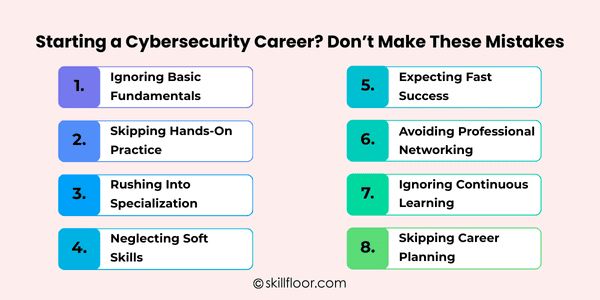
Starting a Cybersecurity Career? Don’t Make These Mistakes
1. Chasing Certifications Without Building Fundamentals
Many beginners ignore the fundamental networking, operating system, and security expertise required for practical cybersecurity goals instead of concentrating just on certificates.
Key Points:
-
Certifications alone don’t guarantee practical skills.
-
Networking and OS basics are essential foundations.
-
Understanding real-world applications is more valuable than exams.
-
Skills without context can’t solve actual security problems.
Prioritize developing solid foundations before using credentials to show your skills and increase your credibility.
2. Ignoring Hands-On Experience


Many beginners simply concentrate on theory, classes, or tests, missing out on the practical experience that is essential for resolving actual cybersecurity issues.
Key Points:
-
Theory alone cannot replace real-world practice.
-
Use labs to simulate security environments safely.
-
Participate in CTFs to improve problem-solving skills.
-
Internships provide practical, on-the-job learning experience.
Make practical experience essential in addition to studying; gaining experience through laboratories, CTFs, and internships speeds up learning and improves practical problem-solving skills.
3. Trying to Specialize Too Early
Entering specialized fields like cloud security or pentesting too quickly can leave beginners with inadequate foundational knowledge.
Key Points:
-
Broad IT knowledge is essential before specialization.
-
Early niche focus limits career flexibility.
-
Understanding security operations builds stronger problem-solving skills.
-
Foundational experience helps choose the right specialization.
To ensure long-term career progress, get wide exposure initially and learn the fundamentals of IT and security before settling on a specialty.
4. Underestimating Soft Skills
A lot of beginners ignore communication, teamwork, and reporting—skills essential to all cybersecurity career paths—in preference to concentrating just on technical skills.
Key Points:
-
Technical skills alone don’t guarantee success.
-
Clear communication improves team collaboration.
-
Writing reports effectively is essential for stakeholders.
-
Emotional intelligence helps manage high-pressure situations.
Invest in soft skills in addition to technical training; great teamwork and communication increase your effectiveness and worth in any cybersecurity job.
5. Expecting Instant High-Paying Roles
Many beginners ignore the importance of entry-level positions and slow career advancement because they believe cybersecurity promises instant six-figure salaries.
Key Points:
-
Entry-level roles are stepping stones, not failures.
-
SOC analyst and IT support build essential skills.
-
Patience is crucial for long-term career growth.
-
Experience opens doors to higher-paying positions.
Focus on developing your skills and strengths; as you prove your competency and dependability over time, high-paying positions will come to you.
6. Not Building a Professional Network
Career advancement may be slowed by concentrating only on technical skills and neglecting a connection. Networking in the industry, networking, and mentoring frequently open doors that abilities alone cannot.
Key Points:
-
Networking helps uncover hidden job opportunities.
-
Mentors provide guidance and real-world insights.
-
Attending events keeps you updated on trends.
-
Strong connections can lead to referrals and collaborations.
Participate actively in cybersecurity communities, make connections with mentors, and go to industry events; connections frequently spur growth more quickly than individual efforts.
7. Failing to Stay Curious and Adaptable
Professionals who stop learning run the danger of slipping behind as cybersecurity continues to change. Your abilities remain current and ready for new cybersecurity threats if you remain inquisitive and flexible.
Key Points:
-
Threats and technologies change rapidly.
-
Continuous learning ensures long-term career growth.
-
Experimentation improves problem-solving and innovation.
-
Flexibility allows smooth adaptation to new roles.
Consider learning a lifetime habit; experiment with new technologies, keep abreast of cybersecurity risks, and modify your abilities to fit changing trends.
8. Overlooking Career Planning and Goals
Time and opportunity might be wasted by drifting without a defined plan. You can prioritize learning, stay focused, and monitor your progress in cybersecurity by setting goals.
Key Points:
-
Clear goals provide direction and motivation.
-
Planning helps prioritize skills and learning paths.
-
Tracking progress ensures steady career growth.
-
Lack of planning can lead to frustration and stagnation.
To stay focused and develop strategically in cybersecurity, set both short-term and long-term professional goals, make a roadmap, and periodically assess your progress.
How to Choose the Right Cybersecurity Career Path
Beginners can avoid disappointment and lost effort by selecting the right cybersecurity job early on, which guarantees career happiness, progress, and skill alignment.
-
Understand Role Types: Examine SOC, pentesting, GRC, cloud, and malware analysis to align tasks with individual interests and strengths.
-
Daily Tasks Matter: To guarantee long-term engagement and job happiness, understand what a normal workday entails for each role.
-
Required Skills: To function well and advance professionally, each career path requires particular technical abilities, credentials, and real-world experience.
-
Career Growth Potential: Prior to making an early commitment, consider long-term prospects, promotions, and specialization alternatives within each cybersecurity domain.
-
Industry Demand: Think about the positions that are in greater demand, offer steady employment opportunities, and fit with changing cybersecurity trends.
-
Passion vs. Pay: To select a career path that inspires and supports you, weigh your personal interests, prospects for advancement, and expected compensation.
How to Plan Your Cybersecurity Career
Early career planning in cybersecurity enables you to define specific objectives, concentrate on your studies, acquire relevant experience, and advance without feeling overburdened or disoriented.
-
Set Short-Term Goals: To gain momentum in your chosen cybersecurity path, set short-term goals like mastering the fundamentals, finishing beginner labs, or obtaining entry-level certifications.
-
Define Long-Term Goals: Plan your ultimate professional goal, such as becoming a cloud security specialist, SOC analyst, or pentester, to successfully direct your education and job experience.
-
Map Required Skills: To prioritize targeted learning, make a list of the technical and soft skills required for your career, such as networking, Linux, coding, reporting, and communication.
-
Plan Certifications Strategically: Select qualifications that are relevant to your position, such as Ethical Hacking certifications, and balance credentials with practical experience to enhance your skills and résumé.
-
Gain Practical Experience: Incorporate laboratories, internships, CTFs, or volunteer opportunities into your plan to put your talents to use, boost your self-esteem, and show that you are capable in the real world.
-
Review and Adjust Regularly: To keep up with changing business trends and personal interests, periodically assess progress, modify objectives, and improve your roadmap.
Although beginning a career in cybersecurity may seem like entering an exciting and complex world, every professional you look up to start where you are. Building solid fundamentals, honing practical abilities, and maintaining curiosity are crucial. Don't rush to specialize too soon; instead, take tiny, gradual steps, learn, try new things, and make connections with people. Recall that entry-level positions and early experiences serve as stepping stones to greater chances rather than being setbacks. Be in the company of people who encourage and mentor you, never stop learning, and make specific plans for your future. You can develop into a self-assured professional who not only stays current with cybersecurity but also flourishes in it every day with perseverance, concentration, and persistent effort.
Digital Marketing Courses in Other Locations in India
Ahmedabad | Aurangabad | Bangalore | Bhilai | Bhopal | Bhubaneshwar | Chandigarh | Chennai | Cochin | Coimbatore | Dehra Dun | Delhi | Faridabad | Ghaziabad | Gorakhpur | Guntur | Gurgaon | Guwahati | Hyderabad | Jaipur | Kanpur | Khammam | Kolkata | Lucknow | Madurai | Mumbai | Mysore | Nagpur | Noida | Patna | Pondicherry | Pune | Ranchi | Shimoga | Surat | Thane | Thiruvananthapuram | Tiruchirappalli | Tirupati | Vadodara | Visakhapatnam | Warangal | Jalandhar | Jodhpur | Indore | Durgapur | Jamshedpur | Dhanbad | Kota | Karnal | Udaipur | Amritsar | calicut | Nashik | Ludhiana | varanasi | thrissur | Mangalore | Raipur |