













































What Is User-Generated Content (UGC) and Why It Matters
Learn what User-Generated Content (UGC) is, why it matters, and how authentic customer stories can drive trust, increase engagement, and grow your brand online.

Imagine browsing your favorite social media feed. You see a lot of well-executed advertisements, paid posts, and dazzling marketing campaigns, but something doesn't feel quite right. It's easy to remove without actually paying attention, formulaic, and rather manufactured.
Then you see a friend post a quick product video or a customer post an unbiased, unvarnished evaluation. You become intrigued all of a sudden. Because it seems genuine, you have faith in this individual. No scripts. Not a sales presentation. Just a person telling their story.
In action, this is user-generated content (UGC). This type of content has the power to convert infrequent scrollers into active followers and cautious buyers into loyal customers. You may be losing out on a lot of sales and trust if your business isn't utilizing it yet.
What is User-Generated Content?
User-generated content (UGC) is essentially any content created by people as opposed to brands, including text, photos, videos, reviews, and social network posts. UGC is very relatable since, in contrast to professional marketing campaigns, it represents real experiences and viewpoints.


Types of UGC Include
-
Social Media Posts: Customers use social media platforms like Facebook, Instagram, and TikTok to publish images, videos, or narratives that highlight their experiences using goods or services.
-
Reviews and Testimonials: People offer their honest thoughts on goods, services, or companies they have tried by writing reviews on Google, Yelp, or Amazon.
-
Blog Posts and Articles: Users write blogs or articles to share their experiences, offer advice, or instruct others on how to use goods or services.
-
Forums and Discussion Boards: People join discussion boards or websites such as Reddit and Quora in order to share their experiences, offer guidance, or pose questions.
-
Creative Contributions: Fans show off their creativity and excitement for a product or brand by making artwork, memes, unboxing videos, or do-it-yourself tutorials.
User-generated content encompasses not only posts but also reliable suggestions. According to studies, brands that utilize user-generated content (UGC) experience 4.5 times higher engagement rates, and 79% of respondents believe it has a significant impact on their purchasing decisions. Real user reviews, images, and videos give your company a genuine feel and build trust more quickly than traditional advertising.
The Emotional Power of User-Generated Content
UGC serves as a link between your brand and actual people's experiences, making it more than just content. People arouse emotion, empathy, and trust when they tell their stories. Let's study this:
1. Trust Trumps Advertising
Consider two product descriptions: a 30-second video of an actual customer and a text produced by the brand. The genuine human story is the foundation of digital marketing since it always seems more plausible.
2. Engagement Feeds Community
Conversations are sparked by UGC. By inviting others to participate in conversations, users create a feeling of community. Real people sharing content fosters a stronger bond than formal advertising alone.
3. FOMO Without Saying “FOMO”
Subtle urgency is created when you see actual customers enjoying your goods. Naturally, audiences want to share in other people's experiences, which increases interest and makes a brand more desirable.
4. Inspiration Sparks Action
Others are inspired when users show their inventive usage of your product. Emphasizing these stories in content marketing drives interaction and persuades prospective clients to take action.
5. Social Proof Builds Credibility
People trust the evidence provided by UGC. Testimonials, images, and reviews demonstrate authenticity and give your business a sense of dependability and credibility, which increases impact and loyalty.
6. Amplifies Brand Reach
Your message reaches new audiences with each user share. Paid advertisements frequently fall short of this organic amplification in terms of visibility, campaign strength, and ripple effects.
How User-Generated Content Actually Works
UGC is effective because it capitalizes on social proof, which is the idea that people are more likely to believe other people's experiences than advertisements. UGC is encouraged by brands in several ways:
1. Hashtag Campaigns
Brands can easily locate and display content by using hashtags that users use while sharing their experiences.
2. Social Media Challenges
Users are inspired to produce innovative postings while interacting with the brand community online by entertaining challenges.
3. Contests and Giveaways
Companies hold contests where users must submit information to boost engagement and enthusiasm for their goods.


4. Featuring User Posts
Brand trust is increased when user images or videos are shared on official accounts, showcasing genuine experiences.
5. Customer Reviews and Testimonials
On websites or social media, brands display reviews to promote sales and offer social evidence.
6. Collaborations with Creators
Collaborating with loyal customers or micro-influencers facilitates the creation of genuine, high-quality content that appeals to viewers.
User-generated content is abundant on platforms such as YouTube, Instagram, TikTok, and even company websites. Curating user content is a crucial component of any digital marketing strategy since it allows companies to reduce production costs while simultaneously fostering community and engagement.
A fashion company could, for example, repost images of consumers wearing its clothes, showcasing actual people rather than models, making the items seem more approachable and appealing.
The Importance of User-Generated Content
UGC is important because it strengthens relationships between audiences and brands by creating engagement, authenticity, and stronger bonds.
1. Builds Trust and Authenticity
Peer recommendations are more trusted than commercials; user photographs or testimonials are perceived by new audiences as being truthful, objective, and extremely relatable.
2. Drives Engagement and Community
Contributors feel appreciated when their work is shared by brands, which encourages brand loyalty and encourages others to join in and participate actively online.
3. Influences Purchase Decisions
Conversion rates and sales are greatly increased when prospective customers are persuaded of a product or service's worth by seeing actual users recommending it.
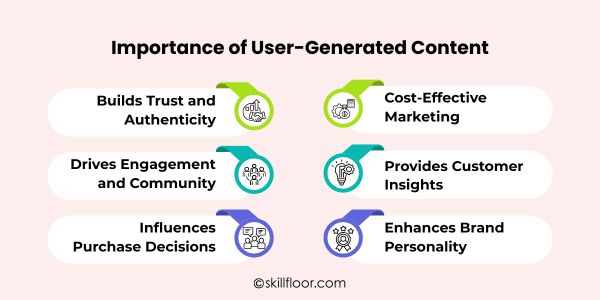
4. Cost-Effective Marketing
Authentic content can be produced by brands using their community instead of investing extensively in traditional advertising campaigns, models, or photographers.
5. Provides Customer Insights
User-generated content (UGC) helps brands improve their goods, services, and content marketing campaigns by revealing what consumers enjoy, current trends, and places for improvement.
6. Enhances Brand Personality
Sharing images, videos, or user tales humanizes a brand and helps audiences remember it in their everyday lives.
Key Benefits of User-Generated Content for Brands
UGC gives brands real, interesting content while engaging their audience and building connections of trust and loyalty.
1. Increased Reach and Exposure
Each user-generated post expands the brand's reach, increasing its awareness and drawing in new clients through social media sharing.
Brand websites receive more organic traffic because of backlinks, great engagement, and fresh user content that raises search ranks.
3. Stronger Brand Loyalty
Including content from customers builds a feeling of community, which increases user value and builds strong brand loyalty.
4. Valuable Market Insights
UGC reveals consumer preferences, trends, and comments, enabling companies to efficiently improve their goods, services, and overall marketing plans.
5. Humanized Brand Image
A brand gains consumers' trust and emotional connection by sharing authentic user experiences, which also makes the company approachable and relatable.
6. Cost-Effective Content Creation
Utilizing user-generated content instead of costly campaigns, models, or picture sessions allows for the production of genuine, stronger ads.
How Users Benefit from User-Generated Content
User-generated content empowers people by providing them with online prominence, a voice, and meaningful engagement. It is not just beneficial for brands.
1. Recognition
When brands include their content, many people become more visible and credible, which enhances their reputations both personally and professionally.
2. Community Contribution
Users who create and distribute user-generated content (UGC) feel more included in a wider discussion, fan base, or online community with similar interests.
3. Influence
In UGC campaigns, user reviews and opinions have the power to influence product development, brand choices, and general market trends.
4. Creative Expression
Through images, movies, memes, and other original content formats, user-generated content enables people to express their creativity.
5. Skill Development
Users can enhance their digital skills, storytelling, photography, video editing, and social media communication by consistently creating user-generated content.
6. Personal Satisfaction
When users see their thoughts or experiences appreciated by the public, contributing UGC gives them a sense of achievement and appreciation.
Best Practices for Using User-Generated Content
Brands should adhere to these useful tactics to guarantee authenticity, engagement, and long-term value in order to optimize the potential of user-generated content.
1. Encourage Participation
Organize contests, creative challenges, or hashtag campaigns to encourage users to actively interact with the brand and submit content.
2. Seek Permission
Always get people' permission before distributing their content in order to honor ownership, preserve transparency, and uphold trust.
3. Curate Carefully
Choose user-generated content (UGC) that is consistent with your brand's image, values, and messaging to maintain consistency across all marketing platforms.
4. Show Appreciation
Give shout-outs, prizes, or features to contributors to motivate more users to join and contribute in a meaningful way.
5. Integrate Across Channels
Use user-generated content (UGC) in emails, advertisements, websites, and social media to increase audience engagement, impact, and reach.
6. Monitor and Moderate
Maintain a secure community and brand reputation by routinely checking posted content for appropriateness, relevancy, and quality.
Challenges and Risks of User-Generated Content
Although user-generated content has great potential, brands need to be mindful of the dangers and difficulties in order to safeguard engagement and reputation.
1. Content Moderation
Content that is abusive, improper, or misleading can harm a company's reputation; not all user inputs are consistent with brand values.
2. Copyright and Ownership Issues
In order to minimize legal issues and uphold intellectual property rights, brands must make sure they have authorization to use user-generated content.
3. Maintaining Brand Consistency
Tone, style, and quality variations in user material can clash with a brand's voice or marketing messaging.
4. Inaccurate or Misleading Content
If UGC is not closely watched, it could mislead other consumers and damage trust since it may contain mistakes or overstated claims.
5. Privacy Concerns
When gathering or disseminating user-generated content (UGC), brands must verify compliance with privacy rules and safeguard sensitive user data.
6. Mitigation Strategies
Establish explicit submission standards, make use of moderation tools, give users credit whenever possible, and approve work before publication.
Case Studies / Real Examples
UGC isn’t just theory—it’s a proven growth engine. Here’s how top brands leverage it:
-
GoPro: GoPro transformed its clients into a dominant force in content creation. Users created YouTube audiences, unlimited content pipelines, and a brand identity associated with adventure by submitting incredible movies through the GoPro Awards and Million Dollar Challenge, all without the need for traditional advertisements. Their primary marketing tactic is now user-generated content.
-
Glossier: Glossier shared uncensored selfies and candid evaluations, concentrating on actual customers rather than models. They achieved a $1.2 billion value and drastically reduced acquisition costs through user-generated content by promoting and reposting #Glossier postings, which fostered a sense of community, trust, and belonging.
-
Airbnb: Airbnb is totally dependent on user content: stories, guest reviews, and host images foster confidence. With UGC at the core of their business, campaigns like #WeAccept magnified genuine experiences, generating millions of listings and reviews, generating social proof, and assisting Airbnb in growing to a valuation of over $100 billion.
The Future of User-Generated Content
Alongside technology, user-generated content is developing quickly in the future, providing both users and marketers with interesting options.
-
AI-Enhanced Content: Brands may use cutting-edge AI techniques to find, select, and even enhance user-generated content (UGC) to make it more interesting and superior.
-
AR and VR Experiences: In virtual and augmented reality environments, users will produce more and more immersive content, providing engaging and memorable marketing experiences.
-
Social Commerce Integration: Shoppable UGC transforms real content into a potent online sales engine by enabling users to directly impact purchases.
UGC, which emphasizes authenticity, engagement, and community building, will continue to be a fundamental component of digital marketing as technology develops, influencing how brands interact with consumers in the years to come.
User-generated content shows that the voices of real people can have a greater impact than traditional advertising. This type of content fosters connection and trust while building communities where customers feel valued and recognized. Businesses gain authentic content that drives action, and users feel acknowledged when brands share their stories. Casual customers can transform into loyal fans, and regular followers may become brand advocates through user-generated content. Brands that embrace these narratives will create stronger connections, expand their audience, and stay relevant as more people share their experiences online. It's about listening to, sharing, and honoring the individuals who give your brand its significance.
Digital Marketing Courses in Other Locations in India
Ahmedabad | Aurangabad | Bangalore | Bhilai | Bhopal | Bhubaneshwar | Chandigarh | Chennai | Cochin | Coimbatore | Dehra Dun | Delhi | Faridabad | Ghaziabad | Gorakhpur | Guntur | Gurgaon | Guwahati | Hyderabad | Jaipur | Kanpur | Khammam | Kolkata | Lucknow | Madurai | Mumbai | Mysore | Nagpur | Noida | Patna | Pondicherry | Pune | Ranchi | Shimoga | Surat | Thane | Thiruvananthapuram | Tiruchirappalli | Tirupati | Vadodara | Visakhapatnam | Warangal | Jalandhar | Jodhpur | Indore | Durgapur | Jamshedpur | Dhanbad | Kota | Karnal | Udaipur | Amritsar | calicut | Nashik | Ludhiana | varanasi | thrissur | Mangalore | Raipur |