













































Most In-Demand Data Science Career Paths in 2026
Discover the most in-demand data science career paths in 2026, key skills required, and how to build a future-proof career in our fast-growing data industry.

Today, companies use data science to make quicker and more informed decisions. Businesses may better understand their clients, enhance their offerings, and find new opportunities with the use of data science and analytics. The development of cloud computing, artificial intelligence, and machine learning has made it simpler and more effective to analyze big datasets.
According to industry reports, the demand for data scientists and machine learning specialists has increased by 30–40% in recent years, and the data science market may soon surpass $300 billion. Data science is becoming more and more important in sectors like healthcare, banking, e-commerce, and entertainment, opening up a variety of employment options outside of the typical data scientist position.
Finding out about the most sought-after data science career paths in 2026 might help you identify the finest prospects and the abilities you should concentrate on if you intend to begin a career in this industry or wish to advance your talents.
Why Data Science Careers Are Booming in 2026
More data is being produced globally than ever before. Industry projections indicate that by 2026, the amount of data generated worldwide will exceed 180 zettabytes. Professionals who can evaluate this data, draw insightful conclusions, and create intelligent systems are in high demand.


Several factors contribute to the growing demand for data science professionals:
1. AI and Machine Learning Adoption
Companies are using AI into their operations, services, and goods to boost productivity and enhance consumer satisfaction.
2. Data-Driven Decision Making
Instead of using instinct, organizations use data insights to inform their strategic choices.
3. Automation and Predictive Analytics
Predictive models are used by businesses for fraud detection, prediction of trends, and process optimization.
4. Growth of Cloud Computing
Large volumes of data can be processed and stored by businesses due to cloud platforms.
Key Skills Required for Data Science Careers in 2026
Before considering different career paths, it's critical to comprehend the essential data science skills that employers in a variety of industries nowadays require.
Core Technical Skills
1. Programming Languages
Python is still the most often used programming language in data science because of its extensive library ecosystem.
2. Statistics and Mathematics
Professionals can create effective prediction models by having a solid understanding of probability, statistical modeling, and linear algebra.
3. SQL and Data Management
For arranging and obtaining structured datasets kept in databases, SQL is a must.
4. Machine Learning Fundamentals
Understanding supervised and unsupervised learning methods is essential for developing intelligent models.
5. Data Visualization
Stakeholders can better comprehend complex data by using visual dashboards and charts to communicate insights.
Emerging Skills
As the field evolves, new skills are becoming increasingly valuable:
-
Generative AI and Large Language Models
-
Cloud computing platforms
-
MLOps (Machine Learning Operations)
-
Data ethics and responsible AI
-
Real-time data processing



Professionals will have an advantage in the job market if they combine these contemporary abilities with traditional data science learning.
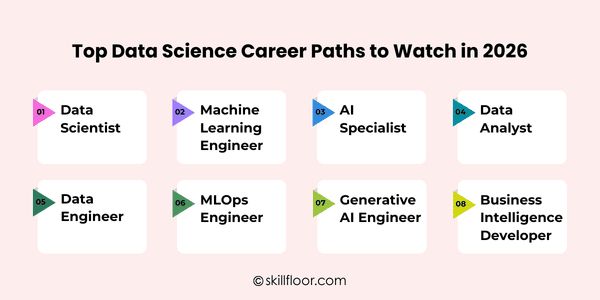
Top Data Science Career Paths to Watch in 2026
These days, the data science industry offers a wide range of jobs that encompass every phase of the data science life cycle, from gathering and storing data to developing AI models and producing business insights.
In the data sector, the role of data scientist is still one of the most well-known. Data scientists assist companies in making data-driven decisions by analyzing massive databases and developing prediction models.
To find patterns and trends, their work usually entails gathering data, cleaning it, doing exploratory analysis, and creating machine learning models.
Key Responsibilities
-
Data cleaning and preprocessing
-
Exploratory data analysis
-
Building predictive models
-
Communicating insights to stakeholders
Skills Required
-
Python or R
-
Machine learning algorithms
-
Statistics
-
Data visualization tools
Salary (2026):
-
US / Global: $110K–$180K+ (median ~$120K)
-
India: ₹9–₹20 LPA (entry–mid), up to ₹35 LPA+ (experienced)
2. Machine Learning Engineer
Designing and implementing machine learning models at scale is the primary focus of machine learning engineers. Machine learning engineers make sure the models work well in practical applications while data scientists construct them.
They are in charge of incorporating machine learning systems into real-world settings.
Key Responsibilities
-
Developing scalable ML systems
-
Model deployment
-
Performance optimization
-
Monitoring models in production
Skills Required
-
Python
-
Software engineering principles
-
Machine learning frameworks
-
Cloud computing
Salary (2026):
-
US / Global: $130K–$200K+ (median ~$150K)
-
India: ₹9–₹25 LPA, up to ₹45 LPA+ for senior roles
3. AI Specialist
AI specialists concentrate on creating, deploying, and developing artificial intelligence solutions to address challenging business issues. They concentrate on developing intelligent systems that can forecast, automate procedures, and give businesses useful insights.
These experts serve as a link between AI research and real-world commercial applications.
Key Responsibilities
-
Developing AI models and algorithms
-
Implementing AI solutions for business processes
-
Optimizing AI system performance
-
Collaborating with cross-functional teams
Skills Required
-
Python or R programming
-
Machine learning and deep learning frameworks
-
Data analysis and statistics
-
Problem-solving and critical thinking
Salary (2026):
-
US / Global: $140K–$220K+ (median ~$160K)
-
India: ₹9–₹25 LPA, up to ₹45 LPA+
4. Data Analyst
The primary goal of data analysts is to analyze data and provide insights that assist companies in making wise decisions. Analysts usually work with structured data and concentrate more on reporting and visualization than data scientists do.
Key Responsibilities
-
Analyzing datasets
-
Creating dashboards
-
Generating reports
-
Identifying trends and patterns
Skills Required
-
SQL
-
Excel
-
Data visualization tools
-
Basic statistics
Salary (2026):
-
US / Global: $85K–$140K (median ~$100K)
-
India: ₹4–₹10 LPA (entry–mid), up to ₹12–₹15 LPA (experienced)
Data engineers create and manage the infrastructure that enables businesses to gather, store, and handle massive volumes of data.
They create pipelines that transfer data into data warehouses or analytics platforms from many sources.
Key Responsibilities
-
Building data pipelines
-
Managing databases
-
Ensuring data reliability
-
Optimizing data storage systems
Skills Required
-
Python or Scala
-
SQL
-
Big data tools
-
Cloud platforms
Salary (2026):
-
US / Global: $110K–$170K+ (median ~$130K)
-
India: ₹8–₹22 LPA, top roles ~₹30 LPA+
6. MLOps Engineer
Organizations require experts that specialize in managing the lifecycle of ML models as the use of machine learning increases. This is the role of MLOps engineers.
MLOps ensures that models are deployed effectively and maintained over time by fusing DevOps techniques with machine learning.
Key Responsibilities
-
Automating model deployment
-
Monitoring model performance
-
Managing ML pipelines
-
Ensuring model scalability and reliability
Skills Required
-
Cloud platforms
-
CI/CD pipelines
-
Machine learning frameworks
-
Containerization tools
Salary (2026):
-
US / Global: $120K–$200K (median ~$140K)
-
India: ₹8–₹20 LPA, senior roles ₹25–₹35 LPA
7. Generative AI Engineer
Generative AI has become one of the fastest-growing areas in technology. Generative AI engineers focus on building applications powered by large language models and other generative technologies.
These professionals develop AI systems capable of generating text, images, code, and other forms of content.
Key Responsibilities
-
Building LLM-based applications
-
Prompt engineering
-
AI workflow automation
-
Integrating generative AI tools
Skills Required
-
Python
-
Natural language processing
-
AI model APIs
-
Prompt design
Salary (2026):
-
US / Global: $130K–$210K (median ~$150K)
-
India: ₹9–₹25 LPA, top roles ~₹45 LPA+
8. Business Intelligence (BI) Developer
Business intelligence (BI) has emerged as a crucial field for companies looking to make data-driven choices. BI developers concentrate on using dashboards, reports, and analytics tools to turn unstructured data into insightful knowledge.
These experts support businesses in monitoring performance, identifying patterns, and formulating wise strategic choices.
Key Responsibilities
-
Designing and developing interactive dashboards
-
Collecting and integrating data from multiple sources
-
Generating actionable business reports
-
Collaborating with stakeholders to understand requirements
Skills Required
-
SQL and database management
-
Data visualization tools
-
ETL processes
-
Analytical and problem-solving skills
Salary (2026):
-
US / Global: $85K–$140K (median ~$100K)
-
India: ₹5–₹12 LPA, top roles ₹15–₹18 LPA
Industries Hiring Data Science Professionals in 2026
Data science is not just used by tech companies. Data-driven insights are crucial to many sectors.
1. Healthcare
Data science supports individualized treatment strategies, enhances patient care, forecasts diseases, and streamlines hospital operations.
2. Finance
Data professionals use predictive analytics and machine learning to identify fraud, evaluate risks, maximize investments, and enhance financial decision-making.
3. E-commerce
Analyzing consumer behavior, tailoring suggestions, refining pricing tactics, and enhancing online buying experiences are all made possible by data science.
4. Marketing and Advertising
Effective consumer segmentation, campaign optimization, engagement tracking, and marketing performance measurement are all made possible by data-driven insights.
5. Cybersecurity
Threat detection, vulnerability identification, attack prediction, and bolstering digital security systems are all aided by data science.
6. Entertainment
Analyzing audience preferences, optimizing content recommendations, predicting trends, and boosting engagement across streaming platforms are all tasks performed by data experts.
How to Choose the Right Data Science Career Path
With so many options, your individual abilities, interests, and the skills you're most passionate about honing will determine which data science career path is best for you.
Jobs as a data engineer or machine learning engineer might be ideal for you if you enjoy designing systems and programming.
2. Interest in Business Insights
If you find it exciting to analyze patterns and offer insights, you might want to look into positions like data analyst or BI developer.
3. Interest in AI Research
An AI engineer or generative AI specialist is a good fit if you enjoy building AI models and experimenting with algorithms.
4. Problem-Solving Skills
Data scientist or analytics jobs are great choices if you enjoy using data to solve complicated problems.
5. Visualization and Communication Skills
BI developer or analyst positions are appropriate if you're interested in presenting data through dashboards and reports.
6. Interest in Cloud and Big Data
Data engineer or MLOps engineer positions are ideal if you enjoy working with big datasets and cloud platforms.
Roadmap to Start a Data Science Career in 2026
If you want to work in the field, adhering to a planned roadmap can help you successfully prepare for various data science career paths.
Step 1: Learn Programming
Learn the fundamentals of Python and programming to lay the groundwork for developing the abilities required for the majority of data science career paths.
Step 2: Build Statistical Foundations
To improve your analytical skills—which are crucial for succeeding in data science career paths—study probability, statistics, and data analysis techniques.
Step 3: Learn Machine Learning
Take a top-notch data science course to learn important techniques for real-world AI applications, such as clustering, classification, and regression.
Step 4: Work on Real Projects
Utilize your expertise by creating models and evaluating actual datasets to acquire real-world experience and problem-solving abilities.
Step 5: Build a Portfolio
Showcase your work on personal websites or GitHub to efficiently show prospective employers how knowledgeable you are.
Step 6: Prepare for Interviews
To successfully follow your selected data science career paths, practice answering technical questions, machine learning tasks, and coding challenges.
Structured learning programs are typically beneficial for professionals looking for a clear data science path. Through guided projects and professional supervision, Skillfloor's industry-focused data science courses help students grasp tools like Python and SQL, gain hands-on experience with actual datasets, and develop a solid portfolio.
The Future of Data Science Careers
Data science's future is strongly linked to developments in automation and artificial intelligence. Even if some repetitive operations may be automated by AI technologies, there will always be a need for experts in the design, interpretation, and management of intelligent systems.
Even more specialized positions, such as autonomous systems engineers, real-time analytics professionals, and AI ethics specialists, are anticipated to emerge in the upcoming years.
It will be crucial for prospective professionals to develop a blend of technical proficiency, business acumen, and problem-solving skills.
Frequently Asked Questions
Q1: What are the top data science career paths in 2026?
A: The most in-demand roles include data scientist, machine learning engineer, AI engineer, data engineer, BI developer, and MLOps engineer.
Q2: What skills do I need for a data science career?
A: Key skills include Python or R, SQL, statistics, machine learning, data visualization, cloud platforms, and data engineering knowledge.
Q3: How long does it take to start a career in data science?
A: Basics can be learned in 3–6 months, while hands-on experience, projects, and building a portfolio usually take longer.
Q4: Do I need a degree to work in data science?
A: Not always. Employers often value practical skills, certifications, and project experience more than formal degrees.
Q5: Which industries are hiring data science professionals in 2026?
A: Healthcare, finance, e-commerce, marketing, cybersecurity, entertainment, and EdTech are actively recruiting data science talent.
Currently, data science is one of the most exciting and rewarding professions available. With a wide range of opportunities, there is something for everyone, whether you are interested in becoming a BI developer, MLOps engineer, data scientist, or AI engineer. By gaining practical experience, building a strong portfolio, and mastering the necessary technologies, you can confidently explore various career paths in data science. Regardless of your background, by focusing on problem-solving, acquiring practical skills, and nurturing your curiosity, you can excel and enjoy a long and fulfilling career in this field.
Digital Marketing Courses in Other Locations in India
Ahmedabad | Aurangabad | Bangalore | Bhilai | Bhopal | Bhubaneshwar | Chandigarh | Chennai | Cochin | Coimbatore | Dehra Dun | Delhi | Faridabad | Ghaziabad | Gorakhpur | Guntur | Gurgaon | Guwahati | Hyderabad | Jaipur | Kanpur | Khammam | Kolkata | Lucknow | Madurai | Mumbai | Mysore | Nagpur | Noida | Patna | Pondicherry | Pune | Ranchi | Shimoga | Surat | Thane | Thiruvananthapuram | Tiruchirappalli | Tirupati | Vadodara | Visakhapatnam | Warangal | Jalandhar | Jodhpur | Indore | Durgapur | Jamshedpur | Dhanbad | Kota | Karnal | Udaipur | Amritsar | calicut | Nashik | Ludhiana | varanasi | thrissur | Mangalore | Raipur |