














































8 Top Machine Learning Tools Explained
Discover the top machine learning tools explained in a practical, easy-to-follow guide for any pro eager to learn and apply the new latest AI solutions today.
Everyone is moving fast, and if you pause too long, you risk falling behind. You're not the only person who has ever wondered, "Where do I even start?" when faced with a blank notebook, a brand-new dataset, and a looming deadline. Almost 65% of data professionals are perplexed when selecting machine learning technologies for actual tasks under pressure, according to 2024 industry research.
Machine learning is now influencing everyday business decisions; it is no longer merely a fad. Nowadays, more than 77% of businesses employ AI in some capacity, and the percentage is growing every day. Systems operate silently in the background, from fraud detection to intelligent product recommendations. Tool mastery that saves time, money, and lost opportunities is the true difference, not talent.
Why Machine Learning Tools Matter
We are living in a golden age of machine learning. Businesses are investing billions in AI to remain relevant and competitive. The worldwide AI market is expected to reach $1 trillion by 2030, according to reports. Both startups and large corporations are vying to develop more intelligent systems before their rivals do.
Data-driven decisions are now essential in every industry, from cybersecurity to retail to healthcare and banking. Employers are actively seeking experts with knowledge of machine learning tools and practical applications. Demand is outpacing supply, and individuals who become proficient with the appropriate tools are landing better jobs and more chances.


But here’s the catch:
-
Not all ML tools are built for the same purpose.
-
Some are beginner-friendly.
-
Some are research-focused.
-
Some are built for enterprise-scale deployment.
-
Some win Kaggle competitions.
-
Some shine in production environments.
Choosing the wrong tool can mean:
-
Weeks of refactoring code
-
Performance bottlenecks
-
Scaling nightmares
-
Or worse… missed opportunities
Let's examine the trusted tools used by experts to accomplish machine learning objectives, comprehend actual use cases, and select the best solutions based on project requirements and goals.
A Simple Guide to the 8 Top Machine Learning Tools
1. TensorFlow
Among the most popular and potent machine learning frameworks worldwide is TensorFlow. It was created by Google and can support everything from large-scale production systems to research tests.
Key Features:
-
Deep learning support
-
Distributed training
-
TensorFlow Lite (for mobile/edge devices)
-
TensorFlow Serving (for deployment)
Best For:
Large-scale production systems and advanced deep learning applications that need high performance, scalability, dependability, and robust ecosystem support for deployment across web, mobile, and business settings are the best candidates.
2. PyTorch
PyTorch is a popular deep learning framework developed by Meta, renowned for its adaptability, dynamic computation graphs, and user-friendly architecture, which makes research, experimentation, and real-world model construction easier.
Key Features:
-
Dynamic computation graphs

-
Pythonic design
-
Strong GPU acceleration
-
TorchServe for deployment


Best For:
It is ideal for deep learning experiments, academic research, quick prototyping, and developers that want flexibility, dynamic model construction, quicker debugging, and a more hands-on neural network training experience.
3. Scikit-learn
The beginner-friendly machine learning library Scikit-learn provides simple tools for data analysis, modeling, and performance evaluation, focusing on traditional methods such as regression, classification, and clustering.
Key Features:
-
Regression, classification, clustering
-
Data preprocessing tools
-
Model evaluation utilities
-
Clean and consistent API
Best For:
Ideal for developers, learners, and novices who wish to quickly create, test, and assess machine learning models using straightforward methods without having to deal with intricate deep learning frameworks.
4. Keras
Keras is a high-level deep learning API based on TensorFlow that makes it easier to create neural networks. It allows developers to easily design, train, and deploy models with little coding complexity.
Key Features:
-
User-friendly interface
-
Modular architecture
-
Easy model building
-
Seamless integration with TensorFlow
Best For:
Offering an easy-to-use interface that enables quicker experimentation, quick model creation, and easier comprehension of deep learning ideas, it is ideal for beginners investigating neural networks and learning useful applications of machine learning tools.
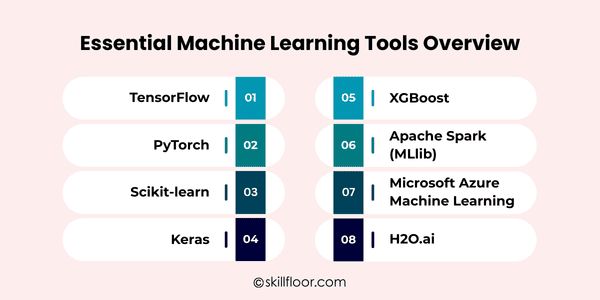
5. XGBoost
XGBoost is a potent gradient boosting framework that offers effective training, regularization, and high accuracy in predictive modeling tasks. It was created for speed and performance and is frequently used for structured data challenges.
Key Features:
-
Efficient gradient boosting algorithm
-
Built-in regularization to prevent overfitting
-
Parallel and distributed computing support
-
Handles missing values automatically
Best For:
Suitable for competitive machine learning projects, structured datasets, and classification, regression, and ranking tasks where success depends on high accuracy, quick training, and optimum performance.
Among contemporary machine learning tools, Apache Spark MLlib is a scalable library made for large data processing and distributed model training across clusters to effectively manage enormous datasets.
Key Features:
-
Distributed computing
-
Big data processing
-
Integration with Spark ecosystem
-
Scalable machine learning pipelines
Best For:
Best suited for big data projects at the corporate level that need strong machine learning techniques that can analyze massive amounts of data, spread computation, and provide faster performance in complicated, high-volume data environments.
7. Microsoft Azure Machine Learning
The entire machine learning lifecycle is supported by Microsoft Azure Machine Learning, a cloud-based platform that includes deployment, monitoring, and management in addition to data preparation and model training.
Key Features:
-
AutoML capabilities
-
Model monitoring
-
MLOps integration
-
Cloud scalability
Best For:
Best suited for businesses operating in the Microsoft ecosystem that require scalable model deployment, automated processes, secure cloud infrastructure, and integrated tools for managing machine learning projects from start to finish.
8. H2O.ai
The machine learning platform H2O.ai is well-known for its robust AutoML capabilities, which allow companies to rapidly create precise predictive models with automated processes and intuitive enterprise solutions.
Key Features:
-
Automated model selection
-
Model interpretability
-
Enterprise-ready tools
-
Built-in AutoML capabilities
Best For:
The best option for companies looking to deploy machine learning solutions without a lot of human coding is one that offers easier deployment, automatic model selection, and useful tools for enterprise-level decision-making.
Comparison of Popular Machine Learning Tools
The brief overview that follows will make it simpler for you to select the best machine learning tools by helping you comprehend the distinctions, advantages, and applications of various tools:
|
Machine Learning Tool |
Best For |
Difficulty |
Scalability |
Key Advantage |
|
TensorFlow |
Large-scale production and deep learning |
Hard |
Very High |
Powerful, production-ready, strong ecosystem |
|
PyTorch |
Research and rapid experimentation |
Medium |
High |
Flexible, easy to debug, intuitive |
|
Scikit-learn |
Beginners and quick model building |
Easy |
Medium |
Simple, lightweight, excellent documentation |
|
Keras |
Beginners building neural networks |
Easy |
Medium |
User-friendly, fast prototyping, works with TensorFlow |
|
XGBoost |
Structured data and predictive modeling |
Medium |
High |
Fast, accurate, handles missing values |
|
Apache Spark MLlib |
Big data machine learning |
Hard |
Very High |
Distributed computing, scalable for large datasets |
|
Microsoft Azure Machine Learning |
Enterprise cloud ML projects |
Medium |
Very High |
Complete ML lifecycle, automation, secure cloud |
|
H2O.ai |
Businesses using AutoML |
Easy-Medium |
High |
Automated ML, fast model building, enterprise-ready |
So… Which Machine Learning Tool Should You Choose?
The goals, skill level, and nature of your project will all influence which machine learning technology is best for you. To help you make an informed choice, here is some basic guidance.
1. TensorFlow
Excellent for managing enormous data, creating extensive deep learning models, and implementing AI in production for companies in need of dependable and expandable solutions.
2. PyTorch
Perfect for study and experimentation, it provides developers investigating novel AI concepts with flexibility, quick prototyping, and easily comprehensible code.
3. Scikit-learn
Ideal for novices or small projects utilizing traditional machine learning techniques on structured data, such as clustering, classification, and regression.
4. Keras
A simple high-level library for rapidly constructing neural networks, perfect for individuals who are new to deep learning or who need to test concepts quickly.
5. XGBoost
Outstanding for competitions, predictive modeling, and structured data; provides quick, precise, and effective results on tabular datasets.
6. Apache Spark (MLlib)
Scalable machine learning on massive data is made possible by Apache Spark MLlib, which effectively manages distributed model training for quicker, more extensive analytics.
7. Azure Machine Learning
End-to-end AI workflows and team communication are supported by this enterprise-ready technology that works well with Microsoft products.
8. H2O.ai
Model construction is accelerated by this open-source AutoML platform, which also automatically tests methods to determine the optimal solution for your data.
Real-World Applications of Popular Machine Learning Tools
1. Healthcare
Machine learning technologies evaluate medical images, forecast illnesses, customize therapies, and enhance hospital operations effectively.
2. Finance
ML tools improve decision-making, automate trade, evaluate credit risk, predict trends, and detect fraud.
3. E-commerce
Dynamic pricing, demand forecasting, recommendation engines, and effective customer experience enhancement are all made possible by these solutions.
4. Self-Driving Cars
Sensor processing, object recognition, traffic prediction, and safe autonomous vehicle navigation are all made possible by machine learning technologies.
5. Natural Language Processing (NLP) Applications
Machine learning algorithms are used to evaluate text, comprehend context, power chatbots, translate languages, and precisely identify sentiment.
6. Manufacturing & Supply Chain
Machine learning tools help with quality control, demand forecasting, inventory optimization, failure prediction, and logistics efficiency.
Emerging Trends in Machine Learning Tools
Today's industries' adoption of AI solutions is shaped by the rapid evolution of machine learning techniques, which provide automation, scalability, and efficiency.
Developers no longer need to write as much code thanks to automated machine learning tools that streamline model creation, selection, and deployment.
2. MLOps Integration
Model deployment, monitoring, and lifecycle management are all made more efficient when machine learning and DevOps are combined.
3. Low-Code / No-Code Platforms
Machine learning models can be created, trained, and implemented by non-developers using tools that require little coding.
4. Edge AI
Locally installed machine learning models enhance real-time forecasts and successfully lessen reliance on the cloud.
5. Responsible AI
Fairness, openness, and explainability are currently the main criteria used in tools to lessen bias and boost model credibility.
6. Cloud-Based ML Platforms
Cloud services offer managed services, scalable infrastructure, and pre-trained models for quicker, ready-to-use solutions.
Learning how to use machine learning tools is more about taking the first step than it is about understanding everything. Whether it's automated model building, large-scale deployment, or rapid experimentation, each technology has its advantages. Choose a tool that best suits your needs, start small, and create a project from the ground up. You'll get faster, more confident, and more aware of what works best over time. The true benefit stems from perseverance, curiosity, and practice. Future AI solutions will be shaped by those who take action today, transforming concepts into impactful projects.
Digital Marketing Courses in Other Locations in India
Ahmedabad | Aurangabad | Bangalore | Bhilai | Bhopal | Bhubaneshwar | Chandigarh | Chennai | Cochin | Coimbatore | Dehra Dun | Delhi | Faridabad | Ghaziabad | Gorakhpur | Guntur | Gurgaon | Guwahati | Hyderabad | Jaipur | Kanpur | Khammam | Kolkata | Lucknow | Madurai | Mumbai | Mysore | Nagpur | Noida | Patna | Pondicherry | Pune | Ranchi | Shimoga | Surat | Thane | Thiruvananthapuram | Tiruchirappalli | Tirupati | Vadodara | Visakhapatnam | Warangal | Jalandhar | Jodhpur | Indore | Durgapur | Jamshedpur | Dhanbad | Kota | Karnal | Udaipur | Amritsar | calicut | Nashik | Ludhiana | varanasi | thrissur | Mangalore | Raipur |