


































Future of Data Analytics Jobs in the Age of AI
Discover how AI is transforming data analytics jobs, the essential skills to thrive, and why adapting now can future-proof your career in a rapidly evolving world.
By 2025, the world is expected to generate around 181 zettabytes of data, which equates to approximately 2.5 quintillion bytes each day. Data analytics is essential for converting raw data into valuable insights, as businesses are overwhelmed with information from markets, operations, and consumers.
AI is transforming the way we analyze vast amounts of data. Videos, social media, and log accounts for over 80% of the world’s unstructured data, which can be difficult for humans to manage manually. With the help of AI tools that automate tasks such as data cleaning, reporting, and predictive analysis, teams can work more efficiently and intelligently.
Despite this, analysts have a great opportunity because just 21% of organizational data is actively studied. Professionals can concentrate on strategy, narrative, and insight generation by combining AI expertise with business knowledge. AI takes care of repetitive chores, increasing the effect of data analytics.
The Current Landscape of Data Analytics Jobs
Before understanding how AI is changing the industry, it's critical to examine the situation of data analytics employment. Professionals in data analytics have historically held a variety of positions, such as business analysts, data scientists, and data analysts. Specific duties are associated with each role:


-
Data Analysts: Clean, arrange, and analyze data to produce dashboards, reports, and business insights that are useful.
-
Business Analysts: Establish KPIs and strategically measure overall performance to connect business needs with data insights.
-
Data Scientists: To find significant trends, use machine learning, advanced statistics, and predictive modeling.
-
Data Engineers: Create, construct, and manage reliable data pipelines for effective data gathering, storing, and processing.
-
BI (Business Intelligence) Developers: To improve decision-making, create dashboards and visuals that make complicated datasets easier to understand.
-
Analytics Consultants: Combine technological know-how with commercial acumen and insights to provide firms with data strategy advice.
Key Skills Required Today
Technical and analytical skills are the foundations of any data analytics job:
-
Technical Skills: Tableau or Power BI for visualization, Excel for data manipulation, SQL for database queries, and fundamental machine learning principles for predictive modeling.
-
Analytical Skills: Large-scale dataset analysis, pattern recognition, trend interpretation, and actionable insights that enable wise business decisions.
-
Communication Skills: The capacity to effectively communicate technical results, converting data into useful and intelligible information for decision-makers throughout the company.
Industries Most Reliant on Data Analytics
Tech companies are no longer the only ones using data analytics. Analytics is now essential for almost every industry to remain competitive:
-
Finance: Risk control, investment modeling, and fraud detection.
-
Healthcare: Operational efficiency, patient care optimization, and predictive diagnostics.
-
Retail and eCommerce: Inventory optimization, demand forecasting, and customer personalization.
-
Manufacturing and Supply Chain: Process optimization, logistical planning, and predictive maintenance.
AI’s Impact on Data Analytics
Data analysis is changing as a result of artificial intelligence, with AI Data Analytics automating labor-intensive and time-consuming processes.
Automation of Repetitive Tasks
Many routine analytics tasks are now handled by AI tools:
-
Data Cleaning: AI is capable of detecting discrepancies, outliers, and missing values.
-
Reporting: Manual labor is decreased with automated dashboards and summaries.
-
Basic Insights: AI can produce initial trend interpretations, freeing up analysts to concentrate on more in-depth research.
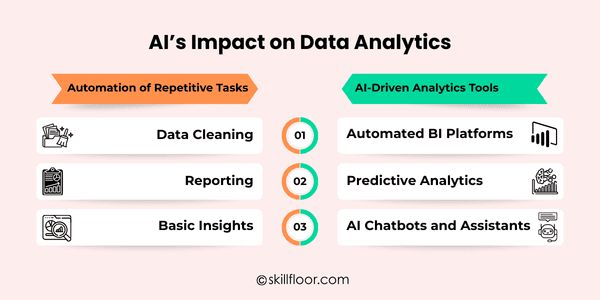
AI-Driven Analytics Tools
There are a ton of AI-powered analytics tools available on the market that provide accessibility to complex analysis:
-
Automated BI Platforms: Tools that automatically generate reports and visualizations.
-
Predictive Analytics Software: AI algorithms that forecast trends, detect anomalies, or predict customer behavior.
-
AI Chatbots and Assistants: ChatGPT-like tools that help generate queries, automate code, or summarize datasets.
Shift from Descriptive to Prescriptive and Predictive Analytics
In the past, descriptive analytics—what took place—was the main focus of data analytics. With AI, attention is turning to:


-
Predictive Analytics: Anticipating what might happen based on historical patterns.
-
Prescriptive Analytics: Recommending actionable decisions for future outcomes.
Emerging Roles in the Age of AI
As AI changes analytics, new positions that blend technological know-how with human creativity and judgment are appearing.
-
AI-Augmented Data Analysts: Experts who work with AI tools to produce faster, more accurate insights and streamline analysis.
-
Data Storytellers: Professionals that use the right data analytics technique to interpret complex AI-driven information into clearly understood narratives for stakeholders.
-
AI Model Interpretability Specialists: Analysts make sure AI models are ethical, clear, and comprehensible.
-
Analytics Translators: Experts who ensure AI-driven recommendations are useful and implementable by bridging business knowledge with technical insights.
These positions emphasize the value of human creativity, critical thinking, and ethical supervision—areas in which AI is presently unable to completely replace people.
Skills That Will Define Future Data Analytics Jobs
Professionals must acquire a blend of technical, analytical, and interpersonal abilities in order to succeed in AI-enhanced analytics jobs.
Technical Skills
-
Programming: R and Python are still crucial for modeling and analysis.
-
AI Tool Integration: Being familiar with the use and implementation of AI-driven analytics solutions.
-
Machine Learning Fundamentals: Familiarity with prediction methods, model evaluation, and supervised and unsupervised models.
Soft Skills
-
Communication and Storytelling: Giving an engaging presentation of data insights.
-
Ethical Reasoning: Ensuring the impartiality and fairness of choices made by AI.
-
Collaboration: Collaborating well with cross-functional groups.
Analytical Thinking and Domain Knowledge
-
Consider industry knowledge when interpreting insights produced by AI.
-
Make strategic suggestions that support the objectives of the company.
-
Find trends and patterns that AI might miss or misunderstand on its own.
Continuous Learning Mindset
AI is developing at a fast pace. To further their careers in data analytics, professionals need to feel at ease picking up new tools, methods, and technologies.
Challenges and Considerations
Even though AI has a lot of potential, data analytics professionals must overcome certain challenges.
-
Job Displacement Fears: Professionals may need to upskill in order to stay relevant when some mundane analytical activities become automated.
-
Ethical Considerations: Oversight and moral judgment are necessary since AI models may be biased or provide unfair recommendations.
-
Over-Reliance on AI: Making bad decisions might result from blindly relying on AI results without human review.
-
Data Privacy and Regulations: Making sure privacy regulations are followed becomes crucial as AI uses more data.
Organizational policies and personal vigilance are both necessary to address these issues.
Opportunities Created by AI in Data Analytics
AI doesn’t just automate—it also unlocks new opportunities.
-
Enhanced Business Insights: More complex analysis is made possible by AI, which reveals patterns that people might overlook.
-
Higher-Value Work: Instead of focusing on monotonous work, analysts can concentrate on strategy, interpretation, and innovation.
-
Democratization of Analytics: Non-technical staff members can access and comprehend data thanks to AI-driven technologies, which promote a data-driven culture.
To put it briefly, AI is turning analytics from a labor-intensive process into a strategic, decision-making role.
Preparing for the Future: Actionable Advice
Professionals should concentrate on the following tactics to stay ahead in an AI-enhanced analytics environment:
-
Upskilling Pathways: Enroll in a data analytics course, take online classes, get certified, and work on practical AI projects. You must include tools like Tableau, Power BI, R, Python, and AI platforms into your learning process.
-
Embrace Hybrid Roles: Combining domain knowledge, AI comprehension, and analytics skills is where the future rests.
-
Networking and Community Involvement: To stay up to date, participate in professional communities, go to webinars, and keep up with trends in analytics and artificial intelligence.
In the quickly changing AI-driven data analytics market, individuals will not only survive but also thrive and lead if they are proactive about learning through platforms like Skillfloor, embrace new technologies, and constantly adjust to changes in the industry.
FAQs: Data Analytics Jobs in the Age of AI
Q1: Will AI take over data analytics jobs?
A: No. AI automates routine tasks, but humans are still essential for interpretation, strategy, and ethical judgment.
Q2: What new roles are emerging with AI?
A: Roles like AI-augmented data analysts, data storytellers, and analytics translators are becoming important.
Q3: Which skills matter most for the future?
A: Focus on Python/R, AI tools, predictive analytics, communication, storytelling, and continuous learning.
Q4: How is AI changing analytics work?
A: AI automates repetitive tasks, enables predictive insights, and allows analysts to focus on strategic decisions.
Q5: Which industries benefit most from AI analytics?
A: Finance, healthcare, retail, manufacturing, and supply chain are leveraging AI for smarter decision-making.
Q6: What are the risks of over-relying on AI?
A: Bias in models, ethical concerns, data privacy issues, and blind trust in AI outputs are key risks to watch.
The development of AI in data analytics is an opportunity to flourish rather than something to be afraid of. You can concentrate on creativity, strategy, and storytelling—skills that machines cannot replace—while AI takes care of repetitive duties. You can increase the significance and influence of your employment by picking up new skills, comprehending business requirements, and maintaining an inquisitive attitude. For individuals who are open to change, there are plenty of opportunities, from leadership in AI-driven projects to newly developing hybrid jobs. The secret is to continue being proactive, welcome change, and view AI as a collaborator rather than a rival. The future is brimming with opportunities, and your career in data analytics is only getting started.
Digital Marketing Courses in Other Locations in India
Ahmedabad | Aurangabad | Bangalore | Bhilai | Bhopal | Bhubaneshwar | Chandigarh | Chennai | Cochin | Coimbatore | Dehra Dun | Delhi | Faridabad | Ghaziabad | Gorakhpur | Guntur | Gurgaon | Guwahati | Hyderabad | Jaipur | Kanpur | Khammam | Kolkata | Lucknow | Madurai | Mumbai | Mysore | Nagpur | Noida | Patna | Pondicherry | Pune | Ranchi | Shimoga | Surat | Thane | Thiruvananthapuram | Tiruchirappalli | Tirupati | Vadodara | Visakhapatnam | Warangal | Jalandhar | Jodhpur | Indore | Durgapur | Jamshedpur | Dhanbad | Kota | Karnal | Udaipur | Amritsar | calicut | Nashik | Ludhiana | varanasi | thrissur | Mangalore | Raipur |