













































Hyperparameter Tuning in Machine Learning
Unlock your model’s full potential with Hyperparameter Tuning in Machine Learning. Learn to optimize settings, boost accuracy, and achieve top performance fast.

Don't let minor settings hinder your model's performance! Many beginners repeatedly train the same machine learning model, yet the results can vary significantly. Hyperparameters—small guidelines that influence a model’s learning from data—are often the key to achieving high performance.
By selecting the correct hyperparameters, you can highly enhance an average model's accuracy. Simple adjustments, such as changing the tree depth or learning rate, can lead to substantial improvements. In this blog, we will explore straightforward techniques for tuning hyperparameters and boosting your model's performance.
What Is Hyperparameter Tuning?
Hyperparameter tuning is akin to adjusting the dials on a machine. It involves selecting the optimal parameters for your machine learning model to ensure it performs well on new, untested data, rather than just on the training set.
Unlike model parameters, which the system learns autonomously during training, hyperparameters are set either manually or automatically before the training process begins. Proper tuning can improve accuracy, help avoid overfitting, and enhance the overall effectiveness of the model. This crucial yet often overlooked stage is what differentiates high-performing models from mediocre ones.


Why Hyperparameter Tuning Matters
Your models will function dependably, effectively, and stand out with proper hyperparameter optimization.
-
Boost Model Accuracy: Increases the accuracy of the model, making predictions more trustworthy and practical in practical applications.
-
Prevent Overfitting: Avoids overfitting, guaranteeing that the model does not memorize training data but rather performs effectively when applied to new data.
-
Optimize Training Efficiency: Reduces the amount of time and computer power required for model creation and experimentation by optimizing training efficiency.
-
Ensure Model Stability: Improves model stability by preventing inconsistent performance brought on by bad hyperparameter selections or haphazard initialization.
-
Unlock Algorithm Potential: Unlocks the full potential of algorithms, enabling even basic models to compete with more sophisticated methods.
-
Gain Competitive Edge: Gives data scientists and ML developers a competitive edge by enabling them to produce better findings more quickly than others.
Parameters vs Hyperparameters
Before tuning, it’s important to understand the difference between parameters and hyperparameters.
Parameters
The values that a model learns automatically from the training set are known as parameters. For example, in a neural network, the coefficients or weights in linear regression are adjusted to best fit the data.
Hyperparameters
In contrast, the model's learning process is guided by hyperparameters, which must be set before training begins. Examples of hyperparameters include the learning rate, batch size, the number of neighbors in K-nearest neighbors (KNN), and the depth of trees in decision trees. These hyperparameters influence the model's behavior and performance.
Common Hyperparameters Across ML Models
The hyperparameters of various models vary. Here are a few typical examples:
-
Linear Models: The model's ability to resist overfitting is determined by the regularization strength (alpha or C). It strikes a balance between simplifying the model and fitting the training set.
-
Tree-based Models: Tree size and ensemble strength are determined by maximum depth (max_depth) and number of estimators (n_estimators), which have an impact on overfitting and accuracy.
-
Support Vector Machines (SVM): The model's flexibility and performance are affected by the margin and decision boundary, which are controlled by regularization parameter C, kernel type, and gamma.
-
Neural Networks: The network's speed and accuracy during training are influenced by the learning rate, batch size, optimizer type, and number of epochs. For improved outcomes in machine learning projects, these settings are essential.
-
K-Nearest Neighbors (KNN): Predictions based on neighboring data points are influenced by the number of neighbors (k) and the distance metric (Euclidean, Manhattan).
-
Gradient Boosting Models: Sequential models balance speed and performance by controlling the number of boosting rounds, learning rate, and maximum tree depth.
Evaluation Strategy Before Tuning
Before tuning, you need a robust evaluation strategy:
-
Train/Validation/Test Split: For the final assessment, keep the test data totally hidden. Hyperparameters are adjusted using validation data to guarantee a reasonable performance prediction.
-
Cross-Validation: To obtain a more accurate estimate of the model's performance across several data subsets, use k-fold or stratified splits.
-
Choosing the Right Metric: Depending on your issue, use measures such as accuracy, F1-score, AUC, or RMSE. The proper measure guarantees that hyperparameters significantly enhance the model.
-
Avoiding Data Leakage: Ensure that information from the test set is not used for hyperparameter adjustment. An unduly positive assessment may result from data leaking.
-
Consistent Random Seed: To guarantee reproducibility, use a random seed. This makes it easier to objectively compare hyperparameter results from various runs.
-
Monitoring Overfitting: Examine the discrepancy between validation and training performance. Large gaps suggest overfitting, which helps with hyperparameter selection.



Popular Hyperparameter Tuning Techniques
1. Manual Search
The process of manually adjusting hyperparameters is based on intuition and trial-and-error. It is ineffective for complex models or huge search spaces, while it is effective for small datasets or basic models.

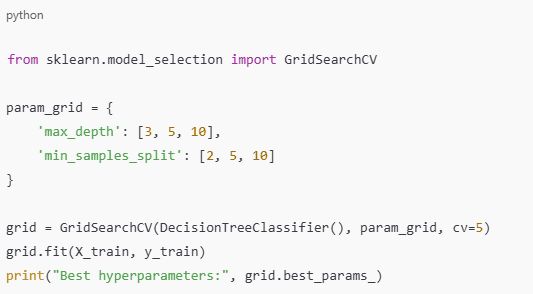
2. Grid Search
Grid search examines all potential hyperparameter combinations within a specified range. It is dependable and simple to comprehend, although it can take a while for several factors.
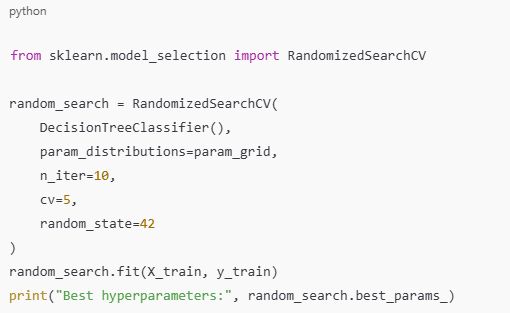
3. Random Search
Hyperparameter combinations are chosen at random-by-random search. It is more effective for real-world machine learning applications because it frequently discovers good results more quickly than grid search, particularly in large or high-dimensional environments.
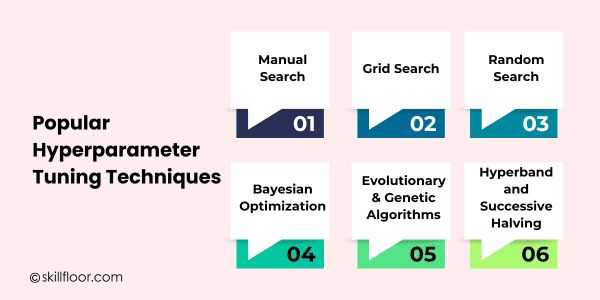
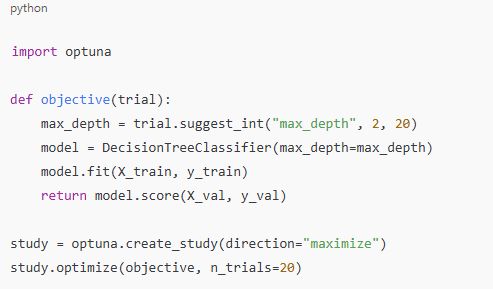
4. Bayesian Optimization
Bayesian optimization predicts which hyperparameter combinations may perform best next based on evaluation results from the past. When compared to exhaustive or random search, it saves time by efficiently searching big spaces.
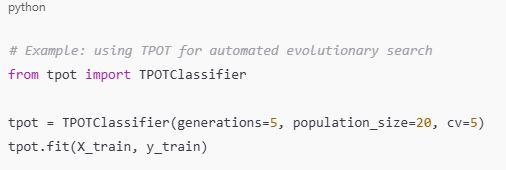
5. Evolutionary & Genetic Algorithms
By generating a population of hyperparameter sets, picking the best, and merging them to create better configurations across generations, these algorithms imitate natural selection.
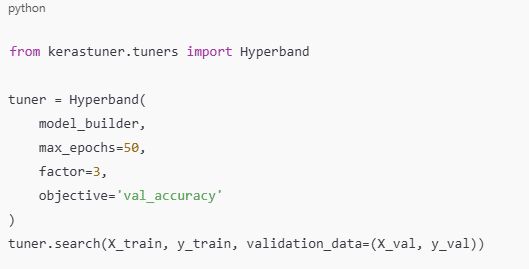
6. Hyperband and Successive Halving
Hyperband makes tuning quicker and more effective, particularly for deep learning models, by allocating more resources to promising hyperparameter configurations while halting underperformers early.
How Hyperparameter Tuning Works
1. Define Search Space
Establish the ranges or potential values for hyperparameters to investigate, such as learning rate, number of trees, or batch size.
2. Choose Method
Based on your resources and objectives, choose a tuning technique like Grid Search, Random Search, Bayesian Optimization, or Hyperband.
3. Train & Evaluate
Utilizing several combinations of hyperparameters, train the model and assess each one using metrics like accuracy or MSE on validation data.
4. Identify Best
Choose the set of hyperparameters that balances accuracy, stability, and generalization to new data to produce the best validation performance.
5. Test on Holdout Set
To make sure the model works well in real-world situations, check the selected hyperparameters on a test set that has never been encountered.
6. Iterate & Refine
To further enhance performance and find more ideal hyperparameter combinations, change ranges or techniques and repeat the tuning process.
Popular Tools and Libraries for Hyperparameter Tuning
-
Scikit-learn: Provides RandomizedSearchCV and GridSearchCV for random or exhaustive hyperparameter search. Perfect for small to medium datasets for beginners.
-
Optuna: An advanced library for effective hyperparameter search and Bayesian optimization. It assists in determining the optimal parameters more quickly than conventional techniques.
-
Ray Tune: A distributed, scalable library for hyperparameter tuning. Ideal for complicated models or big datasets that need to be searched in parallel across several machines.
-
Keras Tuner: Made with deep learning models in mind. Neural network tuning is made simpler and quicker by the support for Random Search, Hyperband, and Bayesian optimization.
-
Hyperopt: A random search and Bayesian optimization Python package. For flexible tuning, it integrates with XGBoost, Scikit-learn, and other ML frameworks.
-
TPOT: An automated machine learning application that provides end-to-end ML pipelines by optimizing model selection and hyperparameters via genetic programming.
Best Practices for Effective Tuning
-
Start with Defaults: The default hyperparameters should always be used as a starting point. Later on, when you experiment with specific settings, it helps gauge progress.
-
Prioritize Important Hyperparameters: Prioritize hyperparameters such learning rate, tree depth, and number of estimators that have a major effect on model performance.
-
Coarse-to-Fine Search: To find interesting regions, start with large ranges; for better results, narrow the search with smaller increments.
-
Log Experiments: All experiments should be documented, along with the hyperparameters and outcomes. This helps compare performance between runs and guarantees reproducibility.
-
Monitor Overfitting: Monitor the results of training and validation. When a model does well on training data but poorly on validation data, adjust the hyperparameters.
-
Reuse Knowledge: Make use of insights from comparable datasets or models when selecting hyperparameters. Experience reduces tuning time.
Hyperparameter Tuning Pitfalls
-
Tuning on Test Data: Never tune hyperparameters using the test set. To assess and direct your decisions, always use a different validation set.
-
Over-Tuning: If you search too much, your model may overfit the validation data, which may limit its capacity to generalize to new, untested data.
-
Ignoring Randomness: Every time they run, certain models yield slightly different outcomes. Always take into account several runs to make sure hyperparameter selections are trustworthy.
-
Blindly Trusting Automated Tools: While useful, automated tuning tools cannot take the place of comprehension of the model or the data. Always evaluate outcomes critically.
-
Neglecting Data Preprocessing: Hyperparameter tweaking may be misguided by poorly preprocessed data. Before adjusting, make sure your data is properly cleaned, scaled, and encoded.
-
Changing Too Many Hyperparameters at Once: It can be challenging to determine what enhances performance when multiple hyperparameters are changed at once. One or several at a time, tune.
Gaining proficiency in machine learning hyperparameter tuning can drastically alter the performance of your models. Your models can become faster, more accurate, and more dependable with minor tweaks. You can take charge of your work and feel more confident when you know how to adjust parameters. Whether you're learning about Hyperparameter Tuning in Machine Learning for the first time or honing your craft, regular practice and well-considered approaches are crucial. Spending time on machine learning hyperparameter tuning guarantees that your models realize their full potential and perform very well in practical applications.
Digital Marketing Courses in Other Locations in India
Ahmedabad | Aurangabad | Bangalore | Bhilai | Bhopal | Bhubaneshwar | Chandigarh | Chennai | Cochin | Coimbatore | Dehra Dun | Delhi | Faridabad | Ghaziabad | Gorakhpur | Guntur | Gurgaon | Guwahati | Hyderabad | Jaipur | Kanpur | Khammam | Kolkata | Lucknow | Madurai | Mumbai | Mysore | Nagpur | Noida | Patna | Pondicherry | Pune | Ranchi | Shimoga | Surat | Thane | Thiruvananthapuram | Tiruchirappalli | Tirupati | Vadodara | Visakhapatnam | Warangal | Jalandhar | Jodhpur | Indore | Durgapur | Jamshedpur | Dhanbad | Kota | Karnal | Udaipur | Amritsar | calicut | Nashik | Ludhiana | varanasi | thrissur | Mangalore | Raipur |