












































Cyber Security Career Guide for BCA Students
Complete cyber security career guide for BCA students: learn essential skills, top certifications, salary insights, career roadmap, and how to start confidently.
Almost everything we do in the modern digital world is done via technology, including online banking, shopping, and communication. Cyberattacks are increasing rapidly as a result. Over 265 million cyberattacks occurred in India in 2025, indicating the scope of the risk. Targets increasingly include banks, healthcare facilities, and educational institutions, and this pattern is expected to grow annually.
Students, particularly those studying BCA, would benefit greatly from this. Industry statistics state that the Indian cybersecurity market was valued at over USD 11.3 billion in 2025 and is expected to rise significantly more in the future. Additionally, there is a shortage of qualified workers; projections indicate that India alone may soon require more than 1 million cybersecurity positions. This is a great job option for BCA students because companies are now hiring new talent with certifications and actual security expertise.
Cyber Security Isn’t the Future — It’s the Present
Companies lose millions of dollars every day due to cyberattacks. Big giants like Google and Microsoft, as well as smaller companies, are constantly in danger. Due to the sophistication of hackers, no company, regardless of size, can afford to disregard security.
Because of this, cybersecurity positions are expanding quickly. People who can identify weaknesses, prevent assaults, and safeguard data are essential to every firm. This implies that you can enter a highly sought-after industry with lots of room for professional advancement if you begin your education now.


-
Ransomware attacks are increasing year by year.
-
Data breaches are becoming more sophisticated.
-
Governments are investing heavily in cyber defense.
-
Businesses are hiring security professionals faster than they can find them.
-
Remote work has made companies more vulnerable to cyber threats.
-
New technologies like AI and IoT are creating more opportunities for hackers.
Cybersecurity is now essential to every company's survival and expansion, not just a small, specialized field. The good news? BCA students are well-positioned to begin a successful career in this industry since they already possess the necessary foundation in programming, networking, and systems.
Why Cyber Security is a Great Career Option for BCA Students
The need for cybersecurity specialists is rapidly expanding both in India and globally, making cybersecurity an attractive career option for BCA students. According to reports, there were almost 40,000 cybersecurity job opportunities in India recently, with a significant skill gap, indicating that employers are aggressively pursuing graduates with the necessary training.
-
High Job Demand Now: Due to growing cyber risks, cybersecurity job advertisements have increased by about 14% in India, making it simpler for recent BCA grads to obtain employment.
-
Skill Gap Advantage: Because there is a 30–50% talent shortage, BCA students who develop practical skills can stand out and land employment more quickly than many other IT positions.
-
Growing Global Opportunities: Over 3 million cyber security positions are anticipated worldwide, providing career choices outside of India and higher compensation abroad.
-
Campus Placements Trending: In some IT hubs, nearly 40% of school hiring are now for cybersecurity and AI positions, indicating high recruiter interest.
-
Strong Long-Term Growth: Due to the country's fast digital growth, India is predicted to need 1.5 million professionals in cyber security by 2026.
-
Build On BCA Foundation: Students already have the fundamental skills required to advance in cyber security with further training because BCA covers programming, networks, and databases.
BCA students already have a rudimentary understanding of computers, networks, and programming, in contrast to students from non-technical backgrounds. They may understand and effectively implement cyber security ideas much more quickly and easily because of this foundation.
Skills Required for Cyber Security Careers
BCA students must have a solid background in networking, programming, and security tools to be successful in this industry. Effective system protection requires cybersecurity skills, including problem-solving and analytical thinking.
Technical Skills
1. Networking Basics
It is essential to comprehend the communication between PCs and servers. Understanding TCP/IP, DNS, HTTP/HTTPS, and firewalls makes it easier to spot vulnerabilities and properly safeguard networks.
2. Linux Fundamentals
Linux is used by the majority of cyber security tools. To effectively monitor, manage, and safeguard servers, one must understand file systems, permissions, and commands.
3. Cyber Laws
Understanding cyber laws, data privacy standards, and regulations guarantees that security jobs are handled ethically and legally while avoiding legal problems during security operations.
4. Programming (Python, Bash)
Automation, testing, and the creation of security tools are made possible by programming. Python is extensively used, while Bash scripting facilitates efficient task execution and management of Linux-based settings.
5. Web Security Basics
Web security can be strengthened by identifying vulnerabilities like SQL injection, XSS, and CSRF by understanding how websites work, including HTML, JavaScript, and databases.


6. Tools (Wireshark, Nmap, Burp Suite)
Network monitoring, system scanning, and web security testing are all made possible by using programs like Wireshark, Nmap, and Burp Suite. Practical skills are developed through hands-on practice.
Soft Skills
1. Analytical Thinking
Identifying trends, odd activities, and possible dangers is the essence of cyber security. Strong analytical abilities aid in the prompt identification of issues.
2. Problem-Solving
Every cyberattack and vulnerability calls for innovative fixes. Effective system protection requires thinking like a hacker.
3. Communication
It's critical to give non-technical personnel a clear explanation of security issues. Reports, warnings, and instructions need to be clear.
4. Continuous Learning Mindset
Cybersecurity is a dynamic field. Being willing to learn and adapt is crucial for a long-term profession because new risks emerge every day.
Major Career Roles in Cyber Security
There are many career options in cyber security. These are the most well-liked ones that BCA students could look into for personal development.
1. Security Analyst
Identifies dangers, keeps an eye on systems, and stops attacks. For BCA students beginning their careers in cybersecurity, this entry-level position is appropriate.
2. SOC Analyst (Security Operations Center)
Collaborates in groups to monitor networks, analyze events, and address security breaches. a crucial career milestone in cybersecurity.
3. Ethical Hacker
Legally tests programs and systems to identify weaknesses, assisting companies in data security. In the field of cybersecurity, this position is quite fulfilling.
4. Penetration Tester
Identifies vulnerabilities, records results, and suggests fixes by simulating actual attacks. essential for practical experience in employment in cybersecurity.
5. Incident Responder
Ensures little harm by investigating cyberattacks, reducing threats, and restoring systems. vital for students who want to work in real-world security.
Provides a vital component of cyber defense teams by designing and constructing safe IT systems, putting safeguards in place, and keeping an eye on infrastructure to stop assaults.
7. Cloud Security Specialist
Creates specialized opportunities in contemporary cyber environments by protecting cloud platforms like AWS and Azure, keeping an eye out for vulnerabilities, and guaranteeing compliance.
Step-by-Step Cyber Security Roadmap for BCA Students
1. Strengthen Your Foundations
Prioritize studying solid fundamentals before pursuing certificates. It will be simpler to handle complex cybersecurity ideas with confidence if you have a solid understanding of networks, operating systems, programming, and cryptography.
-
Learn TCP/IP, DNS, HTTP, and firewall basics clearly.
-
Understand Linux and Windows operating system internals thoroughly.
-
Practice Python and Bash scripting for automation tasks.
-
Study basic cryptography: encryption, hashing, and digital signatures.
2. Choose a Specialization
Cybersecurity is really important. Concentrate your learning on a subject you are passionate about. Specialization boosts the likelihood of landing the ideal employment and helps in the development of skills.
-
Ethical hacking: find vulnerabilities and secure systems effectively.
-
SOC Analyst: monitor incidents, analyze threats daily.
-
Cloud Security: protect AWS, Azure, or cloud applications.
-
Digital Forensics: investigate cybercrimes and analyze digital evidence.
3. Learn Industry Tools
Practical skills are more important than theory. Practicing techniques will boost your self-esteem and help you stand out during interviews.
-
Use Nmap for network scanning and security checks.
-
Analyze traffic using Wireshark effectively and safely.
-
Test vulnerabilities with Metasploit and Burp Suite.
-
Set up Kali Linux for practical experimentation and practice.
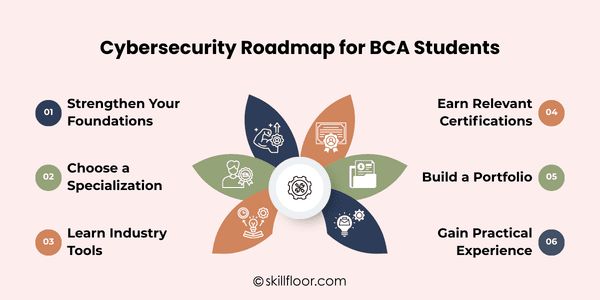
4. Earn Relevant Certifications
Certifications increase your credibility and certify your abilities. Before getting advanced certifications, start with selections that are suitable for beginners.
-
CompTIA Security+ builds general security knowledge foundation.
-
CEH teaches ethical hacking and penetration testing techniques.
-
Google Cybersecurity Certificate is beginner-friendly and practical.
-
Avoid advanced CISSP until you gain real work experience.
5. Build a Cyber Security Portfolio
Use projects, blog postings, and useful contributions to show your abilities. When employing new employees, employers prefer proof over claims.
-
Upload scripts and projects to GitHub repositories consistently.
-
Write blogs explaining vulnerabilities and solutions clearly.
-
Share learning and insights regularly on LinkedIn profile.
-
Participate in CTF competitions for hands-on experience.
6. Gain Practical Experience
Practical experience, bug bounties, and internships help you get ready for real-world cyber security threats. Experience increases employment prospects and boosts self-confidence.
-
Apply for internships in IT and security companies.
-
Join bug bounty programs to find vulnerabilities legally.
-
Create a home lab for practical learning daily.
-
Practice on platforms like TryHackMe and Hack the Box.
Best Certifications for BCA Students
Certifications assist establish credibility, showcase skills, and enhance employment opportunities for BCA students who wish to pursue a career in cyber security. Here are a few possibilities for beginners and experts:
-
CompTIA Security+
-
Certified Ethical Hacking Associate (CEH-A)
-
Certified Penetration Testing Professional (CPTP)
-
Certified SOC Analyst (CSA)
-
OSCP (Offensive Security Certified Professional)
Internship and Project Opportunities for BCA Students
For BCA students pursuing careers in cybersecurity, gaining real-world experience is essential. Projects and internships enable you to put your theoretical knowledge into practice, develop your talents, and become ready for the workforce.
-
Cyber Security Internships: Students can learn network security, ethical hacking, and monitoring through internships offered by many IT companies, startups, and government agencies.
-
Real-World Projects: You can gain practical experience for your portfolio by working on projects like malware research, website security testing, and vulnerability assessment.
-
Capture The Flag (CTF) Challenges: Interactive projects to practice penetration testing and problem-solving are available on websites like TryHackMe, Hack the Box, and CTFtime.
-
Open-Source Contributions: Students can work together, learn coding standards, and obtain practical experience by taking part in open-source security initiatives.
-
Freelance Security Tasks: Students can participate in bug bounties or conduct brief security assessments for businesses online, enhancing their confidence and skill sets.
-
College-Based Cyber Labs: Virtual machines, Kali Linux configurations, and lab activities for simulated security environments are available in several BCA colleges.
Average Salary and Growth Opportunities in Cybersecurity
|
Role |
Key Responsibilities |
Entry-Level Salary (INR) |
Growth Opportunities |
|
Security Analyst |
Monitors systems, detects threats, ensures network safety |
₹3 – 6 LPA |
Can advance to SOC Analyst, Security Engineer, or Ethical Hacker roles |
|
SOC Analyst |
Works in Security Operations Center, analyzes and responds to incidents |
₹4 – 8 LPA |
Can specialize in incident response, threat analysis, or SOC management |
|
Ethical Hacker |
Legally tests systems and applications for vulnerabilities |
₹5 – 12 LPA |
Can move to Penetration Tester, Security Consultant, or Security Architect |
|
Penetration Tester |
Simulates cyber-attacks to find weaknesses in systems |
₹6 – 15 LPA |
Advanced roles include Red Team Lead or Security Consultant in large firms |
|
Incident Responder |
Investigates and mitigates cyber-attacks, restores systems |
₹4 – 9 LPA |
Can grow into Forensics Analyst, SOC Lead, or Security Manager |
|
Security Engineer |
Designs and implements secure systems and infrastructures |
₹6 – 14 LPA |
Can become Senior Security Engineer, Security Architect, or Cybersecurity Manager |
|
Cloud Security Specialist |
Secures cloud platforms like AWS, Azure, and Google Cloud |
₹7 – 16 LPA |
Can specialize in cloud security architecture or global cloud security roles |
Notes:
-
Salaries vary by city, company, and certifications.
-
Growth depends on skill development, certifications, and hands-on experience.
-
Globally, cybersecurity roles pay significantly higher, often 2–3 times Indian salaries.
Common Mistakes BCA Students Make
-
Learning is slowed and actual abilities are diminished when tutorials are only watched without practice.
-
Ignoring the fundamentals of networking makes it far more difficult to comprehend cyber security ideas later on.
-
It is a waste of time and effort to get too many qualifications without practical experience.
-
For recent grads, it is impractical to expect a large wage right away.
-
Employers and recruiters are less likely to be impressed if you don't have a portfolio.
-
Understanding of real-world security concerns is limited when actual labs and projects are neglected.
Future Scope and Trends in Cybersecurity
The demand for cybersecurity is rising quickly and provides long-term job security. Among the main causes are:
-
As more companies shift to the cloud, there is a growing need for secure systems.
-
AI and machine learning are always producing new, complex cyberthreats.
-
Experts in cyber defense are needed by governments to safeguard data and national infrastructure.
-
While working remotely raises security concerns, it also presents opportunities for qualified workers.
-
The need for more robust cyber security solutions is driven by the growth of digital transactions.
-
IT jobs in cyber security are still solid, in-demand, and lucrative.
FAQs About Cyber Security Careers for BCA Students
Q1: What is cyber security?
A: Cyber security is the practice of protecting computers, networks, and data from digital attacks.
Q2: Can BCA students start a career in cyber security?
A: Yes. BCA students have IT fundamentals like networking, programming, and databases, which help in cyber security.
Q3: Which certifications are best for beginners?
A: CompTIA Security+, CEH (Certified Ethical Hacker), and Certified SOC Analyst are ideal for starting out.
Q4: Do I need programming knowledge for cyber security?
A: Yes. Basic programming like Python or Bash helps automate tasks, test systems, and improve security skills.
Q5: What is the average starting salary in cyber security?
A: Entry-level roles pay around ₹3–6 LPA in India, with higher growth as experience and certifications increase.
For BCA students who already have the necessary background, cybersecurity is a unique and expanding area. You can start small and progressively climb into more senior roles provided you have the necessary training, real-world experience, and certifications. The work is engaging and significant because there are fresh difficulties and opportunities for learning every day. You can stand out and secure a solid career by acting now—developing practical skills, coming up with projects, and looking for internships. The need will only grow, and individuals who begin studying now will be the experts influencing cybersecurity in the future.
Digital Marketing Courses in Other Locations in India
Ahmedabad | Aurangabad | Bangalore | Bhilai | Bhopal | Bhubaneshwar | Chandigarh | Chennai | Cochin | Coimbatore | Dehra Dun | Delhi | Faridabad | Ghaziabad | Gorakhpur | Guntur | Gurgaon | Guwahati | Hyderabad | Jaipur | Kanpur | Khammam | Kolkata | Lucknow | Madurai | Mumbai | Mysore | Nagpur | Noida | Patna | Pondicherry | Pune | Ranchi | Shimoga | Surat | Thane | Thiruvananthapuram | Tiruchirappalli | Tirupati | Vadodara | Visakhapatnam | Warangal | Jalandhar | Jodhpur | Indore | Durgapur | Jamshedpur | Dhanbad | Kota | Karnal | Udaipur | Amritsar | calicut | Nashik | Ludhiana | varanasi | thrissur | Mangalore | Raipur |