














































Cyber Security Jobs for Freshers: Complete Guide 2026
Kickstart your career in cybersecurity! Discover top jobs, skills, and certifications, and strategies for freshers to thrive in 2026's booming digital arena.

In 2026, computers and online resources are essential to nearly everything we do. As a result, more businesses are subject to cyberattacks; therefore, they want individuals who can defend them. The **cybersecurity workforce is predicted to grow to approximately 5.9 million professionals worldwide by 2026, yet there will still be between 3.1 and 3.5 million unfilled positions due to a shortage of qualified workers. That shows how much demand there is.
Cybersecurity job postings are increasing at a considerably quicker rate than many other IT jobs, with an annual growth of roughly 18–22% until 2026. Particularly in positions like SOC analysts, cloud security engineers, and penetration testers, Cyber Security Jobs for Freshers are in high demand.
The need for cybersecurity expertise is expanding quickly, even in India, yet there is still a big skills shortage. As companies are actively looking for flexible learners to fill the growing number of cybersecurity responsibilities nationwide, Cybersecurity Jobs in India now offer freshers actual opportunities.
Why Choose a Career in Cybersecurity?
Cybersecurity isn’t just a buzzword—it’s a requirement. The risk of cyberattacks increases as people, organizations, and governments rely more on technology. As a result, there is a huge demand for cybersecurity experts.


For freshers, the advantages are clear:
-
High Demand and Job Security: The cybersecurity sector is expanding quickly, and businesses are always looking for qualified candidates to fill critical positions.
-
Attractive Salary Packages: Due to the growing need for qualified workers, even new hires in entry-level cybersecurity roles can command competitive pay.
-
Diverse Career Paths: Cybersecurity serves a variety of interests by offering a number of domains, such as risk management, cloud security, and ethical hacking.
-
Global Opportunities: There is a global need for skilled cybersecurity specialists, offering newcomers remote, international, and high-growth employment options.
Understanding Cybersecurity: A Beginner’s Overview
At its core, cybersecurity is about protecting systems, networks, and data from unauthorized access or attacks. The field can be broken down into several domains:
-
Network Security: Network security entails defending an organization's systems, data, and infrastructure from potential cyberthreats, attacks, and illegal access.
-
Application Security: In order to protect applications from hackers and cyberattacks, application security focuses on finding and addressing software vulnerabilities.
-
Cloud Security: Cloud security guarantees that information, programs, and services housed on cloud platforms are shielded from potential breaches and unwanted access.
-
Ethical Hacking / Penetration Testing: By spotting flaws in systems, networks, or apps before malevolent attackers can take advantage of them, ethical hacking enhances cybersecurity in general.
-
Security Operations & Incident Response: In order to minimize damage and stop breaches, security operations teams keep an eye on systems, identify risks, and react swiftly to security occurrences.
-
Compliance & Risk Management: Organizations may mitigate possible cybersecurity risks while adhering to security policies, regulations, and best practices thanks to compliance and risk management.
Understanding these domains provides clarity and advice, enabling you to explore numerous professions while acquiring essential cybersecurity skills to determine the career path that best suits your interests.
Top Cybersecurity Roles for Freshers in 2026
Confused about where to begin? Let's examine the positions where freshers can actually get their first job and succeed.
1. Security Analyst / SOC Analyst
Role
As the organization's first line of defense against cyber threats, a Security Analyst in a SOC keeps an eye on alarms, spots possible assaults, and reacts to occurrences.
Skills Needed
-
Networking Basics: Understanding how data moves across networks helps spot unusual activity.
-
SIEM Tools (like Splunk, QRadar): These are software platforms that collect and analyze security alerts from different systems.
-
Attention to Detail: Even small anomalies in logs or alerts can indicate a serious threat.
Why It’s Great for Freshers
In addition to learning from professionals and gaining practical experience with actual threats, this position helps freshers build a solid basis for more advanced cybersecurity responsibilities.
2. Penetration Tester / Ethical Hacker
Role
An ethical hacker, also known as a penetration tester, looks for security holes in networks, systems, or apps before malevolent hackers may take advantage of them. They simulate real attacks to help firms repair weaknesses.


Skills Needed
-
Python & Linux: For scripting, automation, and system understanding.
-
Penetration Tools: Metasploit, Burp Suite, Nmap, etc.
-
Problem-Solving & Creativity: To think like a hacker and identify hidden weaknesses.
Why It’s Great for Freshers
This position gives freshers the chance to use innovative problem-solving techniques, securely investigate real-world attack scenarios, and obtain practical experience that develops strong cybersecurity skills.
3. Incident Response Specialist
Role
When there is a security breach, an incident response specialist responds swiftly, looks into the attack, and minimizes damage. They ensure that cyber incidents are contained and systems are restored safely.
Skills Needed
-
Threat Analysis: Identify what happened and how.
-
Forensic Tools: Investigate digital evidence of attacks.
-
Communication: Coordinate with teams to resolve incidents efficiently.
Why It’s Great for Freshers
In addition to managing actual crises and understanding how assaults take place, new hires see the immediate repercussions of their labor. It develops useful, practical abilities that are beneficial for any career in cybersecurity.
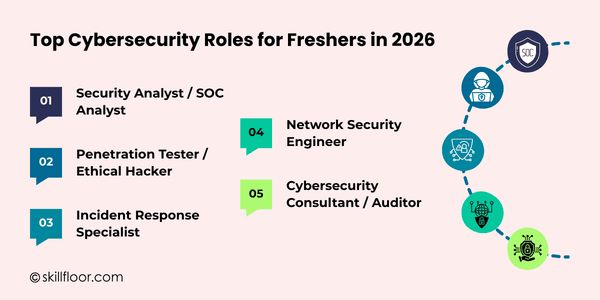
4. Network Security Engineer
Role
A network security engineer defends an organization's networks and systems from cyberattacks, guaranteeing dependable access, secure connections, and safe data flow for both staff and clients.
Skills Needed
-
Firewalls & VPNs: Control access and secure communications.
-
TCP/IP & Networking Basics: Understand data transmission and network structures.
-
Cloud Networking: Protect cloud-based systems and services.
Why It’s Great for Freshers
In order to progress into specialized or leadership roles in the cybersecurity industry, new hires acquire fundamental cybersecurity skills, obtain network protection experience, and lay a solid foundation.
5. Cybersecurity Consultant / Auditor
Role
A cybersecurity consultant or auditor assesses security threats, verifies regulatory compliance, and suggests enhancements to fortify an organization's procedures, policies, and general cybersecurity posture.
Skills Needed
-
Risk Management: Identify and evaluate security risks.
-
Documentation: Record findings, create reports, and maintain audit trails.
-
Regulatory Knowledge: Understand laws and standards like GDPR, ISO 27001.
Why It’s Great for Freshers
Freshers gain practical, business-facing skills, create credibility, grasp risk management and compliance, and develop a good basis for specialized or leadership jobs in cybersecurity.
In India, entry-level cybersecurity positions usually pay between ₹4 and ₹7 lakhs annually for freshers with 0 to 2 years of experience. Taking a cybersecurity course can boost skills and employability. These numbers may differ slightly depending on the city and firm, but industry compensation surveys and job postings for 2025–2026 often show this range.
Average Salary for Entry-Level Cybersecurity Roles in India (2026)
|
Job Role |
Experience |
Average Salary (INR) |
Notes |
|
Security Analyst / SOC Analyst |
0–2 years |
₹4,00,000 – ₹6,50,000 |
Salary may vary depending on city and company size |
|
Penetration Tester / Ethical Hacker |
0–2 years |
₹4,50,000 – ₹7,00,000 |
Certifications like CEH or OSCP can increase starting pay |
|
Incident Response Specialist |
0–2 years |
₹4,00,000 – ₹6,50,000 |
Exposure to real-world incidents provides practical experience |
|
Network Security Engineer |
0–2 years |
₹4,50,000 – ₹7,00,000 |
Hands-on networking and firewall experience highly valued |
|
Cybersecurity Consultant / Auditor |
0–2 years |
₹4,00,000 – ₹6,50,000 |
Business-facing and compliance skills can improve career growth |
Skills Required for Cybersecurity Jobs
To stand out as a fresher, you need a mix of technical and soft skills.
Technical Skills
1. Networking & Protocols (TCP/IP, DNS, VPNs)
Comprehending network protocols such as TCP/IP, DNS, and VPNs facilitates the detection of anomalous activity and safe connection across business systems.
2. Operating Systems (Linux, Windows, MacOS)
Understanding Linux, Windows, and MacOS enables analysts to efficiently monitor, manage, and secure systems on several platforms.
3. Cybersecurity Tools (Wireshark, Nessus, Metasploit, Splunk)
Efficient detection, analysis, and avoidance of cybersecurity threats are made possible by familiarity with tools such as Wireshark, Nessus, Metasploit, and Splunk.
4. Programming Basics (Python, Bash, PowerShell)
Basic Python, Bash, and PowerShell coding facilitates data analysis, task automation, and the creation of scripts for cybersecurity operations.
Soft Skills
1. Analytical Thinking
Finding vulnerabilities and reacting to cyber incidents require the ability to analyze issues, spot trends, and reach logical conclusions.
2. Attention to Detail
Early detection of threats and system security are ensured by closely observing minor irregularities and anomalies.
3. Problem-Solving
Professionals with strong problem-solving abilities are able to prevent future cybersecurity breaches, discover solutions, and react to situations promptly.
4. Communication
Effective reporting of findings to non-technical stakeholders, team coordination, and the explanation of technical challenges are all made possible by clear communication.
Pro Tip: Employers value curiosity as much as technical skills. Build a small home lab, practice on platforms like TryHackMe or Hack the Box, and document your projects.
Certifications That Boost Your Career
Certifications can give freshers an edge in a competitive employment market, considerably boosting their chances of landing Cyber Security Jobs for Freshers in 2026.
1. CompTIA Security+
CompTIA Security+, which covers basic security principles, risk management, and critical cybersecurity practices, is a great entry-level certification for novices.
2. Certified Ethical Hacker (CEH)
Certified Ethical Hacker (CEH) teaches individuals to find vulnerabilities and execute penetration testing, mimicking real-world attacks ethically and responsibly.
3. Cisco CCNA Cyber Ops
In order to prepare beginners for operational cybersecurity roles, Cisco CCNA Cyber Ops concentrates on network security operations, threat monitoring, and incident response.
4. Cloud Security Certifications (AWS Security, Azure Security)
Professionals with certifications in cloud security, such as AWS Security or Azure Security, are better equipped to secure cloud platforms and services.
Obtaining these certificates can show your skills, commitment, and readiness even in the absence of previous work experience, greatly increasing your prospects of successfully landing Cyber Security Jobs for Freshers in 2026.
How to Land Your First Cybersecurity Job
Although it may seem difficult, getting your first cybersecurity job is possible. Here are some practical strategies, pointers, and actions that beginners can take to begin going:
1. Learn from Online Resources
Utilize sites such as Coursera, Skillfloor, and YouTube courses to develop real-world cybersecurity scenarios and acquire practical skills.
2. Hands-On Practice
-
Participate in capture-the-flag (CTF) competitions
-
Contribute to open-source security projects
-
Build personal labs
3. Networking & Mentorship
-
Join LinkedIn groups, forums, and local meetups
-
Connect with industry professionals
-
Get guidance from experienced mentors
4. Resume & Interview Tips
-
Highlight practical projects, labs, and certifications
-
Prepare for scenario-based questions (“What would you do if a firewall alert triggered?”)
-
Show your curiosity and eagerness to learn
Pro Tip: Candidates who are proactive and willing to learn are highly valued by recruiters. Maintaining a GitHub profile with cybersecurity projects can often impress more than a blank or simple résumé.
Common Challenges Freshers Encounter in Cyber Security Jobs
Lack of experience and complicated tools are common barriers for beginners to the field of cybersecurity. Comprehending these obstacles aids in your readiness and success:
-
Limited hands-on experience with real-world attacks
-
Rapidly evolving technologies and security threats
-
High competition for entry-level roles
-
Understanding complex cybersecurity tools and systems
-
Gaining industry-recognized certifications
-
Balancing technical skills with communication and problem-solving
Newcomers entering the field of cybersecurity frequently encounter difficulties such as inexperience, rapidly evolving technologies, intense rivalry, complicated tools, and certification requirements. Overcoming these challenges increases competence, self-assurance, and preparedness for actual cyber roles.
Although pursuing a career in cybersecurity may initially seem daunting, the opportunities are genuine and thrilling. You may stand out in this expanding profession by acquiring the necessary abilities, obtaining real-world experience, and maintaining your curiosity. Companies are seeking driven individuals who are prepared to learn and contribute since Cyber Security Jobs for Freshers are in high demand. You may develop a solid foundation, try out various roles, and become a successful cybersecurity professional with commitment, practical experience, and the correct mindset. Your doorway to a fulfilling and safe future may be Cyber Security Jobs for Freshers.
Digital Marketing Courses in Other Locations in India
Ahmedabad | Aurangabad | Bangalore | Bhilai | Bhopal | Bhubaneshwar | Chandigarh | Chennai | Cochin | Coimbatore | Dehra Dun | Delhi | Faridabad | Ghaziabad | Gorakhpur | Guntur | Gurgaon | Guwahati | Hyderabad | Jaipur | Kanpur | Khammam | Kolkata | Lucknow | Madurai | Mumbai | Mysore | Nagpur | Noida | Patna | Pondicherry | Pune | Ranchi | Shimoga | Surat | Thane | Thiruvananthapuram | Tiruchirappalli | Tirupati | Vadodara | Visakhapatnam | Warangal | Jalandhar | Jodhpur | Indore | Durgapur | Jamshedpur | Dhanbad | Kota | Karnal | Udaipur | Amritsar | calicut | Nashik | Ludhiana | varanasi | thrissur | Mangalore | Raipur |

-
 Sumithra RNeed to cyber security jon