













































Zero Trust Security Model: What It Means and Why It Matters
Discover the Zero Trust Security Model, why traditional security fails, and how proactive risk protection can safeguard your business in today’s digital world.

Have you ever questioned the level of security at your company? The majority of businesses continue to use outdated techniques that presume network security. Today's cyberattacks, however, are advanced, quicker, and capable of coming from anywhere—including within.
What if a single error costs millions of dollars? Sensitive information is present everywhere due to employees using several devices and working remotely, including laptops and cloud storage. Zero Trust Security is essential for safeguarding your company because traditional "trust but verify" approaches are no longer sufficient.
In fact, a recent report by IBM found that the average cost of a data breach in 2025 reached $4.45 million. And guess what? Most breaches weren’t caused by external hackers alone—they often exploit weaknesses inside your network.
The Zero Trust Security Model can be helpful in this situation. It's more than just a catchphrase; for aspirational companies that won't take a chance on their future, it's a lifeline.


Why Traditional Security Isn’t Enough Anymore
Organizations depended on the simple principle of "trust the inside, block the outside" for many years. With firewalls, a digital moat was formed. VPNs enable workers to securely access the company network. The antivirus program served as a vigilant watchdog.
But the world has changed.
-
Remote Work is Here to Stay: Sensitive data is accessed via laptops, personal devices, and unprotected networks since approximately 60% of people worldwide now work remotely at least part-time.
-
Cloud Adoption is Skyrocketing: Storage and applications are no longer protected by a single firewall. Everywhere and nowhere is the perimeter.
-
Insider Threats are Real: Verizon reports that inside actors, whether intentional or not, are involved in 34% of breaches.
The reality? It's like shutting the front door but leaving the windows open when you rely on "trust but verify." Cybersecurity cannot rely on implicit confidence in the modern world.
What Is Zero Trust Security Anyway?
"Never trust, always verify" is what Zero Trust is all about. It's more than simply technology—it's a way of thinking. Even if it's already within your network, every person, device, and connection needs to be verified and approved.
It's similar to airport security on steroids—no badge is sufficient. Each and every boarding card, suitcase, and gadget is subjected to several levels of verification.
Key Principles of Zero Trust:
-
Never Assume Trust: Prior to providing access, always confirm users, devices, and apps.
-
Segmentation for Control: To reduce hazards, divide applications and systems into different zones.
-
Real-time Threat Awareness: Keep an eye on patterns of activity to quickly identify any unexpected behavior.
-
Strong Authentication: Make multi-step verification procedures mandatory to guarantee that only authorized users connect.
-
Secure Data Handling: Use encryption and secure storage to safeguard sensitive data at every level.
-
Dynamic Permissions: Automatically modify access permissions according on activity risk, device, and context.
In short, ensure that no one is trusted by default. Verify everyone and make sure that all activities align with your cybersecurity principles. This approach will help identify risks early and minimize potential harm to your systems and data.
The Importance of Zero Trust in Today’s Security
Zero Trust is now crucial for safety due to a number of expanding cyberthreats, remote work, cloud use, and antiquated security practices:
-
Increasing Cyber Threats: Phishing, ransomware, and insider threats are all on the rise. Millions of dollars' worth of harm and reputational damage can result from a single breach.
-
Remote Work & Cloud Adoption: Employees use personal devices to access company systems from any location, circumventing conventional network security measures and raising risk exposure.
-
Regulatory Compliance: Strong access management is crucial for enterprises since regulations like GDPR, HIPAA, and CCPA demand stringent control over sensitive data.
-
Perimeter Security is Failing: Networks are already vulnerable. Traditional security techniques are no longer enough because firewalls by themselves cannot safeguard inside systems.
-
Third-Party & Vendor Risks: Vulnerabilities may be introduced by partners and vendors gaining access to your network; Zero Trust guarantees that all external connections are limited and validated.
-
Evolving Technology & Devices: Cloud apps, IoT, and mobile devices increase attack surfaces, necessitating ongoing verification to stop illegal access and data breaches.
In short, Zero Trust is no longer optional—it’s essential for businesses of all sizes, as robust network security ensures every user, device, and connection is continuously verified and protected.
Understanding the Core Components of Zero Trust
In order to safeguard people, devices, and data at all times, a strong Zero Trust architecture requires a number of coordinated components:
1. Identity & Access Management (IAM)


Multi-factor authentication (MFA) and other strong authentication methods guarantee that only authorized users can access systems. Secure access is made easier without sacrificing security due to Single Sign-On (SSO).
2. Least Privilege Access
By granting users only the permissions required for their roles, danger is decreased. Restricted access stops credentials from being misused and helps contain possible breaches.
3. Micro-Segmentation
Networks are divided into more manageable parts. The potential damage to other systems or sensitive regions is reduced if an attacker manages to gain entrance since they are unable to travel laterally.
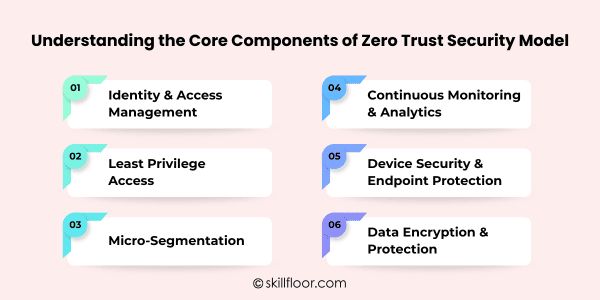
4. Continuous Monitoring & Analytics
By identifying anomalous activity, login irregularities, or suspicious conduct, real-time monitoring and behavioral analytics enable enterprises to take prompt action prior to significant security problems.
5. Device Security & Endpoint Protection
Before a device may access a network, it must adhere to security rules. Antivirus software, endpoint security, and up-to-date software all aid in preventing malware infestations and unwanted access.
6. Data Encryption & Protection
Both in transit and at rest, sensitive data is encrypted to prevent unwanted access. This guarantees that essential information cannot be compromised by cybersecurity threats, even if attackers manage to get past protections.
How Zero Trust Actually Works to Secure Networks
Let's examine a real-world example: Zero Trust checks each step to guarantee security before allowing access when an employee attempts to access a cloud application from their own laptop:
-
Identity Verification: The system uses multi-factor authentication, checks the employee's credentials, and makes sure that only people with permission can try to access confidential company information.
-
Device Check: In order to stop compromised or unsafe devices from connecting to the network, the laptop is checked for compliance, antivirus, and security patch updates.
-
Contextual Analysis: Before granting access, the system assesses variables such as time, location, login habits, and user behavior to identify any anomalous activities.
-
Access Granted with Limits: Only the files and programs required for their position are accessible to the employee, and every action is constantly watched for security.
-
Threat Detection & Prevention: In order to reduce cybersecurity risks, real-time monitoring automatically restricts access and notifies security professionals when it finds suspicious activity or possible breaches.
-
Continuous Reassessment: To maintain strong network security, the system regularly reassesses the session even after access is given, confirming credentials, device health, and behavior.
The system continuously assesses the session's security even after access is allowed, highlighting the importance of cybersecurity. If any questionable activity is found, access can be instantly revoked.
Exploring the Advantages of Zero Trust Security
Adopting the Zero Trust Security Model offers businesses improved access control, lower risk of breaches, and stronger protection—all of which are concrete advantages for contemporary cybersecurity.
-
Reduced Risk of Breaches: Uses the least privilege principle and ongoing access verification to reduce the effect of compromised credentials or insider threats.
-
Better Visibility & Control: Businesses are able to recognize and respond to possible risks more quickly because they have complete knowledge into who has access to what, when, and from where.
-
Simplified Compliance: Helps companies adhere to stringent data protection laws like the CCPA, GDPR, and HIPAA by implementing robust auditing controls and secure access.
-
Support for Remote & Hybrid Work: Offers safe access to resources from any place or device, assisting in mitigating threats like phishing attacks directed at staff members.
-
Faster Threat Detection & Response: By seeing unusual activity in real-time, security teams may react swiftly, minimizing the potential harm caused by breaches or insider assaults.
-
Protects Critical Data and Assets: By limiting access and regularly validating people and devices, Zero Trust guarantees the security of critical systems and sensitive data.
Challenges and Things to Consider in the Zero Trust Security Model
Although Zero Trust provides strong safety, there are obstacles to its implementation, such as complexity, legacy systems, expenses, and the requirement for organizational and cultural adjustments:
-
Complexity of Implementation: It can be challenging to integrate the Zero Trust Security Model with current legacy systems; in order to prevent interruptions, rigorous planning, testing, and collaboration amongst IT teams are necessary.
-
Cultural Change: Under the Zero Trust Security Model, employees could object to new access procedures, thus training and awareness campaigns are necessary to guarantee uptake and compliance.
-
Cost: For the Zero Trust Security Model, initial investments in IAM, monitoring, endpoint protection, and micro-segmentation can be substantial, but they offer long-term security advantages.
-
Technology Compatibility: Upgrades, replacements, or workarounds may be necessary to maintain security standards since some legacy systems and applications might not support the Zero Trust Security Model.
-
Continuous Management: For the Zero Trust framework to be effective in the face of changing organizational structures and increasing threats, it must be continuously monitored, updated, and adjusted.
-
Vendor and Third-Party Risks: Vulnerabilities may be introduced by external partners gaining access to your network, necessitating strict monitoring, verification, and access controls to preserve overall security.
Implementation Strategies for the Zero Trust Security Model
For effective protection, implementing the Zero Trust Security Model necessitates meticulous preparation, beginning with vital assets, layered security, and ongoing monitoring:
-
Start with Critical Assets: Prioritize safeguarding sensitive information and valuable systems by making sure they are protected with robust access controls, appropriate Zero Trust rules, and monitoring.
-
Layer Security Controls: Create several security levels by combining IAM, micro-segmentation, endpoint protection, and ongoing monitoring to lower risks from both internal and external attacks.
-
Adopt a Phased Approach: Expand Zero Trust policies gradually throughout the company, starting small, evaluating their efficacy, then expanding to include all people, devices, and systems.
-
Use the Right Tools: Identity verification, access control, behavioral analytics, and cyber security technologies are all integrated into contemporary Zero Trust solutions, which make installation easier while upholding strict security standards.
-
Train Employees and Stakeholders: Educate employees on security best practices, access policies, and Zero Trust procedures to ensure seamless implementation and reduce the possibility of human mistake.
-
Continuously Evaluate and Improve: Review and update policies on a regular basis, keep an eye on network activity, and modify tactics to deal with new risks and changing organizational requirements.
The Future of Zero Trust Security
Zero Trust is evolving with new technologies:
-
AI & Machine Learning: Instantly modifies access policies and automatically identifies threats.
-
Integration with Cloud & IoT: Safeguards intricate, dispersed ecosystems, including as cloud services and linked devices.
-
Beyond IT: Applies Zero Trust concepts to supply chain security and operational technologies.
-
Identity-Centric Security: Ensures secure access everywhere by continuously verifying people, devices, and workloads.
-
Adaptive & Contextual Policies: Access choices dynamically take risk scores, location, behavior, and device health into account.
Adopting the Zero Trust Security Model involves more than just implementing technology; it is about confidently protecting your people, data, and organization. Every individual, device, and connection is verified to create a safer environment where potential damage is minimized and threats are identified early. Businesses that embrace the Zero Trust Security Model can grow fearlessly, benefiting from greater control and peace of mind. This approach allows teams to work effectively, safely, and remotely while safeguarding sensitive information. Organizations that prioritize immediate action, put security first, and cultivate trust from within will thrive in the future.
Digital Marketing Courses in Other Locations in India
Ahmedabad | Aurangabad | Bangalore | Bhilai | Bhopal | Bhubaneshwar | Chandigarh | Chennai | Cochin | Coimbatore | Dehra Dun | Delhi | Faridabad | Ghaziabad | Gorakhpur | Guntur | Gurgaon | Guwahati | Hyderabad | Jaipur | Kanpur | Khammam | Kolkata | Lucknow | Madurai | Mumbai | Mysore | Nagpur | Noida | Patna | Pondicherry | Pune | Ranchi | Shimoga | Surat | Thane | Thiruvananthapuram | Tiruchirappalli | Tirupati | Vadodara | Visakhapatnam | Warangal | Jalandhar | Jodhpur | Indore | Durgapur | Jamshedpur | Dhanbad | Kota | Karnal | Udaipur | Amritsar | calicut | Nashik | Ludhiana | varanasi | thrissur | Mangalore | Raipur |