

































AI and Automation Roles in Digital Marketing
Discover how AI and automation are reshaping digital marketing, improving efficiency, personalization, and ROI for all ambitious marketers aiming to stay ahead.

More than 80% of top marketers say that automation and AI have increased the effectiveness of their campaigns. Although managing multiple platforms, emails, and advertisements can seem confusing, clever tools speed up repetitive activities, freeing up marketers' time for innovation.
AI can quickly transform vast amounts of consumer data into simple insights. Imagine being completely aware of every customer's preference without having to guess. Real-time campaign adjustments, personalized messaging, and the ability to concentrate on strategy rather than endless manual duties are all advantages for marketers. Discover the ways in which AI is transforming marketing.
Businesses that don't use AI risk falling behind. While you find it hard to respond to every email and post, competitors utilize clever automation to improve digital marketing engagement and conversions. Adopting these technologies now can enhance the speed and precision of your marketing.
Why AI and Automation Are Game-Changers in Digital Marketing
Traditional digital marketing has drawbacks. Effectiveness is frequently hampered by manual data analysis, laborious campaign administration, and generic messages. Companies have a hard time figuring out what customers actually want, when they want it, and how best to offer it.


This is where AI and Automation shine:
-
Efficiency: Manage ad bids, schedule emails, and keep an eye on social media by automating complex processes.
-
Data-Driven Decisions: AI examines enormous databases to find trends and information that people would overlook.
-
Personalization at Scale: Improve engagement and conversions by targeting consumers with personalized offers and content.
-
Cost-Effectiveness: Improve campaigns, cut down on wasteful advertising expenditures, and more wisely distribute resources.
In short, AI and automation are not just tools—they are catalysts for smarter, faster, and more effective digital marketing.
Understanding AI vs Automation in Marketing
Even though they are frequently discussed together, automation and AI have different uses in marketing:
Artificial Intelligence: AI uses machine learning and algorithms to evaluate data, forecast consumer behavior, and make judgments. AI-generated content, chatbots that mimic human speech, and predictive analytics for ad targeting are a few examples.
Automation: The goal of automation is to carry out routine, rule-based processes without the need for human interaction. Sending prearranged emails, publishing content on social media, or setting off alerts in response to user activity are a few examples.
How they work together: Automation can be improved by AI by becoming more intelligent. An AI-powered automated email campaign, for example, can modify messaging to enhance your digital marketing strategy based on user involvement and increase conversions.
How AI and Automation Are Transforming the Digital Marketing Puzzle
Automation and artificial intelligence are more than just catchphrases. They are helpful tools that put strategy into practice. Let's examine the specific ways in which they are transforming digital marketing.
AI Roles in Digital Marketing
1. Data Analysis & Insights
-
AI quickly scans enormous information to find patterns that humans would overlook.
-
For example, predictive analytics solutions enable hyper-targeted advertising by predicting the things a consumer is most likely to purchase next.
Impact: Makes it possible to make more informed marketing decisions, eliminates uncertainty, reveals hidden trends, and greatly increases the effectiveness, targeting, and overall return on investment of campaigns.
2. Content Creation
-
AI is capable of creating video scripts, blog entries, social media captions, and ad text.
-
Imagine spending hours coming up with ideas for content, just to have AI suggest dozens of pertinent choices in a matter of minutes.
Impact: Saves time, encourages innovation, keeps your marketing and creative staff from burning out, and maintains consistent, high-quality content across platforms.
3. Customer Segmentation & Personalization
-
AI recognizes trends in preferences and behavior.
-
You can ensure that every consumer feels like you know them personally by delivering customized messaging at scale.
Impact: Increases consumer engagement, builds loyalty, increases conversions, and guarantees tailored experiences that give each audience member a sense of worth.
4. Predictive Analytics & Lead Scoring
-
AI helps sales teams focus on the correct prospects by scoring leads according to their chances of converting.
Impact: Time is saved, high-potential leads are given priority, conversion rates are increased, and more effective, data-driven, and successful marketing campaigns are made possible.


5. Chatbots & Customer Interaction
-
AI-driven chatbots respond to consumer questions around-the-clock, offering prompt assistance and freeing up human teams for more intimate exchanges.
Impact: Improves customer satisfaction, provides prompt, round-the-clock responses, lightens team workloads, and saves overall operating expenses.
Learning AI applications is crucial for marketers who want to stay ahead of the curve. Taking courses in digital marketing can impart useful skills that improve productivity, creativity, and outcomes in contemporary campaigns.
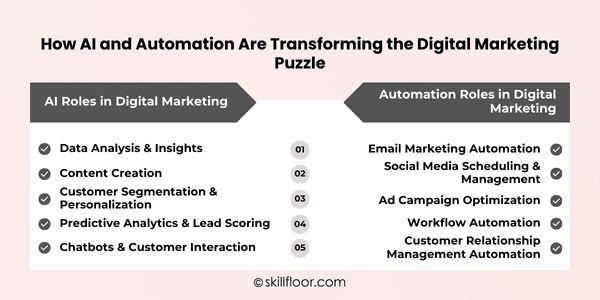
Automation Roles in Digital Marketing
1. Email Marketing Automation
Customers are guaranteed to receive the right message at the right moment due to automated drip campaigns, triggered emails, and tailored follow-ups.
Impact: Campaigns are streamlined, open and click-through rates are increased, customer attrition is decreased, and timely, tailored messaging that encourages interaction and sales is guaranteed.
2. Social Media Scheduling & Management
Posting, tracking engagement, and performance analysis are all handled through automation technologies.
Impact: Guarantees regular posting, monitors interaction, offers useful information, saves time, and frees up marketers to concentrate on strategy and innovation.
3. Ad Campaign Optimization
AI is used by platforms like Facebook Ads and Google Ads to automatically optimize targeting and bidding in real-time.
Impact: Increases campaign performance, optimizes the effectiveness of ad spending, enhances targeting precision, and yields a higher return on investment with less manual labor.
4. Workflow Automation
Automating repetitive tasks, like lead nurturing or reporting, can save hours per week.
Impact: Releases teams from monotonous work, boosts productivity, permits concentration on strategy and innovation, and more successfully propels business expansion.
5. Customer Relationship Management (CRM) Automation
CRM system automation ensures that no opportunity is lost by tracking customer interactions, managing leads, and automatically sending follow-up reminders.
Impact: Enhances client connections, boosts conversion rates, promotes lead management effectiveness, and guarantees timely, tailored communication at scale.
AI-Powered Tools Every Digital Marketer Should Know
Several tools make AI and automation accessible to marketers of all sizes:
-
ChatGPT & Jasper: Use AI to effectively create excellent content, ad copy, and customer service support.
-
HubSpot: Uses AI analytics and marketing automation to track prospects, enhance engagement, and optimize campaigns.
-
Hootsuite & Buffer: Plan, automate, and keep an eye on social media posts while efficiently monitoring audience participation.
-
Google Analytics AI Features: Offers performance predictions, anomaly identification, and predictive insights for data-driven marketing choices.
-
Canva AI: Quickly create presentations, social media graphics, and expert infographics with AI-powered design recommendations.
-
Drift: AI chatbots automatically increase conversion rates by engaging visitors, qualifying leads, and setting up meetings.
By assisting marketers in putting AI-driven ideas into practice, these technologies make AI in digital marketing more approachable without requiring a high level of technical knowledge, making advanced marketing methods available to anyone.
Case Studies / Real-World Examples
-
Netflix: Employs AI algorithms to examine watching habits in order to provide tailored content recommendations, increase user engagement, increase retention rates, and maintain subscribers' satisfaction with pertinent, individualized entertainment experiences.
-
Amazon: Uses artificial intelligence (AI) for targeted marketing campaigns, dynamic pricing, predictive inventory management, and personalized product recommendations. This improves customer satisfaction, conversion rates, and operational efficiency throughout its e-commerce platform.
-
Coca-Cola: Uses AI-powered chatbots to engage with consumers, offer immediate assistance, collect feedback, and improve overall engagement. This increases brand loyalty and efficiently streamlines marketing communications.
-
Starbucks: Creates highly relevant marketing campaigns that connect with audiences and increase sales by using AI-driven social listening to track trends, assess customer sentiment, and customize promotions.
These examples show observable advantages, such as enhanced customer satisfaction, sales, engagement, and operational effectiveness.
Challenges and Ethical Considerations
Despite the advantages, AI and automation come with challenges:
-
Over-Reliance: Campaigns may appear robotic or impersonal due to over-automation, which can diminish human creativity and authenticity.
-
Data Privacy: Protecting consumer information requires adherence to GDPR and other privacy laws.
-
Algorithmic Bias: If training data or models are not adequately supervised, AI may inadvertently reinforce prejudices.
-
High Implementation Costs: Automation systems and sophisticated AI technologies demand a large initial investment and continuous upkeep.
-
Integration Complexity: Businesses may find it technically difficult to integrate AI with current marketing systems and operations.
-
Transparency Issues: If automated marketing judgments lack explainability or clarity, customers may become suspicious.
Ethical, efficient, and sustainable marketing strategies are ensured by finding a balance between technology and human monitoring.
The Future of AI and Automation in Digital Marketing
The future promises even more innovation:
-
Hyper-Personalization: AI will produce completely personalized user experiences for every touchpoint.
-
Predictive Marketing: AI forecasts in real time will assist marketers in anticipating consumer demands before they materialize.
-
AI-Driven Creativity: AI will increasingly assist creative marketing, from storytelling to ad design.
-
Voice and Visual Search Optimization: Brands will be able to improve their content for image-based searches and voice assistants thanks to AI.
-
Automated Customer Journey Mapping: Every stage of the client journey will be tracked and optimized in real time by AI.
-
Advanced Marketing Analytics: For more intelligent choices, AI will provide deeper insights, practical suggestions, and automated performance optimization.
Adopting AI and automation now will put marketers in a better position to innovate, adapt, and maintain their lead in the cutthroat digital market.
Automation and AI are not just passing trends; they are powerful tools that enhance the efficiency, speed, and intelligence of digital marketing. These technologies allow marketers to focus on strategy and creativity by handling repetitive tasks, analyzing data, and personalizing campaigns. By embracing AI in marketing, businesses can enhance customer experiences, make informed decisions, and maintain a competitive edge in a challenging marketplace. Achieving success requires a balance between technology and human insight, even amidst concerns about data privacy and excessive automation. Today, adopting AI goes beyond simply staying current; it involves innovation, experimentation, and infusing excitement into marketing efforts.
Digital Marketing Courses in Other Locations in India
Ahmedabad | Aurangabad | Bangalore | Bhilai | Bhopal | Bhubaneshwar | Chandigarh | Chennai | Cochin | Coimbatore | Dehra Dun | Delhi | Faridabad | Ghaziabad | Gorakhpur | Guntur | Gurgaon | Guwahati | Hyderabad | Jaipur | Kanpur | Khammam | Kolkata | Lucknow | Madurai | Mumbai | Mysore | Nagpur | Noida | Patna | Pondicherry | Pune | Ranchi | Shimoga | Surat | Thane | Thiruvananthapuram | Tiruchirappalli | Tirupati | Vadodara | Visakhapatnam | Warangal | Jalandhar | Jodhpur | Indore | Durgapur | Jamshedpur | Dhanbad | Kota | Karnal | Udaipur | Amritsar | calicut | Nashik | Ludhiana | varanasi | thrissur | Mangalore | Raipur |