











































Top Machine Learning Skills You Need to Learn in 2026
Learn the top machine learning skills you need in 2026. Stay ahead in AI for your career, boost it, and master the essential skills employers are seeking today.

Organizations today rely heavily on data to make faster and smarter decisions. Machine learning makes this possible by enabling systems to identify patterns, predict outcomes, and automate complex tasks. As businesses expand their use of AI across products and services, the demand for professionals with strong machine learning skills continues to grow.
Understanding the most important machine learning skills can help aspiring professionals focus their learning and prepare for emerging opportunities in the AI-driven job market.
Key Takeaways
-
Machine learning remains the most in-demand AI capability, appearing in about 34% of AI job postings, with strong year-over-year growth across industries.

-
AI job postings have grown rapidly worldwide, with AI hiring increasing about 74% year-over-year and strong demand for machine learning engineers and data specialists.
-
Organizations increasingly require professionals who combine programming, statistics, and model deployment skills to build production-ready AI systems.


What is Machine Learning
Machine learning is a branch of artificial intelligence that enables computers to learn from data and improve their performance without explicit programming. Instead of following fixed instructions, machine learning algorithms analyse large datasets, identify patterns, and generate predictions or insights based on those patterns.
According to IBM, machine learning focuses on building models that allow systems to automatically learn and adapt through experience. This capability supports many modern technologies such as recommendation systems, fraud detection tools, voice assistants, and image recognition applications across industries including finance, healthcare, retail, and technology.
Top Machine Learning Skills You Need to Learn in 2026
Building strong machine learning skills requires a combination of programming expertise, mathematical knowledge, and real-world problem-solving abilities. The following capabilities represent the core skills machine learning professionals are expected to master.
1. Programming Skills
Programming forms the foundation of machine learning development. Most machine learning models are built and tested using programming languages that support data processing and algorithm implementation.
Python remains the most widely used language in the field because of its extensive ecosystem of libraries and frameworks designed for machine learning development. R is also popular for statistical computing and data analysis.
Understanding machine learning languages enables developers to write efficient algorithms, process large datasets, and build scalable AI systems.
Professionals with strong programming capabilities can move beyond theory and develop real applications such as recommendation engines, chatbots, or predictive analytics systems.
2. Statistics and Probability
Machine learning relies heavily on statistical modeling and probability theory. These mathematical concepts help professionals understand patterns in data and evaluate model performance.
Statistical knowledge allows machine learning practitioners to:
-
Analyze datasets accurately
-
Select appropriate algorithms
-
Evaluate prediction accuracy
-
Interpret results for business decisions
Without a solid statistical foundation, it becomes difficult to build reliable models or understand the limitations of predictions.
3. Data Preprocessing and Feature Engineering
Data rarely arrives in a perfect format. In most real-world scenarios, raw datasets contain missing values, inconsistencies, and irrelevant variables.
Data preprocessing involves cleaning, transforming, and structuring data so that machine learning algorithms can process it effectively.
Feature engineering is the process of selecting or creating variables that improve model performance. Skilled practitioners identify which data attributes carry meaningful predictive signals.
Many experienced professionals consider this one of the most important skills needed for machine learning because the quality of data preparation often determines the success of the final model.
4. Machine Learning Algorithms
Understanding algorithms is central to developing effective models.
Common machine learning algorithms include:


-
Linear and logistic regression
-
Decision trees and random forests
-
Support vector machines
-
Clustering algorithms such as k-means
-
Gradient boosting methods
Each algorithm is suited for different types of problems such as classification, regression, or clustering.
Professionals who understand these algorithms can select the most appropriate approach for a specific dataset or business challenge, aligning their choice with the machine learning objectives of the project.
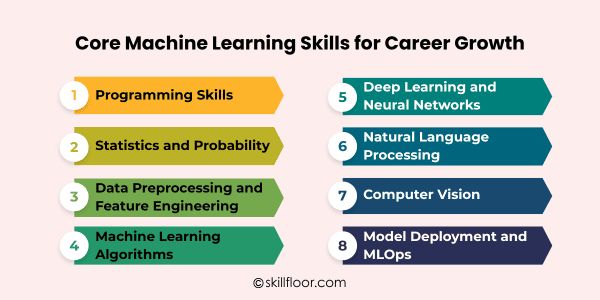
5. Deep Learning and Neural Networks
Deep learning represents a specialized area of machine learning focused on neural network architectures that process complex patterns in large datasets.
These models power many advanced AI applications, including:
-
Image recognition systems
-
Voice assistants
-
recommendation engines
-
language translation systems
Deep learning frameworks allow machines to analyse vast amounts of information and learn hierarchical representations of data.
The increasing adoption of generative AI technologies has made deep learning expertise one of the most valuable machine learning skills required in modern AI development.
6. Natural Language Processing
Natural language processing (NLP) focuses on enabling computers to understand and generate human language.
Applications include:
-
chatbots
-
document analysis
-
sentiment analysis
-
voice assistants
-
automated translation
Demand for NLP expertise has grown significantly as businesses invest in conversational AI platforms and automated customer support solutions.
Recent industry research shows continued growth in NLP roles as organizations deploy AI systems capable of processing large volumes of text and voice data.
7. Computer Vision
Computer vision enables machines to interpret visual information from images and videos.
Industries such as healthcare, manufacturing, and retail increasingly rely on computer vision systems for tasks such as medical image analysis, product inspection, and facial recognition.
Professionals with computer vision expertise often work on applications involving object detection, image classification, and video analytics.
8. Model Deployment and MLOps
Building a model is only part of the machine learning workflow. Organizations require professionals who can deploy models into production environments and maintain their performance over time.
This process is known as MLOps.
Key capabilities include:
-
Model deployment through APIs
-
Monitoring model performance
-
Managing data pipelines
-
Version control for machine learning systems
-
Continuous integration and delivery for AI models
The demand for MLOps skills has grown significantly as organizations move from experimental AI projects to large-scale deployment of machine learning systems.
Tools for Machine Learning
Professionals working in machine learning rely on specialized tools and frameworks to develop, train, and deploy models efficiently.
Some of the widely used machine learning tools include:
-
TensorFlow - a powerful framework for deep learning and neural network development
-
PyTorch - widely used in research and production environments
-
Scikit-learn - a Python library for classical machine learning algorithms
-
Keras - a high-level deep learning API
-
Apache Spark - used for processing large-scale data
-
MLflow - supports machine learning lifecycle management
Learning how these machine learning tools work together helps developers streamline the model development process and scale AI applications.
Jobs in the Machine Learning Industry – Responsibilities and Salaries
Machine learning expertise opens the door to several specialized careers across artificial intelligence, data science, and analytics. Below are some of the key machine learning roles, along with their responsibilities and salary ranges.
1. Machine Learning Engineer
Machine learning engineers design, build, and deploy machine learning models that enable systems to learn from data and improve predictions. They focus heavily on coding, model optimization, and deployment of AI systems into production environments.
Key Responsibilities
The key responsibility of an ML engineer is to develop and train machine learning models, prepare datasets, and deploy models into production environments while improving their performance and scalability.
Average Salary
-
India: ₹6 LPA – ₹35 LPA depending on experience
-
Global average: $110,000 – $160,000 per year in major tech markets
Entry-level professionals typically start around ₹4–8 LPA in India, while experienced engineers can earn ₹20–35 LPA or more in leading technology companies.
2. Data Scientist
Data scientists analyze structured and unstructured data to identify patterns, build predictive models, and generate insights that support business decisions. Many organizations rely on data scientists to guide strategy through advanced analytics and machine learning.
Key Responsibilities
Analyze structured and unstructured data, develop predictive models, and communicate insights through reports and data visualizations.
Average Salary
-
India: ₹8 LPA – ₹30 LPA
-
Global average: $100,000 – $150,000 per year
Demand for data scientists continues to grow as organizations increasingly rely on data-driven decision-making.
3. AI Engineer
AI engineers develop intelligent applications that integrate machine learning, deep learning, and automation technologies. They often build complete AI systems that interact with users, process data, and automate complex processes.
Key Responsibilities
Build AI solutions, integrate machine learning models into applications, and optimize AI systems for performance and scalability.
Average Salary
-
India: ₹6 LPA – ₹25 LPA
-
Global average: $120,000 – $170,000 per year
AI engineers are among the most sought-after professionals as businesses expand their AI capabilities.
4. Natural Language Processing (NLP) Engineer
NLP engineers specialize in developing systems that understand and process human language. Their work powers applications such as chatbots, voice assistants, and automated document analysis systems.
Key Responsibilities
Build models for text and speech analysis, develop chatbots or language applications, and improve accuracy in natural language processing systems.
Average Salary
-
India: ₹10 LPA – ₹35 LPA
-
Global average: $110,000 – $160,000 per year
The growth of conversational AI and generative AI has significantly increased demand for NLP specialists.
5. Computer Vision Engineer
Computer vision engineers develop AI systems that analyse visual data such as images and videos. Their work supports technologies used in autonomous vehicles, medical imaging, security systems, and industrial automation.
Key Responsibilities
Develop image recognition and object detection models, train visual AI systems, and deploy computer vision applications.
Average Salary
-
India: ₹12 LPA – ₹40 LPA
-
Global average: $110,000 – $170,000 per year
Computer vision roles are expanding as industries increasingly rely on automated visual analysis.
Understanding both the theoretical foundations and practical implementation of machine learning technologies is essential for building a successful career.
Professionals who want structured learning pathways often benefit from guided training programs. Skillfloor offers industry-focused programs designed to help learners develop practical machine learning skills through real projects, expert mentorship, and hands-on learning experiences.
Frequently Asked Questions
1. What skills are required for machine learning?
Key machine learning skills include programming, statistics, data preprocessing, machine learning algorithms, deep learning, and model deployment.
2. Which programming language is best for machine learning?
Python is widely considered the most popular language due to its extensive libraries and frameworks for AI development.
3. How long does it take to learn machine learning?
Learning the fundamentals may take three to six months, while gaining professional-level expertise usually requires continuous practice and project experience.
4. Is machine learning a good career in 2026?
Yes. Demand for AI and machine learning professionals continues to grow as organizations integrate artificial intelligence into business operations.
5. Do I need a degree to work in machine learning?
Many employers prioritize practical skills and project experience over formal degrees, especially for applied machine learning roles.
Learning Machine Learning Skills can help you advance in your job as technology continues to advance. These abilities offer you the confidence to take on real-world tasks, whether your goal is to develop AI models, analyze data, or develop intelligent apps. Concentrating on Machine Learning Skills makes learning new technologies simpler and helps you stay ahead in a rapidly changing job market. You can grasp the ideas and take pleasure in problem-solving if you practice frequently and apply what you've learned to practical assignments. Strong Machine Learning Skills can open up intriguing opportunities for you tomorrow.
Digital Marketing Courses in Other Locations in India
Ahmedabad | Aurangabad | Bangalore | Bhilai | Bhopal | Bhubaneshwar | Chandigarh | Chennai | Cochin | Coimbatore | Dehra Dun | Delhi | Faridabad | Ghaziabad | Gorakhpur | Guntur | Gurgaon | Guwahati | Hyderabad | Jaipur | Kanpur | Khammam | Kolkata | Lucknow | Madurai | Mumbai | Mysore | Nagpur | Noida | Patna | Pondicherry | Pune | Ranchi | Shimoga | Surat | Thane | Thiruvananthapuram | Tiruchirappalli | Tirupati | Vadodara | Visakhapatnam | Warangal | Jalandhar | Jodhpur | Indore | Durgapur | Jamshedpur | Dhanbad | Kota | Karnal | Udaipur | Amritsar | calicut | Nashik | Ludhiana | varanasi | thrissur | Mangalore | Raipur |