








































Data Science Jobs Without Coding Roles
Explore data science jobs that do not need coding. Learn roles, skills, and tools to build a data career focused on insights, not for programming or decisions.

Many people only think about coding when they hear the term "data science." They think of Python, R, and complex machine learning scripts. Industry studies state that around 60% of professionals stay clear of data responsibilities because they think competent coding is essential. Despite the fact that many data professions emphasize insights, tools, and decision-making over programming, this misconception discourages many skilled individuals from pursuing careers in data science.
-
Not all data science roles require coding.
-
Some of the most impactful data-driven roles focus on insights, business thinking, and communication—not programming.
What Data Science Really Is
Data science is really about using data to solve actual problems. Instead of merely writing code or creating intricate models, it focuses on recognizing patterns, gaining insights, and assisting in making smarter decisions.


A typical data science workflow includes:
-
Understanding the business problem
-
Identifying the right data
-
Analyzing and interpreting that data
-
Communicating insights to stakeholders
-
Driving decisions and actions
Coding mostly supports one step of the data science process, like model construction and analysis. Writing code is not necessary for many crucial functions, such as comprehending results and making conclusions.
For this reason, modern data teams comprise people who have a variety of skills, including communication, business thinking, and visualization. It takes more than just programmers to succeed in data science; cooperation is essential.
Why Non-Coding Roles Exist in Data Science Teams
Businesses spend money on data science to help them make better decisions, not only to create models. Transforming data into understandable insights that direct business activities is the true goal of data science objectives.
Technical aspects of Python code are rarely examined by executives. To comprehend patterns and make quicker, more assured judgments, they rely on dashboards, straightforward information, and unambiguous suggestions.
That’s where non-coding data professionals come in:
-
Translating technical outputs into business language
-
Identifying trends and patterns
-
Asking the right questions of the data
-
Helping leaders act on insights
Without these roles, even the best algorithms fail to create impact.
So, let’s look at the actual data science jobs where coding is minimal or not required.
High-Demand Data Science Jobs That Don’t Require Coding
1. Data Analyst
By examining historical data to identify trends and patterns, data analysts assist businesses in making well-informed decisions without the need to write advanced algorithms or code.
What they do:
-
Analyze datasets using spreadsheets or BI tools
-
Create reports and dashboards
-
Answer business questions using data
Key skills:
-
Analytical thinking
-
Excel / Google Sheets

-
Power BI, Tableau, or similar tools


Why coding isn’t essential:
Programming is not necessary for creating reports and insights because the majority of analysis uses simple formulas and drag-and-drop tools.
2. Business Analyst
Business analysts ensure projects achieve their objectives by facilitating communication between business and data teams. Their ability to establish needs, understand insights, and convert data into useful business decisions is aided by strong data science skills.
What they do:
-
Define business problems
-
Translate requirements into data needs
-
Interpret insights for stakeholders
Key skills:
-
Domain knowledge
-
Communication
-
Requirement gathering
-
Data interpretation
Why coding isn’t essential:
Instead of developing code, this job concentrates on what should be analyzed and why, enabling experts without programming experience to make judgments.
3. Data Visualization Specialist
Experts in data visualization transform complicated data into comprehensible, captivating narratives that assist stakeholders and teams in comprehending trends, patterns, and insights for improved decision-making.
What they do:
-
Design interactive dashboards
-
Present insights visually
-
Simplify complex datasets
Key skills:
-
Visual storytelling
-
Design sense
-
Tools like Tableau, Power BI, Looker
Why coding isn’t essential:
Professionals may generate dynamic dashboards and charts without knowing programming, as most visualization tools support data science skills through low-code or no-code platforms like Tableau or Power BI.
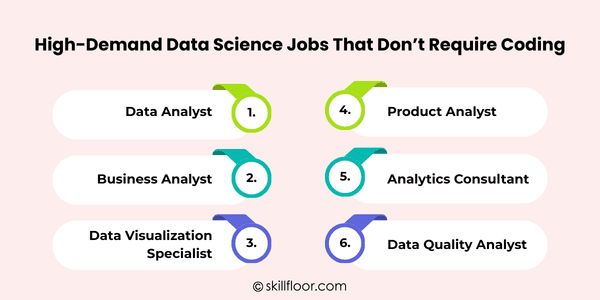
4. Product Analyst
Product analysts research user behavior and product performance. They use data to analyze important metrics, develop functionality, and assist teams in making decisions that will improve the user experience.
What they do:
-
Analyze user behavior
-
Track product metrics
-
Provide insights to product managers
Key skills:
-
Analytical mindset
-
Understanding of user journeys
-
Communication
Why coding isn’t essential:
The position is suitable for non-programmers since it places more emphasis on evaluating metrics and producing insightful data than on creating algorithms or writing code.
5. Analytics Consultant
By analyzing data, offering suggestions, and converting complicated information into workable business plans for stakeholders, analytics consultants help organizations make more informed, data-driven decisions.
What they do:
-
Interpret analysis results
-
Create presentations and recommendations
-
Work closely with clients
Key skills:
-
Storytelling
-
Business strategy
-
Client communication
Why coding isn’t essential:
Rather than doing technical coding or creating models themselves, their emphasis is on providing insights and quantifiable results.
6. Data Quality Analyst / Data Steward
Data accuracy, consistency, and dependability are guaranteed by data quality experts and stewards. Maintaining clean datasets for reporting and well-informed business decisions is facilitated by effective data preparation procedures.
What they do:
-
Monitor data quality
-
Define data standards
-
Validate datasets
Key skills:
-
Attention to detail
-
Process understanding
-
Documentation
Why coding isn’t essential:
The function is accessible to non-coders because it is primarily process-driven and concentrates on validation, monitoring, and documentation rather than programming.
The Skills That Matter More Than Coding
Coding is frequently overtaken by the most ignored skills, which include data interpretation, critical thinking, storytelling ideas, business comprehension, and excellent stakeholder communication.
1. Data Interpretation
The capacity for in-depth numerical analysis, identifying patterns and trends that provide useful information for improved business decision-making.
2. Business Thinking
Knowing which measures have the biggest effects on corporate objectives and coordinating analysis and strategy to promote quantifiable efficiency and growth.
3. Storytelling
Converting complicated data into engaging stories that stakeholders can comprehend, recall, and use successfully.
4. Critical Thinking
Asking the correct questions, questioning presumptions, and assessing the data will guarantee that suggestions are precise and significant.
5. Stakeholder Communication
Effectively and clearly bridging the gap between data and decision-making while effectively communicating findings to non-technical audiences.
6. Problem-Solving Mindset
Recognizing business problems and creating workable, data-driven solutions that produce noticeable outcomes without the need for programming.
By taking a data science course, you may learn how to build these abilities strategically and effectively, even though they are the most valuable and hardest to teach.
Tools to Learn Instead of Programming Languages
Rather than focusing on Python or R, prioritize these tools:
-
Excel / Google Sheets (advanced level)
-
Tableau or Power BI
-
SQL basics (reading > writing)
-
Presentation & storytelling tools
-
Domain-specific analytics platforms
These tools are highly appreciated for effectively producing insights, reports, dashboards, and visualizations and are frequently utilized in non-coding data science jobs.
How to Break into Data Science Without Coding
Gaining momentum in data science without knowing how to code calls for concentrated study, real-world experience, and clever placement to highlight your findings and commercial implications.
Step 1: Learn Data Fundamentals
You don’t need advanced math. Focus on understanding:
-
Metrics
-
KPIs
-
Descriptive statistics
-
Business analysis concepts
Step 2: Build a Practical Portfolio
Show, don’t tell:
-
Dashboards
-
Case studies
-
Business insights from public datasets
Step 3: Reposition Your Resume
Stop listing tools only. Highlight:
-
Decisions influenced
-
Problems solved
-
Impact created
Step 4: Apply Strategically
Target roles that mention:
-
“Business-focused”
-
“Insights”
-
“Stakeholder communication”
-
“Decision support”
Step 5: Network with Purpose
Make connections with experts in product, BI, and analytics positions. Attend communities, seminars, or LinkedIn events to learn about and find untapped employment prospects.
Step 6: Keep Learning & Upskilling
Stay ahead of the curve by investigating analytics trends, business intelligence platforms, and visualization tools while adhering to a structured data science syllabus to advance your skills and become a valuable asset in non-coding data professions.
Common Myths About Non-Coding Data Science Jobs
1. Myth: These roles pay less
Reality: Competitive pay is available for many non-coding positions, particularly as experience and skill levels increase.
2. Myth: Career growth is limited
Reality: Positions as an analytics manager, product manager, or strategy leader are accessible to non-coding professionals.
3. Myth: You’ll eventually be forced to code
Reality: In many non-coding professional pathways, coding is still optional in favor of decision-making and insights.
4. Myth: Non-coding roles are entry-level only
Reality: Professionals with experience can lead teams, assume senior roles, and have an impact on company direction.
5. Myth: Non-coders can’t work in tech companies
Reality: Non-programming analysts, consultants, and visualization experts are needed by tech companies.
6. Myth: These roles lack impact
Reality: Critical decisions are made and company outcomes are directly impacted by non-coding positions.
Career Growth and Future Scope
Roles that link data with business are growing increasingly crucial as data becomes a key component of decision-making.
Non-coding data professionals often move into:
-
Analytics leadership
-
Product strategy
-
Business intelligence management
-
Decision science roles
Human skills like judgment, critical thinking, and narrative have grown more crucial as AI and automation handle many technical jobs, assisting organizations in making vital decisions and efficiently interpreting data.
Coding is only one aspect of data science; many high-impact positions concentrate on strategy, insights, and converting data into practical business decisions. In reality, there are many Data Science Jobs where your aptitude for problem-solving, curiosity, and commercial acumen is more important than your ability to write Python programs. You can succeed in roles like analyst, consultant, or visualization specialist and have a significant impact by developing abilities like storytelling, critical thinking, and effective communication. Companies are looking for someone who can use data to make decisions that can be put into action, which is driving growth in these Data Science Jobs. These Data Science Jobs allow you to flourish and influence the future without knowing how to code. Begin learning, develop a solid portfolio, and demonstrate your worth.
Digital Marketing Courses in Other Locations in India
Ahmedabad | Aurangabad | Bangalore | Bhilai | Bhopal | Bhubaneshwar | Chandigarh | Chennai | Cochin | Coimbatore | Dehra Dun | Delhi | Faridabad | Ghaziabad | Gorakhpur | Guntur | Gurgaon | Guwahati | Hyderabad | Jaipur | Kanpur | Khammam | Kolkata | Lucknow | Madurai | Mumbai | Mysore | Nagpur | Noida | Patna | Pondicherry | Pune | Ranchi | Shimoga | Surat | Thane | Thiruvananthapuram | Tiruchirappalli | Tirupati | Vadodara | Visakhapatnam | Warangal | Jalandhar | Jodhpur | Indore | Durgapur | Jamshedpur | Dhanbad | Kota | Karnal | Udaipur | Amritsar | calicut | Nashik | Ludhiana | varanasi | thrissur | Mangalore | Raipur |