

























12 Best Professional Courses and Short-Term Courses After BCom
Explore the best professional courses and short-term courses after BCom to boost your career growth, increase salary, and confidently choose the right path.

Every year, lakhs of BCom graduates’ step into a competitive job market, but very few actually secure high-paying roles without extra skills. You put a lot of effort into earning your BCom degree, taking a route that many people seem sensible and safe. BCom programs are among the most popular undergraduate courses in commerce in India, with over 40 lakh students enrolling each year.
After graduation, reality sets in. The starting salary for many recent BCom graduates is between ₹3 and ₹6 LPA, which seems low in comparison to expectations. Candidates with additional certificates or skills are increasingly preferred by employers. You can stand out and advance more quickly in jobs and careers by taking a professional course after BCom.
Everywhere you turn, people are enrolled in digital skills, MBA, or CA programs. Actually, according to polls, 81% of job seekers think they need to acquire new skills in order to remain competitive. Even short-term possibilities, such as short-term courses after BCom, can help your career quickly.
Why Choosing the Right Course Matters After BCom
Your career can be created, wages can be increased, and opportunities can be opened by making the right choice after receiving your BCom. Time and money could be wasted if the incorrect choice is made.


-
Specialized Skill Advantage: After earning your BCom, taking a professional course can help you develop specific skills that will help you stand out to recruiters for corporate, accounting, or financial positions.
-
Quick Job Readiness: After earning your BCom, enrolling in short-term courses will help you quickly acquire practical skills that will help you find entry-level jobs and gain experience that is relevant to your sector.
-
Better Salary Growth: Choosing the right course helps BCom graduates compete in today's crowded and competitive job market by increasing pay potential, professional advancement, and confidence.
-
Focused Career Path: Choosing the right course enables you to concentrate on your abilities, passions, and professional objectives, guaranteeing a fruitful and fulfilling post-BCom period.
Professional Course or Short-Term Course?
Many BCom grads must make the difficult decision between a short-term course and a professional course. Both offer advantages, but the best option will depend on your time, resources, and professional objectives. Knowing the difference will help you grow more quickly and save time.
Professional Courses: Long-Term Growth
Although professional programs like CA, CS, CMA, or CFA require years of study, they offer prospects for leadership, greater pay, and recognition. Important advantages include:
-
Offers long-term career growth and high-paying corporate opportunities.
-
Provides in-depth knowledge in finance, accounting, or business management.
-
Recognized widely by employers and increases credibility in competitive jobs.
-
Requires 2–5 years of commitment and consistent preparation to complete.
Short-Term Courses: Quick Skills
After receiving a BCom, short-term courses are perfect for swiftly gaining real-world experience and joining the workforce. Among the main advantages are:
-
Quick skill-based learning for practical knowledge in a few months.
-
Helps secure jobs faster and gain industry-relevant experience.
-
Affordable compared to professional courses, requiring less financial investment.
-
Useful for freelancers, part-time work, and improving existing skills.
Best Professional Courses After BCom (High Impact, Long-Term Growth)
Professional courses help people advance their careers. Industries recognize them, and they help you land specialized jobs and better pay.
Why CA?
After earning a B.Com., the highly respected and successful CA program is perfect for people who are enthusiastic about accounting, taxation, and auditing. It takes 4 to 5 years to complete.
What you Learn
-
Financial accounting
-
Corporate laws
-
Taxation & audit
-
Advanced finance



Career Roles
-
Auditor
-
Tax consultant
-
Financial analyst
-
CFO (long term)
Pro Tip: CA is difficult but very rewarding; it calls for commitment, perseverance, and hard work, but it also offers opportunities for outstanding career progression and top finance employment.
2. Cost and Management Accountant (CMA)
Why CMA?
After a B.Com., CMA is a professional education that focuses on budgeting, management planning, and cost control. It lasts about 3 to 4 years and is perfect for managerial positions.
What you Learn
-
Cost accounting
-
Budgeting
-
Performance management
-
Risk analysis
Job Roles
-
Cost accountant
-
Management consultant
-
Financial planner
-
Budget Analyst
Pro Tip: Strong managerial and financial skills are developed through CMA, which is strategic and analytical and offers fulfilling corporate positions for people who like to plan and make decisions.
3. Chartered Financial Analyst (CFA)
Why CFA?
Typically lasting 2 to 3 years, CFA is a worldwide renowned program for jobs in investment, equities research, and portfolio management that comes following a B.Com.
What It Covers
-
Investment analysis
-
Portfolio management
-
Financial reporting
-
Ethics
Career Areas
-
Investment banking
-
Equity analysis
-
Financial advisory
-
Fund management
Pro Tip: CFA opens doors to high-paying investment, portfolio management, and international finance career options, but it also requires hard study and knowledge of global finance.
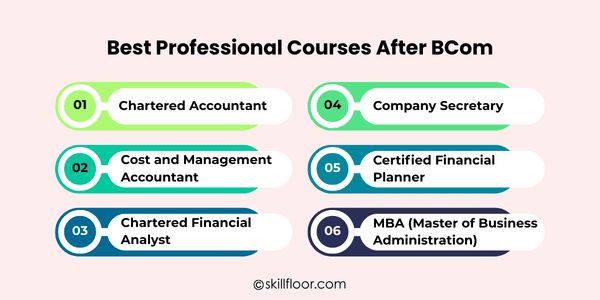
4. Company Secretary (CS)
Why CS?
After a B.Com., CS is a professional program that lasts 3 to 4 years and is perfect for people who are interested in corporate governance, legal compliance, and boardroom strategy.
What You Study
-
Corporate law
-
Tax & compliance
-
Secretarial practices
-
Business ethics
Typical Roles
-
Company secretary
-
Compliance officer
-
Legal consultant
-
Corporate Governance Advisor
Pro Tip: CS offers specialized positions in legal, advising, and boardroom management, making it demanding but beneficial for careers in corporate governance and compliance.
5. Certified Financial Planner (CFP)
Why CFP?
After earning a B.Com., CFP is a professional course that focuses on wealth management, investments, and financial planning. It typically lasts 1 to 2 years and is perfect for advisory positions.
What You Learn
-
Financial planning & wealth management
-
Investment & portfolio management
-
Retirement & estate planning
-
Risk management & tax planning
Career Roles
-
Financial planner/advisor
-
Wealth manager
-
Investment consultant
-
Personal finance consultant
Pro Tip: For professions in wealth management and financial advising, CFP is demanding yet lucrative, providing useful skills and established credibility in the financial sector.
6. MBA (Master of Business Administration)
Why MBA?
After a B.Com., an MBA is a professional program that typically lasts 2 years and provides doors to management positions in marketing, human resources, finance, and operations.
What You Learn
-
Strategic management
-
Business development
-
Marketing & HR
-
Financial analysis
Career Opportunities
-
Business consultant
-
Marketing manager
-
HR manager
-
Operations manager
Pro Tip: An MBA prepares you for managerial, consulting, and entrepreneurial prospects while fostering leadership and strategic thinking. It's competitive and heavily invested.
Best Short-Term Courses After BCom (Quick Skills, Faster Jobs)
Not every student desires lengthy classes. Many desire abilities that are quick, inexpensive, and employable. What's popular right now is:
1. Advanced Excel Course
Every accounting, financial, or business professional needs to know how to use Advanced Excel since it can improve data analysis, reporting, dashboards, and decision-making efficiency in a matter of weeks.
What You Learn
-
Formulas & functions
-
Pivot tables
-
Dashboards
-
Data analysis
2. Digital Marketing
After a B.Com., the digital marketing course is an essential short-term program that teaches SEO, social media, content development, and paid campaigns. It usually lasts 3 to 6 months.
Core Areas
-
SEO
-
Social media marketing
-
Content planning
-
Paid ads
Job Roles
-
Digital Marketer
-
SEO Specialist
-
Social Media Manager
-
PPC Specialist
3. Data Analytics
Typically lasting 4 to 6 months, the data analytics course follows a B.Com. covers data interpretation, visualization, and reporting utilizing programs like Power BI and Tableau.
Core Areas
-
Data visualization (Power BI, Tableau)
-
Data cleaning & preprocessing
-
Statistical analysis & reporting
-
Business intelligence & dashboards
Job Roles
-
Data analyst
-
Business intelligence analyst
-
Reporting analyst
-
Data visualization specialist
4. Financial Modeling
Anyone interested in company research, investment banking, or finance must understand financial modeling. It facilitates the creation of precise financial predictions, valuations, and reports, which speeds up and improves the dependability of decision-making in actual company situations.
What You Learn
-
Building financial statements and projections
-
Business valuation techniques
-
Scenario analysis and forecasting
-
Investment and risk assessment
5. Tally & GST Certification
After earning a B.Com., the Tally + GST certification course, which typically lasts 2 to 3 months, teaches accounting, bookkeeping, and GST filing in order to assist students land employment and internships.
Core Areas
-
Accounting & bookkeeping fundamentals
-
GST registration & filing
-
Payroll management
-
Financial report generation
Job Roles
-
Accountant
-
Accounts assistant
-
GST consultant
-
Bookkeeper
6. Stock Market & Trading Courses
After earning a B.Com., students can begin their careers in finance by enrolling in Stock Market & Trading courses, which typically last 3 to 6 months and teach equity, derivatives, technical and fundamental analysis, and trading techniques.
Core Areas
-
Equity and derivatives trading
-
Technical and fundamental analysis
-
Risk management & portfolio strategies
-
Trading platforms and tools
Job Roles
-
Stock trader
-
Investment analyst
-
Equity researcher
-
Portfolio manager
Career Opportunities After Completing These Courses
Let’s see how these courses translate into real job roles and salaries (approx. estimate):
|
Course |
Typical Roles |
Expected Salary (India) |
|
Chartered Accountant (CA) |
Auditor, Tax Consultant, Financial Analyst, CFO (long term) |
₹6–₹30 LPA |
|
Cost and Management Accountant (CMA) |
Cost Accountant, Management Consultant, Financial Planner, Budget Analyst |
₹5–₹20 LPA |
|
Chartered Financial Analyst (CFA) |
Investment Analyst, Portfolio Manager, Financial Consultant, Equity Research Analyst |
₹8–₹35 LPA |
|
Company Secretary (CS) |
Company Secretary, Compliance Officer, Legal Consultant, Corporate Governance Advisor |
₹5–₹18 LPA |
|
Certified Financial Planner (CFP) |
Financial Planner/Advisor, Wealth Manager, Investment Consultant, Personal Finance Consultant |
₹4–₹12 LPA |
|
MBA (Master of Business Administration) |
Business Consultant, Marketing Manager, HR Manager, Operations Manager |
₹6–₹30 LPA |
|
Advanced Excel Course |
Data Analyst, Financial Analyst, Reporting Analyst, Business Analyst |
₹3–₹8 LPA |
|
Digital Marketing Course |
Digital Marketer, SEO Specialist, Social Media Manager, PPC Specialist |
₹3–₹10 LPA |
|
Data Analytics |
Data Analyst, Business Intelligence Analyst, Reporting Analyst, Data Visualization Specialist |
₹4–₹12 LPA |
|
Financial Modeling |
Financial Analyst, Investment Banker, Equity Research Analyst, Business Consultant |
₹5–₹15 LPA |
|
Tally + GST Certification |
Accountant, Accounts Assistant, GST Consultant, Bookkeeper |
₹2–₹6 LPA |
|
Stock Market & Trading Courses |
Stock Trader, Investment Analyst, Equity Researcher, Portfolio Manager |
₹3–₹12 LPA |
Note: Salaries vary by experience, city, and skills; courses boost careers, either long-term or quick jobs.
How to Choose the Right Course after B.Com
To succeed, evaluate interests and goals carefully. Choose a professional course after BCom or short-term courses after BCom that aligns with skills and career aspirations.
Step 1: Evaluate Your Interest
Determine which subjects—finance, marketing, analytics, or law—excite you the most in order to firmly select a career-aligned path.
Step 2: Check Job Demand
Make sure the course creates chances in the industry of your choice by researching the market demand for your desired skill or career.
Step 3: Evaluate Time & Cost
When choosing a course, weigh the duration, costs, and your own schedule while weighing the potential return on investment.
Step 4: Consult Professionals
Obtain guidance from mentors, former students, or professionals in the field to gain useful information on the relevance of the course and future job opportunities.
Step 5: Start with Short Courses
Before committing to long-term professional programs, if in doubt, start with short-term courses to explore talents after earning a B.Com.
Step 6: Assess Career Goals
To ensure significant professional advancement, match course selection with long-term objectives, expected salaries, and desired employment roles.
Your career success is shaped by the course you take. Examine your alternatives using Skillfloor and reputable training facilities, evaluate programs, and choose courses that align with your long-term objectives, interests, and skill set.
Top Mistakes to Avoid After B.Com
Many graduates fall into common traps. Avoid these:
1. Following Friends Blindly
Many graduates choose courses based only on the recommendations of their friends, disregarding their own interests, abilities, or professional significance, which results in time and financial waste.
2. Ignoring Personal Interests
Low motivation, subpar performance, and unfulfilling career pathways might arise from choosing courses without taking your passion or strengths into account.
3. Spending on Low-Value Courses
Purchasing courses that lack industry reputation or credibility can be a waste of time and money, and they don't really help students land fulfilling careers.
4. Overlooking Job Prospects
You risk being unprepared and jobless after the course if you don't look into possible employment roles, salary, or industry demand.
5. Taking Too Many Courses
Enrolling in several classes at once without concentrating dilutes learning, causes confusion, and postpones developing specialized knowledge in your chosen field of work.
6. Ignoring Skill Updates
Your profile may become outdated if you don't keep your abilities up to date or industry-relevant, which will limit your chances for advancement in a cutthroat employment market.
FAQs After B.Com
1. Which courses suit B.Com graduates best?
It depends on career goals. Professional options include CA, CFA, CS, MBA. Short-term skills: Excel, Tally, Digital Marketing, or Data Analytics.
2. Can I get a job immediately after B.Com?
Yes. Short-term courses like Advanced Excel, Tally, Digital Marketing, or Data Analytics help you secure entry-level roles quickly.
3. Do I need an MBA after B.Com?
Not always. MBA helps for management and corporate roles, but only if it fits your long-term career objectives.
4. Which courses lead to higher salaries?
Professional courses such as CA, CFA, CS, and MBA generally offer the highest earning potential compared to short-term skill programs.
5. Is it okay to do multiple courses at once?
Yes, if they complement each other. For example, Excel with Data Analytics or Digital Marketing with SEO can boost your career prospects.
6. How to select the right course effectively?
Evaluate your interests, career goals, market demand, and time. Platforms like Skillfloor or top training institutes can guide your decision.
Now that you are aware of your options, it's time to make an investment in yourself. Making the correct decision after graduation can have a huge impact. The most important thing is to take the initial step, whether you choose to enroll in a professional course after BCom for long-term growth or look at short-term courses after BCom to acquire practical skills rapidly. Learn, develop, and keep going. Your career is waiting for you, and every little choice you make now will determine your level of success tomorrow
Digital Marketing Courses in Other Locations in India
Ahmedabad | Aurangabad | Bangalore | Bhilai | Bhopal | Bhubaneshwar | Chandigarh | Chennai | Cochin | Coimbatore | Dehra Dun | Delhi | Faridabad | Ghaziabad | Gorakhpur | Guntur | Gurgaon | Guwahati | Hyderabad | Jaipur | Kanpur | Khammam | Kolkata | Lucknow | Madurai | Mumbai | Mysore | Nagpur | Noida | Patna | Pondicherry | Pune | Ranchi | Shimoga | Surat | Thane | Thiruvananthapuram | Tiruchirappalli | Tirupati | Vadodara | Visakhapatnam | Warangal | Jalandhar | Jodhpur | Indore | Durgapur | Jamshedpur | Dhanbad | Kota | Karnal | Udaipur | Amritsar | calicut | Nashik | Ludhiana | varanasi | thrissur | Mangalore | Raipur |

-
 ayush palin all build carrer in certification course in all specilization in minimized after bcom mba in all courses in build on career