









































10 Essential Programming Languages for Data Science
Which data science programming languages should you learn to advance your career? Explore 10 essential languages every aspiring data scientist must master today.
Today, data science is more than just a catchphrase; it's the foundation for applications like Netflix recommendations and health result prediction. However, it might be confusing and daunting to encounter a job advertisement requesting "proficiency in multiple programming languages." I have also wondered which languages are truly worth learning, which can help me land a job, and which might become out of date.
In reality, choosing the correct programming language requires more than just mastering syntax and libraries. It's about preparing yourself for success in a world that is competitive and changing quickly. Knowing the right data science programming languages is crucial for this reason. We'll go over 10 crucial data science programming languages that all prospective data scientists should master in this post, along with the reasons each one might significantly impact your career.
Why Programming Languages Matter in Data Science
Understanding the importance of programming languages in data science is crucial before studying them. Programming facilitates the conversion of unprocessed data into comprehensible, decision-relevant information.
Data collection, cleansing, analysis, and display are all part of data science. Anyone would find it difficult and slow to handle a lot of information without programming.


At its core, data science involves:
-
Data Collection: This is the process of compiling data for subsequent analysis from many sources, such as databases, websites, or APIs.
-
Data Cleaning: In order to make analysis precise and dependable, it entails correcting untidy data by eliminating errors, filling in missing information, and appropriately structuring it.
-
Data Analysis: In order to comprehend and make meaning of the data, this stage looks for patterns, trends, or linkages.
-
Data Modeling: Constructing models with statistical or machine learning techniques to successfully classify data, forecast results, or address practical issues.
-
Visualization: Displaying data in dashboards, graphs, or charts so that people can quickly comprehend findings and make decisions based on insights.
And the stakes are high. A 2025 LinkedIn report predicts that data science jobs will grow by 28% over the next five years, with companies seeking professionals who can hit the ground running with multiple languages.
The importance of data science is growing, and companies need specialists who can transform complex data into insights. As a result, having the necessary programming abilities is more important than ever.
Top Programming Languages Used in Data Science
The most significant data science programming languages are listed below, taking into account current trends and industry demands:
1. Python: The Undisputed Champion
In data science, Python is not only widely used but also ubiquitous. It is ideal for beginners as well as professionals due to its ease of use and adaptability.
-
Use Cases: Data cleaning, machine learning, AI, visualization
-
Popular Libraries: pandas, NumPy, scikit-learn, TensorFlow
-
Why it Matters: Python enables quick prototyping and effortless project scaling. Proficiency in Python is a career accelerator, from startups to tech giants like Google.
2. R: The Statistical Powerhouse
R is like a Swiss army knife if data science is your thing. It provides you with strong tools for statistics, analysis, and easily producing understandable, insightful visualizations.
-
Use Cases: Statistical modeling, advanced analytics, research
-
Popular Libraries: ggplot2, dplyr, caret
-
Why it Matters: Data scientists who wish to go deeply into analysis without creating complicated code are the target audience for R. In just a few minutes, its plotting capabilities can transform unprocessed data into insights.
3. SQL: Your Key to Structured Data
Data is kept in databases rather than existing in isolation. One of the most crucial data science programming languages is SQL (Structured Query Language), which enables you to access and handle it effectively.
-
Use Cases: Querying and managing relational databases
-
Why it Matters: Businesses rely on SQL for operations and analytics, so even if you know Python and R, you're only seeing half the picture without SQL and tools like MySQL, PostgreSQL, and SQL Server.
4. Java: Scaling Data Science
Although Java may appear "old school," it is one of the most dependable data science programming languages for experts because it powers some of the biggest data infrastructures in the world.
-
Use Cases: Big data frameworks like Hadoop, enterprise-scale applications

-
Why it Matters: Learning Java, a crucial data science programming language, makes you stand out and improves your career prospects for data scientists managing large datasets or operating in corporate settings.


5. Scala: Spark’s Perfect Partner
Scala is the best option if you require really quick data processing. It is one of the best data science programming languages due to its speed and functional programming approach.
-
Use Cases: Big data processing, functional programming
-
Why it Matters: Large-scale machine learning and real-time analytics are made possible by Scala's seamless integration with Apache Spark, which empowers data scientists to manage enormous datasets effectively.
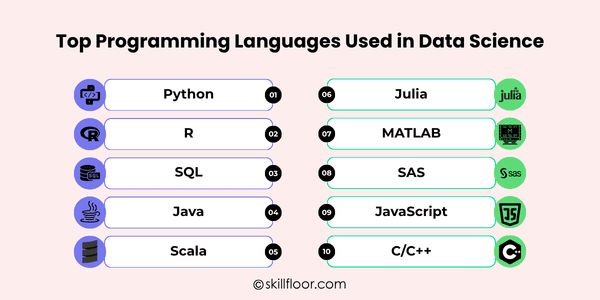
6. Julia: The Speed Demon
One of the most potent data science programming languages available today is Julia, a relatively young language that shows great promise, particularly for quick numerical computation and intricate computations.
-
Use Cases: Scientific computing, simulations, linear algebra
-
Why it Matters: Julia can significantly reduce runtime if your projects require complex mathematical computations, allowing you to work more quickly and gain a significant competitive edge in data science.
7. MATLAB: The Engineer’s Ally
MATLAB is widely used for mathematical modeling and simulation. For engineers and academics, it is one of the most reliable data science programming languages due to its accuracy and specialized tools.
-
Use Cases: Prototyping, signal processing, algorithm development
-
Why it Matters: MATLAB is still crucial for data science positions with an engineering focus. Its toolboxes enable you to solve complicated issues quickly—often more quickly and effectively than with nearly any other language.
8. SAS: The Enterprise Standard
SAS is one of the most dependable data science programming languages in enterprise settings, despite its rather archaic appearance. It is a powerhouse for analytics in the financial, medical, and pharmaceutical industries.
-
Use Cases: Predictive analytics, business intelligence
-
Why it Matters: SAS is used for crucial analytics by many of the biggest companies in the world. Gaining knowledge of it can lead to high-impact employment opportunities and specialized sectors.
9. JavaScript: Visualizing Data in Style
JavaScript allows you to portray the story that numbers tell in an interactive way. It is one of the most useful data science programming languages due to its flexibility and visualization tools.
-
Use Cases: Front-end data visualization, dashboards
-
Popular Libraries: D3.js, Chart.js
-
Why it Matters: JavaScript is crucial if your objective is to make insights understandable and useful. It enables you to produce interactive dashboards and visualizations that successfully convey complicated data.
10. C/C++: The Performance Edge
Although C and C++ may appear difficult, they are crucial for data science programming languages that prioritize speed and data preparation because they offer total control over performance and efficiency.
-
Use Cases: High-speed computation, algorithm optimization
-
Why it Matters: C and C++ are indispensable for AI research, simulations, or any work where milliseconds count, assisting data scientists in precisely handling large-scale processing and optimizing computations.
Specialized & Emerging Programming Languages
There are a few specialized or emerging languages that are rarely used in mainstream data science, even though the majority of data scientists concentrate on widely used languages like Python, R, or SQL. These languages are frequently used in specialized fields, have historical significance, or are suitable for particular sectors.
1. F#
Mostly utilized on the.NET platform as a functional programming language. It is rarely used in routine data science tasks, although it is typically found in academic research or finance.
2. COBOL
One of the earliest computer languages, it is utilized in government and finance systems. It is rarely seen by contemporary data scientists in machine learning or analytics jobs.
3. Fortran
Fortran, which was formerly utilized for engineering computations and scientific simulations, is now primarily restricted to particular fields of scientific study and is not a component of standard data pipelines.
4. Lisp
Despite its historical significance as one of the first AI languages, Lisp is seldom ever utilized in modern data science workflows.
5. Ada
A language designed for safety-critical systems, aerospace, and defense. It is not utilized for analytics or big data projects, while being dependable for crucial operations.
Even though these data science programming languages aren't frequently utilized in daily tasks, understanding them shows how programming has changed and explains why contemporary tools like Python, R, and Julia are so popular.
How to Choose the Right Data Science Programming Language
Choosing the right data science programming language depends on your project, career goals, and the type of data you plan to analyze. A data science expert often balances learning curve, tools, and industry demand when deciding.
-
Project Type: When choosing a language, take into account if your work relies on large data processing, machine learning, analytics, or visualization.
-
Career Goals: Different programming languages may be needed for different roles, such as data engineer, analyst, or machine learning specialist.
-
Learning Curve: Select a language that is appropriate for your level of proficiency so that you can learn efficiently without becoming overwhelmed or upset.
-
Industry Demand: Certain businesses have a preference for particular programming languages, such as SAS in the healthcare sector or Python in startups and tech companies.
-
Community Support: Strong community support for a language provides forums, tutorials, and pre-built tools to facilitate learning and problems.
-
Integration & Tools: For more efficient workflows and analysis, think about languages that work well with databases, big data frameworks, or visualization tools.
Current Trends and the Future of Data Science Programming Languages
Data science continues to be a rapidly evolving field. Python remains the most widely used programming language in data science due to its ease of use, extensive libraries, and versatility. Meanwhile, languages like Julia are gaining popularity for high-performance computing and numerical tasks, while R remains a powerful tool for statistical analysis.
The need for data science programming languages is being shaped by big data and machine learning. Java and Scala are frequently used with distributed computing frameworks such as Apache Spark. While JavaScript is widely utilized for interactive data visualization and dashboards in web-based applications, SQL is still necessary for database processing.
Learning more than one language is essential to staying competitive. Beginners can begin with Python and SQL, then experiment with R, Julia, or Scala as necessary. A useful method to study various programming languages, obtain practical experience, and establish a solid basis is to enroll in a data science course.
Learning expertise with the right tools can greatly facilitate and enhance your data science journey. You may reliably manage projects, whether they involve data analysis, model construction, or visualization creation, by concentrating on essential data science programming languages. Acquiring proficiency in various languages facilitates flexibility, work adaptation, and increased professional prospects. Recall that developing abilities gradually is more important than learning everything at once. These data science programming languages will become second nature to you with experience and curiosity, enabling you to solve issues and transform data into insightful knowledge daily.
Digital Marketing Courses in Other Locations in India
Ahmedabad | Aurangabad | Bangalore | Bhilai | Bhopal | Bhubaneshwar | Chandigarh | Chennai | Cochin | Coimbatore | Dehra Dun | Delhi | Faridabad | Ghaziabad | Gorakhpur | Guntur | Gurgaon | Guwahati | Hyderabad | Jaipur | Kanpur | Khammam | Kolkata | Lucknow | Madurai | Mumbai | Mysore | Nagpur | Noida | Patna | Pondicherry | Pune | Ranchi | Shimoga | Surat | Thane | Thiruvananthapuram | Tiruchirappalli | Tirupati | Vadodara | Visakhapatnam | Warangal | Jalandhar | Jodhpur | Indore | Durgapur | Jamshedpur | Dhanbad | Kota | Karnal | Udaipur | Amritsar | calicut | Nashik | Ludhiana | varanasi | thrissur | Mangalore | Raipur |