











































Machine Learning Basics: A Simple Roadmap for Beginners
Want to learn machine learning but don’t know where to start? Discover a simple roadmap for beginners to understand basics step by step and get started today.
“Ever wondered how Netflix knows what you want to watch next?
Or how apps seem to predict your choices before you even search?”
That's the power of machine learning - a technology that's quietly shaping the apps, platforms, and systems we use every day. From personalized recommendations and voice assistants to smart predictions in healthcare, finance, and gaming, machine learning is driving some of the most exciting tech innovations. For beginners, the field may seem overwhelming, but with a clear roadmap, anyone can start learning the basics and build real-world skills.
As machine learning reshapes industries across the globe, career opportunities in this field have never been more promising. According to a Grand View Research report, the global machine learning market is projected to reach nearly $282 billion by 2030, with AI/ML roles growing faster than almost any other IT sector.
Freshers and professionals alike are seeing tremendous opportunities, with millions of AI-related jobs opening worldwide. Understanding exactly what to learn, and in what order, can save months of confusion and position you for a high-demand career.


Before we dive into the roadmap, let's first understand what machine learning really is.
What Is Machine Learning?
Machine learning is a branch of artificial intelligence that allows computers to learn from data without being explicitly programmed for every single task. Instead of writing detailed instructions for each situation, we provide data and examples, and the system learns patterns on its own.
Machine learning is typically divided into three main types:
1. Supervised Learning - In supervised learning, the system learns from labeled data. Labels act like answers, helping the algorithm understand the relationship between input features and outcomes. Common tasks include:
-
Classification – Predicting categories, such as identifying spam emails or categorizing news articles.
-
Regression – Predicting continuous values, like stock prices or sales forecasts.
2. Unsupervised Learning - Here, the machine analyzes data without labels. It tries to find patterns or structure in the dataset. A common application is clustering, such as grouping customers based on buying behavior or segmenting social media users by interests.
3. Reinforcement Learning - In reinforcement learning, machines learn through trial and error. They receive feedback in the form of rewards or penalties and gradually improve their actions to maximize performance. This approach is used in robotics, game AI, and other goal-oriented tasks.
Prerequisites For Getting Started with Machine Learning
Before stepping into machine learning, you just need a few basics to get started comfortably.
1. Mathematics & Statistics
Key areas:
-
Linear Algebra — vectors and matrices
-
Calculus — derivatives and gradients
-
Probability & Statistics — distributions and basic hypothesis testing
You don't need deep math knowledge, just enough intuition to understand how algorithms like gradient descent and probabilistic models work.
2. Programming Skills
-
Python is the preferred language for ML due to its powerful ecosystem
-
Key libraries: NumPy, Pandas, Matplotlib, and Scikit-learn
Practice writing scripts, working with data, and basic debugging to build confidence.
3. Basic CS Concepts
-
Data structures — arrays, lists, and sorting
-
Object-oriented programming basics
-
SQL for querying structured data
These fundamentals support clean code and efficient data handling when building ML pipelines. Having this foundation makes the rest of your machine learning journey far more manageable.
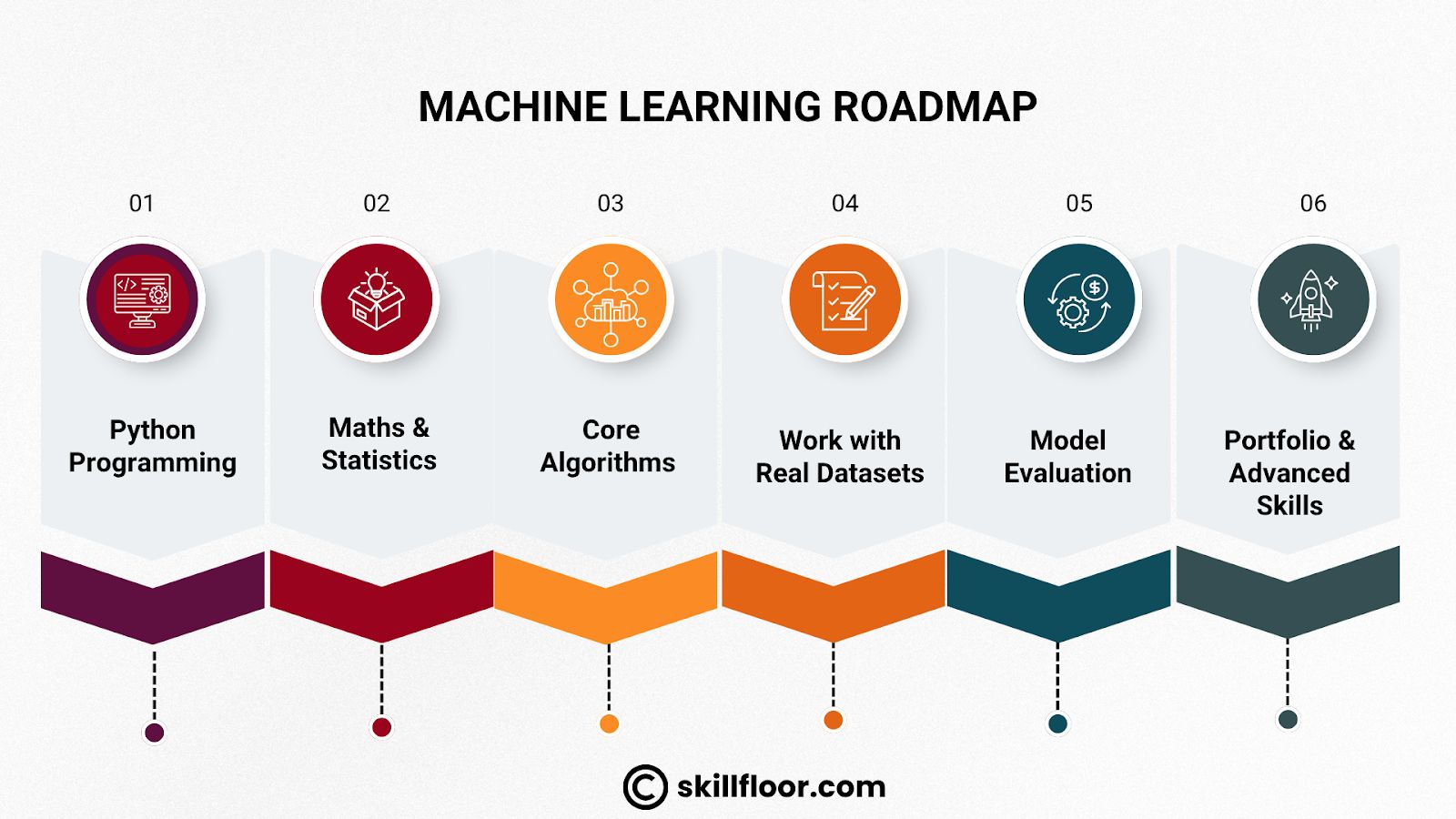
Machine Learning Roadmap: Step-by-Step Guide
This machine learning roadmap gives you a clear learning path from beginner to advanced levels. It helps you build strong foundations, understand core concepts, and move forward with confidence in your machine learning journey.
Step 1: Start with Python Programming


Python is the preferred language for machine learning because it’s simple and has powerful libraries for data handling and modeling. Begin with the basics: variables, loops, functions, and conditions. Then explore libraries like NumPy for numerical operations and Pandas for working with structured data. Practice consistently, even in short daily sessions, to build a strong coding foundation.
Step 2: Learn Basic Mathematics
You don’t need to be a math expert, but understanding statistics, probability, linear algebra, and basic calculus helps you grasp how algorithms work. Focus on concepts like mean, standard deviation, matrices, and gradients — these are essential for understanding how models learn from data.
Step 3: Learn Core Algorithms
Focus on simple and widely used algorithms first:
-
Linear Regression: Predict numerical values
-
Logistic Regression: Classify categories
-
Decision Trees & Random Forests: Rule-based predictions
-
K-Nearest Neighbors & K-Means Clustering: Understanding patterns and groups
-
Support Vector Machines: Advanced classification
Master these before moving on to complex algorithms.
Step 4: Work with Real Datasets
Theory is important, but real understanding comes from practice. Use beginner-friendly datasets like Iris flowers, Titanic survival data, or California housing prices. Always follow the workflow: clean data → explore visually → select algorithm → train → evaluate. Use scikit-learn to implement models efficiently, and take notes on your experiments to track progress.
Step 5: Evaluate and Improve Models
Learning to measure your model’s performance is crucial. For classification, track accuracy, precision, recall, and F1 score. For regression, focus on mean absolute error and root mean squared error. Avoid overfitting by using cross-validation, regularization, and pruning. Iteration is key: every model can be refined and improved.
Step 6: Build a Portfolio & Explore Advanced Topics
Once comfortable with the basics, level up:
-
Explore Deep Learning, NLP, and Model Deployment
-
Build a portfolio to showcase your skills:
-
Share projects on GitHub
-
Write blogs explaining your work
-
Participate in Kaggle competitions
A strong portfolio opens doors to real jobs and internships—it proves you can apply your skills, not just learn theory.
Real-World Applications of Machine Learning
Machine learning is solving real-world problems across industries, and here are some of its most impactful applications today.
-
Healthcare and Medical Diagnosis: for detecting diseases early and supporting accurate treatment decisions
-
Finance and Fraud Detection: identifies unusual patterns to prevent fraud and improve financial security
-
E-commerce and Recommendation Systems: suggest relevant products based on user behavior and preferences
-
Cybersecurity and Threat Detection: analyzes network behavior and identifies threats in real time
Career Opportunities After Learning Machine Learning
Machine learning skills open up roles across industries and sectors.
Roles You Can Target:
-
Machine Learning Engineer: For building and productionizing ML models
-
Data Scientist: Analyzes, models, and derives insights
-
NLP Engineer: Works with language models and text analytics
-
Computer Vision Engineer: Focuses on image and video-based tasks
Salary Insights:
Machine learning salaries in India depend on factors like skills, experience, and the type of company. According to Glassdoor, here is a simple and realistic overview:
-
Entry-level (0–2 yrs): ~₹7L to ₹20L range
-
Mid-level (3–5 yrs): ~₹12L to ₹26L+
-
Senior-level (6+ yrs): ~₹22L to ₹50L+
Salaries tend to be higher in top tech companies, fast-growing startups, and roles that involve advanced skills, model deployment, and hands-on project experience.
Future Scope of Machine Learning
Machine learning is stepping into a bold new era — driven by Generative AI, LLMs, and AutoML, making intelligent systems more autonomous, transparent, and accessible than ever. As automated decisions grow, Explainable AI and ethical machine learning are becoming essential priorities.
Over the next few years, key trends will shape the field:
-
Edge ML will bring on-device intelligence with greater privacy and speed
-
Federated Learning will enable model training across decentralized devices
-
Quantum ML is emerging as an early but promising research direction
-
Domain-specific integration will deeply connect ML with healthcare, robotics, and IoT
Staying updated with these developments ensures your machine learning skills remain relevant and future-ready.
Frequently Asked Questions
1. Do I need a math degree to learn machine learning?
You don’t need a math degree to learn machine learning; You just need basic knowledge of statistics, probability, and linear algebra to understand and work with machine learning models.
2. Which programming language should I learn first for ML?
Python is the best programming language to start with for machine learning. It is beginner-friendly and has powerful libraries like scikit-learn, NumPy, and Pandas.
3. How long does it take to learn machine learning basics?
Learning the fundamentals may take three to six months, while gaining professional-level expertise usually requires continuous practice and project experience.
4. What are the best ways to practice and improve my machine learning skills?
Use beginner datasets like Iris or Titanic, follow a workflow (clean → explore → train → evaluate), and try algorithms like linear regression or decision trees.
5. What is the career future of ML in India?
ML and AI are set for explosive growth in India, with companies across multiple industries actively hiring talent, salaries rising for niche roles like NLP and CV, and global remote opportunities making 2026 the right time to start your ML journey.
Machine learning may seem overwhelming at first, but it becomes much easier when you follow a structured approach and focus on one skill at a time. By building strong fundamentals, learning core algorithms, and working on real projects, you can gradually develop real expertise. With consistency and curiosity, even beginners can gain the skills needed to step confidently into one of the most in-demand fields today.
Digital Marketing Courses in Other Locations in India
Ahmedabad | Aurangabad | Bangalore | Bhilai | Bhopal | Bhubaneshwar | Chandigarh | Chennai | Cochin | Coimbatore | Dehra Dun | Delhi | Faridabad | Ghaziabad | Gorakhpur | Guntur | Gurgaon | Guwahati | Hyderabad | Jaipur | Kanpur | Khammam | Kolkata | Lucknow | Madurai | Mumbai | Mysore | Nagpur | Noida | Patna | Pondicherry | Pune | Ranchi | Shimoga | Surat | Thane | Thiruvananthapuram | Tiruchirappalli | Tirupati | Vadodara | Visakhapatnam | Warangal | Jalandhar | Jodhpur | Indore | Durgapur | Jamshedpur | Dhanbad | Kota | Karnal | Udaipur | Amritsar | calicut | Nashik | Ludhiana | varanasi | thrissur | Mangalore | Raipur |