














































Highest Paying Entry-Level Data Science Jobs
What are the highest paying entry-level data science jobs? Discover top roles, salaries, and skills needed to start data science career in 2026 for beginners.

Most fresh graduates enter data science with strong skills but struggle because they don’t know which roles actually match their profile or pay the best.
I have mentored hundreds of freshers through their first data science job searches. The ones who struggled were not less talented. They just applied to the wrong roles or did not know what to put in front of a hiring manager.
This guide keeps things simple, no jargon, no confusion. By the end, you will understand which entry-level data science positions pay the highest, what each one actually requires, and how to start applying for them right now.
Data science is one of the fastest-growing career paths for freshers. As businesses across India rely more on data, analytics, and AI, the demand for skilled professionals continues to rise. This creates strong opportunities, but only for those who choose the right role and build the right skills early.


Why Entry-Level Data Science Jobs Pay So Well
Entry-level data science jobs pay well because demand is far higher than supply. According to NASSCOM, India is expected to face a shortage of over 2 lakh data professionals in 2026, driving salaries upward. LinkedIn’s Jobs Report also highlights data science as one of the fastest-growing career fields globally. Freshers contribute to real business decisions through data insights, making their work highly valuable from the start. Because of this combination of high demand and impact, companies offer strong salaries even at the beginner level.
Key Reasons
-
In India, entry-level data scientists usually make between ₹4 and 8 LPA, which is more than many positions for new hires.
-
Data science is one of the fastest-growing professions in the world, with an annual growth rate of over 25–30%.
-
In competitive organizations, skilled new hires with strong projects and technical experience can make up to ₹10–12 LPA.
-
Specialized skills like machine learning, Python, and statistics are needed for data science, but they are still hard to come by in the workforce.
-
Professionals' salaries rise swiftly, from ₹5–8 LPA at the entry level to ₹15+ LPA in a few years.
The Highest Paying Entry-Level Data Science Jobs
1. Data Scientist: A Data Scientist analyzes large datasets to find patterns and insights that help businesses make strategic decisions. This role is highly paid because it directly impacts business growth and performance. Freshers often work on real-world predictive and analytical problems.
Salary
-
Entry-level salaries range from ₹4–8 LPA depending on skills, projects, and company hiring standards.
-
Skilled professionals can earn up to ₹10–12 LPA in top organizations with strong technical expertise.
Skills Needed
-
Strong knowledge of Python, statistics, and machine learning concepts for solving complex analytical problems effectively.
-
Data science skills and the ability to solve real-world business problems using structured and unstructured data.
Roles & Responsibilities
-
Collect, clean, and analyze large datasets to extract meaningful insights for effective business decision-making processes.
-
Build machine learning models and create visualizations that support clear and impactful data-driven decisions.
2. Data Analyst: A data analyst uses structured data to find patterns and produce reports that help with business choices. Since businesses depend on data for day-to-day operations, this position is in great demand. New hires are heavily exposed to technologies and actual datasets.
Salary
-
Entry-level salaries range from ₹3–6 LPA depending on skills and industry.
-
With experience, salaries can grow up to ₹8 LPA or more in top firms.
Roles & Responsibilities
-
Collect and arrange data for analysis from various sources, such as databases and spreadsheets.
-
To analyze data and build dashboards for decision-making, use Python, Excel, or SQL.
Skills Needed
-
Strong Excel, SQL, and basic Python skills for data processing, cleaning, and analysis as key Data Analyst skills.

-
Strong analytical ability to understand business problems and convert them into actionable insights for a Data Analyst role.


3. Machine Learning Engineers: Machine learning engineers create advanced algorithms that provide predictions automatically based on data. Due to the growing need for automation in businesses across the globe and the quick adoption of AI across industries, this position is in great demand.
Salary
-
Due to the strong demand and availability of skilled talent, entry-level earnings range from ₹6 to 10 LPA.
-
Leading firms pay between ₹12 and ₹15 LPA, and the demand for AI in tech sector jobs continues to grow steadily across industries.
Skills Needed
-
Strong programming skills in Python and a deep understanding of machine learning algorithms and techniques.
-
Experience with frameworks like TensorFlow or PyTorch for building and deploying machine learning models.
Roles & Responsibilities
-
Create and implement machine learning models to effectively and precisely address real-world business issues.
-
Increase model accuracy through the use of big datasets, optimization strategies, and ongoing performance assessment methodologies.
4. Business Intelligence (BI) Analyst: A BI Analyst converts raw business data into dashboards and reports that help companies make better decisions. This role focuses on improving business performance using data insights.
Salary
-
Entry-level pay ranges from ₹4 to 7 LPA, depending on the company's requirements, talents, and tool expertise.
-
In prominent businesses around the world, earnings might increase to ₹8–10 LPA with experience.
Skills Needed
-
Strong familiarity with Power BI and Tableau technologies, as well as SQL and Excel.
-
The capacity to translate complicated statistics into understandable, useful insights for teams and business stakeholders.
Roles & Responsibilities
-
For transparent company performance tracking, use Tableau or Power BI tools to create dashboards and reports.
-
To successfully assist strategic decision-making and enhance overall organizational performance, analyze business data.
5. Data Engineer: A Data engineer creates and oversees systems that effectively gather, store, and process massive amounts of data. Because it supports analytics, machine learning, and AI systems in contemporary enterprises worldwide, this function is crucial.
Salary
-
Depending on technical abilities, projects, and corporate requirements, entry-level pay might range from ₹5 to 9 LPA.
-
In prominent businesses around the world, seasoned workers can make up to ₹10–12 LPA or more.
Skills Needed
-
Strong familiarity with large data tools like Hadoop or Spark frameworks, as well as Python and SQL.
-
Large-scale data management requires knowledge of databases, ETL procedures, and data warehousing platforms.
Roles & Responsibilities
-
Create and manage data pipelines to guarantee efficient, scalable, and seamless data transfer between various systems.
-
Make sure the data is dependable, clean, and routinely accessible to the machine learning and analytics teams.
6. AI Engineer: An AI engineer uses machine learning and artificial intelligence to create intelligent systems for automation. Because of the strong technical capabilities and the rising usage of AI across worldwide sectors, this profession is well compensated.
Salary
-
Entry-level salaries range from ₹6–10 LPA depending on skills and expertise.
-
Skilled professionals can earn up to ₹12–15 LPA in top companies.
Skills Needed
-
Solid understanding of deep learning, machine learning, and Python for creating intelligent systems.
-
Knowledge of neural networks and AI frameworks for model creation, such as PyTorch or TensorFlow.
Roles & Responsibilities
-
Create AI models to address automation and prediction-based issues in a range of practical business applications.
-
Incorporate AI algorithms into applications to guarantee smooth operation and useful business use across industries.
7. Statistician / Data Science Associate: A statistician supports precise, data-driven decision-making processes by analyzing data using statistical techniques. Research, analytics, and the successful interpretation of complex datasets across a range of sectors and business domains depend on this function.
Salary
-
Entry-level salaries range from ₹4–7 LPA depending on skills, domain expertise, and company standards.
-
With strong analytical skills, salaries can grow up to ₹8–10 LPA in top organizations.
Skills Needed
-
Strong familiarity with probability, statistics, and data analysis tools like R or Python.
-
The capacity to analyze data trends and effectively convey findings to stakeholders who are both technical and non-technical.
Roles & Responsibilities
-
Utilize statistical methods to examine data and produce insightful information for corporate decision-making procedures.
-
To increase accuracy and facilitate better strategic choices, design experiments and analyze the findings.
Core Skills That Actually Get You Hired in Data Science
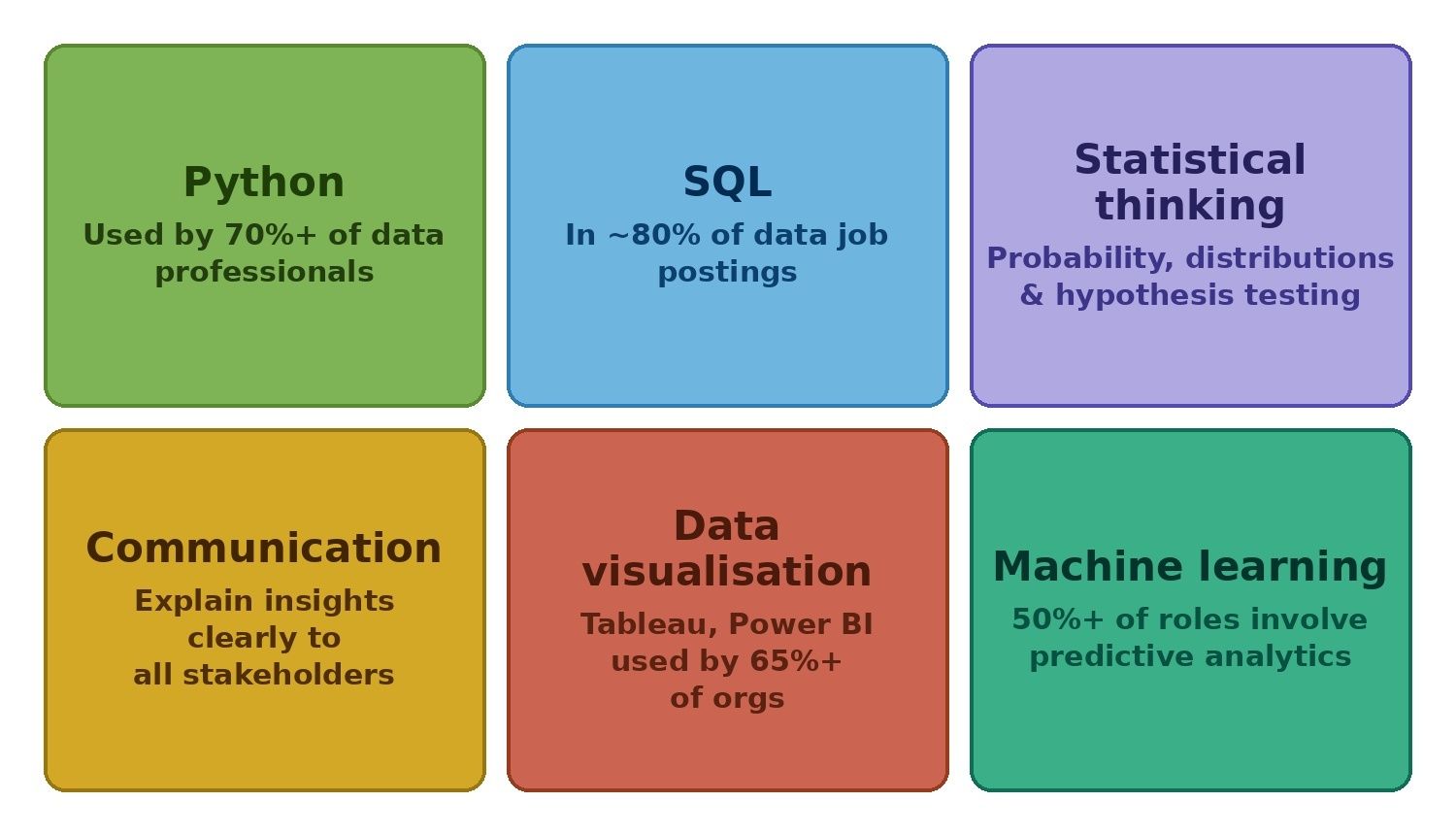
Across all data science roles, a few core skills consistently decide whether a candidate gets hired or ignored. Companies are rapidly shifting toward skill-based hiring, especially in AI and analytics, where practical knowledge is now valued more than degrees alone.
The demand is accelerating fast. Global reports show AI has already created over 1.3 million jobs, while AI skill demand in job postings has surged by nearly 70% year-over-year.
-
Python Proficiency: Python is widely used in data science and AI, with over 70% of professionals relying on it. It helps solve real-world business problems efficiently.
-
SQL Fluency: SQL is required in most data roles, with nearly 80% of job postings asking for database and querying skills. It is essential for handling structured data.
-
Statistical Thinking: Statistical knowledge helps in understanding data correctly and making accurate decisions using probability, distributions, and hypothesis testing techniques.
-
Communication Skills: Communication is highly valued, as companies prefer candidates who explain insights clearly.
-
Data Visualization: Data visualization tools like Tableau and Power BI are used by over 65% of organizations to present insights clearly.
-
Machine Learning Basics: Machine learning knowledge is important as over 50% of data roles involve predictive analytics and automation tasks.
-
Excel & Data Handling: Excel is a foundational skill required in most entry-level roles for data cleaning, reporting, and basic analysis tasks.
How Freshers Can Break Into These Roles
In 2026, it will be difficult for newcomers to break into data science, since many positions will receive more than 200 applications. You need a targeted strategy that emphasizes problem-solving skills and effective communication if you want to stand out. Your chances of getting employed more quickly might be greatly increased by using the appropriate tactics.
Key Actions Freshers Should Take to Land Entry-Level Data Science Jobs
-
Nearly 60% of recruiters prefer applicants with practical hands-on experience, so build a solid portfolio with real-world projects.
-
Since over 55% of companies only appreciate qualifications when they are paired with practical applications, choose certifications that incorporate projects.
-
Compared to advanced data science professions, entry-level positions like data analyst have greater employment rates, so apply for them.
-
Develop your communication abilities because more than half of applicants are rejected because they can't articulate their project work clearly.
-
Since more than half of entry-level data science job descriptions call for essential competencies like Python and SQL, concentrate on developing these skills.
-
To bridge this gap effectively, the Skillfloor Data Science Course helps freshers gain practical, industry-focused training and build job-ready skills for entry-level data science and analytics roles.
FAQs
-
Do entry-level data science jobs really pay well?
Yes, entry-level data science jobs offer competitive salaries compared to many fresher roles. In India, freshers can earn between ₹3–10 LPA depending on skills, projects, and role selection.
-
Which entry-level data science role has the highest salary?
Machine Learning Engineer and AI Engineer roles usually offer the highest entry-level salaries, often ranging from ₹6–15 LPA in top companies.
-
Is data science a good career for freshers in 2026?
Yes, data science remains one of the fastest-growing careers. With increasing demand and skill shortages, freshers have strong opportunities if they build the right skills.
-
What skills are required for entry-level data science jobs?
Key skills include Python, SQL, statistics, data visualization, and communication. Practical project experience is also very important for getting hired.
-
Can I get a data science job without experience?
Yes, freshers can get jobs without prior experience by building strong projects, creating a portfolio, and applying for beginner-friendly roles like Data Analyst or BI Analyst.
Entry-level data science jobs are not just high-paying; they are full of real opportunities for freshers who build the right skills. The demand is growing faster than the supply, which means companies are actively looking for candidates who can work with data and deliver insights. But getting hired is not about applying everywhere. It is about choosing the right role, building practical projects, and developing skills that companies actually value. Candidates who focus on real-world problem-solving, communication, and consistent learning stand out quickly.
Digital Marketing Courses in Other Locations in India
Ahmedabad | Aurangabad | Bangalore | Bhilai | Bhopal | Bhubaneshwar | Chandigarh | Chennai | Cochin | Coimbatore | Dehra Dun | Delhi | Faridabad | Ghaziabad | Gorakhpur | Guntur | Gurgaon | Guwahati | Hyderabad | Jaipur | Kanpur | Khammam | Kolkata | Lucknow | Madurai | Mumbai | Mysore | Nagpur | Noida | Patna | Pondicherry | Pune | Ranchi | Shimoga | Surat | Thane | Thiruvananthapuram | Tiruchirappalli | Tirupati | Vadodara | Visakhapatnam | Warangal | Jalandhar | Jodhpur | Indore | Durgapur | Jamshedpur | Dhanbad | Kota | Karnal | Udaipur | Amritsar | calicut | Nashik | Ludhiana | varanasi | thrissur | Mangalore | Raipur |