













































Cyber Security Analyst Salary in India in 2026
What is Cyber Security Analyst salary in India in 2026? Know average pay, skills needed, and how experience affects income in simple terms for beginners now.

When you start looking into tech careers, cybersecurity immediately grabs attention — not just because of demand, but because of the cybersecurity analyst salary in India in 2026. And naturally, one question comes up for almost everyone: what does a cybersecurity analyst actually earn in India in 2026?
At the same time, India is witnessing a sharp rise in cyber threats. Industry estimates show that cyberattacks have increased by nearly 30–40% year-on-year, forcing companies to invest more in cybersecurity talent. This growing demand is directly influencing the cybersecurity analyst salary in India in 2026, making it one of the fastest-rising salary trends in the tech space.
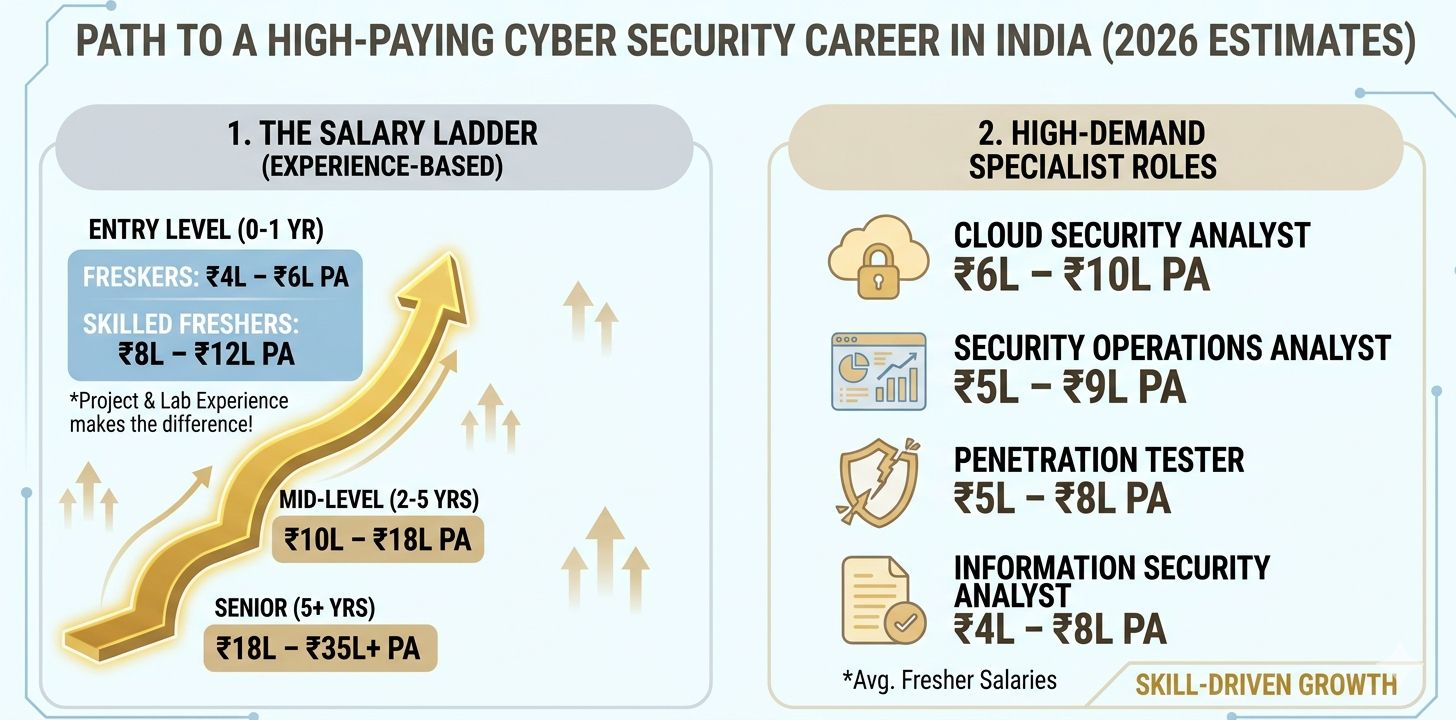
But here’s the reality: while some freshers begin with ₹4–6 LPA, others manage to secure ₹8–12 LPA at the same entry level. Clearly, the difference isn’t random — it depends on skills, specialization, and how prepared you are for real-world roles.
What Does a Cyber Security Analyst Do?
Before talking about salary, it’s important to understand the role itself.


A cybersecurity analyst is responsible for protecting an organization’s digital infrastructure. Understanding the importance of cybersecurity helps professionals prioritize threats, safeguard sensitive data, and ensure business continuity.
On a daily basis, a cybersecurity analyst:
-
Monitors systems for suspicious activity
-
Analyzes security logs and alerts
-
Identifies vulnerabilities in systems
-
Responds to incidents and breaches
-
Implements preventive security measures
This is not just a theoretical role. It is practical, high‑pressure, and requires quick decision‑making. The ability to act during real‑time threats is what separates average professionals from high‑value ones.
Why Many Cyber Security Candidates Don’t Reach High Salaries
So what exactly separates a ₹4 LPA fresher from a ₹10 LPA fresher in the same field?
Most freshers enter cybersecurity with high expectations. They’ve heard it’s a high‑paying field — and that part is true. However, what often gets overlooked is what companies are actually paying for.
Despite the global shortage of cybersecurity professionals, hiring remains highly selective. Demand exists, but so does the expectation of real capability.
The gap becomes clear when candidates move from learning to applying.
Many candidates remain stuck at average salaries because they focus on knowledge but fail to demonstrate practical skills. In most cases, the issue is not a lack of opportunity, but a lack of job readiness.
Common reasons include:
-
Focusing only on certifications without practical exposure
-
Avoiding hands‑on practice with real tools and environments
-
Not building a portfolio to showcase their work
-
Not understanding real‑world attack scenarios
-
Being unable to explain how they would respond to actual threats
Cybersecurity is not a theory‑driven field. Without proof of work, skills have limited value in real hiring situations.
This creates a clear mismatch. While demand for cybersecurity professionals is high, the number of job‑ready candidates remains limited.
What Actually Decides Your Cyber Security Analyst Salary in India
Most people assume salary depends on degrees or certifications. In reality, it depends on how effectively you can solve real‑world problems.
From practical observation, these are the biggest factors:
1. Hands‑On Skills vs Theoretical Knowledge
Knowing definitions is not enough.
A candidate who has practiced in labs, worked on simulations, or used real tools will always outperform someone who has only studied concepts.


For example:
A fresher who has worked on a SIEM tool and understands how to interpret alerts will stand out immediately in interviews.
2. Specialization Over General Learning
Trying to learn everything slows down progress.
Cybersecurity is vast. Focusing on one area — like ethical hacking, cloud security, or threat analysis — creates depth.
Specialists solve specific problems, and companies pay more for that.
3. Ability to Handle Real Scenarios
Interviews are no longer about theory.
Companies test thinking:
-
What would you do if a system shows unusual login attempts?
-
How would you respond to a suspected breach?
Candidates with practical exposure answer confidently. Others hesitate.
That confidence directly impacts salary.
Key Skills That Increase Cyber Security Analyst Salary in India
Not all skills are equal. Some key cybersecurity skills directly impact earning potential because they align with business risk and protection.
1. Network Security & Threat Detection
Understanding networks and identifying threats is foundational. Skills like firewall configuration, intrusion detection, and monitoring are essential.
2. Ethical Hacking & Penetration Testing
Professionals who can think like attackers are highly valued. Identifying vulnerabilities before hackers do significantly increases your market value.
3. Security Tools & Platforms
Hands-on experience with tools like SIEM systems, endpoint security tools, and vulnerability scanners gives a major advantage.
4. Cloud Security
With businesses shifting to AWS, Azure, and Google Cloud, securing cloud environments is one of the highest‑paying skill areas today.
5. Incident Response & Risk Management
Responding to breaches and minimizing damage is a critical skill. Companies prioritize professionals who can act quickly during real threats.
Top Cyber Security Roles That Offer High Salary in India
As of 2026, cybersecurity salary trends in India are based on real user-reported data available on Glassdoor, where over 2,000+ salary submissions indicate an average salary of around ₹6–6.5 LPA, with typical ranges between ₹4–10 LPA for early to mid-level professionals. This data highlights that salaries in cybersecurity are not solely experience-driven but are heavily influenced by skill specialization and job roles. Based on these insights, the following breakdown shows how freshers can secure higher starting salaries and how compensation grows with skills and experience.
|
Skill |
Job Role |
Average Fresher Salary (India) |
|
Network Security |
Security Analyst |
₹4–6 LPA |
|
Ethical Hacking |
Penetration Tester |
₹5–8 LPA |
|
SIEM Tools |
SOC Analyst |
₹4–7 LPA |
|
Cloud Security |
Cloud Security Analyst |
₹6–10 LPA |
|
Incident Response |
Security Operations Analyst |
₹5–9 LPA |
|
Risk & Compliance |
Information Security Analyst |
₹4–8 LPA |
Freshers who align high-demand skills with relevant roles consistently secure better packages.
Salary by Experience Level in India
This is the most practical breakdown of how salaries evolve:
|
Experience Level |
Salary Range |
|
Fresher (0–1 year) |
₹4–6 LPA |
|
Skilled Fresher |
₹6–10 LPA |
|
Mid-Level (2–5 years) |
₹10–18 LPA |
|
Senior (5+ years) |
₹18–35+ LPA |
Growth in cybersecurity is not slow; it is skill‑driven.
A fresher starting at ₹5 LPA can realistically reach:
-
₹10–12 LPA in 2–3 years
-
₹15–20 LPA with specialization
-
₹30+ LPA in senior or niche roles
Additional Factors That Increase Cyber Security Analyst Salary
Certain factors create a direct impact on salary growth.
Certifications
Certifications add value — but only when combined with practical skills.
High‑impact certifications include:
-
CEH (Certified Ethical Hacker)
-
CompTIA Security+
-
CISSP (for senior roles)
-
OSCP (for penetration testing)
-
Cloud security certifications (AWS/Azure)
These don’t guarantee a high salary, but they strengthen your profile when backed by real experience.
Industry Demand
Sectors like:
-
Banking and fintech
-
SaaS companies
-
E‑commerce platforms
-
Healthcare
…tend to offer higher salaries because cybersecurity is critical to their operations.
Company Type
Product‑based companies and MNCs typically offer higher salaries compared to service‑based firms.
A Practical Framework to Increase Your Cyber Security Salary
If you want to increase your earning potential, follow a structured approach:
Step 1: Build Strong Fundamentals: Focus on networking, operating systems, and basic security concepts.
Step 2: Get Hands‑On: Practice through labs, simulations, and real‑world scenarios.
Step 3: Choose a Specialization: Pick one path: ethical hacking, cloud security, SOC, or risk management.
Step 4: Work on Projects: Even small simulations can build credibility.
Step 5: Build a Portfolio: Document your work:
-
Tools used
-
Problems solved
-
Outcomes achieved
This becomes your proof during interviews.
Training programs like Skillfloor focus on this practical approach, helping learners move from theory to real job readiness.
How to Start a High-Paying Cyber Security Career in India
If your goal is to maximize your cybersecurity salary, focus on three things:
-
Build strong fundamentals and specialize early
-
Gain hands‑on experience through projects and labs
-
Create proof of work to showcase your skills
This is what separates high‑paying candidates from average ones.
FAQ
1. How much does a cybersecurity analyst earn in India as a fresher?
A fresher can expect around ₹4–6 LPA, but those with practical skills or projects may earn ₹8–12 LPA at the entry level.
2. What skills do I need to get a higher salary in cybersecurity?
Skills like ethical hacking, cloud security, network monitoring, SIEM tools, and incident response can help you get better pay.
3. Do certifications increase a cybersecurity analyst’s salary?
Certifications like CEH, OSCP, CompTIA Security+, and CISSP are valuable, but salary improves most when combined with hands-on experience.
4. Which companies pay the most for cybersecurity jobs?
Banking, fintech, SaaS, e-commerce, and healthcare companies often offer higher salaries due to critical security needs.
5. How does experience affect cybersecurity salary in India?
With 2–5 years of experience, salaries can rise to ₹10–18 LPA, and senior experts can earn ₹30+ LPA depending on skills.
6. How can I start a high-paying career in cybersecurity?
Focus on practical projects, building a portfolio, specializing in one area, and gaining real-world exposure to stand out in interviews.
The cybersecurity analyst salary in India in 2026 is not fixed; it is flexible and completely skill‑driven. The industry offers strong starting salaries and excellent long‑term growth. But the real difference comes from how well you prepare.
Cybersecurity is one of the few fields where demand is growing faster than supply. However, companies are not just looking for learners; they are looking for professionals who can solve real problems and defend systems effectively.
If you focus on practical skills, real‑world application, and consistent improvement, you can position yourself for higher salary opportunities right from the beginning.
Because in cybersecurity, companies don’t pay for what you know.
They pay for how well you can defend.
Digital Marketing Courses in Other Locations in India
Ahmedabad | Aurangabad | Bangalore | Bhilai | Bhopal | Bhubaneshwar | Chandigarh | Chennai | Cochin | Coimbatore | Dehra Dun | Delhi | Faridabad | Ghaziabad | Gorakhpur | Guntur | Gurgaon | Guwahati | Hyderabad | Jaipur | Kanpur | Khammam | Kolkata | Lucknow | Madurai | Mumbai | Mysore | Nagpur | Noida | Patna | Pondicherry | Pune | Ranchi | Shimoga | Surat | Thane | Thiruvananthapuram | Tiruchirappalli | Tirupati | Vadodara | Visakhapatnam | Warangal | Jalandhar | Jodhpur | Indore | Durgapur | Jamshedpur | Dhanbad | Kota | Karnal | Udaipur | Amritsar | calicut | Nashik | Ludhiana | varanasi | thrissur | Mangalore | Raipur |