










































Machine Learning vs Deep Learning: What’s the Real Difference?
Confused about Machine Learning vs Deep Learning? Discover how they truly differ, their uses in predictions and automation, and which one fits your needs best.
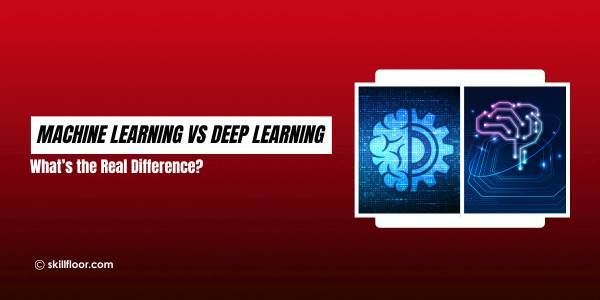
Did you know the global AI market hit $184 billion in 2024, with Machine Learning grabbing 40% and Deep Learning surging 48% yearly through 2030 per Gartner reports? People frequently confuse machine learning (ML) and deep learning (DL) as the same "AI trick," although they are distinct tools, much like a powerful chainsaw for large work and a useful pocket knife for daily tasks. Understanding the true gap allows professionals to improve their skills and beginners to make informed decisions without worry.
Both ML and DL use data to power self-driving vehicles and Netflix recommendations, but DL is a subset of ML's neural network that mimics brain cells, not a substitute. With decision trees, ML ignited the AI boom of the 1990s; huge data and GPUs, like AlphaGo's chess victories, drove DL's post-2012 surge. DL manages raw inputs end-to-end, in contrast to Deep Blue's rules. This blog explains options to save computation and time.
What is Machine Learning?
Machine Learning is a field within Artificial Intelligence that focuses on building systems capable of learning from data, identifying patterns, and making decisions with minimal human intervention instead of relying on hard-coded rules.
-
Even with modest data sets, it performs effectively.

-
Frequently relies on human input to choose and create features
-
In general, easier to comprehend, debug, and implement
-
Perfect for organized datasets like database records or spreadsheets


Types of Machine Learning
-
Supervised Learning: By using labeled data with known inputs and outputs, supervised learning enables the model to discover patterns and produce precise future predictions.
-
Unsupervised Learning: Unsupervised learning uses unlabeled data to identify hidden patterns or groups without the need for human instruction or predetermined solutions.
-
Reinforcement Learning: Through trial and error, reinforcement learning teaches models to make better judgments over time by rewarding right actions and punishing wrong ones.
Real-Life Examples
-
Email spam filtering
-
Fraud detection in banking
-
Product recommendation systems
-
Predicting house prices
What is Deep Learning?
Deep Learning is a subfield of machine learning that mimics the way the human brain processes information by automatically learning complicated patterns from massive amounts of data using multi-layered neural networks.
-
Large datasets are necessary for efficient operation.
-
Features are automatically extracted with minimal human involvement.
-
More difficult to construct, train, and comprehend
-
Ideal for unstructured data, such as text, audio, and photos
Types of Deep Learning
-
CNNs (Convolutional Neural Networks): Excel at processing images and videos by using filters to identify edges, forms, and objects. employs medical scans and face ID.
-
RNNs (Recurrent Neural Networks): Manage speech and text sequences while keeping historical data for prediction. used in time series and chatbots.
-
LSTMs (Long Short-Term Memory): Long patterns are remembered by sophisticated RNNs. Excellent for stock forecasts and translation.
-
Transformers: Attention-based for quick NLP; parallel processing of entire sentences. Translation applications and Drive ChatGPT.
Real-Life Examples
-
Face recognition systems
-
Self-driving cars
-
Voice assistants
-
Language translation tools
Difference Between Machine Learning and Deep Learning
Now we explore the core idea behind this comparison, where understanding machine learning vs deep learning helps you choose the right approach for different real-world problems.
1. Data Requirements
Machine Learning: When features are well designed, machine learning algorithms can function effectively with comparatively fewer datasets. They are more effective even in situations where data is scarce since they depend more on human supervision.


Deep Learning: For Deep Learning models to function properly, enormous volumes of data are needed. They automatically pick up features from unprocessed data, but their effectiveness drastically declines in the absence of big datasets, which could result in overfitting.
2. Feature Engineering
Machine Learning: Manual feature engineering, in which important variables are chosen, cleaned, and transformed by humans, is crucial to machine learning models. The quality and skill of these handcrafted characteristics have a significant impact on the model's performance.
Deep Learning: From unprocessed data, deep learning models automatically identify and extract significant features. Because neural networks use several processing layers to automatically recognize patterns and representations, this lessens human effort.
3. Complexity of Problems
Machine Learning: Structured data, which is arranged in tables or spreadsheets with distinct labels, is ideal for machine learning. It deals with clearly defined issues where traditional algorithms and statistical methods can be used to find patterns.
Deep Learning: When it comes to unstructured data, such as text, audio, and photos, deep learning shines. Its multilayer neural networks are able to recognize intricate linkages and patterns that are difficult for conventional algorithms to recognize.
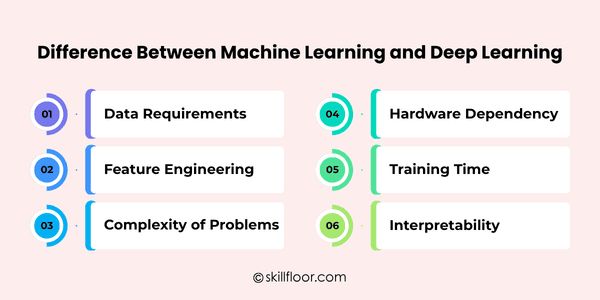
4. Hardware Dependency
Machine Learning: The majority of projects and small-scale applications can use machine learning algorithms since they are typically lightweight and can operate effectively on laptops or conventional PCs without the need for specialist hardware.
Deep Learning: In order to handle massive datasets and intricate neural networks effectively, deep learning models are computationally demanding and frequently require GPUs, TPUs, or high-performance servers. This ensures quicker training and improved performance.
5. Training Time
Machine Learning: Depending on the size of the dataset, machine learning models can be trained in a matter of minutes or hours. Faster experimentation, iteration, and solution rollout are made possible by this.
Deep Learning: Due to their intricate structures and large datasets, deep learning models can take hours, days, or even weeks to train, necessitating substantial computer resources and meticulous optimization.
6. Interpretability
Machine Learning: In general, machine learning models are simpler to understand. Decision trees and linear regression are examples of techniques that are appropriate for high-stakes or regulated situations because they enable humans to comprehend how predictions are made.
Deep Learning: Many people view deep learning models as a "black box." Their intricate, multi-layered neural networks hinder explainability in crucial applications by making it challenging to track how certain inputs result in outputs.
When Should You Use Machine Learning vs Deep Learning?
Choosing the right approach depends on your project needs. Understanding Machine Learning vs Deep Learning helps decide whether simpler models or complex neural networks fit best.
Use Machine Learning When:
-
You have limited data
-
The problem is relatively simple
-
You need explainable results
-
You have limited computational resources
-
You want faster model training and deployment
-
You need easily interpretable results for decision-making
Use Deep Learning When:
-
You have large datasets
-
The problem involves images, audio, or text
-
You need high accuracy on complex tasks
-
You have access to strong hardware
-
You want the model to learn features automatically
-
You aim to handle unstructured or highly complex data efficiently
Advantages and Limitations of Machine Learning and Deep Learning
Machine Learning
Advantages
-
It works well with smaller datasets since it needs less data to function well.
-
In general, training is faster, enabling faster model exploration and iteration.
-
Because models are easy to understand, stakeholders can understand projections more easily.
-
Reduced computational cost because it can function well without GPUs on common hardware.
Limitations
-
limited capacity to manage complicated, unstructured data, such as text, audio, or photos.
-
Requires manual feature engineering, which can be laborious and requires specialized knowledge.
-
Requires careful tailoring to capture complex patterns in large datasets.
-
If the complexity or size of the data grows far beyond capacity, performance frequently reaches a plateau.
Deep Learning
Advantages
-
Reaches high accuracy in challenging tasks such as natural language processing and picture recognition.
-
Works incredibly well with unstructured data, including text, audio, and photos.
-
Eliminates the need for human feature engineering by automatically learning features from raw data.
-
Can reveal complex links and patterns that conventional algorithms frequently overlook.
Limitations
-
Need large datasets in order to prevent overfitting and provide dependable performance.
-
Expensive to train because GPUs and TPUs require a lot of processing power and hardware.
-
Neural networks operate as a "black box," making them challenging to understand.
-
Training sessions might last for hours or even weeks.
Common Misconceptions About Machine Learning and Deep Learning
A lot of people don't grasp how deep learning and machine learning operate. Among the prevalent myths are:
1. Deep Learning is always better than Machine Learning
This is untrue; while machine learning is frequently quicker, simpler, and adequate for lesser tasks, deep learning performs exceptionally well with huge, complicated datasets.
2. Machine Learning is outdated
Machine learning is still frequently used and useful, particularly in situations where interpretability is crucial or data is few.
3. You always need coding skills for AI
Although coding is useful, a lot of tools today make it possible to create models with very little programming.
4. Deep Learning can solve any problem
Although powerful, DL isn't always required. Data, the intricacy of the problem, and available resources all influence the best strategy.
Future Trends in Machine Learning and Deep Learning
The future of AI will involve the intelligent use of both, not the selection of one over the other.
-
Hybrid Models: By balancing speed, accuracy, and interpretability in practical Machine Learning vs Deep Learning applications, businesses can effectively tackle complex challenges by combining ML and DL methodologies.
-
AutoML: In Machine Learning vs Deep Learning projects, automated tools help choose, train, and fine-tune models, simplifying and speeding up AI development while lowering human effort.
-
Edge AI: In Machine Learning vs Deep Learning jobs, running AI models on local devices, such as phones or IoT devices, lowers latency and reliance on cloud computing.
-
Explainable AI (XAI): While contrasting the transparency of machine learning and deep learning systems, XAI focuses on making model decisions transparent and intelligible to help users trust AI.
While deep learning will continue to advance quickly, a comparison of machine learning and deep learning reveals that machine learning is still essential for practicality, efficiency, and easier jobs, which complement deep learning's sophisticated capabilities.
FAQs
1. Is Deep Learning part of Machine Learning?
Yes, Deep Learning is a specialized subset of Machine Learning that handles complex patterns with neural networks.
2. Which is better for beginners?
Machine Learning is easier to start with because it requires less data and simpler computational resources.
3. Do I need coding skills for ML and DL?
Yes, basic programming knowledge, especially in Python, is essential to build and run models effectively.
4. Can Machine Learning work with small datasets?
Yes, Machine Learning performs well with smaller datasets, while Deep Learning usually needs large amounts of data.
5. Are Deep Learning models easy to interpret?
No, Deep Learning models are often considered “black boxes,” making them harder to explain than Machine Learning models.
Understanding the differences between AI tools can feel tricky, but it doesn’t have to be. It is clear from a comprehensive examination of machine learning vs deep learning that both have advantages and optimal applications. While Deep Learning excels with huge, unstructured data and challenging tasks, Machine Learning is best suited for smaller datasets, straightforward challenges, and quicker outcomes. You can make better decisions without wasting time or resources if you know when to use each. This method of thinking about Machine Learning vs Deep Learning makes AI accessible, useful, and even enjoyable to investigate for both novices and specialists.
Digital Marketing Courses in Other Locations in India
Ahmedabad | Aurangabad | Bangalore | Bhilai | Bhopal | Bhubaneshwar | Chandigarh | Chennai | Cochin | Coimbatore | Dehra Dun | Delhi | Faridabad | Ghaziabad | Gorakhpur | Guntur | Gurgaon | Guwahati | Hyderabad | Jaipur | Kanpur | Khammam | Kolkata | Lucknow | Madurai | Mumbai | Mysore | Nagpur | Noida | Patna | Pondicherry | Pune | Ranchi | Shimoga | Surat | Thane | Thiruvananthapuram | Tiruchirappalli | Tirupati | Vadodara | Visakhapatnam | Warangal | Jalandhar | Jodhpur | Indore | Durgapur | Jamshedpur | Dhanbad | Kota | Karnal | Udaipur | Amritsar | calicut | Nashik | Ludhiana | varanasi | thrissur | Mangalore | Raipur |