









































Struggling to Get a Data Science Job? Here’s What You’re Missing
Struggling to land a data science job? Learn the crucial skills, hidden pitfalls, and proven strategies to help you now finally secure your dream role in 2026.
You’ve finished your degree. Maybe you’ve also completed tutorials in Python, machine learning, and SQL. Your resume clearly lists these skills, along with a few basic projects. Yet, the responses from recruiters are silent—or worse, you face rejections right after the first screening round.
So, what are you really missing?
Why are recruiters still not shortlisting you?
You’re not alone. Studies show that recruiters spend less than 10 seconds scanning a resume before deciding whether to move forward or reject it. This is why nearly 60–70% of entry-level data science applicants fail at the resume screening stage—even when they have the required technical skills.
By the end of this, you will clearly understand:


-
What is holding you back from landing a data science job
-
The exact steps to fix it before your next application
The Reality of the Data Science Job Market Right Now
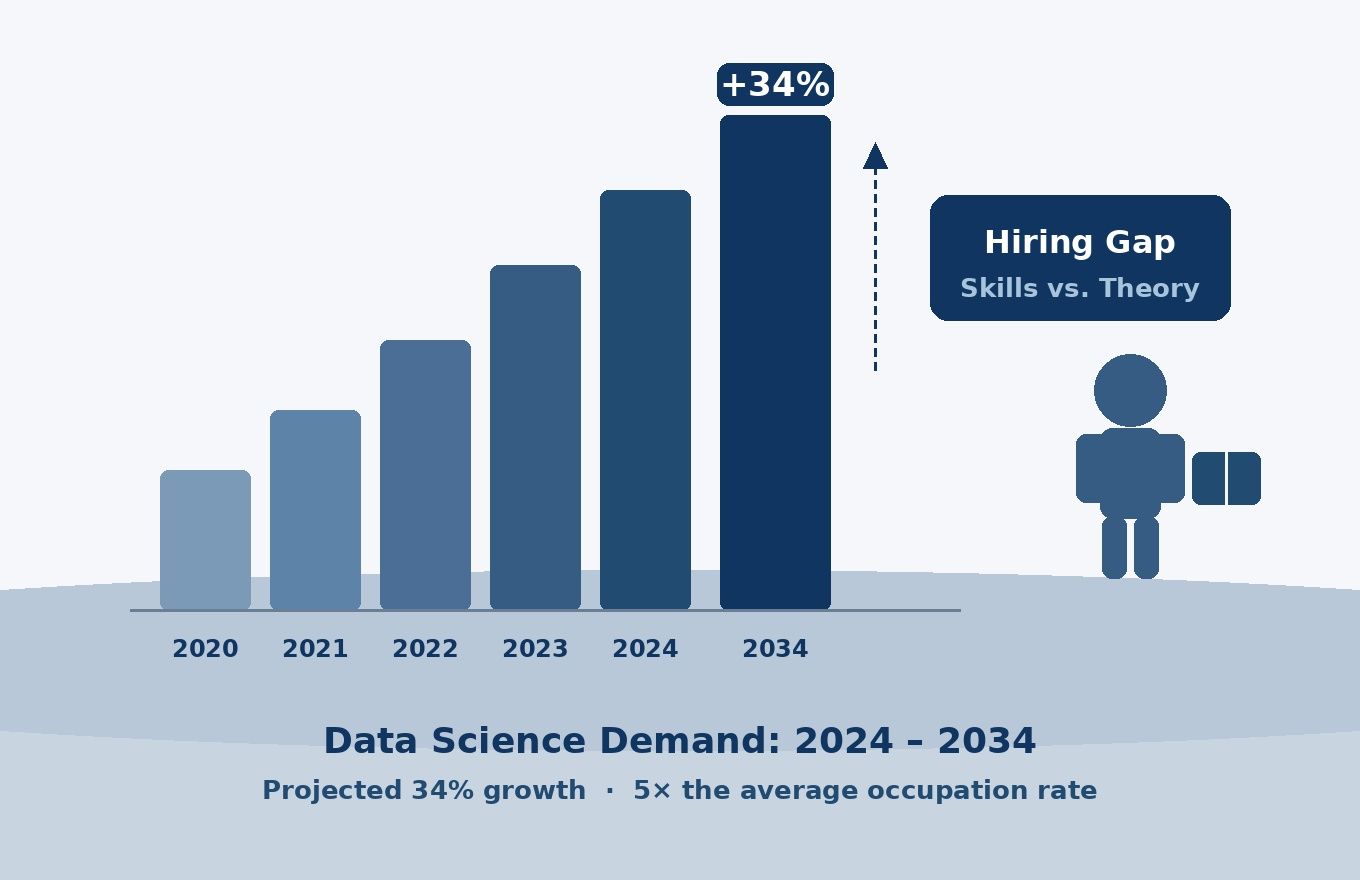
In 2026, the data science job market is growing quickly, with global demand expected to reach millions of roles. According to the U.S. Bureau of Labor Statistics, data scientist employment is projected to grow 34% between 2024 and 2034, nearly five times the average for all occupations. However, industry surveys show that only a small share of candidates are job-ready, creating a major hiring gap. The main reason is the mismatch between academic learning and real-world industry needs, where companies prioritize practical skills over certifications and theory.
Key Challenges in Today’s Data Science Market
-
Entry-level data science roles are highly competitive, with hundreds of applicants competing for a single position in many companies.
-
Employers prioritize practical skills in Python, SQL, machine learning, and data visualization over degrees and certifications alone.
-
Many candidates lack real-world, end-to-end project experience such as data cleaning, feature engineering, model building, and deployment.
-
Recruiters value the ability to explain business impact from data insights more than just technical explanations of algorithms.
-
Poorly structured resumes and similar project portfolios reduce visibility during ATS screening and recruiter review.
What Recruiters Actually Look For
Recruiters look at more than just technical proficiency when hiring for a data science position. They focus on the applicants' practical use of their skills. Studies reveal that more than 70% of hiring managers place a higher value on applied skills than academic knowledge, indicating that practical understanding is frequently more significant than theoretical knowledge.
-
Problem-Solving Skills: Structured thinking is valued by over 65% of data science recruiters for resolving challenging analytical and modeling issues.
-
Practical Projects: Applicants who have completed practical data science projects are up to 40% more likely to be shortlisted.
-
Communication Skills: Clearly explaining insights to non-technical business stakeholders is a need for over 60% of data science positions.
-
Data Preparation Skills: Before creating models, data scientists spend around 80% of their time cleaning and preparing data.
-
Business Knowledge: Candidates who link data insights to quantifiable business impact and decisions are preferred by about 55% of employers.
Step-by-Step Guide to Crack Data Science Jobs
1. Build Real-World Data Science Projects: Forget tutorial clones. Recruiters want to see you tackle real problems: customer churn prediction, fraud detection, sales forecasting, or recommendation engines. These prove you can translate business needs into working solutions.
Skills to demonstrate:
-
Business Problem Translation: Understanding what the business needs and converting those goals into a clear, solvable data science problem statement.
-
Data Collection: Gathering relevant data efficiently using SQL queries, third-party APIs, or publicly available open datasets online.
-
Data Cleaning: Identifying and fixing missing values, duplicate records, and inconsistencies to ensure your dataset is accurate and reliable.
-
Machine Learning Implementation: Selecting and applying the right algorithms like regression, classification, or clustering based on your specific business problem.
Why it matters: Many hiring managers place a high value on end-to-end execution skills, and the majority of recruiters favor applicants with actual project experience.
Outcome: You become job-ready and stand out at the resume screening stage.
2. Explain Insights Like a Professional: Data science is not just about building models, it's about communicating what they mean. Connecting insights to revenue, growth, or KPIs is what separates hirable candidates from technically sound but overlooked ones.
Skills to demonstrate:
-
Data Storytelling: Crafting a clear and compelling narrative around your findings so both technical and non-technical stakeholders can easily understand them.

-
Visualization Tools: Using tools like Tableau, Power BI, Matplotlib, or Seaborn to present data in visually engaging and easy-to-interpret formats.
-
Business Insight Communication: Translating your analytical findings into actionable business recommendations that directly connect to revenue, growth, or KPIs.
-
Presentation Skills: Confidently delivering your insights to a mixed audience, simplifying complex technical concepts without losing accuracy or important detail.


Why it matters: Candidates with actual project experience are preferred by recruiters, and those with end-to-end execution skills are highly valued.
Outcome: You perform better in interviews and signal real-world readiness.
3. Build a Job-Ready Portfolio: Your portfolio is your proof. Before shortlisting you, recruiters will check your GitHub. Each project should tell a complete story — Problem → Approach → Results → Business Impact.
Skills to demonstrate:
-
GitHub Usage: Hosting your projects professionally on GitHub with organized repositories, proper commit history, and a clean, easy-to-navigate folder structure.
-
Project Documentation: Writing detailed README files that clearly explain the problem you solved, the approach you took, and the results you achieved.
-
Code Quality: Writing clean, modular, and well-commented Python code that any reviewer can read, understand, and build upon without confusion.
-
Portfolio Structure: Organizing and presenting your projects based on industry relevance so recruiters instantly see your strengths and the value you can bring.
Why it matters: 50% of candidates with portfolios receive more attention from recruiters, highlighting the importance of showcasing your work effectively.
Outcome: Your portfolio builds credibility and significantly improves your chances of getting shortlisted.
4. Apply Strategically, Not Randomly: Spray-and-pray doesn't work. Target roles that match your current level Data Analyst, Data Scientist, or ML Intern, and tailor every application with the right keywords and skill alignment.
Skills to demonstrate:
-
Resume Optimization: Including the right keywords like Python, SQL, Machine Learning, and Tableau so your resume gets noticed by both ATS systems and human recruiters.
-
ATS Optimization: Structuring your resume in a clean, standard format that passes through automated applicant tracking systems without getting incorrectly filtered out.
-
Role Targeting: Apply only for roles that genuinely match your current skill set and experience level to maximize your response and interview call rate.
-
Networking: Actively connecting with data science professionals, recruiters, and hiring managers on LinkedIn to open doors that job boards alone cannot provide.
Why it matters: 75% of resumes are filtered through ATS systems. 45% of recruiters prefer candidates who match job-specific requirements.
Outcome: You receive more interview calls and significantly improve your overall chances of selection.
5. Strengthen Your Core Data Science Skills: Strong fundamentals are what get you through technical interview rounds and help you perform confidently in a real data science job from day one.
Skills to demonstrate:
-
Python Programming: Building strong hands-on proficiency with libraries like Pandas, NumPy, and Scikit-learn to handle real-world data tasks efficiently and accurately.
-
SQL Expertise: Writing optimized SQL queries involving complex joins, aggregations, and subqueries to extract and manipulate data from relational databases confidently.
-
Statistics and Probability: Understanding core concepts like probability distributions, hypothesis testing, and statistical significance that underpin every reliable machine learning model.
-
Machine Learning Concepts: Deeply understanding key ideas like bias-variance tradeoff, overfitting, underfitting, and model selection to make better, more informed modeling decisions.
Why it matters: In data science positions, Python and SQL are frequently used, and a significant amount of the work involves data cleaning.
Outcome: You confidently clear technical rounds and hit the ground running in real-world data science roles.
6. Practice Data Science Interviews: Cracking a data science job requires more than knowledge—it requires strong data science skills and the ability to perform under pressure. Consistent interview practice is what builds that confidence.
Skills to demonstrate:
-
SQL Query Practice: Regularly solving SQL challenges on platforms like LeetCode or HackerRank to sharpen your ability to write accurate, optimized queries quickly under pressure.
-
Python Coding: Practicing real-world data problems in Python to build the speed, accuracy, and logical thinking that technical interview rounds consistently test and evaluate.
-
Machine Learning Knowledge: Going beyond surface-level understanding to deeply explain how algorithms work, when to use them, and how to tune and evaluate them properly.
-
Case Study Solving: Practicing structured approaches to open-ended business problems so you can think clearly, communicate logically, and impress interviewers with your problem-solving process.
Why it matters: Mock interviews improve success rates by up to 30%. Case studies directly test your real-world problem-solving ability in a job-relevant context.
Outcome: You gain confidence, sharpen your communication, and dramatically increase your chances of landing the data science job you want.
Essential Skills and Tools Required for Data Science Jobs
|
Skill |
Description |
Tools to Learn |
|
Python Programming |
Python is the backbone of data science, used for data analysis, machine learning, and automation. It helps in handling large datasets efficiently. |
Pandas, NumPy, Scikit-learn, Jupyter Notebook, Google Colab |
|
SQL |
SQL is used to extract, manage, and analyze structured data from databases. It is essential for working with real-world business data. |
MySQL, PostgreSQL, Microsoft SQL Server, SQLite |
|
Data Cleaning |
Data cleaning involves handling missing values, duplicates, and inconsistencies to ensure accurate analysis and better model performance. |
Pandas, NumPy, Excel, OpenRefine |
|
Exploratory Data Analysis (EDA) |
EDA helps in understanding patterns, trends, and relationships in data before building models, improving decision-making. |
Pandas, Matplotlib, Seaborn, Plotly |
|
Data Visualization |
Data visualization converts complex data into simple charts and dashboards, making it easier for stakeholders to understand insights. |
Tableau, Power BI, Matplotlib, Seaborn |
|
Machine Learning |
Machine learning helps in building predictive models and identifying patterns in data for better decision-making. |
Scikit-learn, TensorFlow, Keras, XGBoost |
|
Statistics & Probability |
Statistics helps in analyzing data, validating models, and making data-driven decisions effectively. |
SciPy, Statsmodels, Excel, R |
|
Feature Engineering |
Feature engineering improves model performance by creating meaningful variables from raw data. |
Pandas, NumPy, Scikit-learn |
|
Business Understanding |
Business understanding connects data insights to real-world outcomes like revenue growth and customer retention. |
Power BI, Tableau, Excel |
|
Communication Skills |
Communication helps in explaining insights clearly to non-technical stakeholders and driving business decisions. |
PowerPoint, Google Slides, Tableau |
Where Most Freshers Go Wrong in Data Science
Many freshers struggle in data science because they focus more on learning than applying. Without practical execution and clear direction, progress slows, and competition becomes harder to beat.
-
Overlearning Trap: Recruiters prefer real-world experience, but many freshers focus only on courses without applying their skills, which reduces their chances of getting shortlisted.
-
Random Learning: Around 60% of candidates follow unstructured learning paths, leading to confusion and weak skill development.
-
Weak Fundamentals: Many candidates fail technical rounds due to a poor understanding of core concepts like statistics and SQL.
-
Unrealistic Expectations: 70% of successful candidates spend months building skills and projects, while expecting quick results leads to frustration.
-
Delay in Action: With 200+ applicants per role, delaying practice and applications makes it harder to stand out over time.
How Structured Learning Changes the Game in Data Science
Structured learning through a Data Science course provides a clear, step-by-step path, reducing confusion and helping learners build job-ready skills faster compared to random learning.
Importance of a Data Science Course in Career Growth
-
Practical Training: Hands-on experience with real datasets increases shortlist chances by 40%, making practical learning essential.
-
Real-Time Projects: 70% of hiring managers prefer candidates with real-world project experience, as it reflects practical capability.
-
Certification: 55% of recruiters trust certified candidates more, as certifications validate skills during resume screening.
-
Placement Support: Structured career guidance improves interview success rates by up to 50%.
-
Structured Learning Platforms: Learning platforms help students successfully prepare for real-world data science careers by offering step-by-step instruction, hands-on projects, and career support.
For learners aiming to master data science, a structured data science course provides step-by-step guidance. Skillfloor offers hands-on exercises and real datasets, helping students gain practical, job-ready skills efficiently.
Beyond education, mentorship, project management, and placement assistance guarantee that students apply their knowledge with assurance, increasing their employability and equipping them for data science jobs in the real world.
FAQs
1. Why am I not getting shortlisted?
You may lack real-world projects, a strong resume structure, or proper alignment between your skills and job requirements.
2. What do recruiters look for?
Recruiters prioritize practical skills, problem-solving ability, project experience, and clear communication of insights to business stakeholders.
3. Are projects important?
Yes, real-world projects demonstrate your ability to solve business problems and significantly increase your chances of getting shortlisted.
4. How do I pass ATS screening?
Use relevant keywords, maintain a clean resume format, and tailor your application based on each specific job description.
5. Are certifications enough?
No, certifications alone are not enough; recruiters value practical skills, real-world experience, and strong project portfolios more.
6. What skills are most important?
Python, SQL, machine learning, statistics, data cleaning, and data visualization are essential skills for data science roles.
Developing a strong and relevant profile is just as important to landing a data science job as applying broadly. Candidates typically do significantly better during the recruiting process if they work on real-world projects, develop key abilities like Python, SQL, statistics, and machine learning, and effectively showcase their work. These enhancements directly contribute to a rise in recruiter interest and interview calls.
Success also depends on how well applicants convey their qualifications and match their applications to the job specifications. Rejection rates can be greatly decreased, and callback rates increased by optimizing resumes with the appropriate keywords, showing projects on sites like GitHub, and consistently honing problem-solving skills.
Digital Marketing Courses in Other Locations in India
Ahmedabad | Aurangabad | Bangalore | Bhilai | Bhopal | Bhubaneshwar | Chandigarh | Chennai | Cochin | Coimbatore | Dehra Dun | Delhi | Faridabad | Ghaziabad | Gorakhpur | Guntur | Gurgaon | Guwahati | Hyderabad | Jaipur | Kanpur | Khammam | Kolkata | Lucknow | Madurai | Mumbai | Mysore | Nagpur | Noida | Patna | Pondicherry | Pune | Ranchi | Shimoga | Surat | Thane | Thiruvananthapuram | Tiruchirappalli | Tirupati | Vadodara | Visakhapatnam | Warangal | Jalandhar | Jodhpur | Indore | Durgapur | Jamshedpur | Dhanbad | Kota | Karnal | Udaipur | Amritsar | calicut | Nashik | Ludhiana | varanasi | thrissur | Mangalore | Raipur |