













































AI Engineer Salary in India 2026: Updated Salary Trends
Know the updated AI engineer salary in India 2026, latest pay trends, job growth, and company-wise earnings across cities in simple and clear words for everyone.

47% of AI job postings in India right now are going unfilled.
Not because companies stopped hiring. Because there are not enough candidates who actually meet the bar.
Expectations are increasing every quarter, so students who hit that cap in 2026 will get compensation that would have seemed unattainable three years ago.
According to recent hiring research across major Indian tech hubs, what separates a ₹4 LPA offer from a ₹14 LPA offer at the same experience level is rarely a degree alone. The real difference is the strength of the candidate’s skill stack, practical project experience, and how early they started building in-demand AI and machine learning skills.


According to NASSCOM's India AI Talent Report, demand for AI professionals in India is growing at 45% year-on-year, but the pipeline of job-ready candidates is not keeping pace. That gap is your window. But it will not stay open forever.
This post gives you the real AI engineer salary picture in India for 2026, actual numbers, what drives them, and the exact moves that determine which end of the range you land on.
What Does an AI Engineer Actually Do?
AI Engineers design, build, and deploy intelligent systems that learn from data and improve over time, making them central to modern AI careers. According to industry reports, over 70% of companies are investing in AI to automate processes and enhance decision-making. They combine software engineering with machine learning to turn data into scalable, production-ready solutions.
Key Responsibilities
-
Build and train machine learning models using structured and unstructured datasets for predictive and intelligent systems.
-
Ensure successful deployment and monitoring, as only around 38% of organizations have deployed AI models into production, while most remain in pilot stages.
-
Develop and maintain scalable data pipelines to collect, clean, and transform raw data into usable formats.
-
Manage data preprocessing and feature engineering, since data preparation takes nearly 60% of an AI workflow.
-
Deploy machine learning models into production using APIs, cloud platforms, and monitoring tools for real-time usage.
-
Optimize model performance and accuracy, as 80% of AI project time is spent on model development and tuning.
AI Engineer Salary in India
Due to the strong demand for AI expertise across businesses, pay for AI engineers in India is rising quickly, making AI salary trends increasingly attractive for professionals. Depending on their experience and level of skill, professionals typically make between ₹4.5 LPA to ₹40+ LPA. Earnings are greatly impacted by elements like specialization in fields like cloud deployment, NLP, and machine learning.
|
Experience Level |
Average Annual Salary (INR) |
Key Salary Growth Factors |
Market Insights / Stats |
|
Fresher (0–1 year) |
₹4.5 LPA – ₹8 LPA |
Python, ML fundamentals, internships, strong project portfolio |
Entry-level AI roles typically start around ₹5–9 LPA, depending on skills and company |
|
Junior (1–3 years) |
₹8 LPA – ₹15 LPA |
Model deployment, cloud platforms, real-world experience, system understanding |
Professionals switching roles can see salary increases of 30–50% at this stage |
|
Mid-Level (3–6 years) |
₹15 LPA – ₹25 LPA |
Specialization in NLP, GenAI, MLOps, and scalable architectures |
AI job demand in India has grown by ~50–60% YoY, increasing salary competitiveness |
|
Senior (6+ years) |
₹25 LPA – ₹40+ LPA |
Leadership, system design, advanced AI expertise, large-scale deployments |
Senior AI engineers in top firms can earn ₹40–80+ LPA based on impact and expertise |
AI Engineer Salary in India by Role
AI Engineer salaries vary significantly based on specialization, as different roles demand unique technical expertise and business impact. While experience matters, choosing the right role can influence salary growth by 20–40% across the AI domain.
High-demand specializations like NLP and MLOps often command higher pay due to industry adoption and complexity, which is why enrolling in a practical AI course can help you build these in-demand skills faster.
1. Machine Learning Engineer: Machine Learning Engineers design, build, and optimize models that power intelligent applications across industries. They focus on scalability, performance, and deploying models into real-world production systems.
Salary Range
-
₹6 LPA – ₹18 LPA for early to mid-level roles, depending on skills and project experience.
-
According to Glassdoor India salary insights and LinkedIn Workforce data reports, salaries can increase by 25–40% with strong deployment experience and production-level system expertise.
Skills Required
-
Strong proficiency in Python, machine learning algorithms, and frameworks like TensorFlow or PyTorch for scalable systems.
-
Experience with data preprocessing, feature engineering, and deploying models using cloud platforms and APIs.
2. Data Scientist: Data Scientists analyze complex data to generate insights and build predictive models for decision-making. They combine statistics, programming, and domain knowledge to solve business problems using data.
Salary Range
-
₹5 LPA – ₹20 LPA depending on experience, domain expertise, and analytical project portfolio strength.
-
Professionals with strong business impact projects can see salary growth of 20–35% across organizations.
Skills Required
-
Expertise in statistics, Python or R, and data visualization tools like Power BI or Tableau.
-
Strong understanding of machine learning techniques, data cleaning, and exploratory data analysis methods.



3. NLP Engineer: NLP Engineers specialize in building systems that understand, interpret, and generate human language data. They work on chatbots, voice assistants, and text-based AI applications widely used across industries.
Salary Range
-
₹8 LPA – ₹22 LPA due to high demand for language-based AI applications across industries.
-
NLP roles often offer 30–50% higher salaries with expertise in large language models and GenAI tools.
Skills Required
-
Strong knowledge of NLP techniques, transformers, and libraries like Hugging Face for language model development.
-
Experience in text preprocessing, sentiment analysis, and deploying conversational AI systems at scale.
4. Computer Vision Engineer: Computer Vision Engineers develop systems that interpret and process visual data from images and videos. They work on applications like facial recognition, object detection, and autonomous systems.
Salary Range
-
₹7 LPA–₹20 LPA depending on experience and complexity of computer vision projects handled.
-
Specialized roles in autonomous systems or healthcare imaging can increase salaries by 25–45% significantly.
Skills Required
-
Strong understanding of image processing, deep learning, and frameworks like OpenCV and PyTorch for vision tasks.
-
Experience in building models for object detection, segmentation, and real-time visual data processing systems.
5. AI Research Engineer: AI Research Engineers focus on developing new algorithms and advancing AI technologies through experimentation. They often work in R&D teams, contributing to innovation and cutting-edge AI solutions.
Salary Range
-
₹10 LPA–₹25 LPA depending on research expertise, academic background, and innovation-driven contributions.
-
Roles in top tech firms or labs can offer 40–60% higher salaries for advanced research capabilities.
Skills Required
-
Strong foundation in mathematics, deep learning, and research methodologies for developing advanced Artificial Intelligence models.
-
Experience with research papers, experimentation, and implementing novel algorithms in real-world applications.
Skills That Directly Impact Your Salary
In 2026, specialized technical skills will have a greater impact on AI engineer pay than years of experience alone. Professionals who can develop, implement, and scale real-world AI systems are given priority by businesses. According to reports, more than 60% of businesses now use skill-based hiring, which means that having the appropriate skills is a significant factor in determining pay.
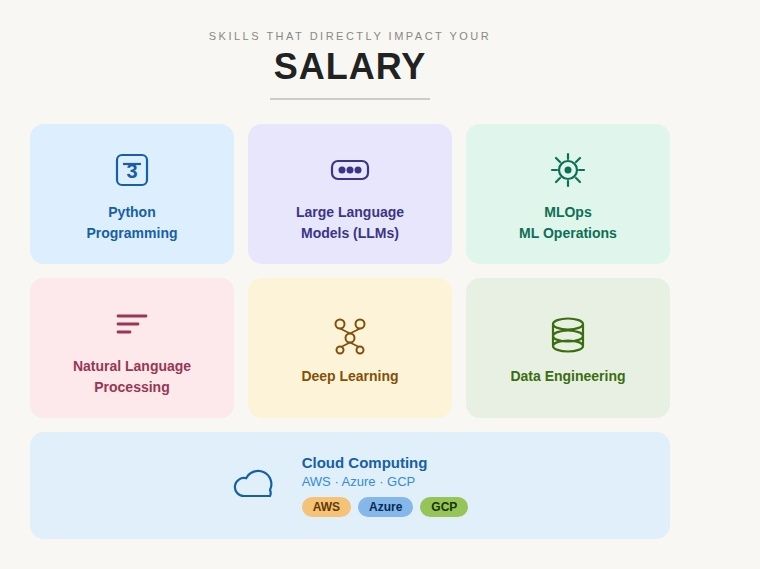
1. Python Programming: The majority of AI development is built on Python, which is utilized for automation, data processing, and model creation. Proficiency in Python facilitates an engineer’s productivity throughout the AI pipeline.
-
Python is the most desired programming language, needed for more than 70% of AI jobs.
-
Because of their productivity and adaptability, professionals with excellent Python abilities can make 20–30% more money.
2. Large Language Models (LLMs): Chatbots, content creation, and automation tools are examples of contemporary AI applications that depend heavily on LLMs. Because of the industry's quick acceptance, expertise in this field is highly prized.
-
According to the LinkedIn Jobs Report and NASSCOM Industry Insights, as demand for GenAI solutions continues to rise, LLM-related positions offer salaries that are 30–50% more.
-
The demand for these talents has expanded due to the over twofold increase in generative AI adoption in recent years.
3. MLOps (Machine Learning Operations): The deployment, upkeep, and monitoring of machine learning models in production settings are the key objectives of MLOps. It closes the gap between development and practical application.
-
Because scalable AI systems are necessary, companies pay 25–40% extra for MLOps skills.
-
The need for deployment and monitoring skills is growing as nearly half of AI initiatives fail to scale.
4. Natural Language Processing (NLP): NLP powers applications like sentiment analysis and chatbots by enabling machines to comprehend and analyze human language. It is extensively utilized in many businesses that deal with text data.
-
The need for NLP experts is rising since more than 80% of business data is unstructured.
-
In data-driven companies, NLP positions can fetch salaries that are 20–35% higher.
5. Deep Learning: Neural networks utilized in advanced AI systems, speech processing, and picture recognition are the focus of deep learning. It makes it possible for engineers to create intricate, highly accurate models.
-
Deep learning expertise is required in over 65% of advanced AI roles.
-
Professionals with this skill often earn 25–40% higher salaries due to high-demand applications.
6. Data Engineering: Building pipelines, overseeing huge datasets, and guaranteeing data quality for AI models are all part of data engineering. Scalable AI systems require it.
-
Strong data engineering foundations are essential to over 70% of AI projects.
-
Because they enable dependable AI workflows, skilled data engineers can earn 20–35% more.
7. Cloud Computing (AWS, Azure, GCP): Cloud platforms are used to deploy, train, and scale AI models efficiently in production environments. They are critical for real-world AI implementation.
-
Over 75% of AI workloads now run on cloud platforms globally.
-
Cloud expertise can increase salaries by 20–40% due to scalability and cost-efficiency skills.
Fresher? Here Is Exactly How to Enter This Field
Breaking into AI as a fresher in 2026 is more achievable than ever with the right approach. Companies are increasingly valuing practical skills, real-world exposure, and the ability to apply knowledge effectively.
According to LinkedIn Workforce Report and NASSCOM Future of Skills Report, over 65% of employers now prefer skill-based hiring, and strong portfolios significantly improve interview chances. . If you focus on building proof of work instead of just qualifications, you can stand out and secure opportunities even without prior experience.
-
Companies now evaluate freshers based on applied skills, project work, and real problem-solving capabilities
-
Building strong portfolio projects showcasing real-world AI use cases increases interview chances by nearly 40%
-
Certifications from recognized platforms add credibility and validate your foundational and advanced AI knowledge
-
Participating in internships, hackathons, and open-source projects improves visibility and practical experience significantly
-
Learning industry tools and frameworks boosts readiness, with over 70% of recruiters expecting tool-based proficiency
-
Consistent practice, networking, and showcasing work online helps freshers attract better job opportunities
What the Next 3 Years Look Like for AI Jobs in India
Over the next three years, AI employment in India is expected to increase significantly due to growing industry usage. Because businesses are actively looking for qualified workers, early admission is quite beneficial. As competition and standards continue to rise, delaying upskilling can hurt your chances.
-
AI employment is expanding quickly in India, with job demand rising by over 55–60% yearly across all industries.
-
According to the NASSCOM AI Adoption Report and IDC India Market Outlook, India’s AI market is expected to grow at a 25–35% CAGR, creating significant long-term career opportunities.
-
High-demand roles by 2027 include AI engineers, data scientists, MLOps specialists, and generative AI experts
-
Delaying upskilling can limit opportunities as companies increasingly prefer candidates with practical, job-ready AI skills
-
Early entry into AI careers provides a strong advantage in securing high-paying and future-proof job roles
-
Now is the best time to start, as AI adoption and industry demand continue accelerating across multiple sectors
3 Actions You Can Take Today
Starting your AI journey doesn’t require months of preparation, just focused, consistent action. Small steps taken today can quickly build momentum and confidence. These simple actions help you move from learning to doing, and enrolling in offline courses can further accelerate your progress by providing structured, hands-on guidance, making you job-ready faster.
-
Map your skill gap by comparing your current abilities with the top in-demand AI skills and identify clear improvement areas
-
Build one small AI project today using beginner-friendly resources to gain hands-on experience and practical confidence
-
Take a structured AI course like Skillfloor’s AI Engineering program, focused on real-world projects and job-ready skills
FAQs
1. What is the average AI Engineer salary in India in 2026?
The average AI Engineer salary in India ranges between ₹4.5 LPA to ₹40+ LPA, depending on experience, skills, and specialization.
2. Which skills increase an AI Engineer's salary the most?
Skills like Python, MLOps, NLP, deep learning, and cloud computing can increase salaries by 20–50% in AI roles.
3. Can freshers get AI jobs in India without experience?
Yes, freshers can get AI jobs by building strong portfolio projects, gaining certifications, and demonstrating practical skills.
4. Which AI roles are the highest paying in India?
Roles like NLP Engineer, AI Research Engineer, and MLOps Engineer are among the highest-paying AI jobs in India.
5. How long does it take to become an AI Engineer?
It typically takes 6–12 months with consistent learning, projects, and hands-on practice to become job-ready.
Salaries for AI engineers in India have risen significantly, but skills, not degrees, determine the difference between average and top pay. Those who start early and get useful, real-world experience have a significant advantage because the demand for job-ready talent is increasing more quickly than the supply. Employers are giving preference to those who can produce outcomes rather than just credentials. Action and perseverance will be rewarded in the upcoming years. In the developing AI employment market, you may obtain high-growth, high-paying possibilities if you invest in studying, creating projects, and using your abilities immediately.
Artificial Intelligence Course | Data Science Courses | Data Analytics Course | Digital Marketing Course
Digital Marketing Courses in Other Locations in India
Ahmedabad | Aurangabad | Bangalore | Bhilai | Bhopal | Bhubaneshwar | Chandigarh | Chennai | Cochin | Coimbatore | Dehra Dun | Delhi | Faridabad | Ghaziabad | Gorakhpur | Guntur | Gurgaon | Guwahati | Hyderabad | Jaipur | Kanpur | Khammam | Kolkata | Lucknow | Madurai | Mumbai | Mysore | Nagpur | Noida | Patna | Pondicherry | Pune | Ranchi | Shimoga | Surat | Thane | Thiruvananthapuram | Tiruchirappalli | Tirupati | Vadodara | Visakhapatnam | Warangal | Jalandhar | Jodhpur | Indore | Durgapur | Jamshedpur | Dhanbad | Kota | Karnal | Udaipur | Amritsar | calicut | Nashik | Ludhiana | varanasi | thrissur | Mangalore | Raipur |