













































Highest-Paying Cybersecurity Jobs in 2026
Want a high-paying tech career in 2026? Explore the highest-paying cybersecurity jobs, salary details, skills needed, and growth paths for a secure life future.

The difference between a ₹6L offer and a ₹22L offer in cybersecurity is rarely skill. It’s role targeting.
I have reviewed hundreds of cybersecurity resumes. Candidates often have the same degree, the same certifications, and sometimes even the same college.
What separates high earners is not what they know — it’s what they build toward.
4.8 million cybersecurity roles are unfilled globally. In India, demand has grown 33% in just two years. Companies are now paying premiums, promoting faster, and prioritizing hands-on, job-ready candidates over those with unfocused experience.


This window is open right now, but it won’t stay this wide forever.
Roles like Cloud Security Engineer, Penetration Tester, Application Security Engineer, and Security Architect consistently pay ₹18L to ₹35L+, but they are not part of campus placements.
They require structured preparation built around real-world skills.
This guide shows you where the money is in cybersecurity in 2026, what each role demands, and how top candidates position themselves to get there faster.
What’s Driving Cybersecurity Salaries Higher in 2026
India's cybersecurity pay is growing quickly as a result of a noticeable supply-demand gap. With MNCs, GCCs, and product businesses competing for qualified workers, India has evolved from being only an outsourcing hub to a significant hiring market.
-
Cybersecurity job openings in India have grown by about 33% from 2025 to 2026, showing how fast demand is rising.
-
India is no longer just doing outsourced work; it has become a major hiring destination for cybersecurity roles.
-
MNCs, GCCs, and product companies are all chasing the same small pool of skilled professionals
-
Only 14% of companies worldwide say they have enough cybersecurity talent in place.
-
Around 95% of organizations admit they are missing critical skills in their security teams.
-
Industries like IT, banking (BFSI), healthcare, and government are taking months to fill open roles.
Top High-Paying Cybersecurity Roles and Salaries in 2026
Rising cyberthreats, rapid digital expansion, and a clear shortage of skilled professionals are key drivers behind high-paying roles, directly influencing cybersecurity salaries in 2026. Specialization, experience, and impact play a major role, with senior positions earning significantly more as organizations increase security investments.
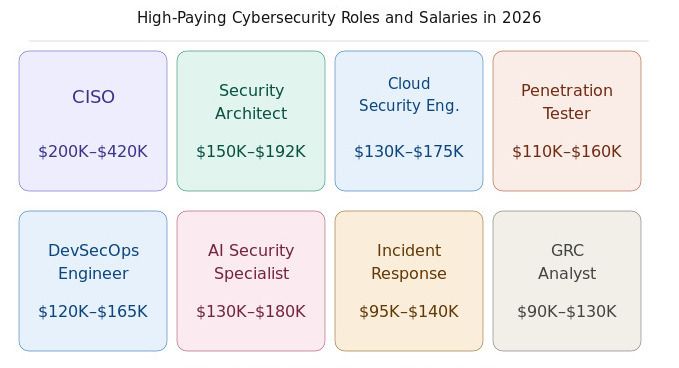
1. Chief Information Security Officer (CISO): The Chief Information Security Officer (CISO) is in charge of overseeing an organization's overall cybersecurity strategy and making sure that security is in line with risk management priorities and commercial objectives. They defend the business from changing cyber threats and make sure that regulations are followed while supervising security operations, teams, and policies.
What It Pays:
-
₹60L–₹2Cr+ per year in India, with leading companies paying incentives of 30–50% based on security maturity, risk reduction, and performance.
-
Big businesses frequently provide CISOs budgets of more than ₹50 crore, which has a direct impact on long-term security strategy choices, compliance investments, and financial risk.
Skills Required:
-
Strong leadership and decision-making skills, along with in-depth knowledge of cybersecurity areas such as cloud security, risk management, governance, and incident response
-
Proficiency in communicating risk, strategy, and financial implications to executives and board members while translating complicated technical threats into business effects.
Key Responsibilities:
-
Establish and implement an organization-wide cybersecurity plan, coordinating security efforts with long-term enterprise risk management frameworks, business objectives, and legal needs.
-
Oversee incident response, budget management, and security team leadership while maintaining ongoing surveillance, threat reduction, and departmental cross-functional cooperation.
2. Security Architect: A security architect is responsible for designing and building secure systems and infrastructure across an organization, ensuring that security is integrated into networks, apps, and cloud environments from the outset.
What It Pays:
-
₹25L to ₹80L each year in India, with demand rising by more than 30% as businesses make significant investments in cloud security and digital transformation.

-
Senior Security Architects help lower breach risks and prevent enterprises from suffering large potential financial losses by influencing infrastructure decisions worth crores.


Skills Required:
-
Knowledge of frameworks like Zero Trust and security architecture concepts, along with proficiency in cloud platforms, network security, and secure system design often developed through a cybersecurity course.
-
Excellent analytical and problem-solving abilities, capable of creating scalable security solutions for intricate IT settings and changing threat contexts.
Key Responsibilities:
-
Create secure architecture to safeguard networks, apps, and cloud systems from attacks, vulnerabilities, and unwanted access across environments.
-
Find security holes in current systems and fix them while working with the development, IT, and security teams to ensure successful implementation.
3. Cloud Security Engineer: Ensuring security against misconfigurations, breaches, and developing cloud-based threats while upholding compliance and system reliability is the responsibility of a Cloud Security Engineer.
What It Pays:
-
₹15L to ₹45L annually in India, with demand rising by over 35% as a result of quick cloud adoption, according to NASSCOM data.
-
Skilled workers frequently manage assets valued at crores in multi-cloud environments, directly lowering breach risks and enhancing organizational security posture.
Skills Required:
-
Strong familiarity with cloud platforms such as AWS, Azure, or Google Cloud, as well as proficiency with cloud security tools and identity access management.
-
Knowledge of DevSecOps procedures, automation, and container security, as well as the capacity to identify setup errors and successfully protect dynamic cloud environments.
Key Responsibilities:
-
Configure identity controls, monitor threats, and apply security best practices across network, storage, and application layers to secure cloud infrastructure, a core responsibility in any cybersecurity job.
-
To maintain safe deployments, identify vulnerabilities, control cloud risks, and guarantee compliance while working with DevOps and engineering teams.
4. Penetration Tester / Ethical Hacker: To find security flaws before actual attackers can, a penetration tester, sometimes referred to as an ethical hacker, finds and takes advantage of vulnerabilities in systems, networks, and applications. They assist companies in enhancing their overall security posture and strengthening their defenses by simulating actual cyberattacks.
What It Pays:
-
₹8L to ₹30L each year in India, with demand rising by more than 25% as businesses give proactive security testing and vulnerability assessments top priority.
-
Their involvement in risk reduction is extremely valuable because skilled ethical hackers working on vital systems can help avert breaches costing crores.
Skills Required:
-
Strong familiarity with networking, web application security, and vulnerability assessment and exploitation tools like Metasploit, Burp Suite, and Nmap.
-
Proficiency in recognizing security vulnerabilities, scripting, and comprehending attack methods, together with analytical and problem-solving abilities.
Key Responsibilities:
-
To find vulnerabilities and replicate actual cyberattacks for security evaluation, do penetration testing on networks, apps, and systems.
-
To address vulnerabilities and strengthen defenses, document discoveries, offer remediation suggestions, and collaborate with development and security teams.
5. DevSecOps Engineer: A DevSecOps Engineer ensures that applications are developed, tested, and deployed with security at every level by integrating security into the software development lifecycle. They maintain safe, fast-paced development environments by automating security tests within CI/CD pipelines to find vulnerabilities early.
What It Pays:
-
₹12L to ₹40L a year in India, with demand increasing by more than 30% as companies prioritize secure software delivery methods and use DevOps.
-
Skilled DevSecOps engineers improve deployment speed and lower risks in production environments by reducing security incidents by up to 40%.
Skills Required:
-
Strong knowledge of DevOps tools like Jenkins, Docker, and Kubernetes, combined with expertise in application security and automation practices.
-
Understanding of CI/CD pipelines, scripting, and vulnerability scanning tools, with the ability to integrate security seamlessly into development workflows.
Key Responsibilities:
-
Continuous testing, vulnerability scanning, and secure code practices are ensured throughout the development lifecycle by integrating security technologies into CI/CD pipelines.
-
Work together with the development and operational teams to automate security procedures, address vulnerabilities early, and uphold compliance in hectic settings.
6. AI Security Specialist: The primary goal of an AI security specialist is to safeguard machine learning and artificial intelligence systems from manipulation, attacks, and misuse of models, data, and algorithms.
What It Pays:
-
₹20L to ₹70L each year in India, with demand rising by more than 40% as AI is used more widely in sectors including technology, healthcare, and finance.
-
Critical AI system security experts can avert hazards costing crores, particularly in industries where automated decisions have a direct influence on operations and income.
Skills Required:
-
Significant experience with adversarial attacks and model flaws, as well as machine learning, data security, and AI frameworks.
-
Proficiency in programming languages such as Python, along with knowledge of threat modeling and safeguarding AI pipelines and training data.
Key Responsibilities:
-
Determine and reduce security threats in AI models, such as adversarial inputs, data poisoning, and model theft in machine learning systems.
-
Work with data science and engineering teams to monitor model behavior, secure AI pipelines, and guarantee compliance for safe release.
7. Incident Response / Forensics Analyst: An incident response and forensics analyst looks into security breaches, investigates cyberattacks, and examines digital data to determine how incidents happened. Through thorough forensic investigation, they are essential in reducing damage, repairing systems, and averting further attacks.
What It Pays:
-
₹10L to ₹35L a year in India, with demand increasing by more than 28% as businesses fortify their incident response capabilities against growing cyberthreats.
-
Through quicker containment, recovery, and precise root cause investigation, skilled analysts help lower breach impact costs by crores.
Skills Required:
-
Strong familiarity with digital forensics, network security, and incident response tools; proficient in the analysis of malware, logs, and attack patterns.
-
Proficiency in threat detection, SIEM technologies, and forensic investigative methods, together with critical thinking and fast decision-making under pressure.
Key Responsibilities:
-
Analyze logs, systems, and network activity to find attack vectors and swiftly contain threats in order to detect, analyze, and respond to security problems.
-
Perform forensic analysis, record results, and offer practical advice to strengthen security posture and stop future occurrences of this kind.
8. GRC Analyst (Governance, Risk & Compliance): Managing an organization's security policies, risk frameworks, and regulatory compliance needs is the primary responsibility of a GRC Analyst. They guarantee that the business adheres to industry norms, minimizes risk exposure, and upholds robust governance throughout all security procedures.
What It Pays:
-
₹6L to ₹25L each year in India, with demand rising by more than 25% as businesses place a higher priority on adhering to rules and data security guidelines.
-
By guaranteeing compliance with legal, regulatory, and security framework standards, seasoned GRC analysts assist firms in avoiding fines worth crores.
Skills Required:
-
Strong knowledge of governance procedures, risk management, and compliance frameworks like ISO 27001, as well as proficiency with documentation and attention to detail.
-
Capacity to evaluate risks, carry out audits, and successfully convey compliance needs to teams, guaranteeing compliance with legal and business requirements.
Key Responsibilities:
-
Create and execute risk management frameworks, security policies, and compliance initiatives that are in line with business goals and industry standards.
-
Perform audits, find holes in compliance, and collaborate with teams to reduce risks while maintaining ongoing oversight and adherence to regulations.
Cybersecurity Careers in 2026: What’s Changing vs What Still Matters
|
What’s Shifting in Cybersecurity Careers |
What Still Holds Value |
|
AI/ML security is now a standalone job category |
Technical fundamentals still matter |
|
Cloud security commands a premium over on-prem skills |
CISSP and CEH certifications remain respected by employers |
|
Entry-level roles now expect hands-on lab and portfolio proof |
Networking basics continue to be the foundation |
|
Bug bounty activity is treated as real work experience |
Communication skills remain underrated but essential |
|
DevSecOps is now a primary hire, not just a crossover role |
Experience depth still matters more than breadth at senior levels |
|
GRC now includes cloud compliance as a separate, specialized skill |
Certifications alone are not enough to secure a job |
What You Should Do Right Now
In 2026, action and clarity will be more important than overthinking if you want to have a successful career in cybersecurity. The proper strategy focuses on what actually produces outcomes rather than trying to understand everything. In a very competitive employment market, taking organized action early on can help you stand out more quickly.
Key Metrics:
-
Pick a Clear Path: Based on your interests, pick one cybersecurity position to concentrate on for at least a year.
-
Build Real-World Skills: Instead of depending just on credentials, demonstrate real-world experience through laboratories, projects, and platforms.
-
Earn a Relevant Certification: Obtain a solid certification that is appropriate for your position and demonstrates your dedication to recruiters on time.
-
Know Salary Factors in India: Because of the significant demand, cybersecurity salaries are greater in MNCs and major cities.
-
Start Before You Feel Ready: Instead of waiting for flawless preparedness, apply early, learn on the job, and advance more quickly.
Start Your Cybersecurity Career with Skillfloor
Skillfloor offers structured, job-focused cybersecurity training with a strong emphasis on practical skills, hands-on projects, and industry readiness in accordance with current recruiting criteria to help you move into real employment more swiftly.
Why Choose Skillfloor for Cybersecurity Training
-
A practical cybersecurity course is more beneficial than a theoretical one since over 70% of cybersecurity jobs in India require practical experience.
-
The need for cybersecurity jobs in India has increased by more than 30% in recent years, offering excellent career prospects in a variety of industries.
-
Cybersecurity skill gaps are reported by almost 95% of firms, which increases the likelihood that candidates with practical project experience and labs will be hired.
-
Candidates with merely theoretical knowledge may be paid 20–40% less than professionals with qualifications and practical experience.
-
Bengaluru, Hyderabad, and Pune are India's top hiring hotspots, accounting for more than 60% of cybersecurity job vacancies.
-
These days, employers favor skills-based hiring, where several certificates are frequently less important than portfolios, labs, and GitHub projects.
FAQ’s
1. Which cybersecurity job pays the highest in 2026?
The highest-paying role is typically the CISO, with salaries ranging from ₹60L to ₹2Cr+ depending on experience, company size, and leadership responsibility.
2. Can freshers get high-paying cybersecurity jobs in India?
Yes, freshers can earn well if they focus on in-demand roles like cloud security or DevSecOps and build strong hands-on skills.
3. Which cybersecurity field is most in demand right now?
Cloud security, DevSecOps, AI security, and GRC are currently among the most in-demand areas due to swift digital adoption.
4. Do certifications alone help in getting a cybersecurity job?
No, certifications help, but employers now prioritize practical experience, labs, and real-world project work over theory alone.
5. Is cybersecurity a good career choice in 2026?
Yes, with rising cyber threats and talent shortages, cybersecurity offers strong job security, high salaries, and long-term growth opportunities.
In 2026, cybersecurity offers significant earning potential for individuals who concentrate on the appropriate responsibilities and develop useful abilities. Companies are willing to pay extra for professionals who are prepared for the workforce because of the growing demand and skill shortages. Making a clear decision, getting practical experience, and being aware of market trends can all help you stand apart. In this competitive sector, those who take initiative and develop appropriate skills can land high-paying jobs and advance swiftly.
Digital Marketing Courses in Other Locations in India
Ahmedabad | Aurangabad | Bangalore | Bhilai | Bhopal | Bhubaneshwar | Chandigarh | Chennai | Cochin | Coimbatore | Dehra Dun | Delhi | Faridabad | Ghaziabad | Gorakhpur | Guntur | Gurgaon | Guwahati | Hyderabad | Jaipur | Kanpur | Khammam | Kolkata | Lucknow | Madurai | Mumbai | Mysore | Nagpur | Noida | Patna | Pondicherry | Pune | Ranchi | Shimoga | Surat | Thane | Thiruvananthapuram | Tiruchirappalli | Tirupati | Vadodara | Visakhapatnam | Warangal | Jalandhar | Jodhpur | Indore | Durgapur | Jamshedpur | Dhanbad | Kota | Karnal | Udaipur | Amritsar | calicut | Nashik | Ludhiana | varanasi | thrissur | Mangalore | Raipur |