










































How to Get a Job in Artificial Intelligence in 2026
Discover how to get a job in artificial intelligence in 2026 with simple steps, key skills, learning path, and practical tips to start your AI career easily.
In 2026, what are the actual criteria for getting a job in artificial intelligence?
Artificial intelligence is now fully ingrained in business operations and has gone beyond its status as a "future technology." Nearly 75% of businesses are using AI in at least one function, according to the World Economic Forum and McKinsey. Adoption of AI is growing quickly.
AI-related jobs in India are expanding at a predicted 25–35% CAGR due to strong industry demand. There is a large skills gap in the industry, though, as studies from NASSCOM show that more than 50% of businesses still have trouble finding AI talent that is ready for the workforce.
This creates a simple but important question for beginners:


How do you actually get a job in Artificial Intelligence in 2026 without getting lost in the confusion around it?
So, let's take a step-by-step, realistic, and honest look at how to get a job in artificial intelligence today.
Why AI Jobs in 2026 Are Still One of the Best Career Opportunities
India's AI job market is growing quickly due to digital transformation and high enterprise utilization. The Indian AI industry is expected to expand at a 25–35% CAGR through 2027, according to NASSCOM, indicating a strong long-term need for qualified workers.
In the last 3 to 5 years, India's need for data scientists and AI specialists has almost doubled, with AI jobs expanding far more quickly than traditional IT positions. According to industry reports, there will be over 185,000 available AI/ML positions in 2026, indicating a strong recruiting trend.
What this means for you:
-
More entry-level AI opportunities than ever before
-
High demand for practical skills (not just degrees)
-
Faster hiring cycles for candidates with strong portfolios
-
Remote AI jobs are increasingly common
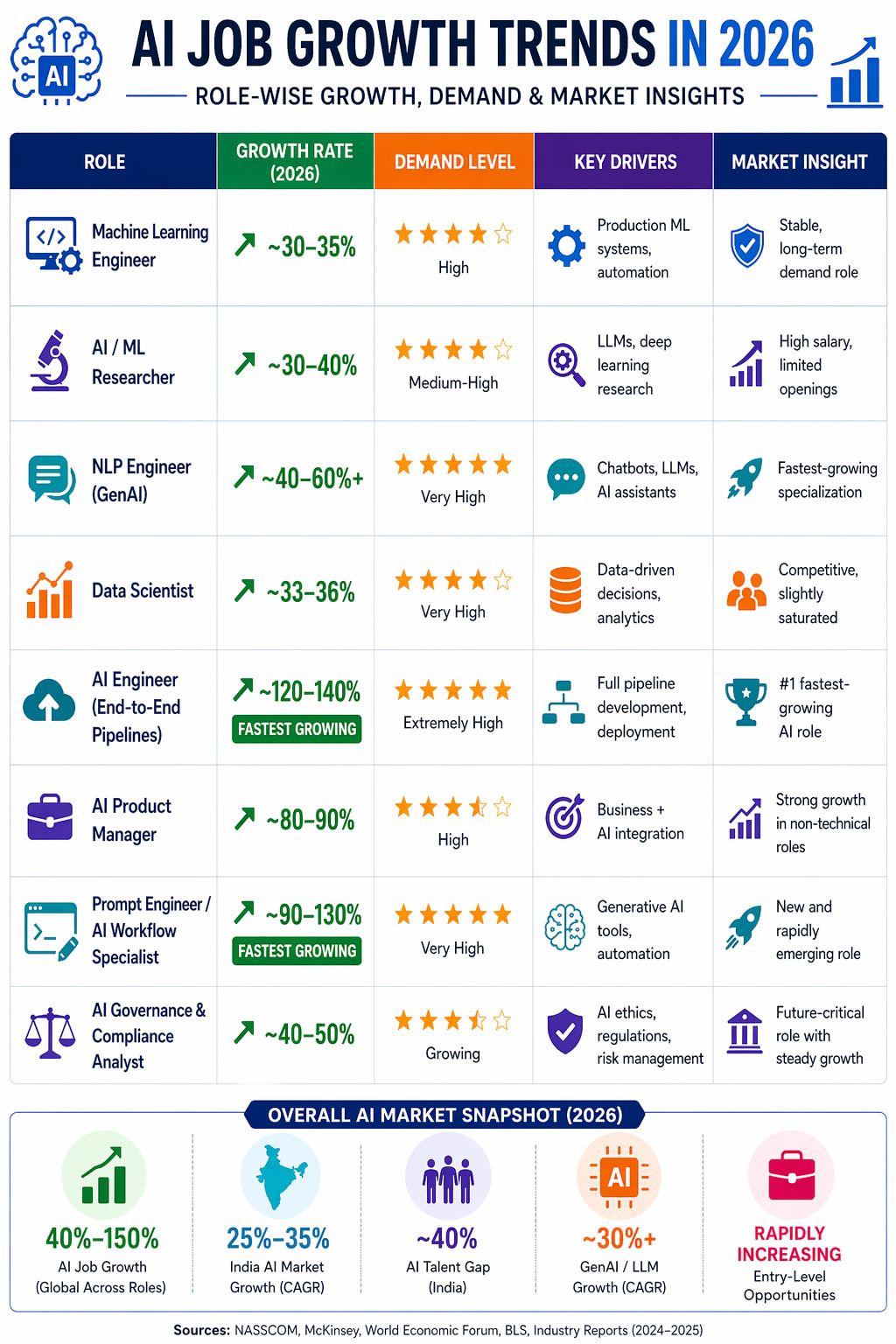
However, competition is rising rapidly, making a structured, step-by-step roadmap essential for successfully landing an AI job today.
Understand what AI jobs actually look like in 2026
Before you start, map the landscape: AI in 2026 isn’t just “data scientist” and “AI engineer.” Roles now span:
-
Machine Learning Engineer
-
AI/ML Researcher
-
NLP Engineer
-
Data Scientist
-
AI Engineer (end‑to‑end pipelines)
-
AI Product Manager
-
Prompt engineer / AI‑workflow specialist
-
AI Governance & Compliance Analyst
In 2026, the median salary range for core AI roles is approximately ₹10–15 LPA for good entry-level positions in India and $140,000–$200,000+ for senior ML/AI engineers and research scientists in the US and Europe.
Key shift in 2026:
-
Nowadays, a lot of businesses demand production-grade AI expertise, which includes deployment, monitoring, and fine-tuning of models in actual systems in addition to Kaggle-style notebooks.
-
Even non-technical roles, such as business analysts using AI-driven dashboards or marketers employing generative artificial intelligence for content, require AI literacy.
Top Skills Required for Artificial Intelligence Jobs
In 2026, employers were not impressed by the statement, "I watched an AI YouTube series." They want at least one domain in addition to Python, the foundations of machine learning, and contemporary AI tools.
Programming
-
Python (NumPy, Pandas, scikit-learn, Matplotlib, Jupyter).

-
Basic SQL for data querying.
-
Optional but useful: Bash, Git, and REST APIs.


Math & statistics
-
Linear algebra (vectors, matrices, dot products).
-
Probability & statistics (distributions, hypothesis testing, p‑values, A/B testing).
-
Calculus basics (gradients, derivatives; mainly for understanding ML, not deriving it from scratch).
Machine learning fundamentals
-
Supervised vs unsupervised learning.
-
Classic algorithms: linear/logistic regression, decision trees, random forests, SVM, k‑means.
-
Evaluation: accuracy, precision‑recall, F1, ROC‑AUC, confusion matrix, bias‑variance trade‑off.
-
Feature engineering and hyperparameter tuning (GridSearch, RandomSearch, basic Bayes‑opt).
Deep learning & modern AI tools
-
Neural networks, CNNs (for vision), RNNs/LSTMs (for sequences).
-
Transformers and LLMs (conceptually and operationally).
-
Frameworks: PyTorch (most research‑heavy) and TensorFlow/TFX (more enterprise).
2026‑specific must‑haves
-
Prompt engineering and LLM integration (OpenAI API, Anthropic, local models).
-
Fine‑tuning and RAG (Retrieval‑Augmented Generation) for domain‑specific Q&A.
-
Vector databases (Pinecone, Weaviate, FAISS, etc.) for semantic search and memory systems.
-
LangChain-like frameworks for building AI workflows and agents.
Step-by-Step Guide to Getting an AI Job in 2026
1. Build Strong Foundations
Before jumping into advanced AI topics, you need solid fundamentals:
-
Mathematics: Gain a solid understanding of statistics, probability, and linear algebra to develop a strong sense for machine learning algorithms.
-
Programming: Learn all there is to know about Python, including fundamental scripting for data manipulation tasks and libraries like NumPy and Pandas.
-
Core Concepts: Design effective, broadly applicable machine learning models by understanding supervised, unsupervised learning, and bias-variance tradeoff.
Developing a solid basis in mathematics, programming, and machine learning principles is crucial because advanced tools and frameworks will seem unclear and challenging without the fundamentals.
2. Choose the Right AI Career Path
AI is not one job—it’s a collection of roles. Picking a direction early helps you focus.
Popular AI roles include:
-
Machine Learning Engineer: Creates, develops, refines, and implements machine learning models for production systems that are scalable.
-
Data Scientist: Creates predictive models for decision-making by analyzing complex datasets and extracting insights.
-
NLP Engineer: Uses natural language techniques to create text processing systems, chatbots, and language models.
-
Computer Vision Engineer: Creates AI systems for tasks including object identification, image recognition, and video analysis.
-
AI Product Manager: Manages development, strategy, and product lifecycle while coordinating corporate objectives with AI solutions.
Early AI career path selection helps you stay focused and on course, enabling you to gain deep competence rather than mastering too many unrelated subjects.
3. Master Industry Tools and Frameworks
To be job-ready, you must be comfortable with widely used tools:
-
Frameworks: Learn PyTorch with TensorFlow to create scalable deep learning and machine learning models.
-
Data Handling: For effective data transformation, cleaning, and large-scale processing jobs, use Pandas, NumPy, and SQL.
-
Visualization: Make intelligent graphs, charts, and visual data representations by utilizing Matplotlib with Seaborn.
-
Deployment Basics: To deploy AI apps, be familiar with APIs, Docker, and cloud platforms like AWS, GCP, and Azure.
Gaining proficiency with industry tools and frameworks is crucial since recruiters frequently assess applicants based on their practical abilities, and familiarity with widely used technology greatly increases the likelihood of being shortlisted.
4. Build Real-World Projects
Projects are your biggest differentiator.
Strong project ideas:
-
AI chatbot using NLP
-
Movie/product recommendation system
-
Image classifier using deep learning
-
Fraud detection model
Make sure your projects:
-
Solve real problems
-
Use clean, documented code
-
Are hosted on GitHub
Working on real-world projects makes you stand out since a single, well-completed project that demonstrates problem-solving skills is more useful than several unfinished or badly handled projects.
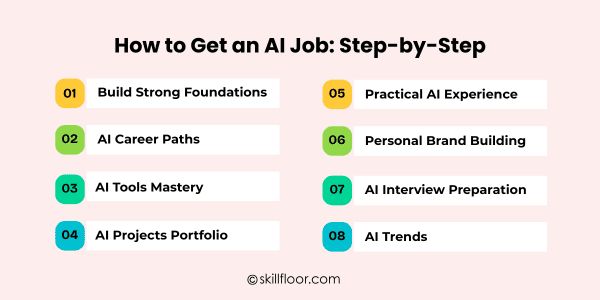
5. Gain Practical Experience
In 2026, certifications alone won’t get you hired.
Instead:
-
Apply for internships (even unpaid initially if necessary)
-
Work with startups or small businesses
-
Take freelance AI projects
-
Participate in Kaggle competitions
By exposing you to real-world difficulties through internships, freelancing, or collaborations, you may demonstrate to companies that you can effectively use knowledge beyond theoretical comprehension.
6. Build Your Personal Brand
Your online presence can significantly impact your job search.
Focus on:
-
GitHub: Showcase polished AI projects with clear code, documentation, and practical applications on GitHub.
-
LinkedIn: Enhance your LinkedIn profile by emphasizing your accomplishments, credentials, abilities, and regular involvement to draw in recruiters.
-
Blogging: To increase your reputation and visibility, write blogs that describe your learning process, AI principles, and project insights.
Since recruiters frequently review profiles, developing a strong online personal brand enhances visibility. Additionally, exhibiting projects, abilities, and insights might generate chances prior to actively applying.
7. Prepare for AI Job Interviews
AI interviews test both theory and practical skills.
Be ready for:
-
Coding Questions: Learn the fundamentals of data structures and algorithms to effectively handle coding challenges during technical interviews.
-
ML Concepts: Gain an understanding of regularization, overfitting, and model evaluation methods to create reliable machine learning models.
-
Case Studies: Use machine learning ideas to solve real-world problems to show that you have organized thought and problem-solving abilities.
-
Project Discussions: During interviews, thoroughly describe your projects' methods, difficulties, solutions, and effects.
Strong communication skills are essential for interview preparation since inadequate explanations can undermine a technically sound profile. This is especially true for projects, choices, and strategies.
8. Stay Updated with AI Trends in 2026
AI evolves fast. Staying updated is non-negotiable.
Key trends to follow:
-
Generative AI and large language models
-
AI automation tools
-
Ethical AI and bias reduction
-
AI integration in everyday business tools
Staying up with AI developments guarantees relevance in a rapidly evolving field, giving you a competitive edge over applicants who rely on antiquated expertise and assisting you in understanding new technology.
To stay updated, enrolling in a practical artificial intelligence course can help you understand evolving AI careers, explore job opportunities, and build relevant skills needed to stay competitive.
Common Mistakes to Avoid
Avoid common mistakes that slow your AI career growth and opportunities.
-
Ignoring Core Concepts: Focusing on techniques without understanding fundamental ideas results in superficial knowledge and the incapacity to successfully address actual issues in real-world situations.
-
Too Many Courses: Too many course changes lead to confusion, disrupt learning consistency, and limit the development of deep knowledge in any particular field.
-
Skipping Real Applications: Your ability to develop workable solutions is hampered by ignoring deployment and practical applications, which makes your skills less applicable to industry demands.
-
No Project Portfolio: Recruiters like applicants who can show practical skills through genuine projects; thus, failing to construct a portfolio lowers your visibility to them.
-
Waiting for Perfection: Opportunities are delayed by waiting to be perfect before applying because interviews, feedback, and practical work experience are frequently the sources of true improvement.
-
Lack of Practice: Your analytical thinking, which is crucial for succeeding in interviews and real-world AI employment, is weakened if you don't routinely practice problem-solving.
Avoiding these mistakes will greatly enhance your learning effectiveness and professional development. To stand out in the crowded AI job market, concentrate on consistency, real-world applicability, and ongoing improvement.
Your 6-Month Action Plan (Start Today)
A roadmap is only effective if you know exactly what has to be done at each step. Let's examine this so you're not just "busy," but actually moving closer to an AI job.
Month 1–2: Build Your Foundation
Learn the fundamentals of Python, statistics, and basic machine learning ideas through regular practice, short coding tasks, and comprehension of how algorithms handle straightforward issues.
Month 3–4: Start Building Real Projects
Build two or three real-world AI projects, concentrate on problem-solving, use machine learning libraries, and demonstrate your ability to produce workable solutions to put your expertise to use.
Month 5–6: Turn Your Work into Opportunities
Make a professional portfolio that highlights your work, enhance your resume, begin applying for internships or positions, engage in active networking, and get ready for interviews by practicing explanations and editing concepts.
Following a structured six-month plan helps you stay focused; choosing the right training provider like Skillfloor can guide your learning, strengthen practical skills, and improve your chances of landing AI roles.
FAQs
1. Do I need a degree to get a job in Artificial Intelligence in 2026?
No, a degree is not required. Strong skills, real projects, and practical knowledge can help you get hired in artificial intelligence.
2. How long does it take to become job-ready in AI?
It usually takes six to twelve months with consistent learning, practice, and building projects, depending on your background and dedication level.
3. Which programming language is best for AI?
Python is the best programming language for AI because it is easy to learn and supports powerful libraries for building machine learning models.
4. Can non-technical people start a career in AI?
Yes, non-technical people can start learning AI by beginning with the basics, practicing regularly, and gradually building projects to gain confidence and skills.
5. What matters more: certificates or projects?
Projects matter more than certificates because they show your practical skills, problem-solving ability, and real understanding of artificial intelligence concepts to recruiters.
6. How do I stand out when applying for AI jobs?
You can stand out by building unique projects, creating a strong portfolio, networking actively, and clearly explaining your work during applications and interviews.
In 2026, breaking into artificial intelligence won't require being perfect or having all the answers right away. It's about developing things that show your skills and following clear, consistent steps. Many people slow down because they spend too much time learning and not enough time acting. You will already be ahead of most beginners if you concentrate on solid fundamentals, useful projects, and actual experience. Although the road may seem overwhelming at times, perseverance makes a significant difference. Even if you don't feel ready, don't be afraid to apply, keep becoming better little by little, and maintain your curiosity. Those who act and keep going, even in the face of uncertainty, are presented with opportunities.
Artificial Intelligence Course in Bangalore | AI Course in Chennai | Data Science Course in Bangalore | Data Science Training in Chennai | Digital Marketing Course in Bangalore | Digital Marketing Course in Chennai
Digital Marketing Courses in Other Locations in India
Ahmedabad | Aurangabad | Bangalore | Bhilai | Bhopal | Bhubaneshwar | Chandigarh | Chennai | Cochin | Coimbatore | Dehra Dun | Delhi | Faridabad | Ghaziabad | Gorakhpur | Guntur | Gurgaon | Guwahati | Hyderabad | Jaipur | Kanpur | Khammam | Kolkata | Lucknow | Madurai | Mumbai | Mysore | Nagpur | Noida | Patna | Pondicherry | Pune | Ranchi | Shimoga | Surat | Thane | Thiruvananthapuram | Tiruchirappalli | Tirupati | Vadodara | Visakhapatnam | Warangal | Jalandhar | Jodhpur | Indore | Durgapur | Jamshedpur | Dhanbad | Kota | Karnal | Udaipur | Amritsar | calicut | Nashik | Ludhiana | varanasi | thrissur | Mangalore | Raipur |