








































What Is the Main Goal of Generative AI and Why It Matters in 2026
Learn the main goal of generative AI and why it matters in 2026. See how it helps improve speed, creativity, and productivity for work and business growth now.
Ever feel like everyone around you is already using AI to work faster and stay ahead, while you are still figuring out where to start? I have seen many professionals feel this gap as generative AI becomes part of daily work.
As I explored generative AI tools, I saw how quickly they improved efficiency, speed, and thought processes. Additionally, studies reveal that users can increase productivity by about 5–10%, saving several hours every week by completing tasks more quickly and effectively.
According to industry reports, the generative AI market is expanding quickly and is expected to reach $55–120 billion by 2026, with a robust annual growth rate of 33–37%, showing its growing significance in business systems.
Currently, 82% of businesses actively incorporate AI into their operations. This demonstrates that it is a reliable technology that is becoming a standard component of how work is completed across industries rather than merely a new fad.


What is Generative AI?
A type of artificial intelligence known as "generative AI" is capable of creating original content, rather than merely examining or evaluating existing data.
Generative AI goes beyond standard AI, which primarily searches for patterns or generates predictions. Large volumes of data are used to teach it new things, which it then uses to make something new.
Examples of Generative AI in Action:
-
Writing blog posts, emails, or stories
-
Creating images and artwork from text prompts
-
Generating code for apps and websites
-
Producing music or voice simulations
In simple terms, generative AI is a type of artificial intelligence that functions similarly to a creative assistant by quickly creating text, images, or thoughts that resemble those of a human.
How Does Generative AI Work?
Generative AI utilizes deep learning models, especially transformer-based systems like GPT. These models have been trained on billions of words from books, webpages, and articles, allowing them to operate at an advanced level. By learning linguistic patterns, these models can predict the next word in a sentence. With over 100 billion parameters, modern models are capable of producing accurate, human-like writing with proper grammar and structure.
Generative AI employs models such as GANs and diffusion models for images and audio. Diffusion models gradually transform random noise into distinct visions, whereas GANs compete between two networks to produce realistic outputs. Diffusion models have reportedly increased image quality by more than 30% in recent years, producing outputs that are more detailed and lifelike than those of previous systems.
The Main Goal of Generative AI
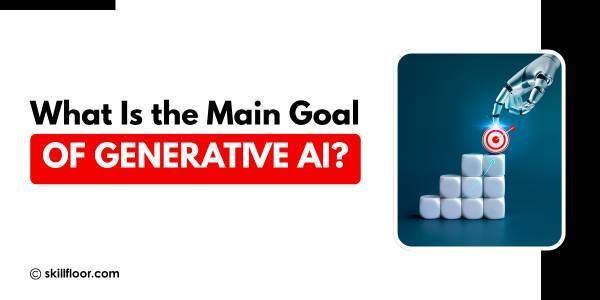
Creating meaningful, human-like content from data is the main goal of generative AI. Personalized user experiences, task automation, and inventiveness are all part of this objective.
1. Creativity at Scale
Companies as well as people may easily create high-quality content with the help of generative AI. These days, tasks that used to take hours or days can be finished in minutes. In fact, studies suggest that around 90% of content marketers are expected to use AI for content creation, showing how quickly this technology is becoming essential.
2. Automation of Knowledge Work
It frees up workers to concentrate more on crucial and strategic work by automating processes like creating code, summarizing information, and making reports.
3. Personalization
AI can create user-specific content, including suggestions, marketing messages, and customized learning resources.
4. Faster Decision-Making
Businesses and people may make better decisions faster due to generative AI's ability to swiftly examine data and produce insights.
5. Idea Generation and Innovation
It supports innovation in a variety of sectors by assisting in the generation of fresh concepts, overcoming creative blockages, and exploring alternative options.
Why This Goal Matters in 2026
By 2026, generative AI will have grown from a simple tool to an essential component of digital interaction, influencing how people work, create, and communicate on a daily basis.
1. Shift from Consumption to Creation
AI is now being used by people to create content rather than merely consume it. These days, anyone may write, create, or construct without any technological expertise.
2. Productivity Explosion
Generative AI is increasing productivity across industries:


-
Marketers create campaigns faster
-
Developers write and fix code efficiently
-
Students learn in smarter ways
3. Democratization of Creativity
Expertise is no longer required. Anyone can effortlessly generate excellent content and make ideas come to life due to AI.
4. Real-Time Assistance
AI provides immediate assistance when drafting emails or resolving issues; it functions as a smart assistant that is constantly on hand.
5. Faster Learning and Skill Development
By instantly offering explanations, examples, and advice, generative AI facilitates the rapid acquisition of new abilities, making learning simpler and more accessible for everybody.
Key Uses and Examples of Generative AI
The practical uses of generative AI make its objectives evident. These days, it is utilized in a wide range of industries to produce content, automate processes, and boost productivity in various ways.
1. Content Writing and Language Generation
Generative AI helps authors and businesses save time, increase productivity, and create ideas fast and consistently of high quality by creating human-like prose for blogs, emails, articles, and more.
2. Visual Design and Image Generation
Designers and artists can swiftly build visuals, explore creative ideas, and make high-quality designs without having to start from scratch thanks to generative AI, which generates images from text prompts.
3. Audio and Music Creation
With the help of generative AI, artists can simply create audio content, experiment with various styles, and improve projects without the need for advanced tools.
4. Video Production and Animation
By creating images, recommending adjustments, and accelerating production, generative AI facilitates the creation of videos, animations, and other visual content, making it simpler for creators to make captivating content.
5. Programming and Code Generation
By creating code, correcting mistakes, and offering solutions, generative AI helps developers create applications more quickly, minimize human labor, and increase overall software development efficiency.
Real-World Applications of Generative AI
Let's examine how generative AI is applied in real-world situations to fully understand its significance.
1. Content Creation
Bloggers, marketers, and creators use AI to:
-
Write articles and scripts
-
Generate social media posts
-
Create marketing copy
AI technology enhances the speed and quality of content creation; ChatGPT, for example, facilitates the rapid and effective writing of blogs, emails, and marketing content.
2. Software Development
Developers use AI tools to:
-
Generate code snippets
-
Debug errors
-
Build entire applications faster
AI copilots help engineers write code, correct errors, and create applications more quickly. Machine learning systems shorten development times and increase productivity.
3. Healthcare
Generative AI is helping professionals by:
-
Assisting in medical documentation
-
Summarizing patient data
-
Supporting diagnostic insights
Although maintaining the importance of human expertise, smart algorithms assist physicians in making better healthcare decisions by facilitating more efficient analysis of reports and patient data.
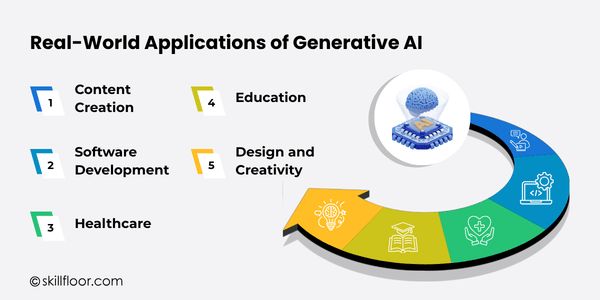
4. Education
Students and teachers benefit from:
-
Personalized learning content
-
AI tutors and explanations
-
Automated grading and feedback
AI-powered tools enable students to learn at their own comfortable speed, comprehend difficult subjects, and receive immediate explanations.
5. Design and Creativity
Designers and artists use AI to:
-
Create visual concepts
-
Generate artwork
-
Explore new creative ideas
Deep learning models foster creativity in design, with image generators serving as designers' creative collaborators to produce concepts, artwork, and graphics.
Benefits of Generative AI
The development of generative AI has various benefits, including increased productivity, less effort, enhanced creativity, and effective job scaling for people as well as businesses.
1. Speed and Efficiency
By processing information quickly, neural networks enable tasks that previously required hours to be completed in a matter of minutes.
2. Cost Reduction
By managing repetitive operations, reducing human labor, and enabling more efficient resource allocation, automation technology lowers operating expenses.
3. Enhanced Creativity
By offering suggestions, eliminating creative roadblocks, and facilitating users' exploration of novel ideas and inventive solutions, generative models foster creativity.
4. Accessibility
People without technological expertise can easily complete difficult jobs and produce high-quality content thanks to intelligent technologies that make advanced tools accessible.
5. Scalability
Businesses can scale operations and content effectively with AI-driven platforms, generating massive amounts of work without sacrificing consistency or quality.
Challenges and Risks of Generative AI
Although generative AI has many benefits, there are drawbacks as well, including bias, false information, job changes, and ethical issues that users need to be aware of.
1. Misinformation and Deepfakes
AI-generated content can propagate false information and deepfakes, making it more difficult to discern the truth, particularly if users don't thoroughly check their sources.
2. Bias in AI Models
Biases from training data may be reflected in AI models, producing unfair or erroneous results that could have a detrimental effect on choices and real-world results.
3. Job Displacement Concerns
Automation has the potential to replace monotonous tasks, which raises concerns about job losses. However, it also necessitates that people adapt and acquire new skills for changing positions.
4. Over-Reliance on AI
Over-reliance on AI tools may eventually diminish users' capacity for critical thought, creativity, and problem-solving, leaving them less capable of making their own decisions.
5. Data Privacy and Security Risks
Sensitive data may be handled by generative AI systems, raising privacy, data abuse, and security problems, if necessary, measures are not taken.
The Future of Generative AI Beyond 2026
Beyond 2026, the future of generative AI looks promising, thanks to the rapid advancement of technology. It is expected to become more intelligent, efficient, and integrated into everyday life, allowing individuals to work faster, create higher-quality content, and address problems more quickly and accurately across various industries.
As generative AI evolves, it will focus on ethical development, multimodal experiences, and personalization. AI will play a vital role in digital transformation, as people will interact with it more naturally, and organizations will rely on it to enhance customer experiences, boost productivity, and make better decisions.
Learning artificial intelligence is becoming increasingly valuable for professionals and students in today’s rapidly evolving digital world. Exploring AI concepts and real-world applications can help you build relevant skills and stay updated with emerging technologies.
If you’re interested in going deeper, structured learning through an artificial intelligence course can be a helpful way to build a strong foundation and gain practical understanding of the field.
FAQs on Generative AI
1. Why is Generative AI becoming so popular today?
Generative AI is popular because it quickly creates content, saves time, and boosts productivity.
2. How is Generative AI different from traditional AI?
Traditional AI mainly analyzes data and makes predictions, while generative AI creates new content based on what it has learned from large datasets.
3. Where is Generative AI used?
Generative AI is used in content creation, software development, healthcare, education, design, marketing, and many other industries to improve efficiency and creativity.
4. Is Generative AI safe to use?
Generative AI is generally safe, but users should be careful about misinformation, data privacy, and verifying outputs before using them in important tasks.
5. Will Generative AI replace human jobs?
Generative AI may change some jobs, especially repetitive ones, but it also creates new opportunities and works best when combined with human skills and creativity.
Generative AI is changing how we work, learn, and create in everyday life. It is here to support and enhance what we can achieve, not to replace humans. It is turning into a helpful collaborator for everything from writing and creating to studying and coding. Those who are familiar with it will benefit as more people use it. Continued curiosity and learning are the finest paths forward. See how these tools can benefit you by making little use of them. Those who adapt early and make intelligent, balanced use of technology will own the future.
Digital Marketing Courses in Other Locations in India
Ahmedabad | Aurangabad | Bangalore | Bhilai | Bhopal | Bhubaneshwar | Chandigarh | Chennai | Cochin | Coimbatore | Dehra Dun | Delhi | Faridabad | Ghaziabad | Gorakhpur | Guntur | Gurgaon | Guwahati | Hyderabad | Jaipur | Kanpur | Khammam | Kolkata | Lucknow | Madurai | Mumbai | Mysore | Nagpur | Noida | Patna | Pondicherry | Pune | Ranchi | Shimoga | Surat | Thane | Thiruvananthapuram | Tiruchirappalli | Tirupati | Vadodara | Visakhapatnam | Warangal | Jalandhar | Jodhpur | Indore | Durgapur | Jamshedpur | Dhanbad | Kota | Karnal | Udaipur | Amritsar | calicut | Nashik | Ludhiana | varanasi | thrissur | Mangalore | Raipur |