













































Voice Search Optimization: How It Affects Digital Marketing
Curious how Voice Search Optimization affects digital marketing? Discover how it can boost all your traffic, reach more customers, and grow your business fast.

“Hey Siri, find me the best digital marketing course near me.”
This small adjustment shows how people today use technology in various ways. They express their searches rather than typing them. Voice search is expanding quickly and altering how companies plan their digital marketing as platforms like Google Assistant, Alexa, and Siri become more common.
Every month, there are more than a billion voice searches. The market reached $4.7 billion in 2024 and will reach $14. 8 billion by 2033, growing at a rate of 13.6% annually. By 2025, there will be 153.5 million adult users in the US, increasing each year by 3%, and 30% of homes will have smart speakers. Growth is booming.
Voice search on digital marketing currently accounts for half of all online searches, requiring brand adaptation. It drives $81.8 billion in global voice sales annually, with nearly 50% of US consumers depending on it. If you don't take advantage of this enormous revenue opportunity, others will succeed. Now is the time to change strategies.


What is Voice Search Optimization (VSO)?
Improving your online content to have it appear when users use voice search is known as voice search optimization, or VSO. Users speak their questions instead of typing them, thus your information should reflect their speech patterns.
VSO places greater emphasis on everyday language and natural sentences than does standard SEO, which concentrates on short keywords. Your content should provide concise, understandable answers to the topics that people typically ask while conversing.
Let’s look at a simple example:
Typed search: “best digital marketing course”
Voice search: “Which is the best digital marketing course near me?”
Have you noticed the difference? Voice searches typically last longer and have a more realistic tone. Phrases like "near me," "right now," and "how to" are frequently used. Voice search is more concerned with meaning, intent, and natural speaking manner than traditional SEO, which concentrates on short keywords.
Why Voice Search Is Growing So Rapidly
Voice search is a sign of how technology is becoming more human-centric, not just a fad. This expansion is being driven by a number of factors:
1. Smartphone Penetration
Nowadays, almost everyone possesses a smartphone, and the voice assistants that come with them make searching simpler and alter how consumers engage with digital marketing.
2. Smart Devices and IoT
Voice-enabled technology is becoming a commonplace aspect of daily life because of the widespread use of smart speakers and connected home appliances.
3. Convenience and Speed
Speaking is quicker than typing, so people may search while multitasking, cooking, or driving, saving time and effort.
4. Rise of Local Searches
Local SEO tactics are more important in digital marketing as a lot of voice searches, such as "restaurants near me," are location-based.
How Voice Search is Changing User Behavior
Adapting your marketing plan requires an understanding of user behavior. People's search behavior is being impacted by voice search in a number of significant ways:
1. Conversational Queries
Search inquiries are getting more natural, understandable, and human-like because people communicate in complete phrases rather than short keywords.
2. Question-Based Searches
Voice searches often begin with:
-
Who
-
What
-
Where
-
When
-
Why
-
How



For example: How can I find the best digital marketing course near me?
3. Local Intent
Many voice searches concentrate on local areas, and users anticipate quick, pertinent answers depending on their current location.
4. Expectation of Instant Answers
Users are looking for quick, easy responses. Instead of displaying a lengthy list of possibilities, voice assistants typically give a single, concise response.
Impact of Voice Search Optimization on Digital Marketing
Voice search optimization is a marketing revolution as much as a technology advancement. The following are some ways it is changing the digital landscape:
1. SEO is Becoming Conversational
The effectiveness of traditional keyword targeting has decreased. To enhance digital marketing success, voice search optimization emphasizes natural language, long-tail keywords, and comprehending user intent.
Key Strategies:
-
Focus on question-based long-tail keywords
-
Use natural, conversational language
-
Align content with user intent
-
Create clear and concise answers
2. Importance of Featured Snippets
Featured snippets are frequently used by voice assistants to extract results. By optimizing for position zero, you can increase your digital marketing reach and search engine optimization visibility.
Key Strategies:
-
Provide direct answers to questions
-
Use structured formatting like lists and bullet points
-
Keep content concise and clear
-
Include important keywords naturally
3. Local SEO Becomes Critical
Location is often the basis for voice searches. Businesses can use local SEO optimization as part of a digital marketing strategy to draw in local clients.
Key Strategies:
-
Keep Google Business Profile updated
-
Include accurate contact details
-
Encourage positive customer reviews
-
Use location-specific keywords in content
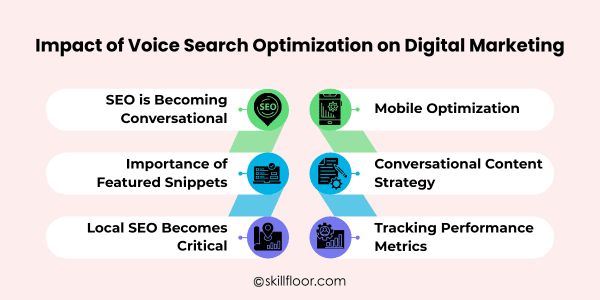
4. Mobile Optimization is Essential
The majority of voice searches take place on mobile devices. User experience is enhanced and successful digital marketing campaigns are supported by mobile-friendly websites.
Key Strategies:
-
Responsive website design
-
Fast page loading speed
-
Easy navigation and layout
-
Optimize images and media for mobile
5. Conversational Content Strategy
Content needs to be consistent with speech. Conversational writing boosts digital marketing initiatives for voice search, increases engagement, and supports SEO.
Key Strategies:
-
Write FAQ-style or Q&A content
-
Include question-based headings
-
Use simple, human-friendly language
-
Focus on natural long-tail keywords
6. Tracking Performance Metrics
New metrics are needed for voice search. Monitoring results aids in improving digital marketing efforts and search engine optimization (SEO) strategies to better align with voice search behavior.
Key Strategies:
-
Monitor long-tail keyword traffic
-
Track position zero rankings
-
Analyze local search performance
-
Adjust content for voice search trends
Key Strategies for Voice Search Optimization
Now that we understand how voice search Optimization impacts digital marketing, let's examine important tactics companies may employ to enhance their content and increase search exposure.
1. Focus on Long-Tail and Question Keywords
Voice searches are typically more conversational and take longer. To increase user engagement and improve your digital marketing outcomes, identify question-based queries that your audience uses and organically include them into your content.
Tips:
-
Research common questions
-
Use long-tail keywords naturally
-
Answer user intent clearly
-
Include these phrases in headings
2. Improve Website Speed and Performance
Users using voice searches anticipate immediate results. Websites that load slowly are detrimental to user experience and rankings. For digital marketing campaigns, speed optimization guarantees increased engagement, retention, and performance.
Ways to improve speed:
-
Compress images and videos
-
Enable browser caching
-
Minimize unnecessary code
-
Use a reliable hosting service
3. Use Structured Data (Schema Markup)
Structured data increases your chances of being chosen for voice search results by assisting search engines in comprehending the context of your material, which also helps with indexing in SEO. Additionally, it improves your presence in digital marketing and SEO.
Tips:
-
Add FAQ and How-To schema
-
Include product or service details
-
Highlight events or offers
-
Keep schema up to date
4. Write Conversational Content
Content needs to imitate human speech. By making your content more accessible and understandable, writing naturally increases engagement, aligns with voice queries, and supports digital marketing strategies.
Tips:
-
Use simple, everyday language
-
Structure content in Q&A format
-
Include short, clear sentences
-
Avoid jargon and complex terms
5. Optimize for Mobile Devices
The majority of voice searches take place on tablets and smartphones. Making your website mobile-friendly boosts digital marketing results, decreases bounce rates, and improves usability.
Tips:
-
Use responsive design
-
Simplify navigation for small screens
-
Ensure fast mobile loading speed
-
Test pages on multiple devices
6. Create Content for Voice Search Intent
Pay attention to the particular requirements that underlie voice questions. Customizing content to promptly and clearly address queries enhances SEO performance and fortifies digital marketing tactics for voice-driven searches.
Tips:
-
Anticipate user questions
-
Provide concise, actionable answers
-
Use conversational, natural tone
-
Update content regularly to stay relevant
Voice Search and Content Strategy
For voice search optimization, content is important. Businesses may effectively coordinate their content strategy to increase SEO and engagement by producing content that is clear, conversational, and question-focused.
1. Use FAQ Pages
Because FAQ sites match question-based requests and offer brief responses that voice assistants can read aloud, they are effective for voice search.
2. Write in a Q&A Format
Arrange blog content according to frequently asked user questions. This increases the likelihood of being selected for voice search and helps search engines in comprehending the text.
3. Focus on Natural Tone
Stay away from formal or robotic language. To make information easy to read and appealing to voice search users, write in a natural, conversational style.
4. Embrace Semantic Search
Nowadays, search engines take into account context in addition to precise terms. Concentrate on the content's significance and provide a clear response to user intent.
Challenges of Voice Search Optimization
Although voice search has a lot of opportunities, there are obstacles that companies need to be aware of in order to properly optimize their content for better outcomes.
1. Limited Visibility
Only one or two responses are often displayed by voice assistants. Due to increased competition, it is more difficult for companies to show up in the top rankings.
2. Difficult to Track Performance
Metrics tracking for voice search is still in its infancy. In contrast to traditional SEO, companies find it difficult to precisely measure traffic, rankings, and conversions for optimization.
3. Privacy Concerns
Voice data sharing is met with caution by users. Concerns about privacy may discourage voice searches, which could have an impact on engagement and the effectiveness of digital marketing as a whole.
4. Language and Accent Variations
Inaccurate findings may arise from voice recognition's misinterpretation of various accents or languages. Both search accuracy and website visibility may be impacted by this.
The Future of Voice Search Optimization in Digital Marketing
Voice search is rapidly evolving and presents exciting opportunities for online advertising. AI-powered assistants will become increasingly intelligent, improving their ability to understand natural language, context, and user preferences. Optimizing for voice search allows businesses to engage with customers across various platforms, including wearables, cars, and homes.
As smart ecosystems and hyper-personalized experiences become more prevalent, search results will adapt to better reflect each user's interests and behaviors. With more people using voice commands to make purchases, voice commerce is expected to grow significantly. By adopting voice search optimization early, businesses can enhance their overall digital marketing strategy and gain a competitive edge.
Do you want to become an expert in digital marketing for the voice-first world? To remain ahead of current marketing trends, take a thorough digital marketing course at Skillfloor and master SEO, voice search optimization, content planning, and more.
FAQs about Voice Search Optimization
1. Why is voice search important for digital marketing?
Voice search is growing fast. Optimizing for it helps businesses reach customers quickly, improve SEO, and attract more local and mobile users.
2. How is voice search different from regular search?
Voice search uses natural, conversational language, often in full questions, unlike typed searches, which are shorter and focused on specific keywords.
3. What types of businesses should use voice search optimization?
All businesses can benefit, but local shops, e-commerce stores, and service-based companies gain more visibility and customer engagement.
4. How can I optimize my website for voice search?
Use long-tail question keywords, create FAQ pages, make content conversational, improve mobile experience, and ensure your website loads quickly.
5. Will voice search affect SEO in the future?
Yes, it will. SEO now needs to focus on conversational queries, user intent, and structured content to stay competitive in search results.
6. How do people use voice search in daily life?
People use voice search to ask questions, find nearby places, check information, get directions, or make quick purchases using smart devices or phones.
Voice search is transforming online decision-making and information discovery. Companies that adopt these changes will be able to communicate with clients more quickly and efficiently. Businesses may stay ahead of the competition by emphasizing conversational, concise content and local relevance. Understanding Voice Search Optimization for Digital Marketing enables organizations to increase user reach, enhance engagement, and improve outcomes without the need for complex tactics. Using Voice Search Optimization for Digital Marketing guarantees that your company stays visible, helpful, and trustworthy while improving the user experience for all users as more people rely on smart devices for everyday searches.
Digital Marketing Courses in Other Locations in India
Ahmedabad | Aurangabad | Bangalore | Bhilai | Bhopal | Bhubaneshwar | Chandigarh | Chennai | Cochin | Coimbatore | Dehra Dun | Delhi | Faridabad | Ghaziabad | Gorakhpur | Guntur | Gurgaon | Guwahati | Hyderabad | Jaipur | Kanpur | Khammam | Kolkata | Lucknow | Madurai | Mumbai | Mysore | Nagpur | Noida | Patna | Pondicherry | Pune | Ranchi | Shimoga | Surat | Thane | Thiruvananthapuram | Tiruchirappalli | Tirupati | Vadodara | Visakhapatnam | Warangal | Jalandhar | Jodhpur | Indore | Durgapur | Jamshedpur | Dhanbad | Kota | Karnal | Udaipur | Amritsar | calicut | Nashik | Ludhiana | varanasi | thrissur | Mangalore | Raipur |