













































High-Demand Machine Learning Jobs in India
Don’t miss high-demand machine learning jobs in India, top skills, salaries, and fast-growing AI careers shaping the future right now for better growth ahead.

Machine learning has been at the core of technology growth in recent years. It is used across many industries such as healthcare, banking, e-commerce, and manufacturing, helping businesses analyse data, improve services, and make better decisions. As companies continue to adopt machine learning in their daily operations, it is creating a growing need for professionals who can work with data and build intelligent systems.
This increasing adoption is directly driving the demand for machine learning talent in India. As startups and established companies invest in AI-based solutions, more job roles are being created across the IT sector. Positions such as Machine Learning Engineer, Data Scientist, and AI Specialist are widely available, with salaries ranging from ₹8 LPA to ₹40–90+ LPA. For those planning to enter this field, understanding the right skills and tools is important to build a strong and successful career.
Why Machine Learning Jobs Are Among the Highest Paying
Machine Learning jobs are among the highest-paying because they combine advanced technical expertise with strong business impact. Professionals in this field help companies make smarter decisions, improve efficiency, and build intelligent systems that directly influence revenue and growth.
Below are some key reasons why Machine Learning jobs offer high salaries:


-
High demand across industries: Companies in finance, healthcare, and e-commerce are actively hiring ML professionals. India’s AI and ML job sector is growing at a 33 to 40 per cent CAGR, increasing salary levels across roles.
-
Specialised and complex skill set: Machine Learning requires expertise in programming, statistics, algorithms, and data modelling. According to Glassdoor, top ML professionals in India can earn up to ₹34.94 LPA, showing the value of these skills.
-
Direct impact on business outcomes: ML models improve processes like fraud detection, recommendations, and predictive analytics. Since these directly affect revenue, companies invest more in skilled talent.
-
Strong salary growth with experience: Entry-level roles start around ₹8 LPA to ₹15 LPA, while experienced professionals can earn ₹20 LPA to ₹40 LPA or more. Senior professionals earn around ₹30.45 LPA on average, based on machine learning salary insights in India, with additional bonuses increasing total compensation.
-
Integration with advanced technologies: Machine Learning works with AI, big data, and cloud platforms. The average ML salary in India is projected to be around ₹10.88 LPA, higher than many other tech roles.
-
Global demand and opportunities: ML skills are in demand worldwide, offering access to international roles. Cities like Bengaluru, Hyderabad, and Mumbai lead in salary growth due to strong tech ecosystems.
Top High-Paying ML Job Roles in India
Machine learning careers in India are evolving at an extraordinary pace. Whether you're just starting or looking to level up, understanding the roles, salaries, and skill requirements is the first step toward building a high-impact AI career. Here's a breakdown of the most in-demand and highest-paying ML roles in 2026.
1. Machine Learning Engineer - A Machine Learning Engineer sits at the core of every AI-driven product team. This role is not just about writing code — it's about building intelligent systems that continuously learn, adapt, and improve in real-world environments.
The journey typically begins with strong proficiency in Python and a solid understanding of ML fundamentals. Over time, engineers work extensively with frameworks like TensorFlow and PyTorch, training models, optimising performance, and deploying them at scale using cloud infrastructure.
-
Average Salary: ₹7–25 LPA
-
Responsibilities: Design ML models; data preprocessing; deployment and monitoring of production systems.
-
Core Skills: Python, TensorFlow, PyTorch, ML algorithms, MLOps, Cloud platforms (AWS/GCP).
-
Growth: Junior MLE → ML Engineer → Senior ML Engineer → AI Architect
2. Data Scientist - A Data Scientist transforms raw data into meaningful business decisions. This role blends analytics, statistics, and machine learning to help organisations understand trends, predict outcomes, and improve decision-making at every level.
Day-to-day work involves cleaning and analysing large datasets, building predictive models, and communicating insights through dashboards and visualisations. Data Scientists collaborate closely with business teams to solve real-world problems using data-driven strategies.
-
Average Salary: ₹8–28 LPA
-
Responsibilities: Analyse large datasets; build predictive models; generate actionable business insights.
-
Core Skills: Statistics, SQL, Python, Scikit-learn, Data Visualisation, ML basics.
-
Growth: Junior Data Scientist → Data Scientist → Senior Data Scientist → Head of Analytics
3. MLOps Engineer - MLOps Engineers ensure that machine learning models don't just stay in notebooks — they run reliably and efficiently in production. This is one of the fastest-growing ML roles of 2026, focused on bridging the gap between development and deployment.
Engineers in this role design automated pipelines for training, testing, deploying, and monitoring ML models. They track model drift, manage versioning, and ensure scalability using cloud-native tools — making this role essential for any organisation running AI at scale.
-
Average Salary: ₹10–30 LPA
-
Responsibilities: Build ML deployment pipelines; monitor model performance; automate ML workflows.
-
Core Skills: Docker, Kubernetes, MLflow, Kubeflow, CI/CD, Cloud platforms, DevOps tools.
-
Growth: Junior MLOps Engineer → MLOps Engineer → Senior MLOps Engineer → ML Infrastructure Architect
4. Generative AI Engineer - Generative AI Engineers are at the forefront of modern AI innovation. They work with large language models to build intelligent applications — from chatbots and AI assistants to coding tools and autonomous agents.


Their work spans designing retrieval-augmented generation (RAG) pipelines, fine-tuning foundation models, and building real-world GenAI solutions that solve complex business problems. Demand for this role has surged dramatically in 2025–26, making it one of the most lucrative and high-growth entry points into the AI industry.
-
Average Salary: ₹12–35 LPA
-
Responsibilities: Build LLM-based applications; design RAG systems; develop AI agents and agentic workflows.
-
Core Skills: LLMs, LangChain, Prompt Engineering, RAG, Vector Databases, Python.
-
Growth: GenAI Engineer → Senior GenAI Engineer → GenAI Architect → AI Product Lead
5. AI/ML Solutions Architect - AI/ML Solutions Architects design the blueprint for large-scale AI systems deployed across enterprises. This role combines deep technical expertise with strong business acumen — ensuring ML models integrate seamlessly into existing infrastructure while remaining scalable, secure, and efficient.
Architects evaluate tools, design end-to-end workflows, and guide engineering teams toward building systems that align with long-term business goals. They serve as the critical link between technical execution and strategic vision at the organisational level.
-
Average Salary: ₹18–40 LPA
-
Responsibilities: Design end-to-end AI systems; define ML architecture; align AI solutions with business strategy.
-
Core Skills: System Design, Cloud Architecture, ML Pipelines, and Scalability Planning.
-
Growth: ML Engineer → Solutions Architect → Principal Architect → Chief AI Architect
6. AI Research Scientist - AI Research Scientists push the boundaries of what artificial intelligence can achieve. They develop new models, improve existing algorithms, and contribute to the global AI research community — publishing findings and influencing the direction of the entire field.
This role is common at organisations like Google, Microsoft, and leading R&D labs across India. It often requires a strong academic grounding and, in many cases, a Master's or PhD. Research Scientists work across deep learning, reinforcement learning, and generative AI.
-
Average Salary: ₹15–45 LPA
-
Responsibilities: Develop new ML algorithms; conduct AI research; publish academic papers and prototypes.
-
Core Skills: Deep Learning, Mathematics, PyTorch, Research Methodology, NLP/Computer Vision.
-
Growth: Research Scientist → Senior Research Scientist → Research Lead → Principal Scientist → AI Lab Head
7. NLP Engineer - NLP Engineers specialise in enabling machines to understand human language — work that powers chatbots, translation systems, sentiment analysis tools, and intelligent search engines used by millions every day.
They work with transformer models like BERT and GPT, fine-tune language models, and design NLP pipelines using frameworks like Hugging Face. As businesses across e-commerce, fintech, and SaaS increasingly rely on conversational AI, this role continues to grow at a rapid pace.
-
Average Salary: ₹8–22 LPA
-
Responsibilities: Build language models; develop chatbots and virtual assistants; perform text analytics.
-
Core Skills: Transformers, Hugging Face, BERT, GPT, spaCy, NLP Pipelines.
-
Growth: Junior NLP Engineer → NLP Engineer → Senior NLP Engineer → NLP Lead → Applied AI Scientist
8. Principal Data Scientist - A Principal Data Scientist is a senior leadership role responsible for driving high-impact AI initiatives across an organisation. They lead complex ML projects, mentor data science teams, and ensure AI solutions align with broader business objectives.
This role requires a rare blend of technical mastery and executive-level communication — acting as the bridge between engineering teams and organisational leadership, shaping the company's overall data and AI strategy at the highest level.
-
Average Salary: ₹25–50+ LPA
-
Responsibilities: Lead AI strategy; manage teams; deliver enterprise ML solutions.
-
Core Skills: Advanced Machine Learning, Leadership, Statistics, Stakeholder Management.
-
Growth: Senior Data Scientist → Principal Data Scientist → Chief Data Officer → AI Director
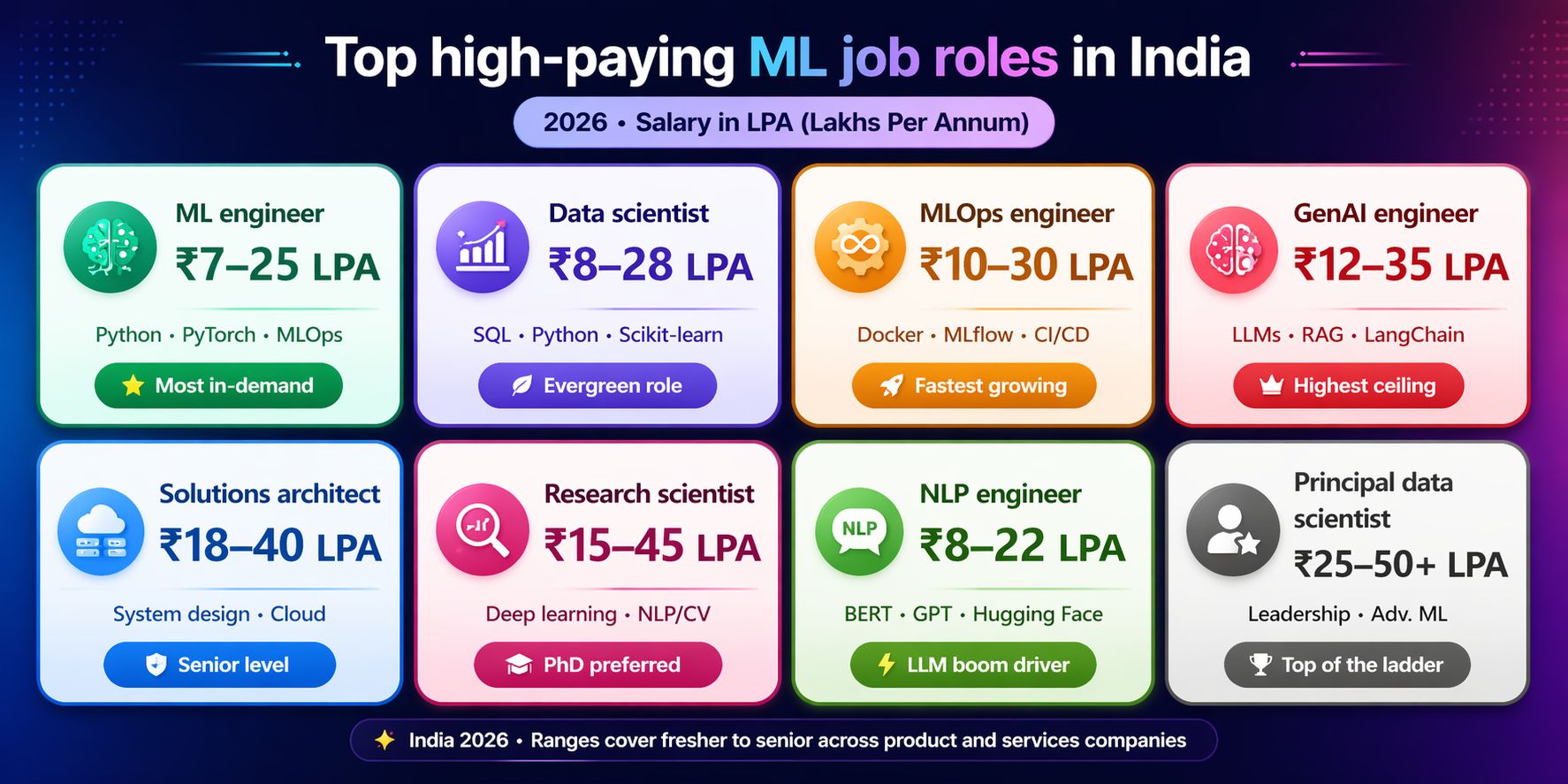
ML careers in India offer opportunities ranging from ₹7 LPA entry-level roles to ₹50+ LPA senior positions, driven by strong fundamentals and practical ML skills. Start with Python, ML basics, and hands-on projects—every advanced AI role begins with these foundations.
Top Industries Hiring ML Professionals in India
Machine Learning hiring in India is growing in 2026, with AI/ML job postings rising by around 35–45% across key industries such as IT, finance, and healthcare due to increased AI adoption. Overall, ML roles are among the fastest-growing tech careers, driven by AI integration across 6+ major industry sectors in India and globally.
|
Industry |
Why They Hire ML Talent |
Common ML Roles |
|
Information Technology (IT) & Software / GCCs |
Core drivers of AI adoption, building AI products, automation, and cloud-based solutions |
ML Engineer, AI Engineer, MLOps Engineer, GenAI Engineer |
|
Finance & Banking (FinTech) |
Uses ML for fraud detection, risk analysis, algorithmic trading, and customer personalisation |
Data Scientist, Quant ML Engineer, Fraud Detection Analyst |
|
Healthcare & Pharma |
Applies ML in diagnostics, medical imaging, drug discovery, and patient prediction systems |
AI/ML Scientist, Medical Data Analyst, NLP Engineer |
|
E-commerce & Retail |
Improves recommendations, demand forecasting, pricing, and customer behaviour analysis |
Data Scientist, Recommendation System Engineer |
|
Cybersecurity & Defense |
Uses ML for threat detection, anomaly detection, and secure systems |
AI Security Engineer, ML Security Analyst |
|
Automotive & Mobility |
Focuses on autonomous driving, smart systems, and sensor-based ML models |
AI Engineer, Computer Vision Specialist |
Essential Skills for Landing a Machine Learning Job
Strong programming mathematics cloud and generative AI machine learning skills ensure success in landing competitive modern ML engineering roles today.
-
Programming & Frameworks: Python remains the most essential language for any ML role. Beyond that, PyTorch has emerged as the dominant deep learning framework, alongside Scikit-learn, Keras, and SQL for data wrangling. Familiarity with the Hugging Face ecosystem is increasingly expected across most ML positions.
-
Mathematics & Theory: A strong foundation in linear algebra, calculus, probability, and statistics is non-negotiable. Understanding Bayesian reasoning and optimisation theory gives candidates a clear edge when working on complex model development and research-oriented roles.
-
Cloud & MLOps: Hands-on experience with cloud platforms like AWS, GCP, or Azure is now a standard requirement. ML professionals are also expected to know Docker, Kubernetes, MLflow, and Kubeflow, along with CI/CD pipelines for ML and model monitoring for drift detection in production environments.
-
Generative AI & LLMs: This is the fastest-growing skill area in 2026. Employers are actively looking for experience in LLM fine-tuning techniques like LoRA and QLoRA, RAG pipeline development, LangChain and LlamaIndex, prompt engineering, and vector databases such as Pinecone and Weaviate.
-
Soft Skills: Technical skills alone are not enough. Business context, cross-functional communication, problem framing, and the ability to write clear technical documentation are qualities that consistently separate good ML professionals from great ones.
-
Specialisations: Candidates with expertise in Computer Vision, NLP and Transformers, Reinforcement Learning, or AI Ethics and Explainability (XAI) often command premium salaries and have access to more niche, high-impact roles.
How to Get the Highest Paying Machine Learning Jobs in India?
Landing the best machine learning jobs in India requires a mix of strong technical skills, practical experience, and strategic career planning. Here’s how you can stand out.
- Build Strong Fundamentals in ML and AI: Start by mastering Python, statistics, linear algebra, data preprocessing, model building, and deployment basics. These skills form the foundation for machine learning engineer jobs and top AI and machine learning jobs for freshers.
- Gain Hands-On Project Experience: Companies prefer candidates who can apply ML concepts to real data. Work on projects involving NLP, computer vision, recommendation systems, and predictive analytics. Showcase them on GitHub and build a strong Machine Learning job profile.
- Get Certified Through Industry-Recognised Training: Complete ML certifications or professional training programs that offer guided learning and practical exposure. This increases your chances of securing high-paying machine learning jobs in India.
- Learn Deployment and MLOps: Modern ML roles demand skills in model deployment, CI/CD, Docker, cloud platforms, and monitoring pipelines. Knowledge of these tools opens doors to better-paying ML engineer positions.
- Network and Apply Strategically: Engage on LinkedIn, participate in hackathons, contribute to open-source, and apply to companies across finance, healthcare, IT, and product-based firms for top machine learning engineer jobs for freshers and experienced candidates.
In order to obtain high-paying machine learning jobs in India, you need to develop projects, strengthen your foundations, and think about structured learning through Skillfloor courses that will help you acquire real-world skills and confidence.
FAQ’s
Q1. Which Machine Learning job has the highest salary in India?
AI/ML Solutions Architects and Principal Data Scientists command the highest salaries in India, with Generative AI roles also emerging as some of the most lucrative positions in the current market.
Q2. Is Machine Learning a good career in India?
Yes, Machine Learning is one of the most promising and highest-paying careers in India, with the AI and ML job sector growing at a CAGR of 33 to 40 per cent and strong demand across multiple industries.
Q3. Can I get a Machine Learning job as a fresher?
Yes, freshers can land Machine Learning jobs in India by building strong Python and ML fundamentals, working on real-world projects, and showcasing a solid GitHub portfolio alongside industry-recognised certification.
Q4 . Which skills should I learn to get into ML?
Start with Python, statistics, and ML basics, then build hands-on experience with frameworks like TensorFlow and PyTorch, cloud platforms, and MLOps tools — adding Generative AI and LLM skills will give you a strong edge in today's job market.
Q5. Which industries hire the most ML professionals in India?
IT and software companies, Finance and Banking, Healthcare and Pharma, E-commerce, Cybersecurity, and Automotive are the top industries actively hiring ML professionals across India.
Machine Learning in India is growing, with strong demand across IT, finance, healthcare, and other industries. It offers a wide range of high-paying roles, from entry-level positions to senior leadership careers. Strong fundamentals, practical experience, and continuous learning are key to success in this field. Overall, ML focuses on solving real-world problems and delivering impactful AI-driven solutions.
Artificial Intelligence Course | Data Science Courses | Data Analytics Course | Digital Marketing Course
Digital Marketing Courses in Other Locations in India
Ahmedabad | Aurangabad | Bangalore | Bhilai | Bhopal | Bhubaneshwar | Chandigarh | Chennai | Cochin | Coimbatore | Dehra Dun | Delhi | Faridabad | Ghaziabad | Gorakhpur | Guntur | Gurgaon | Guwahati | Hyderabad | Jaipur | Kanpur | Khammam | Kolkata | Lucknow | Madurai | Mumbai | Mysore | Nagpur | Noida | Patna | Pondicherry | Pune | Ranchi | Shimoga | Surat | Thane | Thiruvananthapuram | Tiruchirappalli | Tirupati | Vadodara | Visakhapatnam | Warangal | Jalandhar | Jodhpur | Indore | Durgapur | Jamshedpur | Dhanbad | Kota | Karnal | Udaipur | Amritsar | calicut | Nashik | Ludhiana | varanasi | thrissur | Mangalore | Raipur |