







































How to Start a Career in Artificial Intelligence in 2026
Learn how to start a career in Artificial Intelligence in 2026 with simple steps, skills, and guidance to build a strong future in AI and grow your career plan.

What does it actually take to start a career in artificial intelligence in 2026?
Artificial Intelligence is no longer a niche field — it is becoming a core part of how businesses operate. In India, demand for AI-related roles is expected to grow by 30%+ in 2026, while the shortage of skilled professionals continues to create strong opportunities for beginners who are prepared.
From tech companies to banking, healthcare, and e-commerce, organisations are actively investing in AI to automate processes, improve decision-making, and gain a competitive advantage. As a result, they are not just hiring specialists but also professionals who understand how to work with AI in real-world scenarios.
This guide breaks down how to start a career in artificial intelligence in 2026, what you need to learn, and how to build a strong foundation that leads to long-term career growth.


What Actually Is AI?
Think of AI as teaching a machine to recognise patterns the way a human does — except faster and at a much larger scale.
When Netflix suggests a show you end up loving, that is AI. When your email filters spam before you see it, that is AI. When a bank flags a suspicious transaction, that is AI too.
At its core, AI involves feeding machines large amounts of data, showing them examples of what "right" looks like, and letting them figure out the rules on their own. This is called machine learning — the most common branch of AI you will encounter in almost every job role today.
You do not need to build these systems from scratch to work in AI. Many roles — and very well-paid ones — involve using, managing, evaluating, or communicating about these systems.
As AI continues to evolve, it is becoming more integrated into everyday tools and apps we already use. This means understanding how AI works at a basic level is becoming an important skill, even for non-technical roles in modern workplaces.
Because of this shift, AI is no longer limited to researchers or engineers. Students and fresh graduates can now enter the field early by learning how to work with AI tools and apply them to real-world problems effectively.
This growing accessibility is also changing hiring expectations. Employers are increasingly valuing practical understanding and hands-on experience with AI tools over purely theoretical knowledge or advanced academic backgrounds.
Why 2026 Is the Right Time to Start
2026 is the right time to start in AI, as companies are moving from experimentation to real-world use across everyday operations. This shift is creating steady demand for professionals who can apply AI in practical business scenarios.
Globally, over 50% of organisations are already using AI in at least one business function, according to recent AI adoption statistics for 2026, and that number is rising quickly as companies move from experimentation to full-scale implementation.
So what makes 2026 different?
-
AI hiring is outpacing most other job categories: Demand for AI, machine learning, and data roles is growing significantly faster than traditional tech hiring.
-
There is a global shortage of skilled talent: Companies are actively hiring but struggling to find candidates with practical, job-ready skills.
-
AI is becoming a baseline skill across industries: From finance to healthcare to marketing, AI is now part of everyday business operations.
The reality is simple:
2026 sits at the intersection of high demand, real adoption, and a visible talent gap.
If you start now with a clear direction, you are entering the field at a point where companies are not just looking for experts — they are looking for people who can learn fast and contribute early.
One of the biggest advantages for beginners in 2026 is the availability of high-quality learning resources online. Anyone can start learning AI step by step easily today.
Another key reason is the rise of practical, job-oriented AI tools used in companies. These tools help beginners apply concepts quickly and build real-world, job-ready experience faster.
Finally, AI is now used across many industries beyond tech, including finance, healthcare, and education. This creates diverse job opportunities for beginners from different backgrounds everywhere.
Key AI Career Areas You Should Understand in 2026
Before starting your journey, it is important to understand how AI careers are structured. Instead of just theory, focus on areas based on how people actually enter the field today.
AI careers are not limited to one role. They include paths like Data Analyst, Machine Learning Engineer, AI Research Assistant, and Business Intelligence roles depending on your skills and interests.
For beginners, Data Analysis is often the easiest entry point. It helps you understand data, tools like Excel, SQL, and visualization platforms before moving into advanced AI and machine learning concepts.
Another growing area is applied AI in business roles. Companies need professionals who can use AI tools for automation, customer insights, and decision-making without necessarily building complex algorithms from scratch.


|
Career Area |
What You’ll Actually Do |
Entry-Level Roles |
|
Data & AI Analysis |
Clean data, build dashboards, and generate insights using tools and AI assistance |
Data Analyst, AI Analyst |
|
AI Application Development |
Use APIs, tools, and frameworks to build AI-powered apps and automations |
AI Developer, Automation Engineer |
|
Machine Learning Engineering |
Train models, work with datasets, and improve prediction systems |
ML Engineer, Junior Data Scientist |
|
AI Product & Strategy |
Identify where AI can solve business problems and manage implementation |
AI Product Manager, AI Consultant |
Most beginners start with Data & AI Analysis or AI Application roles because they require relatively lower entry barriers and offer faster job opportunities.
However, if you come from a technical background, Machine Learning roles offer higher long-term growth. On the other hand, professionals from business or non-technical backgrounds can build strong careers in AI Product and business-focused roles, where demand is steadily increasing.
What Skills Do You Actually Need?
Here is what hiring managers are prioritising in 2026, based on how AI roles are evolving across industries. The focus is no longer just on coding — it is on how effectively you can work with data, tools, and AI systems in real workflows.
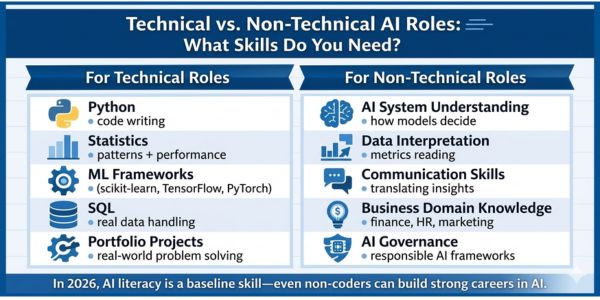
If You Want a Technical Role (ML Engineer, Data Scientist):
-
Python — ability to write and understand code for data handling and model building
-
Statistics & Probability — understanding patterns, uncertainty, and model performance
-
ML Frameworks (scikit-learn, TensorFlow, PyTorch) — used for building and training models
-
SQL — essential for working with real-world business data
-
Portfolio Projects — 2–3 real projects showing problem-solving, not just tutorials
If you want a non-technical role (AI PM, AI Consultant, Ethics Analyst):
- AI system understanding — knowing how models make decisions (not building them)
- Data interpretation skills — reading outputs, metrics, and performance results
- Communication skills — translating AI insights into business language
- Domain knowledge — finance, HR, healthcare, or marketing + AI understanding
- AI governance awareness — responsible AI frameworks like the EU AI Act, NIST AI RMF
AI literacy — understanding what AI can and cannot do — is now expected even in non-technical roles across marketing, HR, finance, and operations. In 2026, it has become a baseline hiring requirement rather than an optional skill. For learners from non-technical backgrounds, data science jobs without coding also provide strong entry opportunities into AI-related career paths without requiring programming expertise.
The Learning Path That Actually Works
I have seen two common approaches, but only one consistently leads to real AI job opportunities in 2026.
The most common mistake beginners make is collecting certificates from multiple platforms without building real projects or applying what they learn. The approach that actually works is simple: pick one clear learning track, build real-world projects early, and consistently document your progress.
Here is a practical roadmap for the technical AI track:
- Month 1–2: Python basics + statistics fundamentals focused on data handling and problem-solving
- Month 3–4: Machine learning basics with focus on understanding how models learn and make predictions
- Month 5–6: Build real-world AI projects using public datasets
- Month 7–8: Specialise in one area such as NLP, computer vision, or AI automation workflows
- Month 9–12: Apply skills through internships, open-source contributions, and building a strong AI portfolio
According to industry research, generative AI has moved beyond early experimentation and is now being actively used in real business operations.
This shift means companies are no longer just testing AI tools — they are integrating them into daily workflows and production systems. As a result, they are actively looking for people who can make AI systems work reliably in real-world environments, not just demonstrate them.
In 2026, this creates a clear shift in hiring priorities: practical, applied AI skills are valued more than theoretical knowledge alone.
Common Mistakes I See Beginners Make
These are the patterns that repeatedly stop beginners from breaking into AI roles in 2026.
-
Waiting until they know enough. There is no clear "enough". The people who get hired are the ones who build things before they feel ready and show their work.
-
Skipping the fundamentals. I understand the temptation to jump straight into large language models or generative AI. But if you do not understand how a model learns from data in the first place, you will hit a wall fast. The fundamentals are not glamorous — they are load-bearing.
-
Treating a certificate as the goal. Certificates signal that you completed a course. They do not signal that you can do the work. Employers are increasingly looking at portfolios and projects over certifications — especially for entry-level roles.
-
Ignoring soft skills. AI teams in companies are cross-functional. You will be working with product managers, engineers, legal teams, and executives. The ability to explain a model's behaviour in plain English, or push back clearly on a project's ethical risks, is genuinely valued — and genuinely rare.
What the Job Market Looks Like Right Now
Recent industry research shows that generative AI adoption has moved into mainstream business use. A large share of organisations are now actively using AI in at least one core business function, reflecting a major shift from experimentation to real implementation.
This shift is creating a clear hiring gap: companies are adopting AI faster than they can build internal talent to support it.
The practical outcome is important for beginners — you are not competing with senior researchers or highly specialised AI scientists. Instead, most opportunities today are emerging in mid-sized companies, startups, consulting firms, and enterprise teams that need professionals who can apply AI in real business workflows.
In 2026, AI hiring is no longer limited to top tech labs. AI career paths and opportunities are now expanding across industries like finance, healthcare, retail, and services, where companies are actively hiring job-ready talent. This shift shows that AI is no longer restricted to research or advanced engineering roles — it is becoming a part of everyday business operations across sectors.
In markets like India, this trend is even more visible, with AI and data-related roles becoming one of the fastest-growing skill categories in the technology sector. Cities such as Bengaluru, Hyderabad, and Pune continue to lead this demand due to strong enterprise and startup ecosystems.
Frequently Asked Questions
1. Do I need to learn advanced mathematics to work in AI?
Not for all roles. Basic statistics and logical thinking are enough for most entry-level positions. Advanced math becomes important only in deep machine learning or research-focused roles.
2. How important is choosing a specialisation early in AI?
You don’t need to specialise immediately. Start with broad fundamentals, then choose a focus like NLP or automation once you understand what kind of work you enjoy.
3. Are internships necessary to break into AI?
They help, but they are not mandatory. Strong personal projects, open-source contributions, or freelance work can also effectively demonstrate real-world experience.
4. How do I know if AI is the right career for me?
If you enjoy problem-solving, working with data, and understanding how systems make decisions, AI can be a good fit. Trying small projects early is the best way to test your interest.
5. Can I learn AI while working or studying full-time?
Yes, many learners successfully transition into AI with part-time study. A consistent 1–2 hours daily with focused learning and project work is often enough to make progress.
6. What role does generative AI play in careers today?
Generative AI is becoming a practical business tool, not just a trend. Understanding how to use tools like AI models in workflows is now a valuable skill across multiple roles.
If you are serious about starting a career in AI, a structured approach can make the entire journey clearer and more practical. It helps you focus on what actually matters, build skills in the right order, and avoid getting stuck in scattered learning without direction.
In the end, success in this field is not about how much you consume — it is about how consistently you apply what you learn and improve through real practice.
The real opportunity is not waiting for perfect preparation. It begins the moment you decide to start and keep moving forward.
Digital Marketing Courses in Other Locations in India
Ahmedabad | Aurangabad | Bangalore | Bhilai | Bhopal | Bhubaneshwar | Chandigarh | Chennai | Cochin | Coimbatore | Dehra Dun | Delhi | Faridabad | Ghaziabad | Gorakhpur | Guntur | Gurgaon | Guwahati | Hyderabad | Jaipur | Kanpur | Khammam | Kolkata | Lucknow | Madurai | Mumbai | Mysore | Nagpur | Noida | Patna | Pondicherry | Pune | Ranchi | Shimoga | Surat | Thane | Thiruvananthapuram | Tiruchirappalli | Tirupati | Vadodara | Visakhapatnam | Warangal | Jalandhar | Jodhpur | Indore | Durgapur | Jamshedpur | Dhanbad | Kota | Karnal | Udaipur | Amritsar | calicut | Nashik | Ludhiana | varanasi | thrissur | Mangalore | Raipur |