












































Skills You Need for a Successful Machine Learning Career
Unlock essential skills for a successful Machine Learning Career. Learn technical, analytical, and soft skills to excel and stand out in AI’s very competitive.

Don't miss this—jobs in machine learning are booming: Demand for ML engineers has increased by roughly 100% annually, and AI jobs are expanding more quickly than those in practically every other IT sector. AI/ML hiring increased by over 25% year-over-year in 2025, with a 22% increase in fresher positions and a significant increase in senior demand.
Machine learning is changing the job market and generating actual opportunities; it is not a passing trend. Startups, established businesses, and IT giants are all vying to develop more intelligent products and make better choices. People who develop these talents will be at the forefront of tomorrow's careers, as there are millions of new AI-related jobs available worldwide.
However, knowing Python or finishing a course is no longer sufficient. A combination of fundamental technical abilities, practical experience, and problem-solving skills is required. Those who strike a balance between these factors are the ones who get offers, interviews, and professional advancement that others may only imagine.
The Booming Demand for Machine Learning Professionals
Due to significant industry acceptance and increased demand for skilled workers, machine learning employment is expanding quickly in India, with AI/ML roles surging around 25–54% annually.


-
AI & ML Job Growth: Despite flat overall employment trends, job opportunities in AI and machine learning in India grew by 25% annually, placing these among the fastest-growing tech professions.
-
Hiring Surge Across Sectors: AI/ML hiring increased by 54% in August due to significant demand outside of IT, indicating that ML skill is desperately needed by organizations worldwide.
-
New Opportunities for Freshers: As businesses increase their teams, there is a growing need for new AI and machine learning professionals, with entry-level positions increasing dramatically in recent quarters.
-
ML Engineers in High Demand: One of the most in-demand jobs, machine learning engineers frequently command high salaries and top hiring lists in the tech industry.
-
Global Job Growth Outlook: Millions of new high-skill jobs are expected to be created globally as AI and ML expert positions expand far more quickly than normal job growth.
-
Competitive Talent Landscape: Gaining the necessary abilities now can provide you a significant advantage in the job market because of the fierce competition that comes with growing demand.
Why Machine Learning Skills Matter
Expertise in machine learning is essential in today's AI-driven world. It allows professionals to develop more intelligent solutions, tackle complex problems, and stand out in a competitive and rapidly growing job market.
-
Solve Real-World Problems: Your ability to evaluate data, spot trends, and build models that effectively address real-world commercial and societal problems is made possible by machine learning skills.
-
High Earning Potential: Due to their particular knowledge and market demand, professionals with ML competence typically earn 30–50% more than those in normal tech roles.
-
Future-Proof Career: ML skills guarantee that your profession stays relevant as AI adoption picks up speed, providing you with resilience against automation and shifting market demands. This benefit can be accelerated by becoming a proficient ML Engineer.
-
Cross-Industry Opportunities: ML talents are in high demand in a variety of industries and job pathways around the world, including finance, healthcare, retail, and technology.
-
Innovation and Creativity: Gaining an understanding of machine learning (ML) enables you to create novel products and solutions, transforming concepts into intelligent, automated systems that provide corporate value.
-
Competitive Advantage: Having machine learning (ML) skills makes you stand out from your colleagues and increases your chances of getting leadership and high-impact positions in tech-focused companies.
The Ultimate Skill Map for Machine Learning Careers
1. Technical Skills: The Foundation You Can’t Ignore
a. Programming & Software Engineering
The basis for realizing your machine learning concepts is programming. The most widely used languages are Python and R, which are prized for their ease of use, adaptability, and robust machine learning packages.
-
Python & R: Data processing, analysis, and model development are made quicker and more effective by libraries like NumPy, Pandas, and Scikit-learn.
-
Deep Learning Frameworks: For building and training neural networks in practical applications, TensorFlow and PyTorch are indispensable.
-
Software Practices: For collaboration and scalable machine learning solutions, writing clear, maintainable code, utilizing version control (Git), and becoming proficient in debugging are essential.
b. Mathematics & Statistics
The foundation of machine learning is mathematics. Building algorithms that truly function in practical applications requires an understanding of the numbers behind models.
-
Linear Algebra: Essential for managing matrices, vectors, and algorithmic operations, particularly in dimensionality reduction and neural networks.
-
Calculus: Helps you comprehend gradients, optimization, and the learning process of models during training.
-
Probability & Statistics: Necessary for predicting, assessing model performance, and comprehending data distributions in order to make defensible choices.
c. Data Skills
Machine learning is powered by data. Having strong data abilities enables you to prepare, comprehend, and visualize data in order to create models that work.


-
Data Wrangling & Cleaning: For accurate model training, convert unstructured, unorganized input into organized representations by eliminating mistakes and inconsistencies.
-
Data Visualization: Utilize dashboards, plots, and charts to investigate trends and effectively convey data to stakeholders.
-
Databases & Big Data Tools: Comprehending NoSQL, SQL, and tools like Hadoop or Spark is essential for effectively managing massive amounts of data.
d. Machine Learning & AI Knowledge
Building models that address actual issues and produce outcomes requires an understanding of ML and AI concepts.
-
Supervised, Unsupervised & Reinforcement Learning: Discover how various algorithms function, such as reinforcement for decision-making systems, unsupervised for patterns, and supervised for labeled data.
-
Model Evaluation: Metrics like accuracy, F1-score, and ROC-AUC can be used to assess the performance of your models and guarantee dependability.
-
Hyperparameter Tuning & Deployment: Optimize models for optimal performance and implement them in realistic applications to make your ideas useful and significant.
2. Analytical & Problem-Solving Skills
Strong analytical and problem-solving abilities enable you to use machine learning to solve practical business problems. The accuracy, dependability, and influence of models are guaranteed by critical thinking.
-
Translating Business Problems: Design ML solutions that directly address real-world problems and produce quantifiable outcomes by having a deep understanding of business objectives.
-
Critical Thinking: To guarantee that results are precise and useful in practical applications, thoroughly assess models, spot mistakes, and modify methods.
-
Debugging Skills: Identify problems with data, code, or algorithms quickly to enhance model performance and preserve project dependability.
-
Pattern Recognition: Examine data patterns to find hidden insights that inform more intelligent choices and successful machine learning tactics.
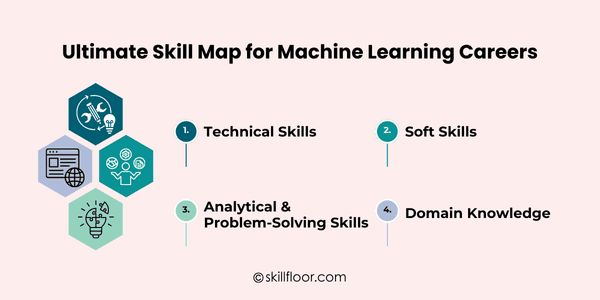
3. Soft Skills
Both technical proficiency and soft skills are crucial. They make it possible for you to work well with others, clearly convey ideas, adjust to changes, and advance your machine learning career.
-
Communication: Make difficult machine learning models understandable to non-technical stakeholders so they can confidently make well-informed judgments.
-
Collaboration: Collaborate effectively with data engineers, product managers, and other team members to accomplish business objectives and complete projects on time.
-
Continuous Learning: To remain competitive and relevant in a rapidly evolving profession, stay up to date on the most recent machine learning research, tools, and industry trends.
-
Adaptability: Adapt quickly to new tools, technologies, or project needs to guarantee smooth progress even in hectic or unpredictable situations.
4. Domain Knowledge
It's important to understand the industry you work in. It helps in improving feature design, accurate data interpretation, and the creation of models that produce significant, practical outcomes.
-
Industry Awareness: Developing pertinent ML solutions requires an understanding of the trends, rules, and difficulties in the fields of banking, healthcare, and e-commerce.
-
Feature Engineering: By guiding which data aspects are crucial, domain knowledge enhances the accuracy and performance of the model.
-
Business Impact: Knowing your business objectives guarantees that your machine learning models will produce quantifiable value and solve actual problems.
-
Decision-Making Insight: Being knowledgeable with the industry enables you to communicate model results in ways that stakeholders can rely on and act upon with confidence.
How to Begin Your Machine Learning Journey Today
You can stand out if you begin your machine learning adventure now. To effectively develop skills and acquire real-world competence, put an emphasis on networking, practical experience, and ongoing study.
-
Online Courses & Certifications: Platforms that offer guided projects, certifications, and structured learning include Coursera, Udemy, and MIT OpenCourseWare. Additionally, Skillfloor provides thoughtfully selected courses to effectively develop fundamental machine learning skills.
-
Hands-On Projects: Take part in Kaggle contests, make GitHub repositories, or conduct independent experiments to put ideas into practice and obtain hands-on experience resolving actual issues.
-
Networking: To share knowledge, discover opportunities, and maintain motivation, join AI/ML communities, go to webinars, and network with professionals.
-
Read & Research: To keep current on machine learning trends, techniques, and upcoming technologies, read research papers, blogs, newsletters, and AI publications.
-
Mentorship: Learn from skilled data scientists or ML experts to get advice, quicken skill development, and steer clear of typical project mistakes.
-
Consistent Practice: To reinforce learning and progressively develop skill over time, set aside time each day or every week to code, model, or analyze data.
Career Pathways in Machine Learning
Career paths in machine learning are specialized. Your abilities, background, and commitment to successfully developing, refining, and implementing machine learning models will determine which position is best for you.
-
ML Engineer: Creates, develops, and implements machine learning models that guarantee excellent performance and dependability for practical AI applications.
-
Machine Learning Researcher: Improves the field of artificial intelligence, investigates novel model designs, and creates new machine learning methods.
-
Data Scientist (ML Focus): Uses machine learning techniques to produce meaningful insights, build predictive models, and analyze data.
-
Deep Learning Engineer: Focuses on creating models for cutting-edge AI applications, neural networks, computer vision, and natural language processing.
-
ML Ops Engineer: Involves implementing, keeping an eye on, and maintaining machine learning models in production settings for scalability and efficiency.
-
Applied ML Scientist: Concentrates on using machine learning algorithms to address real-world issues in sectors including e-commerce, healthcare, and finance.
Emerging Trends in Machine Learning
Quick developments in machine learning, such as edge computing, generative models, AutoML, and ethical AI, are changing sectors and opening up new possibilities all across the world.
1. AutoML & Low-Code ML Platforms
While low-code platforms enable non-experts to produce strong machine learning solutions more quickly, boosting efficiency and lowering the need for manual coding, AutoML automates model building.
2. Explainable AI (XAI)
By ensuring that ML models are accessible and comprehensible, XAI improves adoption and ethical compliance by empowering stakeholders to trust decisions and comprehend algorithmic reasoning.
3. Ethical AI Considerations
Fairness, accountability, and bias reduction are the main goals of ethical AI, which helps businesses apply ethical machine learning solutions that comply with social and legal norms.
4. Generative AI
Realistic text, images, and sounds are produced by generative AI, opening up creative applications, increasing productivity, and facilitating advancements in the media, marketing, and design sectors.
5. Edge AI
Edge AI provides real-time insights, lowers latency, and protects data privacy for mobile and Internet of Things applications by running machine learning models directly on devices.
6. Real-Time ML Applications
Immediate decision-making in autonomous systems, healthcare, and finance is made possible by real-time machine learning (ML), which enables quick forecasts, anomaly detection, and adaptable reactions to changing data streams.
Anyone ready to learn, practice, and maintain their curiosity will find plenty of chances in the fascinating field of machine learning. Gaining the appropriate combination of technical expertise, problem-solving skills, and industry knowledge can lead to challenging, fulfilling, and future-ready positions. At first, starting a Machine Learning Career could seem overwhelming, but every little step counts, whether it's coding a project, reading a research paper, or making connections with experts. You may advance your Machine Learning Career, hone your abilities, and build the self-assurance you need to take on real-world challenges by acting consistently. Every encounter shapes your Machine Learning Career path for long-term success, and a successful Machine Learning Career grows with perseverance.
Digital Marketing Courses in Other Locations in India
Ahmedabad | Aurangabad | Bangalore | Bhilai | Bhopal | Bhubaneshwar | Chandigarh | Chennai | Cochin | Coimbatore | Dehra Dun | Delhi | Faridabad | Ghaziabad | Gorakhpur | Guntur | Gurgaon | Guwahati | Hyderabad | Jaipur | Kanpur | Khammam | Kolkata | Lucknow | Madurai | Mumbai | Mysore | Nagpur | Noida | Patna | Pondicherry | Pune | Ranchi | Shimoga | Surat | Thane | Thiruvananthapuram | Tiruchirappalli | Tirupati | Vadodara | Visakhapatnam | Warangal | Jalandhar | Jodhpur | Indore | Durgapur | Jamshedpur | Dhanbad | Kota | Karnal | Udaipur | Amritsar | calicut | Nashik | Ludhiana | varanasi | thrissur | Mangalore | Raipur |