


































Artificial Intelligence for Students: Best Courses and Learning Plans
Discover the best AI courses and learning plans for students today. Learn how to upskill with AI, get certified, and future-proof your career with Skillfloor.
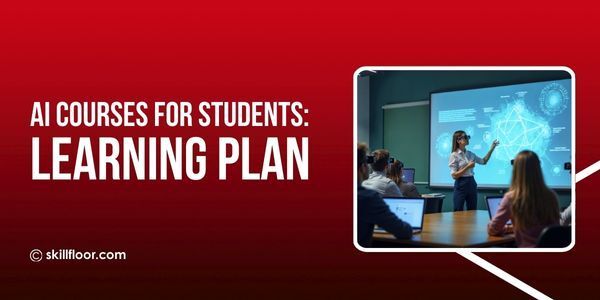
Artificial Intelligence (AI) is no longer a future idea exclusive to IT businesses or scientists. From voice assistants and AI-powered educational apps to Netflix and Google search recommendations, it has subtly permeated students' daily lives.
For students, learning AI is about more than just landing an exciting future job. It is about developing logical thinking, problem-solving skills, and flexibility in a technologically advanced society. Understanding AI may provide you with a significant competitive advantage, whether you are a college student getting ready for the workforce or a student investigating career choices.
For students who wish to learn artificial intelligence, this blog provides a comprehensive guide that includes information on what AI is, why it matters, the best courses, and clear learning strategies so they can begin with confidence.
What Is Artificial Intelligence?
Artificial intelligence is the capacity of machines or computer systems to think, learn, and make decisions like humans. AI systems examine data, identify patterns, and get better over time rather than adhering to predetermined instructions.


Simple Examples of AI Students Already Use
Google Maps predicting traffic
ChatGPT answering questions
YouTube or Instagram recommendations
Grammarly correcting writing
Face recognition on smartphones
AI vs Machine Learning vs Deep Learning
Artificial Intelligence (AI)
The general concept of teaching machines to understand and behave like humans is known as artificial intelligence. It aids computers with decision-making, problem-solving, and other tasks that typically call for human intelligence.
Machine Learning (ML)
AI includes machine learning, which allows computers to learn from experience and data. The system finds patterns over time to improve its outcomes rather than being trained step-by-step.
Deep Learning
An advanced type of machine learning that functions similarly to the human brain is called deep learning. In order to comprehend intricate patterns, including faces, voices, images, and language, it employs layers.
Students gain confidence and see that learning AI is possible when they understand these fundamentals. Gradually acquiring artificial intelligence skills improves hands-on learning and helps students realize that AI is attainable rather than "too complex."
Why Learning AI Early Is a Smart Move for Students
Students who learn AI early on have an advantage, develop their problem-solving abilities, and have more professional and technological options in the future:
1. Career Opportunities Are Growing Rapidly
Healthcare, banking, education, gaming, marketing, agriculture, and even the creative industries are all using AI. This implies that AI expertise is useful in a variety of fields, not only technology.
2. Future-Proof Skill
Automation is changing a lot of traditional jobs. Instead of being replaced, students who comprehend AI will be better equipped to adapt.
3. Builds Strong Thinking Skills
AI learning improves:
-
Logical thinking
-
Problem-solving ability
-
Analytical reasoning
-
Creativity in building solutions
4. No Need to Be a “Topper”
AI is not limited to math experts. Any interested learner can gradually learn AI with the correct method and tools.


5. Boosts Confidence with Technology
Early training in artificial intelligence makes students more at ease with contemporary tools and technology. It gives one the self-assurance to try new things, make projects, and investigate new ideas without fear.
Students who learn AI early on develop their abilities, inventiveness, and flexibility. They are inspired to investigate, test, and confidently get ready for upcoming technology-driven opportunities when they realize the importance of artificial intelligence.
Essential Skills Required to Learn Artificial Intelligence
Students should be aware of the fundamental skills required before enrolling in AI courses. The good news is that you can learn the majority of them as you go.
1. Basic Mathematics
Students can tackle AI tasks without requiring complex mathematics if they have a fundamental understanding of probability, statistics, and simple patterns.
2. Programming Skills
Students who learn the fundamentals of Python may create rudimentary code, comprehend reasoning, and begin developing AI applications.
3. Logical Thinking
AI involves more than just memorization of commands or formulas; it also requires thorough problem analysis and solution.
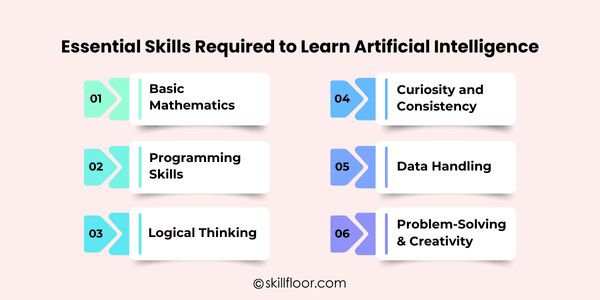
4. Curiosity and Consistency
For learning AI efficiently, curiosity, experimentation, and consistent practice are more crucial than skill.
5. Data Handling
Data organization, cleaning, and interpretation should be taught to students because these skills are crucial for AI projects.
6. Problem-Solving & Creativity
Beyond merely following tutorials, students can build novel AI projects with the use of critical thinking and creative ideas.
Best Artificial Intelligence Courses for Students
Students can save plenty of time and confusion by selecting the right class. The best artificial intelligence courses are listed here, arranged by level and price range.
Free AI Courses for Students
These are ideal for beginners who want to explore AI without investment:
1. Google – AI for Everyone
Beginners will quickly understand the principles of AI and its practical applications with the help of this course, which explains AI concepts without the need for coding.
2. Coursera Free AI Courses
Free audit alternatives are offered by several universities, enabling students to acquire key ideas and explore the fundamentals of AI at no expense.
3. YouTube AI Learning Channels
Visual learners may view examples, follow step-by-step instructions, and understand AI ideas with the help of video tutorials.
4. Open-Source Platforms
Students can practice AI skills and get an understanding of coding by using platforms such as TensorFlow and Scikit-Learn, which offer tutorials and documentation.
Paid AI Courses Worth Considering
For structured learning and certifications:
1. Coursera AI Specializations
These courses, which are offered by top universities and businesses, offer in-depth education and credentialing for professional advancement.
2. Udemy AI & Machine Learning Courses
Practical, inexpensive, and beginner-friendly courses with practical projects to successfully develop genuine AI skills.
3. edX AI Programs
Programs at the university level that provide certification and structured AI instruction spanning everything from basic to advanced subjects.
Students can gain practical experience and effectively develop real-world AI skills with Skillfloor's beginner-friendly AI courses and projects.
Step-by-Step AI Learning Plan for Students
Courses by themselves are insufficient. To prevent being stressed, students require a defined learning roadmap.
1. AI Learning Plan for School Students
-
Understand Basic AI Concepts: Start with providing basic principles of artificial intelligence (AI), using examples from everyday life.
-
Learn Logic and Problem-Solving: Solve problems and comprehend cause-and-effect links in AI scenarios to cultivate critical thinking.
-
Use Visual Programming Tools: Students can develop programs and gain a visual understanding of AI without learning to code by using tools like Blockly or Scratch.
-
Explore Fun AI Projects: To put learning into practice, create little projects like games, chatbots, or basic prediction models.
-
Participate in AI Challenges: Participate in contests, school hackathons, or online AI challenges to develop your skills and acquire experience.
-
Collaborate and Share Learning: Work on AI projects with friends or classmates, share ideas, and develop your communication and teamwork abilities.
2. AI Learning Plan for College Students
-
Learn Python Basics: Learn the syntax, loops, and functions of Python programming first. These concepts are crucial for projects using artificial intelligence and machine learning.
-
Study Data Handling and Visualization: Learn how to gather, clean, and analyze data. Then, utilize visualization tools like Seaborn or Matplotlib to identify trends.
-
Learn Machine Learning Fundamentals: Recognize fundamental ML principles such as regression, classification, supervised and unsupervised learning, and model evaluation.
-
Move to Deep Learning Concepts: For complex AI projects, investigate neural networks, CNNs, RNNs, and frameworks like TensorFlow or PyTorch.
-
Build Real-World Projects: Utilize your knowledge by developing AI projects to demonstrate your abilities, such as chatbots, recommendation engines, or prediction models.
-
Earn Certifications: Obtain reputable certificates from sites like Coursera, Udemy, edX, or Skillfloor to demonstrate your expertise and expand your professional prospects.
6–12 Month Self-Learning AI Roadmap
a. Months 1–2: Python + AI Basics
Discover the foundations of artificial intelligence and Python programming, comprehend fundamental ideas, and investigate the applications of AI in everyday life.
b. Months 3–4: Machine Learning Concepts
To develop fundamental abilities, study algorithms, supervised and unsupervised learning, regression, classification, and fundamental machine learning approaches.
c. Months 5–6: Projects + Practice
Work on practical assignments, coding exercises, and small AI projects to put what you've learned into practice and improve your knowledge and abilities.
d. Months 7–12: Advanced AI, Internships, Portfolio Building
Examine advanced AI ideas, deep learning, and neural networks. Develop a portfolio, get credentials, and obtain real-world experience through internships.
Hands-On Projects to Practice AI Concepts
Practical experience is what truly makes students confident in AI.
1. Beginner Projects
-
Chatbots
-
Simple recommendation systems
-
Spam email detection
2. Intermediate Projects
-
Image recognition
-
Predictive models
-
Sentiment analysis
3. Final Portfolio Projects
-
AI-based apps
-
Real-world datasets
-
Industry-oriented solutions
Students should showcase their projects on GitHub, LinkedIn, or personal portfolios.
Common Mistakes Students Make While Learning AI
Avoiding these mistakes can make learning smoother:
1. Jumping into Advanced Topics Too Quickly
Before understanding the fundamentals of AI, students frequently attempt advanced concepts, which can cause confusion and considerably impede learning progress.
2. Ignoring Fundamentals
Ignoring fundamental subjects like algebra, logic, and Python can make complex AI concepts harder to understand over time.
3. Watching Tutorials Without Practice
Students are unable to develop practical skills and comprehend how AI principles operate if they merely watch videos or tutorials without engaging in hands-on experience.
4. Copying Code Without Understanding
Students who copy code blindly from tutorials or examples are unable to develop problem-solving skills and are unable to think independently.
5. Comparing Progress with Others
Everyone learns at their own pace, and consistency is more important than speed, so comparing yourself to your classmates can put undue pressure on yourself.
6. Neglecting Small Projects
Avoiding small practice tasks restricts practical experience. Working on mini-projects improves comprehension and boosts self-assurance while using AI expertise.
Remember that learning AI is a long-term process; it is more crucial to be patient, practice consistently, and progressively increase your knowledge than to rush through subjects or compare yourself to others.
Career Opportunities in Artificial Intelligence for Students
AI skills open doors to various roles, such as:
1. AI Engineer
Creates AI models, systems, and solutions for various industries' real-world issues.
2. Machine Learning Engineer
Creates, develops, and implements machine learning models to address challenging data-driven problems.
3. Data Scientist
Finds patterns and produces insights to aid in decision-making through the analysis and interpretation of massive datasets.
4. AI Research Assistant
Helps create new AI models and technology, conducts experiments, and supports AI research.
5. AI Product Developer
Creates AI-powered goods and apps, incorporating AI models into practical tools for customers or companies.
6. AI Consultant
Advises businesses on how to use AI for improved business outcomes, enhance processes, and adopt AI solutions.
Students can start with internships, entry-level roles, or freelance projects while studying.
Best Tools and Resources for AI Students
Some helpful tools include:
1. Python Libraries for AI and ML
Students may effectively practice coding and create AI models with the use of libraries like TensorFlow, PyTorch, and Scikit-Learn.
2. Online Coding Platforms
Websites like LeetCode, HackerRank, and Kaggle offer datasets and code challenges for practical AI practice.
3. AI Communities and Forums
Students can ask questions, discuss projects, and receive criticism on websites like Reddit, Stack Overflow, and Discord groups dedicated to AI.
4. Blogs, Podcasts, and Newsletters
Students can stay informed about trends, innovations, and business applications by subscribing to AI blogs, newsletters, and podcasts.
5. Interactive Learning Platforms
For planned learning, platforms like Coursera, edX, and Skillfloor provide guided AI courses with projects and certifications.
6. Open-Source Projects and GitHub Repositories
Students can improve their portfolios and obtain practical experience by contributing to open-source AI projects or browsing GitHub repositories.
Being part of learning communities helps students stay motivated and updated.
At first, learning AI for students may seem thrilling and intimidating, but it is doable if you start small. Building excellent talents requires a solid understanding of the fundamentals and regular practice. AI for Students learning is made enjoyable and meaningful through practical projects, which also increase students' self-confidence and inventiveness. AI for Students becomes more interesting and fulfilling when students participate in challenges, investigate courses, and establish connections with communities. Learning concepts enables pupils to transform information into practical experience if they are patient and curious. In the end, AI for Students encourages creativity in the field of technology and opens doors to fascinating possibilities.
Digital Marketing Courses in Other Locations in India
Ahmedabad | Aurangabad | Bangalore | Bhilai | Bhopal | Bhubaneshwar | Chandigarh | Chennai | Cochin | Coimbatore | Dehra Dun | Delhi | Faridabad | Ghaziabad | Gorakhpur | Guntur | Gurgaon | Guwahati | Hyderabad | Jaipur | Kanpur | Khammam | Kolkata | Lucknow | Madurai | Mumbai | Mysore | Nagpur | Noida | Patna | Pondicherry | Pune | Ranchi | Shimoga | Surat | Thane | Thiruvananthapuram | Tiruchirappalli | Tirupati | Vadodara | Visakhapatnam | Warangal | Jalandhar | Jodhpur | Indore | Durgapur | Jamshedpur | Dhanbad | Kota | Karnal | Udaipur | Amritsar | calicut | Nashik | Ludhiana | varanasi | thrissur | Mangalore | Raipur |

-
 Jaanvi singh“Really enjoyed reading this blog! The content is well-structured, informative, and easy to understand. Every point is explained clearly, which makes it very helpful for readers. Great effort put into this post—keep sharing such valuable and meaningful content.” you also read our blog