




































Data Analytics for MBA Students: Career Benefits
Discover how data analytics can transform an MBA career, boosting employability, salaries, growth, and leadership impact in today’s data-driven business world.
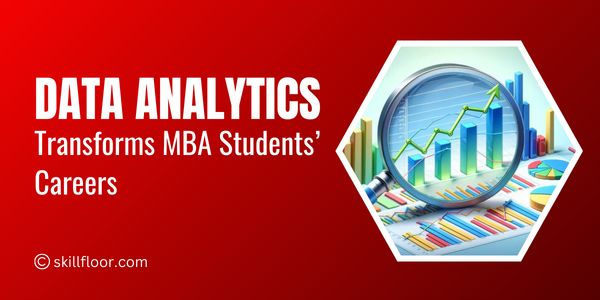
Until it's too late, many future managers are unaware of this. Today, experience and gut feeling are no longer the only factors used to make business judgments. Businesses now rely on data to establish strategies, boost productivity, and maintain a competitive edge, and they expect managers to translate information into actionable recommendations.
This change presents both opportunity and pressure for MBA students. While communication, strategy, and leadership are still important, they are no longer sufficient on their own. Data analytics is a powerful career enhancer since businesses now demand that managers comprehend data, ask insightful questions, and make fact-based decisions.
This blog explores what data analytics means for MBA students, how it complements core management disciplines, and the career benefits it offers in the modern business world.
What is Data Analytics? (A Simple Explanation for MBA Students)
Data analytics is the process of gathering, analyzing, and comprehending data in order to identify trends and insights that aid in decision-making. For MBA students, using data intelligently to inform business plans is more important than coding.


At a high level, data analytics can be categorized into four types:
1. Descriptive Analytics – What happened?
Uses dashboards and reports to summarize historical events in order to easily display trends, patterns, and company performance.
2. Diagnostic Analytics – Why did it happen?
Examines the reasons behind results, such as lower sales or customer attrition, in order to comprehend business issues.
3. Predictive Analytics – What will happen next?
Reliably predicts future patterns, including demand, sales, or shifts in consumer behavior, using historical data.
4. Prescriptive Analytics – What should we do?
Makes recommendations for tactics and activities based on analysis to successfully enhance choices, performance, and company outcomes.
Instead, then creating complex algorithms, MBA students mostly deal with the insights produced by these analyses. Interpreting the data and turning them into business plans is the goal.
Why Data Analytics Is a Must-Have Skill for Modern Managers
Modern businesses function in settings that are marked by uncertainty, competition, and swiftly evolving consumer conduct. In these circumstances, managers with data analysis skills clearly have an edge.
Data analytics enables managers to:
-
Make informed decisions rather than assumptions
-
Identify opportunities and risks early
-
Measure performance accurately using KPIs
-
Improve efficiency and profitability
Managers are increasingly expected to comprehend data by businesses in the retail, banking, healthcare, consulting, IT, and manufacturing sectors. Analytics-savvy managers ask insightful questions, collaborate well with technical teams, and translate insights into actions that advance corporate objectives.
As a result, data analytics skills are now a fundamental capability required for contemporary leadership positions rather than a "nice-to-have" skill. Many working professionals strengthen these analytical and leadership capabilities through advanced business education programs such as the Leavey School of Business Evening MBA Degree in California, which allows students to balance career growth with practical management training.
How Data Analytics Complements Core MBA Specializations
The applicability of data analytics to all MBA specializations is one of its main benefits. Analytics enhances traditional domains, not replaces them.
1. Marketing Analytics
Data analytics in marketing enables managers to comprehend consumer behavior and the efficacy of campaigns. MBA students with a marketing concentration utilize analytics for:
-
Customer segmentation and targeting
-
Measuring digital marketing performance
-
Price optimization and demand forecasting
-
Improving customer experience and retention
Marketing decisions backed by data lead to higher ROI and better brand positioning.


2. Finance Analytics
Data is crucial to the accuracy and risk management of finance professionals. Analytics helps with:
-
Financial forecasting and budgeting
-
Risk and credit analysis
-
Portfolio management
-
Fraud detection and compliance
Fintech, corporate finance, and investment banking all place a high value on MBA graduates with analytics and finance expertise.
3. HR / People Analytics
The field of human resource management has advanced beyond making decisions entirely on intuition. HR managers can do the following with people analytics:
-
Improve hiring decisions
-
Analyze employee performance
-
Predict attrition and engagement levels
-
Design effective compensation strategies
By using HR analytics, businesses can make better decisions about their workforce, which eventually results in stronger, more effective, and more productive workforces.
4. Operations & Supply Chain Analytics
Analytics are used by operations managers to increase productivity and cut expenses. Applications consist of:
-
Inventory optimization
-
Demand and supply planning
-
Process improvement
-
Quality control
Analytics-driven operations help businesses make better use of their resources, optimize workflows, cut expenses, and improve customer happiness and experience.
Career Benefits of Data Analytics for MBA Students
MBA students can benefit from learning data analytics in a number of practical ways.
1. Enhanced Employability
Graduates of an Online MBA in California with data analysis skills are becoming more and more desired by employers. In a competitive market, people with strong analytical abilities can stand out and win better jobs.
2. Higher Salary Potential
Because they can show quantifiable economic effects and offer insights that lead to more intelligent organizational decisions, professionals with analytical expertise frequently receive higher wages.
3. Faster Career Growth
Data-driven managers are more likely to progress swiftly because they can provide data to back their leadership choices, earning senior management's confidence.
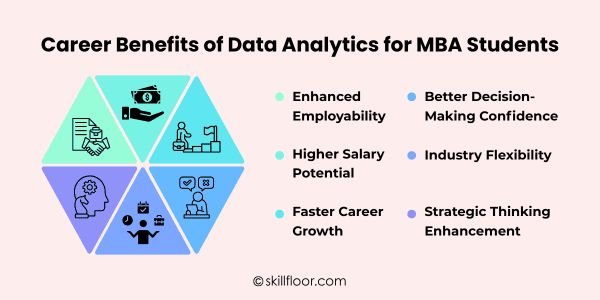
4. Better Decision-Making Confidence
Analytics gives MBA graduates the ability to make well-informed judgments supported by data and facts, boosting their credibility and self-assurance in front of teams and stakeholders.
5. Industry Flexibility
Because analytical abilities are so flexible, MBA professionals can work in a variety of industries or change careers without losing their significance. Enrolling in a data analytics course can help strengthen these skills.
6. Strategic Thinking Enhancement
Learning data analytics helps MBA graduates find opportunities, solve challenging issues, and promote long-term company growth by fostering critical thinking and strategic planning skills.
How MBA Students Can Start Learning Data Analytics
MBA students can begin their analytics journey through:
1. Online Courses and Certifications
For a solid understanding of analytics, sign up for online courses and certifications offered by reliable platforms. A structured data analytics course tailored to business professionals is available on platforms such as Skillfloor.
2. MBA Analytics Elective Subjects
Choose courses that emphasize data interpretation, analysis, and visualization. These courses give students practical experience with actual business issues and scenarios requiring decision-making.
3. Practice Real-World Datasets
Utilize actual datasets and business case studies. This aids MBA students in understanding analytics in real-world situations and applying academic ideas to real-world problems.
4. Internships And Live Projects
Engage in live projects or internships with analytics-using businesses. This provides exposure to actual company data and imparts useful problem-solving techniques.
5. Join Analytics Competitions
Participate in data analysis-focused contests and challenges. They improve teamwork, analytical thinking, and decision-making in practical business settings.
6. Continuous Self-Learning Practice
Practice Excel, SQL, Tableau, and Power BI on a regular basis. After graduation, students are more prepared for data-driven employment due to ongoing self-learning.
Regular practice and active application of principles to actual business challenges are essential to learning analytics, which helps MBA students develop confidence and useful skills.
Challenges MBA Students Face in Learning Data Analytics
Many MBA students hesitate to learn analytics due to:
-
Fear Of Numbers: Some students find statistics and formulae confusing, but analytics may be made easier to understand by beginning with examples that are business-focused.
-
Limited Technical Background: Coding and tool experience may be lacking for MBA students. This can be avoided by gradually learning how to use basic tools like Excel or Tableau.
-
Time Constraints During MBA: Learning analytics is challenging for MBA students with demanding schedules. Setting up brief, regular practice sessions ensures constant advancement without adding too much to the workload.
-
Uncertainty About Application: Students frequently find it difficult to discover practical applications. Effectively connecting theory with real-world business applications is achieved through case studies, internships, and projects.
These challenges can be overcome by:
-
Start With Business-Focused: Start learning analytics with practical business examples. Concepts become simpler to comprehend and instantly applicable when business challenges are the main focus.
-
Learn Tools Gradually: Learn a single tool at a time, like Tableau or Excel. Gradual learning boosts self-assurance and keeps technical complexity from overwhelming one.
-
Focus On Interpretation: Put comprehension and interpretation of outcomes ahead of coding. For managers, data insights are more significant than creating intricate algorithms.
-
Practice With Real Scenarios: Use your analytical skills in projects, internships, and case studies. Practical application strengthens learning and demonstrates how analytics influences business choices.
MBA students can gain knowledge, make wise decisions, and propel corporate success with analytics, a skill that gets better with constant exposure and real-world use.
Future Scope of Data Analytics in Management Careers
The future of management is being shaped by data analytics. Strong analytics abilities will help MBA candidates lead companies, make strategic choices, and maintain their competitiveness in a data-driven world.
-
Strategic Decision-Making: Analytics-savvy managers may effectively support long-term organizational growth and improve business outcomes by making evidence-based decisions.
-
Leadership Roles: MBA graduates can assume leadership roles with the support of data-driven insights, which provide teams with strategic direction and clarity.
-
Cross-Industry Opportunities: Since analytics skills are transferable across industries, MBA professionals can explore a variety of professions and adjust to shifting market demands.
-
Integration with AI and ML: Managers may use artificial intelligence and machine learning for quicker, more intelligent business solutions by having a solid understanding of analytics.
-
Enhanced Problem-Solving: Analytics gives MBA students the tools they need to effectively examine complicated issues, spot trends, and create workable solutions.
-
Career Resilience and Growth: Data analytics helps MBA graduates stay competitive in quickly changing business contexts by ensuring long-term career relevance.
FAQs for MBA Students on Data Analytics
Q1. Why should MBA students focus on data analytics now?
A: Businesses increasingly rely on data, and analytics skills make MBA graduates more competitive and job-ready.
Q2. Do MBA students need programming skills to learn analytics?
A: Not necessarily. Focus on interpreting data with tools like Excel, Tableau, or Power BI. Coding is optional.
Q3. How does learning data analytics benefit an MBA student’s career?
A: It improves employability, supports higher salaries, faster growth, and enhances confidence in decision-making.
Q4. Which MBA specializations benefit the most from data analytics?
A: All specializations—marketing, finance, HR, operations, and strategy—gain better insights and data-driven decision-making.
Q5. How can MBA students start learning data analytics effectively?
A: Use online courses, electives, case studies, internships, competitions, or platforms like Skillfloor for structured learning.
Q6. What tools should MBA students focus on for data analytics?
A: Excel, SQL, Tableau, Power BI, and basic statistics. Python or R is optional but helpful.
Data analytics is more than simply a skill; it's a means of seeing more clearly and making more informed decisions. It gives MBA students access to better employment opportunities, quicker career advancement, and greater assurance in all of their choices. A tiny beginning, such as practicing with actual data or enrolling in a brief course, can have a significant impact. In addition to improving your understanding of business, mastering the art of turning data into insights will make you stand out as a clear and effective leader. You will benefit more from it in your professional journey the earlier you begin.
Digital Marketing Courses in Other Locations in India
Ahmedabad | Aurangabad | Bangalore | Bhilai | Bhopal | Bhubaneshwar | Chandigarh | Chennai | Cochin | Coimbatore | Dehra Dun | Delhi | Faridabad | Ghaziabad | Gorakhpur | Guntur | Gurgaon | Guwahati | Hyderabad | Jaipur | Kanpur | Khammam | Kolkata | Lucknow | Madurai | Mumbai | Mysore | Nagpur | Noida | Patna | Pondicherry | Pune | Ranchi | Shimoga | Surat | Thane | Thiruvananthapuram | Tiruchirappalli | Tirupati | Vadodara | Visakhapatnam | Warangal | Jalandhar | Jodhpur | Indore | Durgapur | Jamshedpur | Dhanbad | Kota | Karnal | Udaipur | Amritsar | calicut | Nashik | Ludhiana | varanasi | thrissur | Mangalore | Raipur |