








































Data Analyst Course Syllabus: Duration, Fees - Updated 2026
Discover the updated 2026 Data Analyst course syllabus, duration, fees, career scope, and how Skillfloor helps you upskill, get certified, and grow your career.

In 2026, data will be the primary factor in almost every business decision. Data is used by companies of all sizes, from start-ups to global conglomerates, to improve productivity, boost sales, and gain a deeper understanding of their clients. One of the fastest-growing professional tracks is data analytics; by 2026, there will likely be 2.7 million new data positions worldwide.
Learning about data analytics not only helps you acquire highly sought-after skills but also opens doors to exciting career opportunities. In India, the average salary for a new data analyst ranges from ₹5 to ₹7 LPA (Lakhs Per Annum), and with experience, this can increase to ₹15 LPA. By 2025, organizations are projected to generate over 79 zettabytes of data worldwide, creating a strong demand for qualified professionals to interpret and analyze this information.
Why Choose a Career in Data Analytics in 2026?
Businesses need skilled professionals to make sense of the data that is all around them. Growth and stability are possible in this line of work.
-
High Industry Demand: High need for skilled data analysts across a variety of sectors, including marketing, e-commerce, IT, finance, and healthcare.

-
Attractive Salary Growth: Professionals with strong data analysis and interpretation skills should expect attractive wages and quick growth opportunities.
-
Work on Real Projects: Possibilities to work on actual projects, patterns, and trends that influence daily business decisions.
-
Flexible Work Options: Remote, freelancing, and full-time jobs in India and overseas are among the flexible employment alternatives.
-
Continuous Learning: Your skills will stay current in the market if you continue to learn using new tools and methods.
-
Career Growth Opportunities: Advancement in one's career from junior analyst positions to advanced ones like analytics manager or data strategist.


Enrolling in a data analytics course gives you real-world experience and useful skills that will help you land jobs fast and build a successful career.
Key Benefits of Becoming a Data Analyst
-
High Demand in the Job Market: Data analysts are in high demand in many industries, providing you with stable employment prospects in India and overseas.
-
Competitive Salary Growth: Data analytics is a financially advantageous job choice in 2026 since starting salaries are appealing and grow rapidly with expertise.
-
Opportunities Across Industries: You can use your data analyst skills to work in a variety of areas, including IT, healthcare, finance, marketing, and e-commerce.
-
Work on Real Projects: You have the opportunity to examine actual business data, spot trends, and offer suggestions that have a direct bearing on decisions and business performance.
-
Career Progression Paths: Over time, you can go from junior analyst to senior positions like data strategist or analytics manager.
-
Flexibility and Remote Work: For data analysts, many employers provide remote, freelancing, and flexible work schedules, which improve your independence and work-life balance.
Understanding the importance of data analytics enables companies to increase profitability, increase efficiency, and make wiser decisions. As a result, qualified data experts are now necessary in every industry.
Who is a Data Analyst?
An expert who gathers, arranges, and analyzes data to assist companies in making better decisions is known as a data analyst. They provide reports or dashboards, find patterns, trends, and insights in raw data, and offer suggestions that boost productivity, profitability, and efficiency in a variety of sectors, including marketing, IT, finance, and healthcare.
Key Responsibilities of a Data Analyst
-
Gathering and arranging data to provide precise business insights and analysis.
-
Reliability is ensured by cleaning and processing raw data.
-
Identifying possibilities and issues by examining trends and patterns.
-
Putting together reports and dashboards to easily show teams the results.
-
Supporting management in making data-driven, well-informed decisions for the expansion of the company.
Working in groups to put initiatives based on data insights into action.
Who Should Learn Data Analytics?
This course is ideal for:
-
Students and fresh graduates seeking in-demand career opportunities.
-
Working professionals looking to switch careers into data-focused roles.
-
IT and non-IT professionals wanting to enhance their analytical skills.
-
Commerce, Arts, Science, and Engineering students exploring data-driven careers.
-
Anyone interested in numbers, logic, and problem-solving for business insights.
-
Entrepreneurs and business owners who want to make smarter decisions.


Eligibility
-
No coding background is required to start learning this course.
-
Basic understanding of mathematics is enough to grasp core concepts.
-
Logical thinking and curiosity to work with data are more important.
-
Willingness to learn and practice tools regularly ensures better results.
What You’ll Learn: Data Analyst Course Syllabus
In 2026, a thorough data analyst course will cover more than simply SQL and Excel. The current curriculum is meticulously crafted to transform novices into self-assured experts capable of providing commercial insights. Here is a summary:
Module 1: Data Analytics Fundamentals
-
What is Data Analytics?
-
Types of Data: Structured & Unstructured
-
Data Analytics Lifecycle
-
Business Understanding
-
Types of Analytics: Descriptive, Diagnostic, Predictive, Prescriptive
-
Introduction to Statistics
Module 2: Excel for Data Analysis
-
Excel interface and functions
-
Data cleaning and formatting
-
Pivot Tables & Pivot Charts
-
VLOOKUP, HLOOKUP, XLOOKUP
-
Conditional formatting
-
Data analysis using Excel dashboards
Module 3: SQL for Data Analysis
-
Database concepts
-
MySQL / PostgreSQL
-
Writing SQL queries
-
Joins, Subqueries, Views
-
Window functions
-
Query optimization
-
Real-world database practice
Module 4: Python for Data Analysis
-
Python basics
-
NumPy and Pandas
-
Data cleaning and preprocessing
-
Exploratory Data Analysis (EDA)
-
Data manipulation and transformation
-
Working with CSV and Excel files
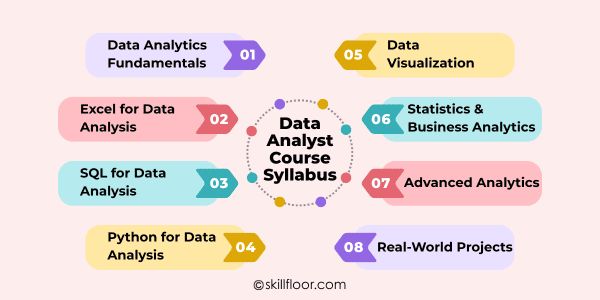
Module 5: Data Visualization (Power BI / Tableau)
-
Introduction to BI tools
-
Creating interactive dashboards
-
Data modeling
-
DAX basics (Power BI)
-
Charts, KPIs, reports
-
Data storytelling techniques
Module 6: Statistics & Business Analytics
-
Descriptive statistics
-
Probability and distributions
-
Hypothesis testing
-
Correlation and regression
-
Business case studies
Module 7: Advanced Analytics
-
Basic Machine Learning for Analysts
-
Forecasting & Trend Analysis
-
Statistical Modeling for Business Insights
-
Data-Driven Decision Making
Module 8: Real-World Projects
-
Sales data analysis project
-
HR analytics project
-
Marketing campaign analysis
-
Finance data analysis
-
Capstone project with real datasets
Data Analyst Course Duration in 2026
The duration of a data analyst course depends on the selected program type and instructional mode. To cater to various learning styles, backgrounds, and professional goals, different tracks are available.
1. Fast Track (3–4 months)
Perfect for students who wish to pick up critical abilities fast. focuses on fundamental subjects through in-depth instruction and useful tasks. Ideal for time-pressed working professionals.
2. Regular Track (6 months)
A well-rounded curriculum that thoroughly covers each important element. provides time for practical exercises, homework, and practical projects. Ideal for newcomers or those changing careers.
3. Professional Program (8–12 months)
Thorough instruction covering advanced data analytics, the fundamentals of machine learning, several projects, and placement readiness. intended for serious students seeking in-depth knowledge and preparedness for the workforce.
Summary: You can select a curriculum that lasts anywhere from three months for quick learning to twelve months for full mastery, depending on your speed, experience, and professional objectives.
Data Analyst Course Fees in 2026
In 2026, the price of a Data Analyst course varies greatly based on the duration, manner of instruction, and degree of support. This is a summary:
1. Online Courses: ₹15,000 – ₹80,000
-
These are usually self-paced programs delivered through platforms like Skillfloor, Coursera, or Udemy.
-
Ideal for working professionals or beginners who want flexibility.
-
Lower cost because there’s minimal overhead and you often learn independently.
-
Many include short projects, video lectures, and quizzes to reinforce learning.
2. Bootcamps: ₹50,000 – ₹2,50,000
-
Intensive, immersive programs designed to make you job-ready quickly.
-
Usually 3–6 months long, combining live mentorship, real projects, and career support.
-
Higher fees reflect hands-on guidance, mentorship, and placement assistance.
-
Great for career switchers who want to land a job fast in the analytics field.
3. University or PG Programs: ₹1,00,000 – ₹4,00,000
-
Full-fledged degrees or professional certifications offered by universities.
-
Longer duration: 6 months to 2 years, often part-time or full-time.
-
Include in-depth theory, industry projects, and sometimes internship opportunities.
-
Higher cost is due to institution credibility, brand recognition, and comprehensive curriculum.
Factors That Affect Fees
-
Brand Reputation
-
Placement Support
-
Project Quality
-
Mentorship
Why Choose Skillfloor for Data Analyst Course?
Skillfloor empowers professionals with hands-on projects, mentorship, and globally recognized certification, ensuring faster career growth in data analytics and real-world skill application.
-
Industry-Aligned Curriculum: Learn methods, tools, and practical analytics skills to fulfill the demands of the industry in 2026 for professionals who are prepared for the workforce.
-
Hands-On Projects: Develop a solid portfolio by completing useful, real-world projects that will improve your employability and show prospective employers your abilities.
-
Expert Mentorship: Get individualized advice from seasoned industry mentors who assist you in successfully navigating challenging ideas and career paths.
-
Flexible Learning: Upskilling is convenient and accessible since you can study online, offline, or hybrid at your own pace without sacrificing work obligations.
-
Placement Assistance: To expedite your entry into the analytics sector, get career guidance that includes resume creation, interview preparation, and job chances.
-
Global Certification: Obtain the accredited certificate from Skillfloor, which attests to your knowledge and gives you an advantage over other applicants and increases your credibility with companies.
Career Opportunities After Data Analyst Course
After completing the course, you can apply for roles like:
-
Data Analyst
-
Business Analyst
-
BI Analyst
-
Reporting Analyst
-
Product Analyst
-
Junior Data Scientist
Industries Hiring:
-
IT & Software
-
Banking & Finance
-
Healthcare
-
E-commerce
-
Marketing agencies
-
Consulting firms
Data Analyst Salary in 2026
|
Job Role |
Fresher Salary (₹/year) |
Mid-Level Salary (₹/year) |
Senior-Level Salary (₹/year) |
|
Data Analyst |
4 LPA – 7 LPA |
8 LPA – 12 LPA |
15 LPA – 20 LPA |
|
Business Analyst |
4.5 LPA – 7.5 LPA |
9 LPA – 13 LPA |
16 LPA – 22 LPA |
|
BI Analyst |
4 LPA – 6.5 LPA |
8 LPA – 11 LPA |
14 LPA – 19 LPA |
|
Reporting Analyst |
3.5 LPA – 6 LPA |
7 LPA – 10 LPA |
12 LPA – 16 LPA |
|
Product Analyst |
4.5 LPA – 7.5 LPA |
9 LPA – 13 LPA |
15 LPA – 20 LPA |
|
Junior Data Scientist |
5 LPA – 8 LPA |
10 LPA – 14 LPA |
18 LPA – 25 LPA |
Notes:
-
Salaries vary depending on the company, city, skills, and experience.
-
Freelance or remote opportunities may also offer higher earnings.
-
Learning tools like Excel, SQL, Python, Power BI/Tableau and completing projects can increase starting salary.
How to Choose the Best Data Analyst Institute/ Course?
For the most career impact, choose a course that strikes a mix between practical skills, industry relevance, certification worth, mentorship, and career assistance.
-
Updated Syllabus: Make sure the course includes basic machine learning, SQL, Python, visualization, and contemporary technologies.
-
Practical Case Studies: Learn through real business scenarios to understand how analytics impacts decision-making and strategy.
-
Experienced Mentors: Advice from pros in the field speeds up learning and professional development.
-
Placement Support: Employability is improved by organizations that provide resume advice, interview preparation, and employment aid.
-
Flexible Learning Options: Your time and pace should be accommodated via online, offline, or hybrid classes.
-
Certification Recognition: Credibility is increased and employment opportunities are improved with a reputable, industry-recognized certificate.
FAQs – Data Analyst Course
Q1. Is Data Analyst a good career in 2026?
A. Yes. With AI and data-driven decision-making, data analysts are in high demand across industries.
Q2. Do I need coding to become a data analyst?
A. Basic coding in Python or SQL helps, but advanced programming is not mandatory for most analyst roles.
Q3. Can non-IT students pursue this career?
A. Absolutely. Many students from commerce, arts, or management backgrounds successfully become data analysts.
Q4. Is AI going to replace data analysts?
A. No. AI assists with tasks, but human judgment, interpretation, and decision-making remain essential.
Q5. Which tool is most important for a data analyst?
A. SQL for data handling, Excel for analysis, and Tableau/Power BI for visualization are the most widely used tools.
Q6. How do I get started if I have no prior experience?
A. Start with beginner-friendly courses like Skillfloor, focus on hands-on projects, and gradually build skills and portfolio.
Starting a career in data analytics can be both exciting and a bit daunting, making it essential to choose the right path. By learning the necessary tools, methods, and practical applications, you're not only honing your skills but also opening up opportunities for better job prospects, higher salaries, and career advancement. Gaining hands-on experience through projects and mentorship can boost your confidence and prepare you for the workforce, whether you're a student, a working professional, or looking to change careers. Employers typically value certification, professional support, and flexible learning options, all of which can be found on platforms like Skillfloor. Given that data is central to many industries, making your move now will enable you to make informed, data-driven decisions every day.
Digital Marketing Courses in Other Locations in India
Ahmedabad | Aurangabad | Bangalore | Bhilai | Bhopal | Bhubaneshwar | Chandigarh | Chennai | Cochin | Coimbatore | Dehra Dun | Delhi | Faridabad | Ghaziabad | Gorakhpur | Guntur | Gurgaon | Guwahati | Hyderabad | Jaipur | Kanpur | Khammam | Kolkata | Lucknow | Madurai | Mumbai | Mysore | Nagpur | Noida | Patna | Pondicherry | Pune | Ranchi | Shimoga | Surat | Thane | Thiruvananthapuram | Tiruchirappalli | Tirupati | Vadodara | Visakhapatnam | Warangal | Jalandhar | Jodhpur | Indore | Durgapur | Jamshedpur | Dhanbad | Kota | Karnal | Udaipur | Amritsar | calicut | Nashik | Ludhiana | varanasi | thrissur | Mangalore | Raipur |


-
 Anvesh gowdaThanks for inspiring me to explore the field of data analytics and the opportunities it presents.
 -
VishnuFound it useful, thanks!
-
Shiva YadavThanks for giving me a roadmap to follow on my journey to mastering data analytics.