












































What Is Conversion Rate Optimisation (CRO)? Strategies & Guide
Learn what conversion rate optimisation (CRO) is, how to calculate conversion rates, CRO strategies, SEO integration, landing page tips, and common mistakes.
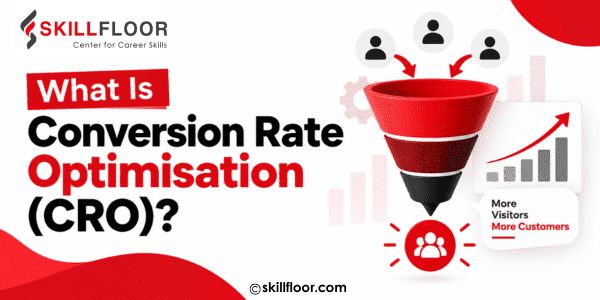
Conversion rate optimisation (CRO) is the practice of getting more of your website visitors to take a desired action, like buying, signing up, or filling out a form. You improve the page, the offer, and the user journey so a bigger share of the same traffic converts. HubSpot reports that the average site converts around 1.7% of visitors, so small gains add up fast.
Key takeaways
• CRO grows the percentage of visitors who act, using the traffic you already have.
• The formula is simple: conversions divided by visitors, times 100.


• Small lifts matter. Going from 1% to 2% can double your leads.
• CRO and SEO work together. SEO brings visitors, CRO turns them into leads.
• Testing, clear CTAs, faster pages, and social proof are core tactics.
What is conversion rate optimisation?
Conversion rate optimisation is a step-by-step way to raise the share of visitors who complete a goal on your site. It is a core skill in any strong digital marketing course. A goal might be a sale, a sign-up, a call, or a form fill. You study how people use the page. You find where they drop off. Then you fix those friction points and test the change.
People also call it conversion optimisation, or CRO for short. It sits at the core of good conversion rate optimization marketing. CRO first grew out of e-commerce, as online stores worked to earn more from each visitor. You spend money and effort to bring people in. CRO makes sure more of them act once they arrive.
|
Term |
What it means |
Example |
|
Conversion |
A visitor completes a desired action |
A user submits a contact form |
|
Conversion rate |
The share of visitors who convert |
30 sign-ups from 1,000 visits = 3% |
|
CRO |
The work done to raise that share |
Testing two headlines to see which wins |
|
Conversion funnel |
The steps a visitor takes to convert |
Home page, to product page, to checkout |
How do you calculate a conversion rate?
The maths is short. Divide your conversions by your total visitors. Then multiply by 100. That gives you a percentage.
Say 40 people buy from 2,000 visits. That is 40 divided by 2,000, times 100. Your conversion rate is 2%.
You can track this for any goal on any page. Most teams use Google Analytics or a similar tool to count it.
Why does conversion rate optimisation matter in digital marketing?
Conversion rate optimization in digital marketing matters because traffic costs money. HubSpot (2026) reports that the average website converts about 1.7% of visitors across sectors. So most visitors leave without acting. CRO helps you earn more from the clicks you already pay for.
The money point is simple. A lift from 1% to 2% can double your leads with the same traffic. You get a lower cost per lead and a better return. This is why conversion optimisation strategies now sit high on most marketing plans.
What is a conversion funnel, and how do you optimise it?
A conversion funnel is the path a visitor takes before they convert. It often runs from a first visit to interest to action. People drop off at each stage. Conversion funnel optimization means fixing the weak stages, so fewer people leave.
Start by mapping your funnel stages. Track how many people move from one step to the next. Find the step with the biggest drop. Fix that step first. Then test again and move to the next leak.
How does CRO work with SEO?
SEO and CRO pull in the same direction. SEO brings the right visitors to your page. CRO turns those visitors into leads and sales. Together they lift results without extra ad spend.
This link is often called conversion optimization seo. Clear content, fast load times, and a strong page structure help both. A page that ranks well and converts well gives you the best return. You can build these skills through focused SEO training with hands-on projects.
Landing page conversion rate optimization
Landing pages are where many conversions happen. A landing page has one job: get the visitor to act. Landing page conversion rate optimization means removing anything that blocks that one action.
A few proven moves:
• Keep one clear goal per page.
• Put the main offer above the fold.
• Cut extra menu links that pull attention away.
• Add trust signals like reviews and ratings.
• Make the form short and easy to finish.
Conversion optimisation strategies that work
Good conversion optimisation strategies come from testing. You form an idea, test it, and keep what wins. These core methods help most teams:
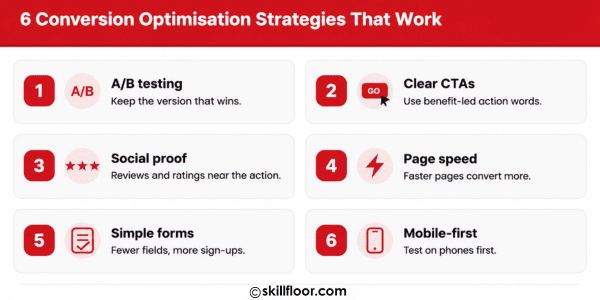
• A/B testing: Show two versions of a page. Keep the one that converts more.
• Clear CTAs: Use action words like “Get my free quote” over a plain “Submit”.
• Social proof: Add reviews, ratings, and client logos near the action point.
• Page speed: Faster pages hold more visitors and lift conversions.


• Simple forms: Ask for less. Each extra field can cost you sign-ups.
• Mobile-first design: Most traffic comes from phones, so test on phones first.
Speed matters most on mobile. Google's research found 53% of mobile visits drop off when a page takes over three seconds to load.
Once you master these basics, you can move to advanced CRO techniques like personalisation and predictive testing.
Common CRO mistakes to avoid
• Testing too many things at once. You cannot tell what worked.
• Calling a test early. Wait for enough data first.
• Copying competitors blindly. Your audience is different.
• Chasing the rate alone. Watch lead quality and revenue too.
Where to learn conversion rate optimisation
CRO blends data, design, and buyer psychology. The best way to learn it is by doing, on live projects. Skillfloor has run skill training since 2013 under SkillFloor Solutions Private Limited. Its certifications carry NASSCOM FutureSkills Prime accreditation.
You can build CRO skills inside a full digital marketing course, where you work on live campaigns and an internship. For a job-ready path, the Certified Digital Marketing Professional program covers SEO, ads, analytics, and conversion work end to end. Career guidance and placement assistance come built in.
FAQs
1. What is a good conversion rate?
It varies by industry. HubSpot reports an all-sector average near 1.7% (Q3 2025). Many teams aim for 2% to 5%, then push higher with testing.
2. Is CRO part of SEO?
They are separate skills that work as a pair. SEO brings traffic. CRO turns it into leads. Strong sites do both.
3. How long does CRO take to show results?
Simple tests can show signals in a few weeks. Bigger gains build over months of steady testing.
4. Do I need coding skills for CRO?
No. Most tools are drag-and-drop. You mainly need testing sense and clear thinking.
5. What tools help with CRO?
Analytics tools, heatmaps, and A/B testing platforms are common. Start with what tracks your goals.
Start applying CRO
Conversion rate optimisation helps you earn more from the traffic you already have. Learn the skills, test with intent, and let the data guide you. Skillfloor's digital marketing and SEO programs give you live projects to practise on from day one.
Learn more about our courses and find the right one for you.
Conversion rate optimisation is about making more of your existing website traffic take meaningful action. By improving your landing pages, simplifying forms, strengthening CTAs, adding social proof, improving page speed, and testing different approaches, you can gradually increase conversions and improve marketing ROI. CRO works best when combined with SEO, analytics, and a clear understanding of user behaviour. Instead of making changes based on assumptions, use data to identify friction points, test improvements, and continuously refine the user journey.
For digital marketers, learning CRO is a valuable skill that can help turn traffic into measurable business results. Whether you are improving a landing page, optimising a conversion funnel, or running A/B tests, a consistent, data-driven approach can make a significant difference over time.
Digital Marketing Courses in Other Locations in India
Ahmedabad | Aurangabad | Bangalore | Bhilai | Bhopal | Bhubaneshwar | Chandigarh | Chennai | Cochin | Coimbatore | Dehra Dun | Delhi | Faridabad | Ghaziabad | Gorakhpur | Guntur | Gurgaon | Guwahati | Hyderabad | Jaipur | Kanpur | Khammam | Kolkata | Lucknow | Madurai | Mumbai | Mysore | Nagpur | Noida | Patna | Pondicherry | Pune | Ranchi | Shimoga | Surat | Thane | Thiruvananthapuram | Tiruchirappalli | Tirupati | Vadodara | Visakhapatnam | Warangal | Jalandhar | Jodhpur | Indore | Durgapur | Jamshedpur | Dhanbad | Kota | Karnal | Udaipur | Amritsar | calicut | Nashik | Ludhiana | varanasi | thrissur | Mangalore | Raipur |