


































10 Best Jobs for Freshers to Start Your Career in 2026
Discover the 10 best jobs for freshers in 2026. Explore career options, key skills needed, and job roles that can help you start your career with confidence.

Every year, lakhs of students and graduates step into the job market with a degree in hand and a dozen questions in their minds. Which industry should I choose? Which skills actually matter? Am I even ready for this? If you're asking yourself these questions right now, you're not alone, and you're not behind either.
Fresher hiring in India grew by 8% in early 2026, signaling expanding entry-level opportunities across sectors, according to Naukri's JobSpeak report. But the same report shows something important: employers are becoming far more selective about who they hire, prioritising practical, job-ready skills over academic marks alone
This guide breaks down the best jobs for freshers in 2026 across marketing, data, technology, and creative fields along with the skills, responsibilities, and realistic salary expectations that come with each. The sooner you start building relevant, job-ready skills, the more confident and prepared you'll be when the right opportunity comes along.
Choosing the Right Job as a Fresher
Your talents, interests, educational background, and long-term professional goals should all be considered when selecting your first job. Overall employability has increased to 56.35%, highlighting the growing importance of developing relevant skills alongside academic qualifications. Instead of choosing a role simply because it is popular, consider whether it matches your strengths and offers opportunities for long-term growth.
-
Educational Background: Choose roles that build on your existing academic knowledge or strengths.
-
Personal Interest: Consider work that genuinely interests you and keeps you motivated.

-
Existing Skills: Identify your current skills and find roles where they provide an advantage.
-
Career Goals: Select a career path that matches your long-term professional ambitions.
-
Salary Expectations: Compare realistic fresher salaries based on skills, location, and company.
-
Industry Demand: Consider industries offering strong hiring opportunities and relevant career prospects.
-
Learning Curve: Understand the time and effort required to become job-ready.
-
Long-Term Growth: Evaluate opportunities for promotions, specialization, and professional development over time.
-
Work Preference: Decide whether you prefer technical, creative, analytical, or client-facing responsibilities.
-
Practical Exposure: Look for roles where projects and internships can strengthen your experience.


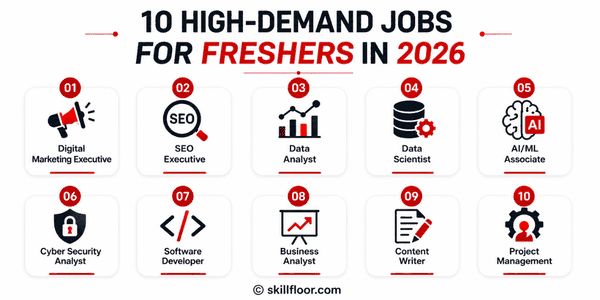
10 High-Demand Jobs for Freshers in 2026
The job market in 2026 offers freshers opportunities across digital marketing, technology, data, AI, cybersecurity, and business roles. These careers provide strong starting points for graduates who build relevant skills and gain practical industry knowledge.
1. Digital Marketing Executive
A digital marketing executive manages online campaigns to raise brand awareness and engagement. SEO, social media, paid advertising, content, and analytics are all included in the job.
Key Skills Required:
-
On-page SEO, keyword research, and fundamentals of digital marketing.
-
Planning content for major platforms and managing social media.
-
Campaign optimization principles, Google Ads, and Meta Ads.
-
Google Analytics and marketing campaign performance reporting.
Key Responsibilities:
-
Manage email, social media, and search marketing campaigns.
-
Track the effectiveness of campaigns and create marketing performance reports on a regular basis.
-
Organize campaign requirements with the design and content teams.
-
Utilize audience behavior and performance data to optimize campaigns.
Career Growth:
-
Progress from Digital Marketing Executive to Digital Marketing Specialist.
-
Advance into digital marketing manager or performance marketing manager roles.
2. SEO Executive
An SEO executive uses content techniques and search engine optimization to increase website presence. The position integrates performance analysis, technical enhancements, content optimization, and keyword research.


Key Skills Required:
-
Using competitive analysis techniques and SEO tools, conduct keyword research.
-
Technical SEO, on-page SEO, and fundamental website optimization.
-
SEO analytics reporting abilities with Google Search Console.
-
Strong content optimization skills and a basic understanding of HTML.
Key Responsibilities:
-
Find valuable search opportunities by conducting keyword research.
-
Improve internal linking structures, headings, metadata, and web pages.
-
Keep an eye on website performance, organic traffic, and keyword rankings.
-
Work together with developers and authors to increase the visibility of your website.
Career Growth:
-
Go from being an SEO executive to an experienced SEO professional.
-
Take on positions like an organic growth manager, SEO lead, or SEO manager.
3. Data Analyst
A data analyst looks for patterns and insightful information in company data. Through dashboards, reporting, and data interpretation, the position facilitates better decision-making.
Key Skills Required:
-
Proficiency with Excel for work involving data analysis and reporting.
-
SQL expertise for managing and querying corporate databases.
-
Use Tableau or Power BI to create interactive data visualizations.
-
Proficiency with Python and basic statistics for sophisticated data analysis.
Key Responsibilities:
-
Collect, validate, and verify datasets from various commercial sources.
-
Create reports and dashboards to track business success.
-
Examine organizational datasets for trends and patterns.
-
Clearly communicate data insights to decision-makers and stakeholders.
Career Growth:
-
Progress from data analyst to senior data analyst roles
-
Move into business intelligence, analytics, or data science careers
4. Data Scientist
A data scientist analyzes complicated datasets using machine learning, programming, and statistics. Entry-level workers support predictive modeling, experimentation, and data-driven business solutions.
Key Skills Required:
-
R or Python programming for data analysis and statistics
-
A solid understanding of the principles of probability, statistics, and machine learning
-
SQL expertise for structured business dataset preparation and querying
-
Proficiency in data manipulation to prepare extensive and intricate datasets
Key Responsibilities:
-
Prepare datasets for machine learning models and analytical experiments.
-
Assist senior scientists with model development and evaluation processes.
-
Analyze patterns and relationships within complex business datasets.
-
Document experiments, findings, models, and analytical results accurately.
Career Growth:
-
Progress from associate data scientist to data scientist roles.
-
Specialize in machine learning, NLP, computer vision, or analytics.
5. AI/ML Associate
Machine learning initiatives, including data, models, and automation, are supported by an AI/ML associate. The position offers hands-on expertise with model building, testing, and deployment procedures.
Key Skills Required:
-
Python programming and fundamental machine learning concepts
-
Data preprocessing, cleaning, and feature engineering techniques
-
TensorFlow or PyTorch fundamentals for machine learning development
-
Basic SQL and cloud computing knowledge for AI projects
Key Responsibilities:
-
Prepare datasets required for machine learning model development
-
Support training, testing, and evaluation of machine learning models
-
Assist teams with model deployment and performance monitoring
-
Document model experiments, results, and development processes
Career Growth:
-
Progress from AI/ML Associate to Junior Machine Learning Engineer
-
Advance toward ML Engineer, MLOps, or Generative AI specialisations
6. Cyber Security Analyst
A Cyber Security Analyst protects organisational systems by monitoring threats and security incidents. The role involves identifying vulnerabilities, investigating alerts, and supporting security operations.
Key Skills Required:
-
Networking fundamentals including TCP/IP, firewalls, and security protocols
-
SIEM tools for monitoring security events and suspicious activities
-
Basic scripting knowledge for security automation and investigation
-
Security certifications such as Security+ or CEH for foundational knowledge
Key Responsibilities:
-
Monitor security alerts, system logs, and suspicious network activities.
-
Investigate security incidents and document findings for further action.
-
Support vulnerability assessments across organizational systems and applications.
-
Assist security teams with incident response and threat analysis.
Career Growth:
-
Progress from SOC Analyst to experienced Cyber Security Analyst.
-
Specialise in penetration testing, cloud security, or security architecture.
7. Software Developer
Applications for various business purposes are designed, developed, tested, and maintained by software developers. Programming, web development, mobile applications, and software testing are opportunities for newcomers.
Key Skills Required:
-
Strong programming fundamentals in Java, Python, or JavaScript.
-
Data structures and algorithms for solving programming problems.
-
Git and version control for managing software development projects.
-
Basic SQL and database management knowledge for application development.
Key Responsibilities:
-
Write, test, and maintain clean application code regularly.
-
Debug software issues and implement appropriate technical solutions.
-
Collaborate with developers to build and improve application features.
-
Participate in code reviews and software development discussions.
Career Growth:
-
Progress from software developer to software engineer with experience.
-
Specialize in backend, frontend, full-stack, cloud, or mobile development.
8. Business Analyst
A business analyst makes the connection between operational and technical solutions and business requirements. Processes, requirements, data, documentation, and stakeholder communication are the main topics of the position.
Key Skills Required:
-
Excel and SQL skills for analyzing business data.
-
Requirement gathering and documentation using structured business processes.
-
Basic data visualization using Power BI or Tableau.
-
Strong communication and stakeholder management abilities for collaboration.
Key Responsibilities:
-
Gather requirements from stakeholders and document business needs.
-
Analyze existing processes and identify opportunities for improvement.
-
Prepare reports supporting business planning and decision-making.
-
Coordinate between business teams and technical project teams.
Career Growth:
-
Progressed from business analyst to senior business analyst roles.
-
Move toward product management, consulting, or strategy career paths.
9. Content Writer
A content writer creates informative, engaging, and search-friendly content for websites and marketing campaigns. The role involves researching topics, developing original content, applying SEO practices, and communicating ideas clearly to target audiences.
Key Skills Required:
-
Strong writing, editing, proofreading, and grammar skills
-
Basic SEO knowledge for creating search-friendly website content
-
Research skills for developing accurate and informative content
-
Familiarity with CMS platforms and content management tools
Key Responsibilities:
-
Write blogs, website content, articles, and marketing materials
-
Research topics and create accurate, audience-focused content
-
Optimise content using relevant keywords and SEO practices
-
Collaborate with marketing teams to support content campaigns
Career Growth:
-
Progress from Content Writer to Senior Content Writer roles
-
Move into Content Strategy, Content Marketing, or Editorial Management.
10. Project Management
A project management role involves planning, coordinating, and monitoring projects from start to completion. Freshers in this field work with teams, track deadlines, manage resources, and ensure projects meet their goals.
Key Skills Required:
-
Project planning and scheduling using structured project management methods
-
Communication and coordination skills for working with different teams
-
Knowledge of project management tools like Jira and Trello
-
Time management and problem-solving skills for handling project challenges
Key Responsibilities:
-
Plan project activities, timelines, resources, and deliverables with teams
-
Coordinate team members and track progress against project schedules
-
Monitor project deadlines, budgets, risks, and overall performance
-
Prepare project reports and communicate updates to key stakeholders
Career Growth:
-
Progress from project coordinator to assistant project manager roles
-
Advance into project manager, program manager, or delivery manager positions
Job Roles, Skills, and Fresher Salary Comparison in 2026
|
Job Role |
Key Skills |
Fresher Salary Range (India) |
|
Digital Marketing Executive |
SEO, Ads, Analytics |
₹2.5–4.5 LPA |
|
SEO Executive |
SEO, Keyword Research, Analytics |
₹2.5–4 LPA |
|
Data Analyst |
Excel, SQL, Power BI |
₹3.5–6 LPA |
|
Data Scientist (Associate) |
Python, statistics, and ML |
₹4–8 LPA |
|
AI/ML Associate |
Python, ML Frameworks, SQL |
₹5–10 LPA |
|
Cyber Security Analyst |
Networking, SIEM, Security+ |
₹3.5–7 LPA |
|
Software Developer |
Programming, Git, SQL |
₹3.5–7 LPA |
|
Business Analyst |
Excel, SQL, Analysis |
₹4–7 LPA |
|
Content Writer |
Writing, SEO, Research |
₹2.5–4.5 LPA |
|
Project Management |
Planning, Communication, Coordination |
₹3–6 LPA |
Skills Freshers Need to Get Hired in 2026
Employers increasingly look beyond a degree certificate. What actually moves you up the shortlist is a combination of practical ability and workplace readiness:
-
Communication: Clear writing and speaking matter in almost every role, from client calls to internal reports.
-
Problem-solving: Employers want to see how you approach a problem, not just whether you know the theory.
-
Digital skills: Comfort with common workplace tools, spreadsheets, dashboards, and project trackers is assumed by default.
-
Analytical thinking: The ability to read data and draw a sensible conclusion, even outside data-specific roles.
-
AI literacy: Understanding how AI tools can support your work (research, writing, analysis) is becoming a baseline expectation, not a bonus.
-
Basic data analysis: Even non-analytics roles increasingly expect comfort with numbers and trends.
-
Domain-specific technical skills: The specific tools tied to your chosen role, such as SQL for analysts, ad platforms for marketers, and so on.
-
Time management: Handling multiple tasks and deadlines without close supervision.
-
Adaptability: Tools, processes, and priorities shift quickly; freshers who adjust well stand out.
-
Interview skills: Structuring answers clearly and backing them with real examples.
-
Resume and LinkedIn optimization: A resume built around outcomes and projects, not just a list of subjects studied.
Why Skill-Based Learning Matters for Freshers
Academic knowledge provides a foundation, but practical skills help freshers demonstrate their abilities in real workplace situations. Hands-on projects, internships, and industry-focused training can strengthen a fresher’s profile and improve job readiness.
-
Develop practical skills aligned with current industry requirements.
-
Gain hands-on experience through real-world projects and assignments.
-
Build a strong portfolio to demonstrate practical capabilities.
-
Improve confidence for interviews and workplace responsibilities.
-
Earn industry-recognized certifications to strengthen your professional profile.
-
Gain internship experience with practical exposure to real projects.
-
Skillfloor provides practical, job-ready training aligned with industry requirements.
-
Skillfloor offers projects, internships, certifications, and placement assistance for freshers.
How Freshers Can Become Job-Ready in 2026
-
Choose one career path to focus on first.
-
Learn the core skills required for that specific role.
-
Complete practical projects that mirror real job tasks.
-
Build a resume centered on outcomes and skills, not just education.
-
Create or optimize a LinkedIn profile with relevant keywords.
-
Build a portfolio where applicable (writing samples, dashboards, GitHub projects).
-
Complete relevant certifications to back up your skills.
-
Apply for internships and entry-level roles consistently, not just occasionally.
-
Practice interviews, including questions about your projects.
-
Keep improving based on the specific requirements you see in job descriptions.
Digital Marketing as a Career Option for Freshers in 2026
Digital marketing is a practical career option for freshers because it combines creative, analytical, and communication skills. With the right training and practical exposure, beginners can build skills across several in-demand marketing areas.
-
SEO & Content Marketing: Learn keyword research, content optimization, and strategies for improving online visibility.
-
Social Media & Paid Advertising: Manage social platforms and create campaigns using Google Ads and Meta Ads.
-
Analytics & Performance Marketing: Track campaign results, understand audience behavior, and improve marketing performance.
-
AI, AEO & GEO: Develop familiarity with AI tools and newer search optimization practices.
-
Practical Training: Skillfloor provides projects, internship exposure, certifications, and job-focused digital marketing course.
FAQ’s
1. Which are the best jobs for freshers in 2026?
Digital marketing, data analytics, software development, cybersecurity, and business analysis are strong options.
2. What skills should freshers learn to get a job?
Freshers should develop communication, problem-solving, technical, analytical, and role-specific skills.
3. Which jobs offer good salaries for freshers?
AI/ML, data science, software development, and data analytics can offer competitive salaries.
4. Can freshers get digital marketing jobs without experience?
Yes, freshers can enter digital marketing with practical skills, certifications, projects, and internships.
5. How can freshers get their first job in 2026?
Build relevant skills, complete practical projects, create a strong resume, and apply consistently.
Starting your career as a fresher in 2026 does not mean choosing a job based only on salary or current popularity. The right career path depends on your interests, existing strengths, learning ability, and the skills required for the role you want to pursue. From digital marketing and content writing to data science, AI/ML, cybersecurity, software development, and project management, freshers have several career options to explore. The most important step is to move beyond theoretical knowledge and develop practical, job-ready skills. Build relevant projects, gain internship experience, earn useful certifications, and keep improving your resume and interview skills. With consistent learning and practical exposure, you can approach your first job with greater confidence and build a strong foundation for long-term career growth.
Digital Marketing Courses in Other Locations in India
Ahmedabad | Aurangabad | Bangalore | Bhilai | Bhopal | Bhubaneshwar | Chandigarh | Chennai | Cochin | Coimbatore | Dehra Dun | Delhi | Faridabad | Ghaziabad | Gorakhpur | Guntur | Gurgaon | Guwahati | Hyderabad | Jaipur | Kanpur | Khammam | Kolkata | Lucknow | Madurai | Mumbai | Mysore | Nagpur | Noida | Patna | Pondicherry | Pune | Ranchi | Shimoga | Surat | Thane | Thiruvananthapuram | Tiruchirappalli | Tirupati | Vadodara | Visakhapatnam | Warangal | Jalandhar | Jodhpur | Indore | Durgapur | Jamshedpur | Dhanbad | Kota | Karnal | Udaipur | Amritsar | calicut | Nashik | Ludhiana | varanasi | thrissur | Mangalore | Raipur |