











































Google Algorithm Update 2026: What Changed & What to Do
The Google algorithm update 2026 timeline explained: every confirmed core and spam update, what actually changed, and how SEO professionals should adapt.

Google Search changes constantly. Most of those changes are small and unnamed, but a handful each year are large enough that Google confirms them, and those are the ones that can move rankings, visibility, and organic traffic in ways site owners actually notice.
The problem is that rankings also fluctuate for reasons unrelated to any confirmed update: seasonal demand, competitor activity, a fresh crawl, or normal volatility. Reacting to every dip as though it were an algorithm change is how good pages get rewritten for no reason.
This guide covers the Google algorithm update 2026 timeline in full: every change Google has officially confirmed this year, what it actually did, and what a measured SEO response looks like. Throughout, we separate three things clearly: what Google confirmed, what the wider SEO industry observed, and what we would recommend you do about it.
What Is the Google Algorithm Update 2026?
The Google algorithm update 2026 is not a single event. It is the set of confirmed changes Google made to its search ranking systems across the year, logged publicly on the Google Search Status Dashboard. In 2026, those confirmed changes fall into three groups: core updates, spam updates, and a Discover-specific update.


A core update is a broad re-evaluation of how Google assesses content quality, relevance, and helpfulness across the whole web. Google states that core updates do not target specific sites or pages; they reassess everything at once, so a page can move without having done anything wrong. Google explains this in its own core updates guidance.
A spam update is narrower. It improves how Google's automated systems detect content and behaviour that already violate its published spam policies. A drop that lines up with a spam update usually points to one identifiable issue, rather than a general quality reassessment.
Not every ranking change signals a Google update. Before concluding that an update caused a drop, confirm a rollout was actually running during the same window. Everything below is drawn from Google's confirmed record.
What Google Algorithm Updates Have Happened in 2026?
As of early September 2026, Google has confirmed six ranking updates for the year, each logged on the Search Status Dashboard with start and end times you can read for yourself.
|
Update |
Dates |
Type |
What Google Confirmed |
Potential SEO Impact |
|
February 2026 Discover Core Update |
February 2026 |
Discover core update |
A core-style update affecting the Google Discover surface, confirmed in Google's documentation changelog |
Visibility shifts in Discover feeds, not classic web search |
|
March 2026 spam update |
Mar 24 to Mar 25, 2026 |
Spam update |
Global rollout, all languages; completed in roughly 19.5 hours, the fastest confirmed spam rollout on the dashboard |
Reduced visibility for sites breaching existing spam policies |
|
March 2026 core update |
Mar 27 to Apr 8, 2026 |
Core update |
A broad core update, roughly 12 days to roll out; ran back-to-back with the March spam update |
Broad ranking movement tied to content quality and helpfulness |
|
May 2026 core update |
May 21 to Jun 2, 2026 |
Core update |
The second core update of the year, roughly 12 days to complete |
Further broad re-evaluation of content quality across sites |
|
June 2026 spam update |
Jun 24 to Jun 26, 2026 |
Spam update |
Global rollout, roughly 2 days; spam-policy coverage expanded to include attempts to manipulate generative AI responses in Search |
Pressure on manipulation tactics, including those aimed at AI Overviews and AI Mode |
|
August 2026 spam update |
Aug 18 to Aug 21, 2026 |
Spam update |
Global, all languages, roughly 2 days and 16 hours; an enforcement refinement to existing policies, with no new spam rules announced |
Sharper enforcement against scaled content abuse and other existing violations |
Two points are worth holding onto. First, none of the three 2026 spam updates introduced a new spam-policy category. They were enforcement improvements to Google's automated systems, applied against rules that already exist. Second, because Google can confirm further updates at any time, the dashboard is the source of truth. Check it directly before acting on this timeline.
What Changed With Google's Search Algorithm in 2026?
Confirmed by Google. The core updates in March and May continued Google's long-running direction: rewarding helpful, reliable, people-first content and reassessing pages that fall short. Google published no new ranking rulebook alongside them; its existing guidance on creating helpful content remained the reference.
On the spam side, the June 2026 update is the most substantive of the year for one reason: Google expanded its spam-policy coverage to address attempts to manipulate generative AI responses in Search, including AI Overviews and AI Mode. The August update then refined enforcement further without adding new policy types.
Google also made confirmed changes outside the ranking systems. It removed the FAQ rich result feature, which no longer appears in search results, and it began phasing out the practice problem and dataset structured data types. If your site still relies on FAQ rich snippets for visibility, that route is gone, though FAQ content itself remains useful for readers and for answer extraction.
Industry observations. Third-party rank trackers reported elevated volatility around the March and May core windows and around the August spam rollout. That volatility is real and worth monitoring, but the specific impact figures circulating in the SEO community are third-party estimates that vary widely between tools, not Google-confirmed numbers. Treat them as directional signals, not facts.
Our reading. The through-line of 2026 is not a dramatic rule change. It is steady tightening of quality and spam enforcement, plus a clear signal that Google now polices manipulation of its AI answer surfaces the same way it polices classic spam. The practical takeaway is continuity: the fundamentals Google has published for years still apply.
How Does the Google Algorithm Update 2026 Affect SEO?
Content SEO
Core updates reward originality, depth, genuine first-hand experience, and content that actually satisfies the query behind a search. Pages that read as though anyone could have written them without real knowledge of the topic are the most exposed. Adding firsthand perspective, accurate detail, and clear authorship is a stronger response than surface-level rewriting.
Technical SEO
Technical health does not become less important during an update; it becomes easier to blame unfairly. Confirm that key pages are indexable, crawlable, and served with correct canonicals and internal links before assuming a content problem. Page experience and mobile usability remain baseline expectations.
On-Page SEO
Titles, headings, internal linking, and structured content should map to search intent, not just to keywords. Clear structure also helps AI systems and featured snippets extract a direct answer from your page, which matters more as answer surfaces expand.
AI Content
Google does not automatically penalise AI-generated content. Its position is about quality and policy compliance, not the tool used to produce the text. Content that is original, useful, and accurate can rank regardless of how it was drafted. What the spam updates target is scaled content abuse: mass-produced, low-value pages built to game rankings rather than help people. Using AI to publish large volumes of thin content is the risk, not using AI to help produce genuinely useful work.
Skillfloor's AI-powered digital marketing programme covers applying AI across SEO and content workflows without crossing into scaled-content territory.
How to Check If Your Website Was Affected
Use Google Search Console as your primary evidence source, supported by your analytics platform.
-
Open the Performance report and compare clicks, impressions, average CTR, and average position across three windows: before the update, during the rollout, and after it is completed.
-
Break the data down by query and by page to find exactly what moved, rather than judging the site as a whole.
-
Line the change up against the confirmed update dates above. A drop that starts on an update's start date is a signal; a drop that does not align may have another cause.
Do not conclude from one or two days of data. Rankings fluctuate during a rollout and often settle only after it completes.
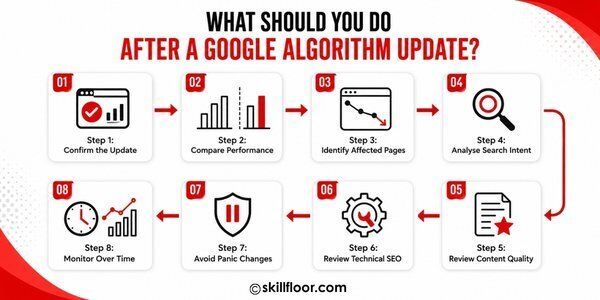
What Should You Do After a Google Algorithm Update?
Step 1: Confirm the update. Check Google's Search Status Dashboard to verify a rollout was actually running.
Step 2: Compare performance. Use Search Console and analytics to measure before, during, and after, using the windows described above.
Step 3: Identify affected pages. Find the specific URLs and queries with meaningful, sustained declines.
Step 4: Analyse search intent. For each affected page, ask whether the content genuinely answers the query a searcher had in mind, or whether a competitor now does it better.
Step 5: Review content quality. Evaluate accuracy, originality, depth, relevance, first-hand experience, author expertise, and trust signals honestly.
Step 6: Review technical SEO. Check indexing, crawlability, canonicals, internal links, structured data, and page experience.


Step 7: Avoid panic changes. Do not gut or rewrite large sections of the site without evidence. Reactive mass edits during a rollout often cause more harm than the update did.
Step 8: Monitor over time. Recovery is not guaranteed and has no fixed timeline. For core updates in particular, meaningful recovery often appears only when a later update runs and reassesses your improved content.
SEO Mistakes to Avoid After a Google Update
-
Changing everything at once, before you have evidence of what moved.
-
Keyword stuffing in an attempt to force rankings back.
-
Deleting pages without analysing whether they genuinely underperform.
-
Copying whatever competitors are doing this week.
-
Publishing large volumes of low-value AI content to fill gaps.
-
Chasing daily ranking fluctuations instead of tracking sustained trends.
-
Assuming every traffic decline is algorithm-related when the cause may be seasonal or technical.
-
Ignoring technical SEO while focusing only on content.
-
Optimising for keywords while ignoring the actual search intent.
-
Treating a correlation between a change and a ranking move as proof of a ranking factor.
How SEO Professionals Should Adapt in 2026
The pattern across the year points to a broader definition of the SEO role. The professionals who stay effective are strong in:
-
Search intent analysis and mapping content to real reader questions.
-
Content strategy and disciplined content updating, rather than one-off publishing.
-
Technical SEO, including crawling, indexing, and page experience.
-
Google Search Console and analytics interpretation, so decisions rest on data.
-
Content quality assessment against E-E-A-T principles.
-
AI-assisted workflows and effective prompting, used to speed up good work rather than to mass-produce filler.
-
Entity and topic optimization that builds topical authority over time.
If you are building these skills deliberately, a structured programme can shorten the path. Skillfloor's Certified SEO Specialist course covers keyword research, on-page and technical SEO, and performance analysis through hands-on projects, which is the kind of practical grounding that update-resilient SEO now demands. For the data side, its data analytics course builds the reporting fluency that turns Search Console numbers into decisions.
Google Algorithm Update 2026: Key Takeaways for Businesses
-
Optimise for people first. Every confirmed 2026 update rewarded useful, reliable content over content built for algorithms.
-
Verify before you react. Confirm a rollout on the Search Status Dashboard before changing anything.
-
Use first-party data. Search Console and analytics beat community speculation every time.
-
Separate confirmed facts from observation. Google-confirmed changes and third-party impact estimates are not the same thing.
-
Build topical authority rather than chasing individual keywords.
-
Keep technical health in good order so it is never the hidden cause of a drop.
-
Use AI responsibly. Quality and originality matter; scaled, low-value output is the real risk.
-
Make evidence-based decisions and give changes time to be reassessed.
Frequently Asked Questions
-
What is the Google algorithm update 2026?
It is the set of confirmed changes Google made to its search ranking systems in 2026. As of early September, that includes two core updates (March and May), three spam updates (March, June, and August), and a February Discover update, all logged on the Google Search Status Dashboard.
-
What is Google's latest algorithm update in 2026?
The most recent confirmed ranking update is the August 2026 spam update. It began on August 18 and completed on August 21, 2026, running globally across all languages. Google described it as an enforcement refinement to existing spam policies, with no new rules introduced.
-
How do I know if Google updated its algorithm?
Check the Google Search Status Dashboard, which is Google's official record of confirmed ranking updates. It lists each update with a start time, an end time, and a rollout duration. If no update is logged for the period your rankings moved, another cause is more likely.
-
How does a Google core update affect rankings?
A core update broadly re-evaluates how Google judges content quality and relevance across the web. It does not target specific sites. A page can rise or fall based on how it now compares with other content for the same query, even if nothing on the page changed.
-
Does Google penalise AI-generated content?
No, not automatically. Google's position focuses on content quality, originality, and compliance with its spam policies, not on the tool used to write it. Useful, accurate AI-assisted content can rank. What the spam updates target is scaled content abuse: mass-produced, low-value pages.
-
How can I recover from a Google algorithm update?
Identify the affected pages in Search Console, then improve genuine quality: accuracy, depth, first-hand experience, and search-intent match. For core updates, recovery often appears only when a later update reassesses your improved content, so there is no instant fix.
-
How long does a Google algorithm update take to settle?
Rollout durations vary widely. In 2026, the confirmed spam updates ran from under a day to about two and a half days, while the core updates took roughly 12 days each. Recovery for affected sites is separate from rollout time and has no fixed timeline.
-
Should I change my website after a Google core update?
Only after you have evidence, confirm the update, identify which pages and queries actually declined, and make targeted quality improvements. Avoid sweeping rewrites or mass deletions made in reaction to a rollout, because unmeasured changes often do more harm than good.
-
How can Google Search Console help after an algorithm update?
The Performance report lets you compare clicks, impressions, CTR, and average position before, during, and after an update, and break the data down by page and query. That evidence tells you what actually moved, so you can respond to specific issues instead of guessing.
-
What SEO skills are important in 2026?
Search intent analysis, content quality assessment, technical SEO, Search Console and analytics interpretation, responsible use of AI in workflows, and topical authority building. The role now rewards judgement and data fluency far more than mechanical keyword placement.
Google Search will keep evolving, and more updates are likely before the year ends. The durable advantage is not predicting each rollout; it is building content and technical foundations strong enough that most updates work in your favour. To develop that skill set in a structured, practical way, explore Skillfloor's digital marketing and SEO training.
Digital Marketing Courses in Other Locations in India
Ahmedabad | Aurangabad | Bangalore | Bhilai | Bhopal | Bhubaneshwar | Chandigarh | Chennai | Cochin | Coimbatore | Dehra Dun | Delhi | Faridabad | Ghaziabad | Gorakhpur | Guntur | Gurgaon | Guwahati | Hyderabad | Jaipur | Kanpur | Khammam | Kolkata | Lucknow | Madurai | Mumbai | Mysore | Nagpur | Noida | Patna | Pondicherry | Pune | Ranchi | Shimoga | Surat | Thane | Thiruvananthapuram | Tiruchirappalli | Tirupati | Vadodara | Visakhapatnam | Warangal | Jalandhar | Jodhpur | Indore | Durgapur | Jamshedpur | Dhanbad | Kota | Karnal | Udaipur | Amritsar | calicut | Nashik | Ludhiana | varanasi | thrissur | Mangalore | Raipur |



-
 ZUBAIR PIXELidk too much but i can say that this is the best update ive needed to (google core update)