










































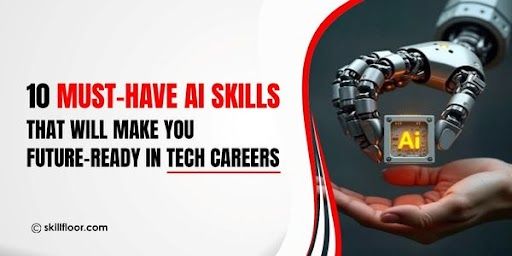
10 Must-Have AI Skills That Will Make You Future-Ready in Tech Careers
Build future-ready tech careers with 10 AI skills. Includes Python, machine learning, data basics, and prompt engineering in simple language to grow tech jobs.
Are you ready to build a career in one of the fastest-growing fields in the world?
If you've been following the tech industry lately, you already know that Artificial Intelligence is no longer a niche skill. It's becoming the backbone of modern businesses across every sector.
From automating workflows to powering intelligent products, AI is reshaping how companies operate and who they hire. Professionals who invest in the right AI skills today are landing higher-paying roles, faster promotions, and more future-proof careers. Here's everything you need to know to get started on the right path.
How AI Is Changing the Technology Industry
Artificial Intelligence is actively reshaping how technology is built, deployed, and experienced across every industry, integrating into core products, workflows, and customer experiences at an unprecedented speed. For tech professionals, this means the tools, roles, and expectations of the industry are evolving faster than ever before.


Here's a closer look at the key ways AI is redefining the technology industry:
-
AI-powered coding tools like GitHub Copilot are reducing development time by up to 55%, allowing engineers to focus on architecture rather than repetitive code writing.
-
AI systems can now detect cybersecurity threats in real time, analyzing millions of data points per second, something no human team could match at scale.
-
Generative AI alone is projected to become a $1.3 trillion market by 2032, signaling massive investment and opportunity across every tech vertical.
-
Roles like Prompt Engineer, MLOps Specialist, and LLM Developer didn't exist five years ago, and today they're among the fastest-growing positions across the global tech job market.
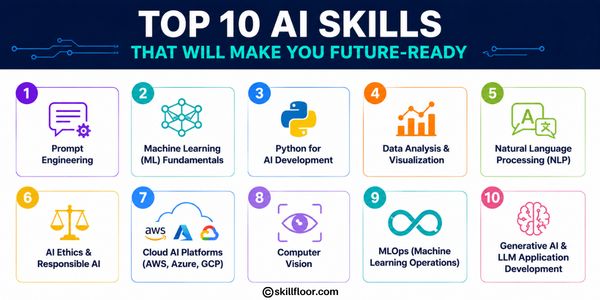
Top 10 AI Skills That Will Make You Future-Ready
1. Prompt Engineering
Prompt engineering is the art of crafting precise, structured inputs to get optimal outputs from large language models. It's one of the fastest-growing AI skills in tech, bridging the gap between raw AI capability and real-world product value. Whether you're building AI chatbots, automating workflows, or powering internal tools, prompt engineering is the foundation.
What You'll Actually Do on the Job:
- Architecting structured prompt chains for multi-turn interactions
- Designing reusable prompt templates for internal knowledge tools
- Fine-tuning outputs for tone, factuality, and task-specific accuracy
- Working alongside product and content teams to build LLM-powered experiences
Skills and Tools to Master:
- Language models: OpenAI (GPT-4), Claude, LLaMA
- Frameworks: LangChain, PromptLayer
- Best practices: Zero-shot vs. few-shot, prompt templating, output parsing
Who's Hiring: Companies across SaaS, legal tech, consulting, and B2B services. From startups to large enterprises, everyone deploying LLMs needs prompt engineers who can build for scale and reliability.
2. Machine Learning (ML) Fundamentals
Machine learning is the engine behind almost every AI product you interact with, from recommendation engines to fraud detection systems. Understanding how models learn from data, make predictions, and improve over time is a non-negotiable skill for any future-ready tech professional. It forms the bedrock upon which advanced AI roles are built.
What You'll Actually Do on the Job:
- Building and training supervised and unsupervised ML models
- Evaluating model performance using metrics like accuracy, precision, and recall
- Preprocessing and transforming raw datasets for model training
- Collaborating with data engineers to deploy models into production pipelines
Skills and Tools to Master:
- Libraries: Scikit-learn, TensorFlow, PyTorch
- Concepts: Regression, classification, clustering, model evaluation
- Platforms: Google Colab, Jupyter Notebook, Kaggle
Who's Hiring: Every industry, fintech, healthcare, e-commerce, logistics, and edtech is actively hiring ML practitioners. Roles range from ML Engineer to Applied Scientist across both product and research teams.
3. Python for AI Development
Python is the universal language of AI. Its simplicity, massive ecosystem of libraries, and strong community support make it the go-to language for data scientists, ML engineers, and AI researchers worldwide. If you're serious about an AI career, Python is not optional — it's essential.
What You'll Actually Do on the Job:
- Writing scripts to automate data collection, cleaning, and transformation
- Building and testing machine learning pipelines end-to-end
- Integrating AI models into APIs and backend services
- Developing custom AI tools using open-source Python frameworks
Skills and Tools to Master:
- Libraries: NumPy, Pandas, Matplotlib, Scikit-learn, Hugging Face
- Concepts: OOP, data structures, file handling, API integration
- Tools: VS Code, GitHub, virtual environments (venv/conda)
Who's Hiring: Python AI developers are in demand across every sector. Startups building AI-first products and enterprises modernizing legacy systems both need Python-fluent engineers who can move fast.
4. Data Analysis & Visualization
AI models are only as good as the data they're trained on. Data analysis skills help you understand patterns, clean messy datasets, and translate numbers into decisions. Visualization takes it a step further, making complex findings clear and compelling for stakeholders, product teams, and executives.
What You'll Actually Do on the Job:
- Exploring and profiling large datasets to uncover trends and anomalies
- Building interactive dashboards for business intelligence reporting
- Communicating data-driven insights to non-technical stakeholders
- Supporting AI teams with clean, well-documented datasets for model training
Skills and Tools to Master:
- Tools: Power BI, Tableau, Google Looker Studio
- Libraries: Pandas, Seaborn, Plotly, Matplotlib
- Concepts: EDA (Exploratory Data Analysis), KPIs, data storytelling
Who's Hiring: Marketing agencies, product companies, healthcare platforms, and retail giants all need data analysts who can bridge the gap between raw AI output and business strategy.
5. Natural Language Processing (NLP)
NLP is the AI discipline that enables machines to understand, interpret, and generate human language. It powers everything from voice assistants and chatbots to sentiment analysis tools and AI writing platforms. As language-based AI products explode in popularity, NLP in AI has become one of the most valuable and in-demand tech skills.
What You'll Actually Do on the Job:
- Building text classification, summarization, and sentiment analysis pipelines
- Training and fine-tuning transformer models for domain-specific tasks
- Working with unstructured text data from emails, reviews, and documents
- Integrating NLP APIs into customer-facing products and internal tools
Skills and Tools to Master:
- Libraries: NLTK, spaCy, Hugging Face Transformers
- Models: BERT, GPT, T5, RoBERTa
- Concepts: Tokenization, named entity recognition, and semantic search
Who's Hiring: Legal tech, media, customer service platforms, HR tech, and healthcare are leading NLP hiring. Any company processing large volumes of text data needs NLP-skilled engineers.


6. AI Ethics & Responsible AI
As AI systems become more influential in hiring, healthcare, finance, and law, the demand for professionals who understand AI ethics is surging. This skill ensures AI is built and deployed fairly, transparently, and without harmful bias. It's both a technical and strategic capability that separates mature AI teams from the rest.
What You'll Actually Do on the Job:
- Auditing AI models for bias, fairness, and discriminatory outputs
- Creating documentation and guidelines for responsible AI deployment
- Advising product and engineering teams on ethical AI frameworks
- Ensuring compliance with AI regulations (EU AI Act, GDPR, etc.)
Skills and Tools to Master:
- Frameworks: Google's Responsible AI toolkit, IBM AI Fairness 360
- Concepts: Bias detection, explainability (XAI), algorithmic accountability
- Soft skills: Critical thinking, stakeholder communication, policy awareness
Who's Hiring: Government agencies, large tech companies, financial institutions, and consulting firms are actively building responsible AI teams. This role is growing fast in regulated industries.
7. Cloud AI Platforms (AWS, Azure, GCP)
Modern AI systems don't run on local machines; they live in the cloud. Understanding how to build, train, and deploy AI workloads on platforms like AWS, Microsoft Azure, and Google Cloud is a critical skill for any AI practitioner. Cloud fluency directly accelerates your ability to scale AI products.
What You'll Actually Do on the Job:
- Deploying and managing ML models using cloud-native AI services
- Setting up data pipelines and storage for large-scale AI workloads
- Using AutoML tools to rapidly prototype and experiment with models
- Monitoring model performance and managing cloud infrastructure costs
Skills and Tools to Master:
- AWS: SageMaker, Rekognition, Comprehend
- Azure: Azure ML Studio, Cognitive Services, OpenAI Service
- GCP: Vertex AI, BigQuery ML, AutoML
Who's Hiring: Tech companies, enterprises undergoing digital transformation, and cloud consulting firms. Cloud AI certifications from AWS, Google, or Microsoft significantly boost employability.
8. Computer Vision
Computer vision enables machines to see and interpret the visual world, from identifying objects in images to reading medical scans. It's one of the most applied branches of AI, with real-world use cases in manufacturing, retail, healthcare, and autonomous vehicles. As camera-equipped devices multiply, so does the demand for computer vision engineers.
What You'll Actually Do on the Job:
- Building image classification and object detection models
- Working with video data for real-time analysis and surveillance applications
- Developing quality control systems using visual inspection AI
- Integrating computer vision APIs into mobile and web applications
Skills and Tools to Master:
- Libraries: OpenCV, TensorFlow, PyTorch, YOLO
- Concepts: CNNs, image segmentation, transfer learning, edge detection
- Platforms: Roboflow, AWS Rekognition, Google Vision API
Who's Hiring: Healthcare diagnostics, autonomous vehicle companies, retail analytics, smart manufacturing, and security tech firms are all heavy hirers in computer vision.
9. MLOps (Machine Learning Operations)
Building a model is only half the battle; deploying it reliably and maintaining it in production is where MLOps comes in. MLOps combines machine learning with DevOps principles to create reproducible, scalable, and automated ML pipelines. It's the bridge between data science experiments and real-world AI systems.
What You'll Actually Do on the Job:
- Building CI/CD pipelines specifically designed for ML model deployment
- Monitoring models in production for data drift and performance degradation
- Versioning datasets, experiments, and models for reproducibility
- Automating model retraining workflows triggered by performance thresholds
Skills and Tools to Master:
- Tools: MLflow, Kubeflow, DVC, Airflow, Docker, Kubernetes
- Concepts: Model versioning, feature stores, A/B testing, drift detection
- Platforms: AWS SageMaker Pipelines, Azure DevOps, Vertex AI Pipelines
Who's Hiring: Any company with AI in production, fintech, healthtech, logistics, and retail. MLOps engineers command some of the highest salaries in the AI field due to their rare combination of ML and DevOps skills.
10. Generative AI & LLM Application Development
Generative AI is reshaping how products are built. From AI copilots to autonomous agents, the ability to build applications on top of large language models is one of the most in-demand skills of the decade. This goes beyond prompting; it involves full-stack development with AI at the core.
What You'll Actually Do on the Job:
- Building RAG (Retrieval-Augmented Generation) pipelines for knowledge-grounded AI apps
- Developing AI agents that can autonomously plan, reason, and take actions
- Integrating LLM APIs into existing SaaS products and internal tools
- Evaluating and benchmarking LLM outputs for accuracy, hallucination, and safety
Skills and Tools to Master:
- Frameworks: LangChain, LlamaIndex, AutoGen, CrewAI
- Models: GPT-4, Claude, Gemini, Mistral, LLaMA
- Concepts: RAG, vector databases (Pinecone, Weaviate), agentic workflows
Who's Hiring: AI-first startups, enterprise software companies, and innovation labs at major corporations. This is one of the fastest-growing hiring categories in tech right now and shows no signs of slowing down.
How to Start Learning AI Skills and Become Future-Ready
Breaking into the AI industry doesn't require a computer science degree; it requires the right roadmap, consistency, and the willingness to keep learning as the field evolves. Whether you're a fresher, a working professional, or someone switching careers, the path to AI readiness is more accessible today than it has ever been.
- Start with the Fundamentals — Before diving into complex models, build a strong foundation in Python, basic statistics, and data handling, as these are the building blocks of every AI skill.
- Pick One Specialization and Go Deep — Whether it's Machine Learning, NLP, or Prompt Engineering, focus on mastering one area first rather than spreading yourself too thin across multiple domains.
- Learn by Building Real Projects — Hands-on experience matters more than certificates alone, so build projects, contribute to open-source, and document your work on GitHub and LinkedIn.
- Follow the AI Community Actively — Stay updated by following AI researchers, practitioners, and publications on platforms like X (Twitter), Hugging Face, Towards Data Science, and MIT Technology Review.
- Enroll in Structured AI Courses or Bootcamps — Platforms like Coursera, fast.ai, and DeepLearning.AI offer industry-aligned programs that take you from beginner to job-ready in a structured, practical way.
The AI industry rewards those who stay curious and consistently upskill. Skillfloor's industry-focused AI programs are a great place to start helping you build the right skills, work on real projects, and step confidently into the most future-proof careers the tech world has to offer.
Skillfloor combines expert-led training, hands-on AI projects, career-focused mentorship, and industry-relevant curriculum, helping learners gain practical experience, build strong portfolios, and confidently prepare for emerging AI job opportunities.
FAQ’s
Q1. Is a degree necessary to learn and grow in the AI field?
A degree is helpful but not mandatory. Most employers today prioritize practical skills, hands-on projects, and certifications over traditional degrees. What matters more is your ability to build, problem-solve, and demonstrate real-world experience.
Q2. Which AI skill should a complete beginner start with?
Python is the best starting point for beginners. It's beginner-friendly, widely used across every AI domain, and forms the foundation for machine learning, data analysis, NLP, and more.
Q3. How long does it take to become job-ready in AI?
With consistent learning and hands-on practice, most beginners can become job-ready within 6 to 12 months. Focusing on one specialization and building real projects significantly speeds up the process.
Q4. Are AI skills relevant only for tech professionals?
Not at all. AI skills are increasingly valuable across marketing, healthcare, finance, legal, and operations. Any professional who works with data, content, or decision-making can benefit from learning AI tools and concepts.
The demand for AI skills is not a passing trend; it's a fundamental shift in how the tech industry operates, hires, and grows. Whether you're just starting or looking to level up your existing career, the ten skills covered in this blog give you a clear and actionable roadmap to follow. Each skill builds on the other, creating a well-rounded profile that employers across every sector are actively looking for. The resources, tools, and learning platforms available today make it easier than ever to get started and grow at your own pace. Invest in the right AI skills now and position yourself confidently at the forefront of the most exciting technological revolution of our generation.
Artificial Intelligence Course in Bangalore | AI Course in Chennai | Data Science Course in Bangalore | Data Science Training in Chennai | Digital Marketing Course in Bangalore | Digital Marketing Course in Chennai
Digital Marketing Courses in Other Locations in India
Ahmedabad | Aurangabad | Bangalore | Bhilai | Bhopal | Bhubaneshwar | Chandigarh | Chennai | Cochin | Coimbatore | Dehra Dun | Delhi | Faridabad | Ghaziabad | Gorakhpur | Guntur | Gurgaon | Guwahati | Hyderabad | Jaipur | Kanpur | Khammam | Kolkata | Lucknow | Madurai | Mumbai | Mysore | Nagpur | Noida | Patna | Pondicherry | Pune | Ranchi | Shimoga | Surat | Thane | Thiruvananthapuram | Tiruchirappalli | Tirupati | Vadodara | Visakhapatnam | Warangal | Jalandhar | Jodhpur | Indore | Durgapur | Jamshedpur | Dhanbad | Kota | Karnal | Udaipur | Amritsar | calicut | Nashik | Ludhiana | varanasi | thrissur | Mangalore | Raipur |