


































Business Analytics vs Data Analytics: What’s the Real Difference?
Understand the difference between business analytics and data analytics, their roles, skills needed, career options, and how both help in real-world decisions.
Two people can work with data every day and still have completely different careers.
One spends hours writing SQL queries and cleaning datasets.
The other sits in strategy meetings, helping companies improve profits and customer retention.
Both roles involve analytics, but one is Data Analytics, while the other is Business Analytics.
This confusion causes many beginners to choose the wrong learning path, certifications, or job applications. Here, we’ll break down the real difference between Business Analytics and Data Analytics using practical examples, career insights, tools, salaries, and industry trends.


What is Data Analytics?
Data analytics is the process of examining data to uncover relevant information. It helps in understanding data patterns, trends, and shifts. By utilizing accurate and transparent information, individuals can make better, more informed decisions in their daily lives, at work, and in business.
This process involves data collection, organized categorization, and thorough verification. Businesses use data analytics to gain insights into their customers, improve their products and services, and solve problems. It allows people to make decisions based on facts rather than speculation or random ideas.
What Data Analysts Actually Do
A data analyst spends most of their time:
-
Cleaning and organizing data
-
Writing queries (SQL)
-
Analyzing datasets using tools like Python or Excel
-
Creating dashboards and reports
-
Identifying trends and anomalies
Data analysts collect, clean, and organize raw datasets, ensuring accuracy before performing analysis for meaningful business insights and decisions effectively.
Data analysts use SQL, Python, and Excel to analyze datasets, build dashboards, identify trends, patterns, anomalies, and actionable insights quickly.
For example, a Data Analyst in an e-commerce company may analyze customer purchase behavior using SQL and Python to identify why cart abandonment rates increased during checkout.
What is Business Analytics?
Business analytics refers to the use of data to enhance company decision-making. By analyzing data, businesses can determine what strategies work and which do not.
This process enables organizations to plan more effectively, achieve better results, and make informed decisions that contribute to growth and success.
It involves examining data, identifying relevant insights, and applying these insights to address business challenges.
Companies use business analytics to increase sales, understand customer needs, and enhance profitability. This approach helps leaders make decisions based on facts rather than guesswork or assumptions.
What Business Analysts Actually Do
A business analyst typically:
-
Interprets data insights in a business context
-
Identifies problems and opportunities
-
Recommends strategies
-
Works closely with stakeholders
-
Translates data into decisions
Business analysts interpret data insights to understand business performance, identify problems, uncover opportunities, and support informed decision making processes better.
Business analysts collaborate closely with stakeholders, gathering requirements, communicating insights, and recommending strategies that improve overall business performance outcomes effectively.
Business analysts translate complex data into actionable decisions, ensuring organizations respond quickly to challenges and make informed strategic choices consistently.
Business Analytics vs Data Analytics: Key Differences
The following explains how data analytics and business analytics differ from one another.


|
Aspect |
Data Analytics |
Business Analytics |
|
Definition |
Study of raw data to find useful patterns, trends, and meaningful insights |
Use of data insights to support business decisions and improve performance |
|
Primary Focus |
Focuses on analyzing data, patterns, and trends from large datasets |
Focuses on solving business problems and improving decision-making processes |
|
Goal |
To understand what happened in the past and why it happened in the data |
To decide what actions should be taken for better business results |
|
Scope |
Includes data cleaning, processing, analysis, and generating reports for understanding |
Includes business planning, forecasting, strategy building, and performance improvement |
|
Approach |
Uses a technical, data-driven approach focused on numbers and statistics |
Uses a business-focused approach aimed at decision-making and growth |
|
Tools & Software |
Uses SQL, Python, R, Excel, and statistical analysis tools for work |
Uses Power BI, Tableau, Excel dashboards, and reporting tools for insights |
|
Key Skills Required |
Requires coding skills, statistics knowledge, and strong data handling ability |
Requires business understanding, communication skills, and decision-making ability |
|
Career Roles |
Common roles include Data Analyst, Data Scientist, and Data Engineer |
Common roles include Business Analyst, Strategy Analyst, and Product Analyst |
Skills Required for Business Analytics vs Data Analytics
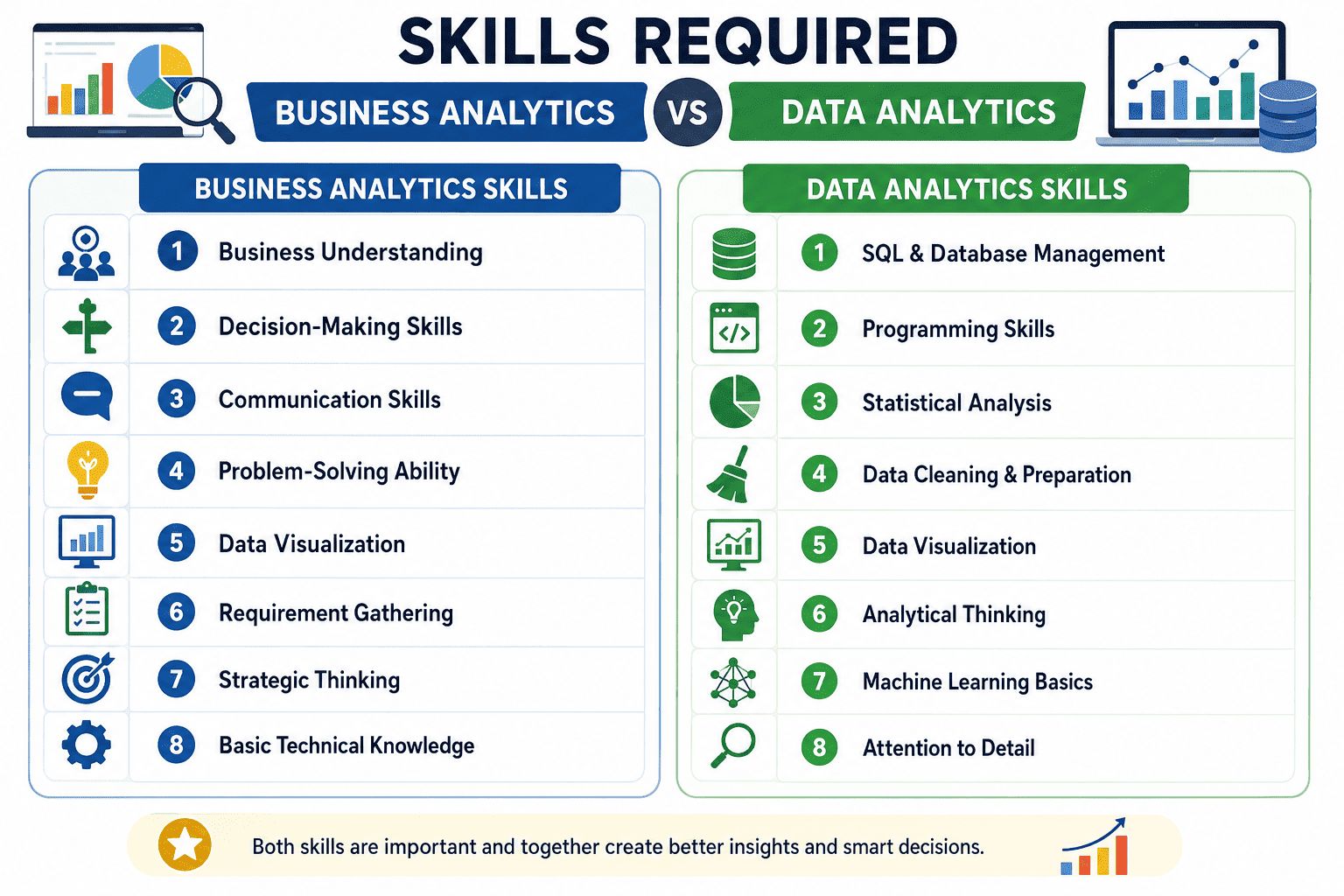
Strong analytical thinking is necessary in both domains, but data analytics is more concerned with technical data management and insights extraction, whereas business analytics is more concerned with strategy and decision-making.
A data analytics course and a business analytics course help learners develop the right mix of technical and strategic skills needed for both fields effectively.
Business Analytics Skills
-
Business Understanding: To match data with business outcomes, comprehend consumer wants, market trends, and company goals.
-
Decision-Making Skills: Transform data findings into useful business practices and performance-enhancing tactics.
-
Communication Skills: For improved comprehension and implementation, effectively communicate results to non-technical teams and stakeholders.
-
Problem-Solving Ability: Determine the problems facing your company and apply data-driven thinking to discover solutions.
-
Data Visualization: Simplify intricate business insights with dashboards and charts to facilitate prompt decision-making.
-
Requirement Gathering: To determine analytical objectives and project scope, gather and analyze company demands.
-
Strategic Thinking: Align analytics with organizational goals and concentrate on long-term business growth.
-
Basic Technical Knowledge: To facilitate analysis and reporting, use programs like Excel, SQL, and BI tools.
Data Analytics Skills
-
SQL & Database Management: Effectively retrieve and handle data for analysis from organized databases.
-
Programming Skills: Process, analyze, and automate data tasks with Python or R.
-
Statistical Analysis: Utilize statistical techniques to identify trends, patterns, and significant connections in data.
-
Data Cleaning & Preparation: To guarantee high-quality datasets, eliminate mistakes, duplication, and inconsistencies.
-
Data Visualization: Make reports, dashboards, and graphs with programs like Tableau or Power BI.
-
Analytical Thinking: To extract valuable insights and conclusions, break down complex datasets.
-
Machine Learning Basics: For advanced analytics, comprehend forecasting methods and predictive models.
-
Attention to Detail: To prevent deceptive outcomes or inaccurate insights, make sure data management is accurate.
Tools and Technologies Used in Business Analytics and Data Analytics
While both Business Analytics and Data Analytics make use of contemporary tools to gain insights and make choices, Business Analytics is more concerned with dashboards, whereas Data Analytics, with its core data analytics skills, is more concerned with coding and analysis.
Business Analytics Tools and Technologies
-
Microsoft Excel: Pivot tables and charts are widely used for reporting, KPI tracking, and simple business analysis.
-
Microsoft Power BI: Real-time business reports and interactive dashboards can be created with this powerful business intelligence tool.
-
Tableau: Enables faster decision-making by visualizing corporate data with user-friendly dashboards.
-
Google Looker Studio: Used to create simple, shareable dashboards using business and marketing data sources.
-
SAP BusinessObjects: Big companies employ enterprise-level reporting tools to monitor business performance.
-
IBM Cognos Analytics: Utilized for predicting, corporate reporting, and AI-driven insights.
-
Salesforce Analytics (Tableau CRM): Concentrated on analyzing sales and customer data to make business decisions.
-
Google Sheets: Quick business analysis, reporting, and collaboration are all possible with this lightweight tool.
Data Analytics Tools and Technologies
-
Python: Most widely used language for automation, machine learning, and data analysis with libraries like NumPy and Pandas.
-
R (programming language): Extensively utilized in research-based analytics, data modeling, and statistical analysis.
-
SQL: Vital for organizing, extracting, and querying big database datasets.
-
Jupyter Notebook: Code creation, data visualization, and analysis sharing are all done in an interactive environment.
-
Apache Hadoop: Large-scale dataset processing and storage framework for distributed systems.
-
Apache Spark: Utilized for real-time analytics and quick big data processing.
-
Google BigQuery: Cloud-based data repository enabling speedy analysis of massive datasets.
-
Matplotlib: Static, animated, and interactive data visualizations can be made with this Python package.
Summary Insight
-
Business Analytics tools focus on dashboards, reporting, and decision-making.
-
Data Analytics tools focus on coding, data processing, and deep statistical analysis.
Together, they form a complete ecosystem where data is first analyzed (Data Analytics) and then converted into business actions (Business Analytics).
Career Paths and Job Demand in Business Analytics vs Data Analytics
Career paths in Data Analytics and Business Analytics offer distinct trajectories tailored to technical depth versus strategic impact, with robust demand in India's tech ecosystem.
Business Analytics Career Paths
-
Core Roles:
-
Business Analyst (data-to-strategy translation, e.g., marketing ROI forecasts)
-
Analytics Manager (team oversight, KPI dashboards)
-
Consultant (client advisory on Power BI).
-
Entry Salaries: ₹8-15 lakhs, blending analytics with MBA/business acumen for quicker impact.
-
Key Employers: Deloitte, KPMG, Accenture—project-based in BFSI/retail (e.g., 20% cost savings models).
-
Demand Drivers: 30% YoY growth tied to revenue influence; paths to C-suite like Chief Analytics Officer.
Data Analytics Career Paths
-
Core Roles: Data Analyst (daily data cleaning, SQL queries, dashboard creation like sales trends); Junior Data Scientist (intro ML models, e.g., customer clustering via Python).
-
Entry Salaries: ₹6-10 lakhs for freshers with B.Tech or Google Data Analytics cert; reflects high volume of openings in IT services.
-
Key Employers: Infosys, TCS, Wipro—focus on scalable data handling for global clients (e.g., e-commerce terabytes).
-
Demand Drivers: 25% YoY growth from cloud/AI data prep; suits volume-focused outsourcing.
Educational Pathways: Business Analytics and Data Analytics Courses
1. Undergraduate Degrees (Foundation Stage)
-
Business Analytics: BBA or business-related degrees with analytics basics.
-
Data Analytics: BSc Computer Science, Statistics, or Data Science, focusing on technical foundations.
2. Postgraduate Degrees (Advanced Learning)
-
Business Analytics: MBA/PGDM in Business Analytics for strategy and decision-making.
-
Data Analytics: MSc/MTech in Data Science, AI, or Analytics for advanced technical expertise.
3. Certification Courses (Skill Enhancement)
-
Business Analytics: Power BI, Excel, Tableau, and business intelligence certifications.
-
Data Analytics: Python, SQL, R, and machine learning certification programs.
4. Online Learning Platforms (Flexible Study)
- Both fields offer Coursera, Udemy, edX, and Skillfloor courses for self-paced learning in either business or technical analytics.
5. Bootcamps (Fast-Track Programs)
-
Business Analytics: Focus on dashboards, reporting, and business insights.
-
Data Analytics: Focus on coding, datasets, and real-world analytical problem solving.
6. Specialized Training Programs
-
Business Analytics: KPI tracking, reporting systems, and decision-making frameworks.
-
Data Analytics: Big data tools like Hadoop, Spark, and advanced statistical techniques.
7. Industry Certifications (Career Validation)
-
Business Analytics: BI tools and enterprise reporting certifications.
-
Data Analytics: Certifications in data science, cloud platforms, and programming tools.
8. Executive & Professional Programs
-
Business Analytics: Designed for managers focusing on strategy and business growth.
-
Data Analytics: Designed for professionals focusing on advanced technical, predictive, and analytical skills.
So… Which One Should You Choose?
Depending on your interests, skills, and long-term objectives, you can choose between them because both provide excellent career advancement, high demand, and worthwhile analytics prospects.
Choose Business Analytics If:
-
You enjoy solving real-world business problems
-
You like communication and storytelling
-
You want to influence decisions
-
You see yourself in leadership roles
-
You enjoy working with teams and stakeholders
-
You are interested in improving business performance and strategy
Choose Data Analytics If:
-
You enjoy working with numbers and code
-
You like solving technical problems
-
You’re comfortable working behind the scenes
-
You want to go deep into data science
-
You enjoy learning tools like SQL, Python, and Excel
-
You like finding patterns hidden in large datasets
Future Trends in Business Analytics vs Data Analytics
The future of analytics is rapidly expanding as businesses increasingly rely on data-driven decision-making. According to IDC, the global datasphere is expected to reach 175 zettabytes by 2025. This growth is driving up the demand for data analytics and business analytics professionals across various sectors, including technology, healthcare, retail, and finance.
In the coming years, automation and artificial intelligence will play a crucial role in both fields.
Business analytics will focus more on real-time decision-making, while data analytics will increasingly leverage machine learning techniques for automation. Professionals who combine technical skills with business acumen will enjoy greater career advancement and improved job prospects.
FAQs: Business Analytics vs Data Analytics
1. What is the main difference between business analytics and data analytics?
Data analytics focuses on analyzing raw data to find patterns, while business analytics uses those insights to support business decisions and improve performance.
2. Which is more technical, business analytics or data analytics?
Data analytics is more technical because it involves coding, statistics, and tools like SQL and Python, while business analytics focuses more on strategy and decision-making.
3. Can a data analyst become a business analyst?
Yes, a data analyst can move into business analytics by improving communication skills, understanding business goals, and learning decision-making frameworks.
4. Which has a better salary, data analytics or business analytics?
Both offer good salaries, but data analytics roles may start slightly higher due to technical skills, while business analytics grows with experience and leadership roles.
5. What skills are common in both fields?
Both fields use Excel, data interpretation, problem-solving, and a basic understanding of data visualization tools like Power BI or Tableau.
6. Which career is better for beginners?
It depends on interest. Beginners who like coding can choose data analytics, while those who prefer business and communication can choose business analytics.
Although they lead you in distinct directions, business analytics and data analytics eventually offer strong opportunities for your career. While the latter aids in making astute business judgments, the former aids in the thorough understanding of facts. Which fits your interests and style of thinking is the best option, not which is superior. Data analytics can be a good fit for you if you like numbers and coding. Company analytics can be a good fit for you if you enjoy exchanging ideas and solving company problems. Both can lead to a prosperous and fulfilling future job with the correct abilities and effort.
Data Analytics Course | Artificial Intelligence Course | Data Science Courses | Digital Marketing Course
Digital Marketing Courses in Other Locations in India
Ahmedabad | Aurangabad | Bangalore | Bhilai | Bhopal | Bhubaneshwar | Chandigarh | Chennai | Cochin | Coimbatore | Dehra Dun | Delhi | Faridabad | Ghaziabad | Gorakhpur | Guntur | Gurgaon | Guwahati | Hyderabad | Jaipur | Kanpur | Khammam | Kolkata | Lucknow | Madurai | Mumbai | Mysore | Nagpur | Noida | Patna | Pondicherry | Pune | Ranchi | Shimoga | Surat | Thane | Thiruvananthapuram | Tiruchirappalli | Tirupati | Vadodara | Visakhapatnam | Warangal | Jalandhar | Jodhpur | Indore | Durgapur | Jamshedpur | Dhanbad | Kota | Karnal | Udaipur | Amritsar | calicut | Nashik | Ludhiana | varanasi | thrissur | Mangalore | Raipur |