













































What Is Artificial Narrow Intelligence?
Understand Artificial Narrow Intelligence (ANI), its functions, and examples of how it is used in everyday AI-powered systems, from assistants to smart tools.
Artificial Narrow Intelligence (ANI) is a type of artificial intelligence designed to perform specific tasks within a limited domain. Unlike human intelligence, ANI cannot think or learn beyond the function it was trained to perform. It powers many of the AI systems used today, including recommendation engines, spam filters, voice assistants, and fraud detection systems.
As the most widely deployed form of AI in 2026, ANI plays a critical role in helping businesses automate processes, improve decision-making, and deliver better user experiences. Understanding ANI is essential for anyone exploring artificial intelligence and its real-world applications.
Examples:
Netflix - Movie Recommendation


Banking - Fraud Detection
Gmail - Spam Filtering
Siri & Alexa - Voice assistance
Google Maps - Route optimization
Why Is Artificial Narrow Intelligence Important?
Artificial Narrow Intelligence (ANI) is important because it underpins how modern AI systems solve real-world problems.
Today, ANI is widely used across industries, not just in tech companies. Over 77% of devices use some form of AI, and most of it is powered by ANI. It is used in areas like banking fraud detection, healthcare diagnostics, and business automation.
Understanding ANI helps you learn:
-
How AI systems are trained and designed
-
How machine learning models make predictions
-
Why AI is strong in pattern recognition
-
How automation improves efficiency
-
The importance of data in AI performance
-
The limitations of AI systems
In short, ANI is the starting point for understanding artificial intelligence and is essential before learning advanced AI concepts in 2026.
What Are the Three Types of Artificial Intelligence?
Artificial Intelligence is generally divided into three types based on its capabilities.
1. Artificial Narrow Intelligence (ANI)
ANI is designed to perform a specific task within a limited domain. Examples include Siri, Alexa, spam filters, facial recognition, fraud detection, and recommendation systems.
2. Artificial General Intelligence (AGI)
AGI refers to AI that can perform any intellectual task a human can. It can learn, reason, and apply knowledge across different areas. AGI is still not developed.
3. Artificial Superintelligence (ASI)
ASI is a theoretical form of AI that would surpass human intelligence in all aspects. It remains a concept under research and debate.
How Is Artificial Narrow Intelligence Different from Artificial General Intelligence?
Artificial Narrow Intelligence and Artificial General Intelligence (AGI) represent different stages of AI development.
ANI focuses on performing specific tasks exceptionally well within a limited domain. It relies on specialized training and cannot extend its capabilities beyond predefined functions.
AGI, on the other hand, refers to a theoretical form of AI capable of understanding, learning, and applying knowledge across multiple domains, similarly to a human being. AGI would possess the ability to reason, solve unfamiliar problems, and adapt to new situations without task-specific programming.
Currently, ANI is the only widely implemented form of artificial intelligence. AGI remains a research objective rather than a commercially available reality.
How Does Artificial Narrow Intelligence Work?
Artificial Narrow Intelligence (ANI) works by learning patterns from data and using those patterns to perform a specific task. ANI analyzes information, identifies relationships, and generates predictions, recommendations, or decisions based on what it has learned.


The process typically follows three simple steps:
Data Input → Pattern Recognition → Output
For example, a spam filter analyzes millions of emails, learns the patterns commonly found in spam messages, and then uses that knowledge to classify new emails as spam or legitimate.
ANI is powered by technologies such as Machine Learning, Deep Learning, Natural Language Processing (NLP), and Computer Vision. Its accuracy depends largely on the quality of the data used for training.
In simple terms, Artificial Narrow Intelligence learns from historical data and applies that learning to solve a specific problem efficiently and accurately.
Types of Artificial Narrow Intelligence
Not every ANI system works the same way. Different tasks require different approaches. Based on how they learn and operate, ANI systems fall into two broad categories.
1. Reactive Machines
Reactive machines are the most basic form of ANI. They respond to inputs based on pre-defined rules or patterns but have no memory of past interactions. They cannot learn from experience — they simply react to the current situation.
Example: IBM's Deep Blue chess computer, which defeated world chess champion Garry Kasparov in 1997, is a classic reactive machine. It could evaluate chess positions and choose the best move — but it had no memory of previous games and could not apply its chess knowledge to any other task.
2. Limited Memory AI
Limited memory AI is the most common and commercially significant type of ANI today. These systems can use past data to inform current decisions, which allows them to learn and improve over time.
Example: Self-driving cars use limited-memory AI to observe other vehicles, road conditions, and traffic patterns. They use this recent data to make real-time driving decisions — but they do not retain memories indefinitely or reason beyond their driving function.
Most real-world ANI applications, including recommendation engines, fraud detection systems, and voice assistants, are built on limited-memory AI because outcomes are influenced by patterns in historical data.
Artificial Narrow Intelligence in a Practical Scenario
Imagine a bank using Artificial Narrow Intelligence (ANI) to detect financial fraud. Instead of manual checks, it uses an AI system that analyzes transaction data in real time.
The system studies:
-
Transaction amounts and frequency
-
Location of transactions
-
Merchant categories
-
Time patterns
-
Device and login behavior
It then identifies risky patterns such as:
-
Unusual location transactions after normal hours
-
Rapid small transactions (possible card testing)
-
New merchant category with location change
Based on this, the system instantly flags suspicious activity, blocks transactions, or alerts the fraud team.
This makes fraud detection faster, more accurate, and more efficient than manual review.
Benefits of Artificial Narrow Intelligence
Artificial Narrow Intelligence (ANI) provides several practical advantages that make it highly valuable across industries. It helps organizations improve efficiency, reduce costs, and enhance decision-making through data-driven systems.
-
Improved Efficiency: ANI automates repetitive tasks, allowing businesses to increase productivity and focus on more important work.
-
Faster Decision-Making: It processes large amounts of data quickly and provides real-time insights for better decision-making.
-
Higher Accuracy: ANI reduces human errors by making decisions based on consistent patterns and trained data.
-
Cost Savings: Automation reduces manual effort and operational costs while improving overall performance.
-
Better Customer Experience: Personalized recommendations and intelligent systems improve user satisfaction and engagement.
-
Scalability: ANI can handle large datasets and increasing workloads without requiring proportional human effort.
Limitations of Artificial Narrow Intelligence
Although Artificial Narrow Intelligence (ANI) is widely used and highly effective in specific applications, it has several important limitations that define its boundaries. Understanding these limitations is essential before building or relying on ANI systems.
-
Lack of General Intelligence: ANI cannot transfer knowledge between unrelated tasks. Each system is designed for a specific function only.
-
Dependence on Data Quality: The performance of ANI depends entirely on the quality of training data. Incomplete or biased data leads to inaccurate results.
-
No Real Understanding or Reasoning: ANI works based on patterns and statistics rather than true understanding, common sense, or logical reasoning.
-
Limited Adaptability: It performs well only within its trained environment and struggles with new or unexpected situations.
-
Vulnerability to Manipulation: ANI systems can sometimes be misled using adversarial inputs designed to trick the model.
-
Ethical and Privacy Concerns: The use of ANI raises concerns related to bias, transparency, data privacy, and responsible deployment.
Understanding both the strengths and limitations of AI is essential for responsible implementation. Learning platforms such as Skillfloor help individuals explore real-world AI challenges, ethical considerations, and practical applications through hands-on training.
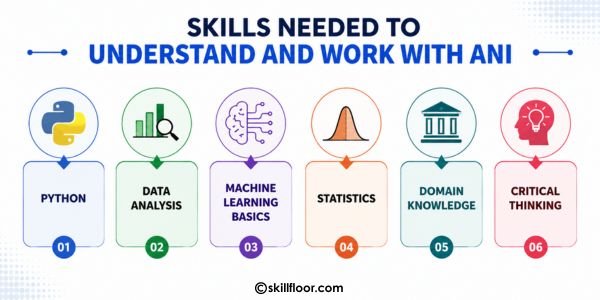
Skills Needed to Understand and Work With ANI
|
Skill |
Why It Matters |
|
Python |
Used for building and testing AI and machine learning models |
|
Data Analysis |
Helps in understanding data patterns and interpreting AI outputs |
|
Machine Learning Basics |
Builds a foundation of how ANI systems learn from data |
|
Statistics |
Supports accuracy, probability understanding, and pattern recognition |
|
Domain Knowledge |
Helps apply AI effectively in fields like finance, healthcare, and cybersecurity |
|
Critical Thinking |
Helps evaluate AI outputs and decide when results are reliable |
Practical exposure to tools like recommendation systems and spam filters is equally important for real understanding.
What Does the Future Hold for Artificial Narrow Intelligence?
Artificial Narrow Intelligence (ANI) will continue to grow with advancements in machine learning, deep learning, and cloud computing. It will become more accurate, scalable, and widely used across industries for automation, prediction, and decision-making.
Future ANI systems are expected to improve personalization, enhance predictive analytics, strengthen cybersecurity applications, and support smarter automation in daily digital tools. At the same time, issues related to ethics, transparency, and data privacy will become more important as AI adoption increases.
Despite progress in Artificial General Intelligence (AGI), ANI will remain the most widely used form of AI in real-world applications for the foreseeable future.
Career Scope for Artificial Narrow Intelligence Professionals in 2026
The demand for ANI skills is increasing across industries such as data science, cybersecurity, finance, and business analytics. Companies are actively hiring professionals who can work with AI systems in practical, real-world environments.
Key career areas include:
-
Data Science and Machine Learning roles
-
Cybersecurity and Threat Detection
-
AI Product Development
-
Business Intelligence and Analytics
In cybersecurity, ANI helps detect threats and unusual behavior patterns in real time.. In analytics and business roles, it helps in improving decision-making through data-driven insights.
Overall, ANI knowledge is becoming an essential skill for modern technology careers and will continue to remain relevant in the future.
Frequently Asked Questions (FAQs)
1. What is Artificial Narrow Intelligence in simple words?
ANI is an AI designed to perform specific tasks like spam detection, voice recognition, or recommendations.
2. How does Artificial Narrow Intelligence work?
It works by analyzing data, identifying patterns, and making predictions for specific tasks.
3. What are examples of ANI?
Siri, Alexa, Netflix recommendations, spam filters, and fraud detection systems.
4. What are the advantages of ANI?
It improves efficiency, reduces errors, lowers costs, and improves decision-making.
5. What are the limitations of ANI?
It cannot generalize across tasks and depends heavily on data quality.
6. Why is ANI important in 2026?
Because it powers most real-world AI systems used in industries today.
Artificial Narrow Intelligence (ANI) is the foundation of most AI systems we use today. From everyday tools like spam filters and recommendation engines to critical applications in healthcare, finance, and cybersecurity, ANI plays a vital role in modern digital life. Although it does not possess human-like reasoning or general intelligence, its ability to deliver fast, accurate, and reliable results makes it the most widely used form of AI in 2026. As technology continues to evolve, ANI will remain at the core of innovation, driving automation, improving decision-making, and shaping how industries operate in the future. Understanding ANI is essential for anyone looking to build a career or stay relevant in today’s AI-driven world.
Artificial Intelligence Course in Bangalore | AI Course in Chennai | Data Science Course in Bangalore | Data Science Training in Chennai | Digital Marketing Course in Bangalore | Digital Marketing Course in Chennai
Digital Marketing Courses in Other Locations in India
Ahmedabad | Aurangabad | Bangalore | Bhilai | Bhopal | Bhubaneshwar | Chandigarh | Chennai | Cochin | Coimbatore | Dehra Dun | Delhi | Faridabad | Ghaziabad | Gorakhpur | Guntur | Gurgaon | Guwahati | Hyderabad | Jaipur | Kanpur | Khammam | Kolkata | Lucknow | Madurai | Mumbai | Mysore | Nagpur | Noida | Patna | Pondicherry | Pune | Ranchi | Shimoga | Surat | Thane | Thiruvananthapuram | Tiruchirappalli | Tirupati | Vadodara | Visakhapatnam | Warangal | Jalandhar | Jodhpur | Indore | Durgapur | Jamshedpur | Dhanbad | Kota | Karnal | Udaipur | Amritsar | calicut | Nashik | Ludhiana | varanasi | thrissur | Mangalore | Raipur |