








































What Are Agentic AI Frameworks? A Beginner's Guide
Curious about Agentic AI Frameworks? Learn what they are, how they work, and how they help AI agents handle tasks on their own in this simple beginner’s guide.
Artificial Intelligence is evolving beyond chatbots and content generation. Today, organizations are increasingly adopting AI systems that can plan, make decisions, use tools, and complete tasks with minimal human intervention.
This shift has given rise to AI agents - systems designed to achieve goals rather than simply respond to prompts. Industry reports show that generative AI adoption has already reached mainstream business use, while organizations are now exploring agentic AI frameworks to automate complex workflows. According to McKinsey, generative AI could contribute between $2.6 trillion and $4.4 trillion annually to the global economy, with automation-driven use cases expected to deliver significant value.
To build these intelligent, action-oriented systems, developers rely on Agentic AI Frameworks. These frameworks provide the tools needed to create AI agents that can reason, plan, remember context, use external tools, and execute tasks autonomously.
The Rise of AI Agents
The majority of traditional AI applications are reactive. They generate an output after waiting for input from the user.


For example:
-
You ask a chatbot a question.
-
The chatbot provides an answer.
-
The interaction ends.
Although helpful, some systems have drawbacks. They usually don't remember long-term objectives, use multi-step thinking, or act on your behalf.
However, conversational AI is not enough for modern organizations. They require systems that can:
-
Conduct research
-
Analyze information
-
Make decisions
-
Use external tools
-
Complete tasks autonomously
This demand has led to the emergence of AI agents.
An AI agent can be thought of as a digital worker that receives a goal and determines how to achieve it.
What Is Agentic AI?
AI systems that can independently pursue objectives by reasoning, planning, acting, and adapting in response to results are referred to as agentic AI.
Agentic AI concentrates on accomplishing goals, in contrast to classic AI models that concentrate on producing replies.
Key characteristics of Agentic AI include:
-
Goal-Oriented Behavior: Instead of just creating text, the system tries to accomplish a certain goal.
-
Planning: Large tasks are divided into manageable sections by the AI.
-
Decision-Making: It identifies the optimal course of action by weighing available possibilities.
-
Tool Usage: Databases, search engines, external apps, and APIs can all communicate with it.
-
Memory: It retains pertinent details and prior exchanges.
-
Autonomy: The system can function with very little human oversight.
Consider agentic AI as an independent worker who can complete tasks from beginning to end, and traditional artificial intelligence as an expert consultant.
How Does an AI Agent Work?
Understanding the lifecycle of an AI agent is important for understanding agentic AI frameworks.
Step 1: Receive a Goal
The agent takes a user-defined goal and knows exactly what has to be done.


Step 2: Understand the Task
It analyzes the request, determines the necessary tasks to be completed, and identifies the intent and limitations.
Step 3: Create a Plan
The agent creates a logical execution sequence by breaking the goal down into smaller steps.
Step 4: Use Tools
It establishes connections with external tools such as databases, search engines, enterprise software systems, and APIs.
Step 5: Observe Results
The agent examines tool outputs to ensure they are accurate, relevant, and helpful for the task at hand.
Step 6: Refine Actions
It dynamically improves its approach, retries unsuccessful stages, or modifies strategy in response to input.
Step 7: Deliver the Outcome
Ultimately, it presents the user with a comprehensive solution by compiling the results into an organized output.
What Are Agentic AI Frameworks?
An Agentic AI Framework is a development platform that helps developers build AI agents capable of reasoning, planning, using tools, managing memory, and completing multi-step tasks autonomously.
Managing reasoning, planning, memory, tool use, and system integrations can all be quite difficult when creating an AI agent from the ground up.
Developers need to handle:
-
Prompt management
-
Tool integration
-
State tracking
-
Memory storage
-
Multi-step reasoning
-
Workflow orchestration
-
Error handling
Instead of creating every component manually, developers can use pre-built abstractions for:
-
Agent creation
-
Tool calling
-
Memory management
-
Workflow execution
-
Multi-agent communication
These frameworks significantly reduce development effort and accelerate the creation of intelligent applications.
Why Agentic AI Frameworks Matter
In real-world AI applications, agentic AI frameworks help in the development of intelligent AI systems that can think, plan, and finish tasks with less assistance from humans.
1. Easy Way to Build AI Agents
They save developers time and effort by providing ready-made tools to swiftly create AI agents without starting from scratch.
2. Better Task Automation
They enable AI to do multi-step activities automatically, such as information search, analysis, and summarization, without continual human guidance.
3. Smooth Tool Integration
These frameworks make it simple to integrate AI with databases, apps, and APIs so agents may use actual tools to do tasks in the real world.
4. Improved Decision Making
They enable AI to deconstruct problems into phases and make better decisions based on data, producing more accurate and valuable solutions.
5. Scalable AI Systems
They facilitate the development of numerous AI agents collectively, assisting companies in expanding automation systems that manage heavier workloads without adding more complexity.
Core Components of an Agentic AI Framework
Frameworks differ in how they are implemented, but they all have a number of essential elements that allow agents to reason, plan, remember, and execute tasks using tools.
1. Large Language Model (LLM)
The LLM serves as the agent's reasoning engine.
It helps the agent:
-
Understand goals
-
Generate plans
-
Make decisions
-
Interpret results
Without an LLM, the agent lacks the intelligence needed to operate autonomously.
2. Memory System
Agents may learn from past interactions and preserve context due to memory.
There are generally two types:
-
Short-Term Memory: Helps the agent keep coherence during ongoing tasks by temporarily storing contextual information during a session.
-
Long-Term Memory: Allows for learning, customisation, and long-term performance improvement by storing permanent data across sessions.
Memory helps agents provide more personalized and context-aware responses.
3. Tool Integration
Agents become significantly more powerful when they can interact with external tools.
Examples include:
-
Search engines
-
APIs
-
Databases
-
Email systems
-
CRM platforms
-
File storage systems
Tool integration enables agents to move beyond conversation and perform real-world actions.
4. Planning Engine
The planning engine enables agents to carry out workflows effectively and methodically by breaking down complicated objectives into organized, sequential activities.
5. Feedback Loop
Agents can evaluate outcomes, learn from them, and continuously refine their choices for improved adaptive performance due to the feedback loop.
How Agentic AI Frameworks Work (Step-by-Step)
Agentic AI frameworks break down user objectives into steps and employ automation, tools, and reasoning to do tasks quickly and with little assistance from humans.
Step 1: Understanding the Goal
In order to interpret the task and establish a defined objective scope, AI models first read and comprehend user intent using natural language processing.
Step 2: Task Planning
It breaks the task into:
-
Identify competitors
-
Collect pricing data
-
Compare features
-
Summarize insights
Step 3: Tool Usage
The agent uses:
-
Web search APIs
-
Databases
-
Analytical tools
Step 4: Execution
AI agents process data, provide interim outcomes, and carry out tasks step-by-step using machine learning and external tools.
Step 5: Validation
Before continuing, AI systems use reasoning models to verify outputs for accuracy, consistency, and alignment with the initial objective.
Step 6: Final Output
AI programs compile all findings into a final, structured output that presents concise responses, reports, or actions according to user needs.
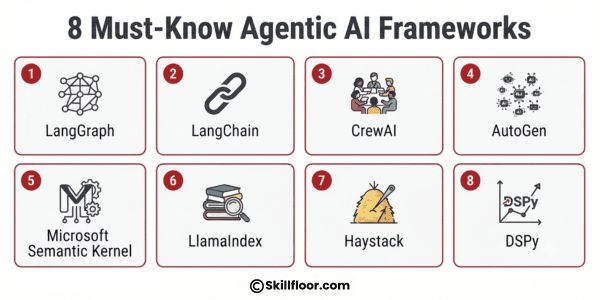
Top 8 Popular Agentic AI Frameworks in 2026
The best option depends on the particular requirements of what you are doing because agentic AI frameworks, which are frequently used by teams today, offer varying degrees of control, complexity, and flexibility.
1. LangGraph
LangGraph is a framework for creating stateful and regulated AI agent workflows that is built on LangChain. It assists developers in creating dependable single-agent and multi-agent systems with production-ready control, memory management, and a clear execution flow.
Key Features Include:
-
Human-in-the-Loop Control: LangGraph enables workflows to include approval or review processes, assisting humans in directing and verifying AI actions as they are carried out.
-
Flexible Workflow Design: It offers the building pieces needed to construct layered, multi-agent, or single-agent systems with complete control over job flow.
-
Memory and State Management: For improved context handling, the framework keeps track of past conversations and maintains shared or distinct states between sessions.
-
Production-Ready Execution: For dependable production AI systems, LangGraph offers error handling, real-time streaming, and robust long-running processes.
2. LangChain
A well-known open-source framework called LangChain connects tools, data, and workflows for interactive intelligent systems while utilizing huge language models to create AI-powered applications.
Key Features Include:
-
Easy LLM Integration: Developers can quickly and effectively create AI capabilities because of LangChain's ability to connect massive language models with apps.
-
Tool and API Usage: It makes it possible for AI systems to leverage databases, external tools, and APIs to carry out practical activities rather than just producing text.
-
Memory Support: LangChain's memory features enable AI to retain context during conversations or workflows and recall previous encounters.
-
Flexible Workflow Building: It makes it simpler to create organized and reusable AI apps by enabling developers to create intricate AI pipelines and chains.
3. CrewAI
CrewAI is a framework for creating groups of AI agents that collaborate to automatically finish challenging jobs. It facilitates the design, implementation, and management of agent-based systems at scale by supporting both visual tools and APIs.
Key Features Include:
-
Multi-Agent Coordination: CrewAI facilitates the collaboration of several AI agents, each of which has a distinct function, objective, and duty within the workflow.
-
Visual and API-Based Development: Users can develop agent workflows using code or a graphical user interface thanks to its visual builder and API support.
-
Tool and System Integration: For actual task execution, the framework links AI agents with external technologies including messaging apps, CRM platforms, email, and business systems.
-
Monitoring and Control: CrewAI uses guardrails, observability, and tracing to monitor agent behavior, increase dependability, and guarantee reliable and safe performance.
4. AutoGen
AutoGen is a framework that facilitates quick prototyping and scalable production applications by utilizing no-code tools and APIs to create conversational and multi-agent AI systems.
Key Features Include:
-
No-Code Workflow Building: AI agent workflows may be designed and tested using AutoGen's Visual Studio interface without the need to write code.
-
Python-Based Agent Development: It provides a Python API called AgentChat that enables developers to create conversational single-agent and multi-agent applications.
-
Event-Driven Execution: Because the core runtime facilitates event-driven workflows, agents can operate in distributed, scalable, and dynamic contexts.
-
Extensible and Modular Design: While maintaining a clear separation between the agent logic, orchestration, and execution layers, AutoGen facilitates interfaces with external tools, APIs, and services.
5. Microsoft Semantic Kernel
A lightweight, open-source SDK called Semantic Kernel links C#, Python, and Java applications with AI models to provide structured, maintainable AI solutions for business systems.
Key Features Include:
-
Multi-Language Support: Because Semantic Kernel is compatible with C#, Python, and Java, developers can create AI applications in a variety of programming environments.
-
Model-to-Function Mapping: It transforms the outputs of AI models into structured function calls, enabling the smooth execution of actual application logic within software systems.
-
Plugin-Based Architecture: The framework facilitates simple interaction with external tools, reusable components, and APIs by supporting plugins and connectors.
-
Enterprise Monitoring and Control: To monitor AI activity and guarantee secure, dependable operation in production systems, it incorporates observability elements like telemetry and filters.
6. LlamaIndex
LlamaIndex is a developer-focused framework for building document-based AI systems and RAG applications, turning raw data into structured, searchable knowledge for AI workflows.
Key Features Include:
-
Document Processing: For AI use, LlamaIndex can parse a wide variety of file types, including intricate documents, tables, pictures, and handwritten text.
-
RAG-Based Workflows: By arranging and indexing data for precise and context-aware AI replies, it facilitates effective retrieval-augmented generation.
-
Modular Agent Design: To create adaptable AI agents, the framework offers capabilities for memory, state handling, and human-in-the-loop operations.
-
Integration and SDK Support: LlamaIndex offers Python and TypeScript SDKs for simple application integration and is compatible with many LLMs, vector databases, and APIs.
7. Haystack
Haystack is an open-source AI orchestration platform for creating context-based AI apps, RAG systems, and agents that are ready for production. It facilitates the creation of scalable and transparent AI workflows.
Key Features Include:
-
Modular Pipeline Design: In order to handle retrieval, reasoning, memory, and tool usage in an organized and transparent manner, Haystack employs adaptable pipelines.
-
Wide Ecosystem Integration: It offers developers flexibility without vendor lock-in by connecting with models, vector databases, and search engines with ease.
-
Production-Ready Development: Real AI systems are simple to construct and scale since the same components may be employed from prototype to deployment.
-
Enterprise Deployment Support: For large-scale AI applications, Haystack enables cloud-ready pipelines with logging, monitoring, and dependable performance.
8. DSPy
DSPy is a declarative Python framework that uses structured programming in place of prompts to create AI systems that automatically optimize model replies using specified inputs and outputs.
Key Features Include:
-
Declarative AI Programming: Instead of creating intricate prompts by hand, DSPy allows you to specify AI behavior using structured input-output signatures.
-
Composable AI Modules: It offers reusable modules for creating adaptable AI workflows and agents, such as reasoning, prediction, and multi-step logic.
-
Model Flexibility: Because DSPy supports multiple language models, you can quickly switch between them without altering the architecture of your system.
-
Automated Optimization: By producing improved instructions, examples, or modifications, it automatically enhances prompts and model performance.
How to Choose the Right Agentic AI Framework
Your project's requirements, complexity level, scalability objectives, and degree of control over AI workflows all play a role in selecting the best Agentic AI framework.
-
Project Complexity: Lightweight frameworks can be used for simple projects, while more sophisticated enterprise AI systems require more robust orchestration and control tools.
-
Multi-Agent Requirements: Frameworks like CrewAI or AutoGen are frequently more appropriate if your system requires several AI agents to collaborate.
-
Production Readiness: Verify whether the framework can enable real-world AI applications' deployment, scaling, monitoring, and consistent performance.
-
Learning Curve: While some frameworks need extensive technical abilities and a deeper grasp of AI systems, others are accessible to beginners.
-
Community Support: A strong community ensures improved tutorials, documentation, updates, and quicker problem-solving while developing AI solutions.
Real-World Use Cases of Agentic AI Frameworks
Agentic AI frameworks are already revolutionizing a number of industries, including robotics systems, by automating jobs, increasing productivity, and facilitating more intelligent decision-making in day-to-day operations.
1. Customer Support Agents
AI agents manage consumer inquiries, resolve problems, and deliver prompt answers to enhance user experience and lessen effort.
2. Research Assistants
For quicker comprehension and decision-making, they gather data from various sources, analyze it, and produce straightforward summaries.
3. Coding Assistants
AI facilitates code writing, error correction, pull request evaluation, and software development work acceleration for developers.
4. Sales and Marketing Automation
Agents develop campaigns, produce leads, monitor consumer interaction, and assist teams in enhancing marketing outcomes.
5. Personal Productivity Assistants
To save time and effort, they automate repetitive processes, manage timetables, set up daily chores, and send reminders.
Challenges and Limitations
Although agentic AI frameworks are strong, there are still a number of issues that can impact their dependability, affordability, and practical performance.
1. Accuracy and Hallucinations
AI agents may occasionally generate inaccurate or deceptive results, particularly when handling ambiguous or incomplete data.
2. High Computational Cost
Large-scale applications may become more expensive due to the substantial processing power needed to run multi-step AI operations.
3. Complex Debugging
Troubleshooting and debugging can be more difficult when it's hard to understand why an agent took a particular decision.
4. Security and Data Risks
Inadequate controls could result in data breaches or dangerous behavior as agents have access to tools and data sources.
5. Limited Real-World Reliability
Unpredictable circumstances might cause AI agents to fail, particularly when jobs call for precise accuracy or instantaneous decision-making.
The Future of Agentic AI Frameworks
AI is evolving from basic chat interfaces to completely autonomous systems that can reason, plan, and carry out complicated activities in a variety of industries with less human intervention and more effectiveness.
Smarter automation will be made possible by agentic AI frameworks, in which AI systems function as digital workers, managing workflows, interacting with people, and adjusting to real-world changes in fields like robotics, software, and business.
Several trends are likely to shape the next generation of agentic AI frameworks:
-
Smarter planning systems
-
Improved long-term memory
-
Advanced multi-agent collaboration
-
Enterprise-grade governance
-
Autonomous workflow orchestration
-
Specialized domain agents
As these frameworks develop, they will serve as the fundamental basis for creating intelligent software programs, facilitating automation, more intelligent decision-making, and the smooth incorporation of AI into regular commercial and technological processes.
Learners can take an Artificial Intelligence course, which helps develop solid foundations in machine learning, AI agents, and practical applications of contemporary intelligent technologies, to gain a deeper understanding of these systems.
Skillfloor is a useful course provider that offers structured AI learning programs, helping students gain practical experience and training for careers in automation and artificial intelligence.
Agentic AI frameworks are changing the development and application of AI systems in daily work. They are assisting machines in going beyond simple responses and beginning to carry out actual activities that require preparation and action. These solutions are already speeding up and simplifying work in a variety of areas, including research, coding, and customer assistance. AI will become more useful in day-to-day business and personal life as additional platforms and tools are developed. Acquiring knowledge of these frameworks now can provide a significant future benefit. Anyone can investigate this field and contribute to the upcoming wave of intelligent systems and smart automation with the appropriate training and experience.
Digital Marketing Courses in Other Locations in India
Ahmedabad | Aurangabad | Bangalore | Bhilai | Bhopal | Bhubaneshwar | Chandigarh | Chennai | Cochin | Coimbatore | Dehra Dun | Delhi | Faridabad | Ghaziabad | Gorakhpur | Guntur | Gurgaon | Guwahati | Hyderabad | Jaipur | Kanpur | Khammam | Kolkata | Lucknow | Madurai | Mumbai | Mysore | Nagpur | Noida | Patna | Pondicherry | Pune | Ranchi | Shimoga | Surat | Thane | Thiruvananthapuram | Tiruchirappalli | Tirupati | Vadodara | Visakhapatnam | Warangal | Jalandhar | Jodhpur | Indore | Durgapur | Jamshedpur | Dhanbad | Kota | Karnal | Udaipur | Amritsar | calicut | Nashik | Ludhiana | varanasi | thrissur | Mangalore | Raipur |