










































Data Analytics Jobs in Bangalore for Freshers
Find data analytics jobs in Bangalore for freshers. Explore entry level roles, skills needed, and top companies hiring. Apply now and start your career today.
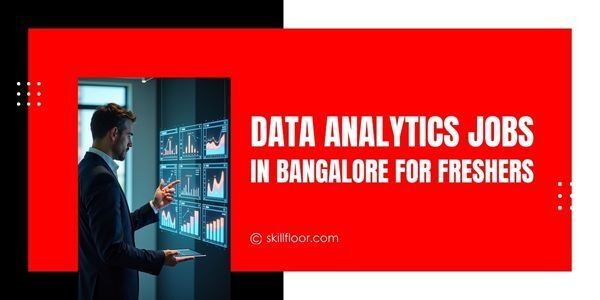
If you are a fresher looking to start a career in data analytics, Bangalore is one of the best cities in India to begin your journey. The city is home to thousands of technology companies, startups, fintech firms, and global enterprises, all of which are actively hiring candidates who can work with data and generate business insights.
But the hiring landscape has changed. Earlier, knowing a few tools was often enough to get shortlisted. In 2026, companies want practical proof. They want to see projects, dashboards, SQL work, and real problem-solving ability, not just a list of tools on a resume.
According to NASSCOM, India will need over 1.3 million data professionals by the end of 2026, and Bangalore continues to account for a large share of that demand. For freshers who build the right data analytics skills and practical exposure early, the opportunities are significant.
What Does a Data Analyst Actually Do?
A data analyst works with raw information and converts it into meaningful insights that help businesses make better decisions. The role focuses heavily on problem-solving, reporting, and identifying patterns from data.
According to LinkedIn’s Jobs on the Rise report, Data Analyst is one of the fastest-growing roles as companies increasingly rely on data-driven decision-making. A data analyst acts as a bridge between data and business decisions, turning large amounts of information from sales, websites, customers, marketing, and operations into meaningful insights through proper organization and analysis.
At the fresher level, responsibilities commonly include:


-
Cleaning and organizing datasets
-
Writing SQL queries for analysis
-
Creating dashboards using Power BI or Tableau
-
Identifying trends and business patterns
-
Preparing reports for teams and managers
-
Supporting business decisions with analytics insights
Companies today also expect freshers to explain insights clearly, not just work with tools. As experience grows, professionals often move into advanced areas such as business analytics, data science, AI analytics, and product analytics.
Data Analytics Job Market in Bangalore for Freshers (2026)
Bangalore is a leading entry-level hub for data analytics jobs in Bangalore for freshers in India, driven by a strong ecosystem of startups, IT services, consulting firms, fintech companies, and global enterprises. As data becomes central to decision-making, demand for analytics professionals continues to grow across industries.
Freshers get opportunities across technology, banking, e-commerce, healthcare, logistics, and consulting, allowing them to explore multiple career paths within analytics based on their skills and interests.
Common Entry-Level Roles
|
Role |
Fresher Salary Range (2026) |
|
Data Analyst |
₹4–8 LPA |
|
Business Analyst |
₹4–9 LPA |
|
Junior Data Analyst |
₹4–7 LPA |
|
Reporting Analyst |
₹3.5–6 LPA |
|
BI Analyst |
₹5–9 LPA |
|
Associate Data Scientist |
₹4–8 LPA |
Note: The salary ranges and role insights mentioned above are based on current job listings and market trends observed across leading job portals such as Naukri, LinkedIn, and Glassdoor.
Key Takeaways
-
Entry-level reporting and basic analytics roles generally start at the lower salary range
-
BI and business-focused roles fall in the mid to upper-mid compensation range
-
Data science-related roles offer comparatively higher starting packages
-
Startups and product-based companies often provide better compensation for skilled candidates
-
Practical exposure, internships, and project experience have a stronger impact on hiring than academic background
-
Candidates with hands-on projects and real dataset experience consistently perform better in interviews than those relying only on theory
Why Is Bangalore a Strong Hub for Data Analytics Careers?
Bangalore is a leading hub for data analytics careers because it brings together startups, IT companies, consulting firms, fintech, healthcare, and global enterprises in a strong ecosystem where data-driven decision-making is widely used. Industry trends show 30%+ annual growth in data analytics and AI roles in India, and this strong momentum reflects the ongoing data analytics career growth in Bangalore, with the city leading job opportunities due to its strong tech and startup presence.
As businesses increasingly rely on data for forecasting, reporting, automation, and customer insights, demand for skilled analytics professionals continues to rise across industries.
-
Companies actively hire for:
-
Customer behavior analysis
-
Sales forecasting
-
Business intelligence reporting
-
Process optimization
-
AI and automation support
-
Operational analysis



This ecosystem gives freshers exposure to multiple industries, including technology, banking, e-commerce, healthcare, logistics, and consulting, helping them build cross-domain expertise instead of being limited to one field. Major companies such as Accenture, IBM, Capgemini, Swiggy, Razorpay, and Meesho, along with fast-growing startups, actively hire analytics talent in Bangalore, making it a strong destination for data analytics jobs for freshers.
What Skills Actually Influence Hiring Opportunities?
Many freshers assume that learning multiple tools automatically increases their chances of getting hired, but recruiters primarily focus on practical application and problem-solving ability rather than the number of tools listed on a resume.
Core Technical Skills Required for Entry-Level Roles
|
Skill |
Use in Analytics Jobs |
|
SQL |
Extracting and managing business data |
|
Excel |
Reporting and basic analysis |
|
Python |
Data analysis and automation |
|
Power BI |
Dashboards and reporting |
|
Tableau |
Data visualization and insights |
|
Statistics |
Identifying patterns and trends |
These skills form the core foundation for entry-level data analytics roles. Many companies also expect familiarity with tools like Google Sheets, MySQL, and Jupyter Notebook for daily analytics work. If you are looking to build job-ready skills through structured learning, you can explore a practical analytics training program in Bangalore that focuses on hands-on projects and industry tools.
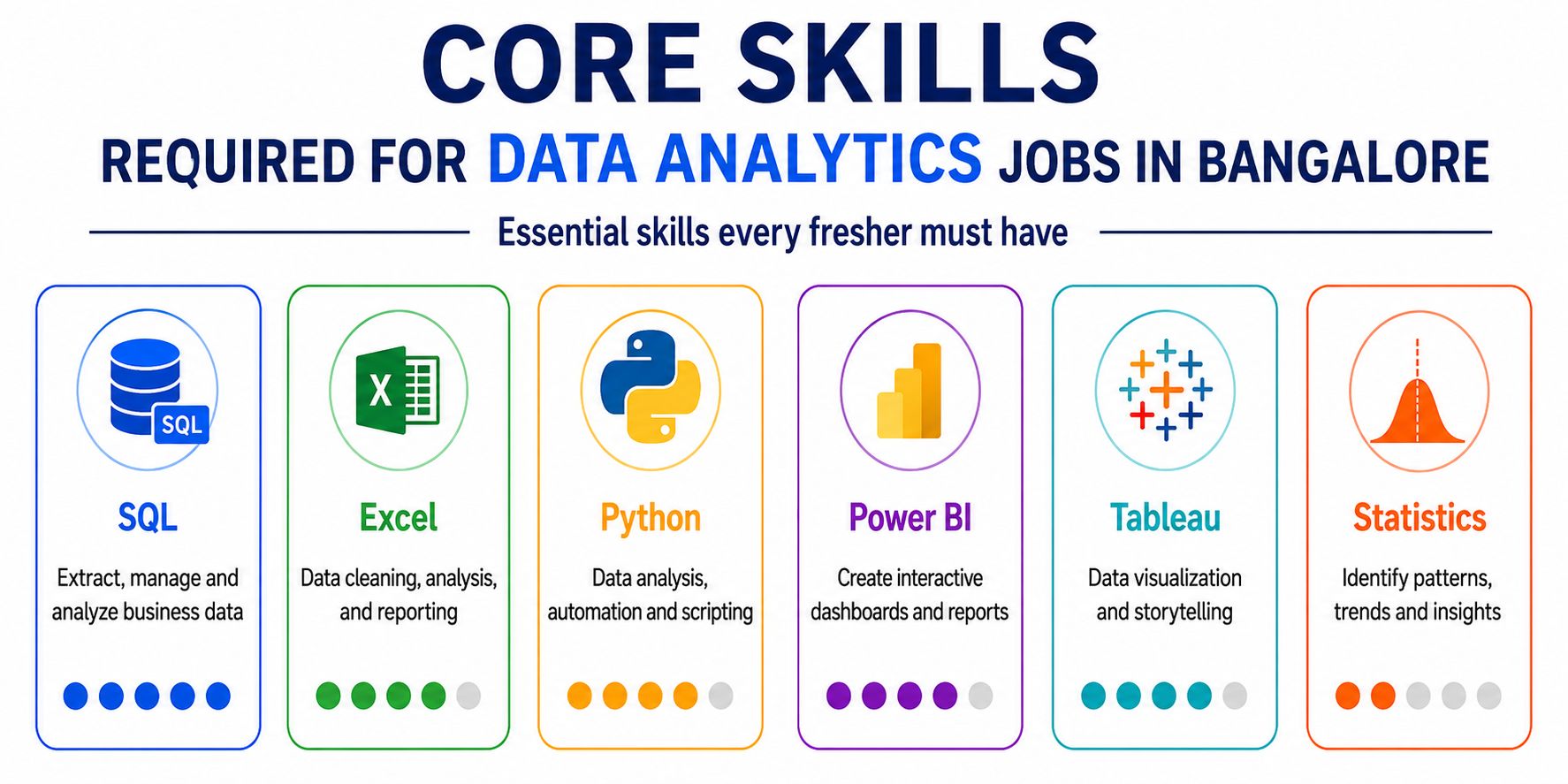
Hiring decisions depend not only on tools, but on how effectively candidates apply them in real projects, dashboards, and business case studies.
Non-Technical Skills Companies Evaluate
-
Communication skills
-
Analytical thinking
-
Logical reasoning
-
Presentation ability
-
Business understanding
While technical skills help in shortlisting, non-technical skills like communication, clarity, and problem-solving often play a key role in final selection during interviews.
How Important Are Projects for Freshers?
Projects are one of the strongest indicators of practical skills in data analytics hiring because they show hands-on application of knowledge rather than just theory. Recruiters often find that candidates with certifications struggle to explain real business problem-solving, while projects clearly demonstrate the ability to work with real-world data and generate insights. In fact, around 87% of data analytics hiring managers prefer candidates with portfolio projects, while only 18% consider certifications a strong deciding factor, making projects far more valuable than certificates during hiring decisions.
Instead of only listing SQL knowledge, a project can demonstrate:
-
Customer purchasing behavior analysis
-
Sales trend prediction
-
Dashboard creation using Power BI or Tableau
-
Data cleaning using Python
-
Market segmentation and segmentation insights
Projects play a key role in interviews as they serve as discussion points to evaluate problem-solving and thinking approach. Candidates with 2–3 strong projects usually perform better than those with multiple certifications but no practical experience. In India, candidates with well-documented portfolios on platforms like GitHub or Tableau Public receive 3–5x higher recruiter engagement compared to those without project evidence.
Ultimately, your projects speak louder than your resume — even before the interview begins.
Do Certifications Really Help in Getting Jobs?
Certifications can help during the initial screening stage, as recruiters use them to identify candidates with a basic understanding of analytics tools and workflows. They are useful for structured learning, building tool confidence, and showing commitment to skill development. If you are still evaluating this career path, you can understand in detail whether data analytics is a good career in today’s job market.
However, certifications alone are rarely enough in interviews. Companies focus more on practical application, not just theoretical knowledge. Recruiters evaluate how well candidates explain their projects, problem-solving approach, analytics concepts, and tool usage in real scenarios, along with communication clarity.
Certifications become more valuable only when combined with real datasets, portfolio work, and practical assignments, as these demonstrate actual hands-on capability instead of just course completion.
In most hiring situations, candidates with strong projects plus 1–2 relevant certifications perform better than those with multiple certifications but no practical experience.
What Industries Hire Data Analytics Freshers in Bangalore?
One of the biggest advantages of data analytics careers is that opportunities are not limited to a single industry. As businesses across sectors increasingly rely on data-driven decision-making, freshers can explore multiple career paths based on their skills and interests.
Industries Actively Hiring Analytics Freshers
-
Technology companies
-
Banking and financial services
-
Healthcare organizations
-
E-commerce companies
-
Retail businesses
-
Consulting firms
-
Logistics and supply chain companies
-
Fintech companies
-
Marketing and advertising agencies
Freshers can enter analytics through different roles depending on their strengths and career goals.
Common Entry-Level Roles
|
Job Title |
What You Do |
Common Tools |
|
Junior Data Analyst |
Clean data, build reports, create dashboards |
SQL, Excel, Tableau |
|
Business Analyst |
Convert business problems into insights |
Excel, SQL, PowerPoint |
|
Data Operations Analyst |
Manage datasets and ensure data quality |
SQL, Python |
|
Reporting Analyst |
Automate and maintain reports |
Power BI, SQL, Excel |
|
Analytics Associate |
Support analysis and reporting tasks |
Python, SQL, Google Sheets |
One role many freshers overlook is the Business Analyst role. Even when it does not explicitly mention “data,” it often involves reporting, data analysis, and business decision support.
Because analytics skills are transferable across industries, professionals gain flexibility to switch domains and grow into different career paths over time.
What Mistakes Reduce Job Opportunities for Freshers?
Many freshers spend months learning analytics, but still struggle to get shortlisted. The problem is rarely a lack of knowledge — it is the gap between what was learned and what can actually be demonstrated.
-
Applying without practical proof of skills is the most common and costly mistake. A resume that lists "Python" or "SQL" looks identical to hundreds of other resumes recruiters see every day. A project — a dashboard, an analysis, or a business insight built from a real dataset — is what actually makes a profile worth shortlisting.
-
Weak SQL fundamentals remain one of the biggest reasons freshers fail technical interviews. SQL is tested in almost every entry-level analytics role, and candidates who cannot write clean queries or explain their logic confidently lose opportunities their resume helped them earn.
-
Focusing only on large MNCs is a mistake many freshers do not realize they are making. Startups and mid-sized firms offer faster learning, broader responsibilities, and are more likely to hire freshers with strong portfolios over formal credentials.
-
Poor interview preparation is the final area where most candidates fall short. Entry-level analytics interviews test SQL logic, basic statistics, problem-solving approach, and the ability to explain findings clearly. Targeted practice in these areas consistently makes a visible difference in conversion rates.
How Can Freshers Improve Hiring Chances Faster?
Freshers can significantly improve their chances of getting hired in data analytics jobs for freshers in Bangalore by focusing on practical application instead of only theory. Employers value candidates who can apply skills to real problems rather than just knowing tools. Skillfloor offers structured analytics training programs.
The most effective steps are:
-
Building a portfolio with two to three strong analytics projects
-
Uploading dashboards and projects to GitHub with proper documentation
-
Practicing SQL regularly using real business scenarios
-
Pursuing internships or freelance analytics work wherever possible
-
Building a presence on LinkedIn by sharing projects and insights
-
Preparing through mock interviews and case studies
-
Learning how to explain projects clearly to non-technical audiences
Recruiters consistently prefer candidates who show initiative, curiosity, and hands-on problem-solving ability. For better clarity on salary expectations and how skills impact pay scales in Bangalore, you can refer to this guide on data analyst salaries in Bangalore. A strong project portfolio combined with clear communication skills is the fastest way to improve interview conversion rates for entry-level analytics roles.
Frequently Asked Questions
Q1. Is Bangalore good for data analytics freshers?
Yes. Bangalore offers one of the largest entry-level analytics job markets in India with opportunities across startups, multinational companies, consulting firms, and product-based organizations.
Q2. Can freshers get data analytics jobs without experience?
Yes. Many companies hire freshers who have strong projects, internships, portfolio work, and practical analytics skills, even without full-time experience.
Q3. What salary can a fresher expect in Bangalore?
Most freshers begin between ₹4–8 LPA depending on skills, projects, company type, and role. Strong practical exposure can help candidates secure higher packages.
Q4. Is coding required for analytics jobs?
Basic coding knowledge is usually expected, especially SQL and Python. However, some reporting and business analytics roles may require only limited programming.
Q5. Which skill should beginners learn first?
SQL is one of the best starting points because it is widely used across almost every analytics role for retrieving and managing business data.
Q6. Are internships important for data analytics freshers?
Yes. Internships provide practical exposure, improve project experience, and help freshers understand real business workflows, which increases hiring chances significantly.
Entry-level data analytics jobs in Bangalore are growing rapidly as companies across every industry increasingly depend on data for reporting, forecasting, automation, customer insights, and business decision-making. At the same time, hiring has become far more skill-focused than before.
Organizations are no longer looking only for degrees or certifications. They want candidates who can analyze real information, solve practical business problems, create meaningful insights, and explain findings clearly.
The good news is that for freshers who build practical exposure early through projects, internships, portfolio development, and consistent skill improvement, the opportunities in Bangalore are genuinely strong right now. NASSCOM's projected shortfall of 200,000+ analytics professionals means qualified, job-ready freshers will continue to be in high demand for years ahead.
Start with SQL. Build your first project. Put it on GitHub. That is how most successful analytics careers in Bangalore actually begin.
Digital Marketing Courses in Other Locations in India
Ahmedabad | Aurangabad | Bangalore | Bhilai | Bhopal | Bhubaneshwar | Chandigarh | Chennai | Cochin | Coimbatore | Dehra Dun | Delhi | Faridabad | Ghaziabad | Gorakhpur | Guntur | Gurgaon | Guwahati | Hyderabad | Jaipur | Kanpur | Khammam | Kolkata | Lucknow | Madurai | Mumbai | Mysore | Nagpur | Noida | Patna | Pondicherry | Pune | Ranchi | Shimoga | Surat | Thane | Thiruvananthapuram | Tiruchirappalli | Tirupati | Vadodara | Visakhapatnam | Warangal | Jalandhar | Jodhpur | Indore | Durgapur | Jamshedpur | Dhanbad | Kota | Karnal | Udaipur | Amritsar | calicut | Nashik | Ludhiana | varanasi | thrissur | Mangalore | Raipur |