










































What Is Generative AI? How It Works, Uses & Benefits in 2026
Learn what generative AI is, how it works, its uses, benefits, limitations, tools, and real-world applications across industries in 2026.
Generative AI is a type of artificial intelligence that can create new content such as text, images, audio, video, code, and other digital outputs in response to a prompt. It works by learning patterns and relationships from large amounts of training data and using those learned patterns to generate new outputs.
Tools such as ChatGPT, Google Gemini, Claude, Midjourney, Adobe Firefly, and GitHub Copilot have made generative AI accessible to individuals and businesses. Today, it is being used across marketing, education, software development, design, customer service, research, and many other professional fields.
As AI continues to become part of everyday workflows, understanding what generative AI is, how it works, what it can do, and what its limitations are has become an important digital skill.
Key Takeaways
-
Generative AI creates new content based on patterns learned during training.

-
It can generate text, images, audio, video, code, and synthetic data.
-
Large language models (LLMs) are commonly used for text-based generative AI applications.
-
Generative AI is different from traditional AI, which is often designed to classify, predict, recommend, or detect.
-
Businesses use generative AI for content creation, marketing, customer support, coding, research, and automation.
-
Generative AI can improve productivity, but its outputs still require human review and fact-checking.
-
Learning practical AI skills can help professionals adapt to increasingly AI-assisted workplaces.


What Is Generative AI?
Generative AI is a branch of artificial intelligence focused on generating new content from a user's instructions or prompts.
For example, you can ask a generative AI tool to:
-
Write an email.
-
Create a product description.
-
Generate an image from a text prompt.
-
Summarize a document.
-
Write or explain computer code.
-
Create a video script.
-
Generate a voiceover.
-
Analyze information and produce a structured response.
The system does not simply retrieve a single pre-written answer from a database. Instead, a trained model uses learned patterns to generate an output based on the prompt and the context provided.
IBM describes generative AI as AI capable of creating content in response to user requests using deep-learning models.
AI, Machine Learning, Generative AI, and LLMs
These terms are related, but they do not mean the same thing.
|
Term |
What it means |
Example |
|
Artificial Intelligence (AI) |
A broad field focused on machines performing tasks that typically require human intelligence |
Fraud detection |
|
Machine Learning (ML) |
A subset of AI that learns patterns from data |
Product recommendations |
|
Generative AI |
AI that generates new content based on learned patterns |
Creating an article with ChatGPT |
|
Large Language Model (LLM) |
A model designed to process and generate human language |
GPT, Claude, Gemini |
Generative AI therefore sits within the broader AI ecosystem rather than being a completely separate technology.
How Does Generative AI Work?
Generative AI systems are built using machine learning and deep-learning techniques. While the exact architecture differs between models, the process can be understood through three broad stages: training, tuning, and generation.
1. Training
During training, a model processes a very large amount of data and learns statistical relationships and patterns within that data.
For a language model, the training data can contain large volumes of text. The model learns relationships between words, phrases, concepts, and structures.
It does not learn in the same way that a person memorizes a textbook. Instead, its parameters are adjusted during training so that the model becomes better at predicting patterns in the data.
2. Tuning
A general-purpose model can be further adjusted for specific tasks or behaviours.
This can involve techniques such as fine-tuning and human feedback. The goal can be to improve performance for particular use cases, make responses more useful, or align the system with specific instructions.
3. Generation
When a user enters a prompt, the trained model processes the input and generates an output.


For text-based models, the system generally predicts the next token based on the context that came before it. It repeats this process until it produces a complete response.
This is one reason prompt quality matters. A clear prompt containing relevant context, requirements, examples, and constraints can often produce a more useful result.
What Is a Prompt?
A prompt is the instruction or input given to a generative AI system.
For example:
“Write a 100-word product description for a beginner-friendly digital marketing course.”
The AI uses this instruction to determine what kind of output to generate.
More detailed prompts can include:
-
The task
-
Target audience
-
Tone
-
Output format
-
Length
-
Context
-
Restrictions
-
Examples
This has led to growing interest in prompt engineering, which involves designing and refining instructions to obtain more useful and consistent AI outputs.
Generative AI vs Traditional AI: What Is the Difference?
Traditional AI and generative AI can both use machine learning, but they often have different objectives.
Traditional AI is commonly designed to classify, predict, detect, recommend, or score something.
Generative AI is designed to create new content.
For example, a spam detection system may determine whether an email is likely to be spam. A generative AI system could write a reply to that email.
|
Feature |
Traditional AI |
Generative AI |
|
Main purpose |
Classify, predict, detect, recommend |
Generate content |
|
Typical output |
Score, label, prediction |
Text, image, audio, video, code |
|
Example |
Fraud detection |
AI-generated report |
|
Interaction |
Often task-specific |
Usually prompt-driven |
|
Common applications |
Forecasting, recommendations, classification |
Content creation, coding, design, research |
The distinction is not always absolute. Modern AI systems can combine predictive and generative capabilities.
What Can Generative AI Create?
Generative AI is no longer limited to text. Different models can work with different types of information, and many modern systems are multimodal.
1. Text
Generative AI can produce:
-
Articles
-
Emails
-
Reports
-
Product descriptions
-
Social media posts
-
Scripts
-
Summaries
-
Brainstorming ideas
-
Chat responses
2. Images
Image-generation systems can create:
-
Illustrations
-
Concept art
-
Product mockups
-
Social media graphics
-
Marketing visuals
-
Backgrounds
-
Design concepts
3. Audio
Generative AI can be used for:
-
Voice generation
-
Voiceovers
-
Music
-
Sound effects
-
Audio editing
4. Video
Video-generation tools can assist with:
-
Short videos
-
AI avatars
-
Marketing videos
-
Video concepts
-
Visual effects
-
Editing workflows
5. Code
AI coding assistants can help developers:
-
Generate code
-
Explain code
-
Debug programs
-
Write functions
-
Create documentation
-
Suggest improvements
6. Synthetic Data
Generative models can also be used to create synthetic datasets for certain testing, development, and research purposes.
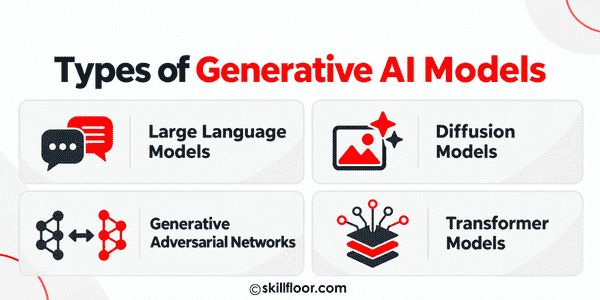
Types of Generative AI Models
Different generative AI applications use different model architectures and approaches.
1. Large Language Models
LLMs are designed primarily to understand and generate language.
Examples include models used in AI chatbots, writing assistants, coding assistants, and research tools.
2. Diffusion Models
Diffusion models are widely used for generating images and other forms of media. They learn how to transform noise into structured outputs based on learned patterns and conditioning information.
3. Generative Adversarial Networks
GANs use two neural networks—a generator and a discriminator—that work against each other during training. GANs have been used for image generation and synthetic media.
4. Transformer Models
Transformers use mechanisms such as attention to process relationships between different parts of input data. They have become an important architecture for modern language and multimodal AI systems.
What Is Multimodal Generative AI?
Multimodal generative AI can work with more than one type of information, such as text, images, audio, and video.
For example, a multimodal system may allow a user to:
-
Upload an image.
-
Ask a question about the image.
-
Receive a text explanation.
-
Ask the system to create a new visual based on the discussion.
This makes AI systems more useful for workflows that traditionally required several separate tools.
Real-World Applications of Generative AI
Generative AI is being adopted across industries because it can assist with both creative and repetitive tasks.
1. Generative AI in Marketing
Marketing teams use generative AI for:
-
Content ideation
-
Blog outlines
-
Ad copy
-
Social media content
-
Email campaigns
-
Customer research
-
Product descriptions
-
Creative concepts
-
SEO research
-
Personalization
AI can accelerate production, but marketers still need to review facts, brand messaging, search intent, originality, and compliance.
2. Generative AI in Education
Students and educators can use AI for:
-
Explanations
-
Study materials
-
Practice questions
-
Summaries
-
Lesson planning
-
Brainstorming
The quality of learning still depends on how the technology is used. AI-generated information should be checked rather than accepted automatically.
3. Generative AI in Software Development
Developers can use AI assistants to:
-
Generate code
-
Explain unfamiliar code
-
Identify potential bugs
-
Create test cases
-
Generate documentation
-
Explore implementation approaches
Developers remain responsible for reviewing generated code for correctness, security, performance, and maintainability.
4. Generative AI in Customer Support
Businesses can use generative AI to assist with:
-
Frequently asked questions
-
Customer conversations
-
Support ticket summaries
-
Knowledge-base content
-
Response drafting
Human escalation remains important for complex or sensitive cases.
5. Generative AI in E-commerce
E-commerce businesses can use AI to assist with:
-
Product descriptions
-
Product recommendations
-
Marketing campaigns
-
Customer-service responses
-
Creative generation
-
Catalog content
Why Does Generative AI Matter?
Generative AI can change how individuals and organizations approach knowledge work and content production.
A marketer can use AI to brainstorm a campaign, generate several copy variations, summarize research, and create an initial content structure. A developer can use an AI assistant to explore implementation options or explain unfamiliar code.
This does not mean every AI-generated output can be used without review. Instead, the technology can act as an assistant that helps people move faster through parts of a workflow.
The economic impact is also significant. McKinsey estimated in 2023 that generative AI could potentially add $2.6 trillion to $4.4 trillion annually to the global economy across use cases.
Generative AI in Marketing and SEO
Search behaviour is also changing as people increasingly use conversational interfaces and AI-powered search experiences to find information.
This creates new considerations for marketers.
Instead of focusing only on traditional keyword rankings, businesses increasingly need content that:
-
Directly answers user questions.
-
Demonstrates first-hand expertise.
-
Provides accurate and useful information.
-
Uses clear structure.
-
Covers related entities and concepts.
-
Supports claims with trustworthy sources.
-
Provides a good user experience.
Generative AI can support parts of this workflow, including research, content ideation, brief creation, and content optimization. However, AI-generated content still needs human expertise, fact-checking, editing, and strategic oversight.
Generative AI vs ChatGPT: Are They the Same?
No.
Generative AI is a broad category of artificial intelligence technology that can generate content.
ChatGPT is a specific AI application from OpenAI that uses generative AI models to interact with users through conversation and perform tasks such as writing, analysis, coding, and other forms of content generation.
In simple terms:
Generative AI = technology category
ChatGPT = one application that uses generative AI
Common Generative AI Tools
Several widely known tools use generative AI for different purposes.
-
ChatGPT: Text generation, analysis, coding, brainstorming, and other AI-assisted tasks.
-
Google Gemini: AI assistance across Google's ecosystem and multimodal tasks.
-
Claude: Conversational AI, writing, analysis, and coding.
-
Midjourney: AI image generation.
-
Adobe Firefly: Generative AI for creative and design workflows.
-
Runway: AI-assisted video generation and editing.
-
Synthesia: AI avatar and video creation.
-
GitHub Copilot: AI assistance for software development.
The capabilities, pricing, usage limits, and features of these tools can change over time, so users should check the current documentation and terms before choosing a tool for professional use.
Benefits of Generative AI
Generative AI can provide several practical benefits when used appropriately.
-
Faster Content Production: AI can help create initial drafts, variations, outlines, and ideas quickly.
-
Increased Productivity: Professionals can automate or accelerate repetitive parts of their workflows.
-
Personalized Experiences: AI can help businesses generate content tailored to different audiences and contexts.
-
Creative Assistance: Generative AI can provide ideas, concepts, variations, and starting points for creative work.
-
Coding Assistance: Developers can use AI to accelerate parts of the development process.
-
Accessibility: Natural-language interfaces make certain software capabilities easier for people without advanced technical knowledge to access.
Limitations and Risks of Generative AI
Generative AI also has important limitations.
Hallucinations
AI systems can generate incorrect information that sounds convincing. This is often called a hallucination.
Important information should therefore be verified against reliable sources.
-
Bias: Models can reproduce or amplify biases present in their training data or other aspects of their development.
-
Privacy: Users should be careful when entering confidential business information, personal information, customer data, passwords, or other sensitive material into AI systems.
-
Copyright and Intellectual Property: Generative AI raises ongoing questions around training data, ownership, licensing, and the use of generated content. Businesses should understand the terms of the AI tools they use and applicable laws before using generated material commercially.
-
Lack of Context: AI may not fully understand a company's internal processes, brand requirements, audience, or business objectives unless appropriate context is provided.
-
Overreliance: Treating AI output as automatically correct can introduce errors. Human review remains important, particularly for high-stakes decisions.
How to Use Generative AI Responsibly
A practical approach is to treat AI as an assistant rather than an unquestionable source of truth.
Before using AI-generated content:
-
Verify important facts.
-
Check claims against reliable or primary sources.
-
Remove confidential information from prompts when appropriate.
-
Review the output for bias and misleading information.
-
Edit the content for accuracy, context, and audience.
-
Check copyright, licensing, and organizational policies where relevant.
-
Keep human judgment involved in important decisions.
The goal is not simply to generate more content. It is to use AI to produce useful, accurate, relevant, and responsible outcomes.
What Skills Should You Learn for Generative AI in 2026?
You do not necessarily need to become an AI engineer to start using generative AI professionally.
Depending on your career goals, useful skills can include:
-
AI fundamentals
-
Prompt engineering
-
Generative AI tools
-
AI-assisted content creation
-
Data analysis
-
AI automation
-
Python fundamentals
-
Machine learning concepts
-
Natural language processing
-
Generative AI application development
-
AI ethics and responsible AI
For marketers and business professionals, understanding how to combine AI with existing skills such as SEO, analytics, advertising, content, and customer research can be particularly useful.
What Is the Future of Generative AI?
Generative AI is continuing to evolve beyond simple text generation.
Future AI workflows are increasingly expected to involve:
-
Multimodal AI
-
AI agents
-
Automated workflows
-
AI-assisted software development
-
Personalized AI assistants
-
AI-powered search
-
Enterprise AI applications
-
More integrated business automation
AI agents are particularly important because they can move beyond generating a response and assist with multi-step tasks using tools, data, and workflows.
As these systems become more capable, the ability to understand, evaluate, direct, and supervise AI will become increasingly relevant across many professional roles.
Frequently Asked Questions About Generative AI
1. Is ChatGPT generative AI?
Yes. ChatGPT is an AI application that uses generative AI models to produce responses and other content based on user instructions.
2. What is the difference between AI and generative AI?
Artificial intelligence is the broader field of technology focused on performing tasks associated with human intelligence. Generative AI is a category of AI that focuses on creating new content such as text, images, audio, video, and code.
3. How does generative AI work?
Generative AI models learn patterns from large datasets during training. When a user provides a prompt, the model processes the input and generates an output based on patterns learned during training.
4. What can generative AI create?
Depending on the model, generative AI can create text, images, audio, video, code, synthetic data, and other digital content.
5. Is generative AI the same as machine learning?
No. Machine learning is a broader approach within AI where systems learn patterns from data. Generative AI refers to AI systems designed to generate new content.
6. Is generative AI free to use?
Some generative AI tools offer free plans or limited access, while others use paid subscriptions or usage-based pricing. Features and pricing vary by provider.
7. Can generative AI replace humans?
Generative AI can automate or assist with many tasks, particularly repetitive drafting and production work. However, human expertise remains important for strategy, judgment, fact-checking, creativity, context, and accountability.
8. What is an LLM?
A Large Language Model (LLM) is a machine-learning model trained on large amounts of language data to process and generate text. Many modern conversational AI applications use LLMs.
9. What is multimodal AI?
Multimodal AI can process or generate multiple types of information, such as text, images, audio, and video, rather than working with only one data type.
10. What are the main risks of generative AI?
Common concerns include inaccurate outputs, bias, privacy issues, copyright and intellectual-property questions, security risks, and overreliance on AI-generated information.
Conclusion
Generative AI has moved from an emerging technology to a practical tool used across content creation, marketing, software development, design, research, and business operations. By learning patterns from large datasets, generative AI models can produce text, images, audio, video, code, and other forms of content from simple prompts.
Understanding how generative AI works is important not only for technical professionals but also for marketers, students, business owners, and anyone looking to work more efficiently with AI. At the same time, its limitations, including inaccurate information, bias, privacy concerns, and copyright questions, make human judgment and fact-checking essential.
The future of generative AI is likely to focus on more capable AI systems, multimodal experiences, AI agents, and deeper integration into everyday professional workflows. Building practical AI skills today can help professionals adapt as these technologies continue to evolve.
If you want to develop hands-on AI skills, Skillfloor’s Certified Artificial Intelligence Professional course covers areas such as machine learning, deep learning, NLP, Generative AI, and practical projects, along with certification, internship, and placement assistance.
Digital Marketing Courses in Other Locations in India
Ahmedabad | Aurangabad | Bangalore | Bhilai | Bhopal | Bhubaneshwar | Chandigarh | Chennai | Cochin | Coimbatore | Dehra Dun | Delhi | Faridabad | Ghaziabad | Gorakhpur | Guntur | Gurgaon | Guwahati | Hyderabad | Jaipur | Kanpur | Khammam | Kolkata | Lucknow | Madurai | Mumbai | Mysore | Nagpur | Noida | Patna | Pondicherry | Pune | Ranchi | Shimoga | Surat | Thane | Thiruvananthapuram | Tiruchirappalli | Tirupati | Vadodara | Visakhapatnam | Warangal | Jalandhar | Jodhpur | Indore | Durgapur | Jamshedpur | Dhanbad | Kota | Karnal | Udaipur | Amritsar | calicut | Nashik | Ludhiana | varanasi | thrissur | Mangalore | Raipur |