












































Data Analytics Salary for Freshers in India: Average Pay, Skills & Career Growth
Discover the Data Analytics salary for freshers in India. Learn average pay, required skills, career growth opportunities, and why this field is worth exploring.

If you're considering a career in data analytics, one of the first questions you'll ask is: How much can a fresher earn in India?
Most entry-level data analysts earn between ₹3.5 lakh and ₹6 lakh per year, while candidates with strong SQL, Python, Power BI, and project experience can secure packages of ₹7–10 LPA in competitive companies. The opportunity remains promising as NASSCOM projects continued growth in demand for AI and data-related talent across India.
Let's break down the average data analytics fresher salary in India, the highest-paying entry-level roles, the skills that influence compensation, and practical ways to position yourself for better offers.
Data Analytics Fresher Salary in India
Data Analytics salaries in India are highly variable, depending on skills, city, and company type. According to recent 2026 industry reports and platforms like Glassdoor summaries, fresher salaries typically start lower in service firms but rise significantly in product companies and metro cities.


Key Salary Insights for Data Analytics Freshers in India
-
According to Glassdoor salary data, entry-level Data Analysts in India typically earn between ₹3–8 LPA, with the average fresher salary being around ₹5 LPA.
-
₹3.5–6 LPA is the most commonly reported fresher range for data analytics roles based on aggregated salary survey data and job market reports in India.
-
Top product companies and high-skill candidates can reach ₹7–10 LPA even at the fresher level based on competitive placement outcomes.
-
Bangalore and Hyderabad offer approximately 15–18% higher fresher salaries compared to the national average due to tech concentration.
-
Overall analytics hiring demand is growing steadily at around 10–15% annually according to industry-wide workforce trend studies.
What Actually Shifts Your Salary in Data Analytics (2026)
Data analytics salaries in India are not random; they are driven by measurable factors such as skills, certifications, industry demand, and location trends. Industry reports suggest salary differences of nearly 40–60% between low-skill and job-ready candidates, making these factors critical for freshers aiming for ₹7 LPA+ packages.
Key Factors That Decide Your Data Analytics Salary
1. Technical Skills: Strong technical skills like SQL, Python, and Power BI significantly increase salary offers by improving job readiness and project capability.
2. Certifications and Structured Training: Certifications improve credibility and help recruiters quickly identify job-ready candidates with practical project exposure and a structured learning background.
3. Industry Type: Industry choice impacts salary heavily, with tech-driven sectors offering higher pay due to strong demand for analytics professionals.
4. Location and Work Model: Location influences salary levels, with metro cities and remote product-based roles offering higher pay compared to Tier-2 cities.
Top Roles and Job Titles You Can Target as a Fresher in Data Analytics
Data analytics offers multiple entry-level job opportunities beyond just the “Data Analyst” title. Each role focuses on different aspects like reporting, business insights, and data operations. Choosing the right role based on Data analytics skills helps freshers enter the industry faster and grow into high-paying positions.
1. Junior Data Analyst / Data Analyst Trainee: Entry-level role focused on cleaning data, building dashboards, and generating structured reports for business decision-making teams.
Key Responsibilities
-
Clean and prepare raw datasets for accurate reporting and analysis across business functions
-
Build dashboards using Power BI, Tableau, or Excel for performance tracking
-
Write SQL queries to extract and analyse structured business data efficiently
-
Support senior analysts in weekly and monthly reporting tasks
Salary
-
According to NASSCOM, entry-level data analytics roles in India typically offer ₹3.5–5.5 LPA, depending on skills, location, and company type.
-
Candidates with strong SQL, Python, and project experience can reach up to ₹6 LPA.
2. Business Analyst: The Business Analyst role focuses on converting data insights into actionable business strategies for organisational decision-making.
Key Responsibilities
-
Understand business requirements and translate them into data-driven solutions.
-
Work with stakeholders to identify problems and define analytical approaches.

-
Prepare reports and presentations explaining business trends and insights.
-
Collaborate with technical and non-technical teams for process improvement.


Salary
-
Freshers typically earn between ₹5–8 LPA depending on industry, company size, and role complexity.
-
Top consulting and BFSI companies may offer up to ₹9 LPA for strong candidates.
3. Reporting / MIS Analyst: A Reporting Analyst focuses on creating structured reports and managing large datasets for business operations and tracking.
Key Responsibilities
-
Generate automated reports using Excel, SQL, or BI tools for business monitoring.
-
Maintain MIS dashboards for daily, weekly, and monthly performance tracking.
-
Ensure data accuracy and consistency across reporting systems.
-
Support operational teams with timely insights and reporting outputs.
Salary
-
Fresher salary usually ranges from ₹4–6 LPA depending on company type and reporting workload.
-
Candidates with advanced Excel and dashboard skills may earn up to ₹6.5 LPA.
4. Data Operations / Analytics Engineer Associate: Hybrid role managing data pipelines, ensuring data quality, and supporting scalable analytics infrastructure systems.
Key Responsibilities
-
Maintain and manage data pipelines, ensuring smooth data flow across systems.
-
Use SQL and analytics tools to ensure data accuracy and reliability.
-
Monitor and fix data quality issues in reports and dashboards.
-
Support analytics and engineering teams in building scalable data systems.
Salary
-
According to Glassdoor, fresher salaries in data analytics jobs can range between ₹6–7 LPA depending on skills and company requirements.
-
Product-based companies may offer up to ₹8 LPA for strong technical candidates.
5. Data Quality Analyst: A Data Quality Analyst ensures the accuracy, consistency, and reliability of data used across business systems and analytics platforms.
Key Responsibilities
-
Validate datasets to ensure accuracy and remove duplicate or incorrect data entries.
-
Monitor data quality issues across multiple business systems and databases.
-
Work with engineering teams to fix data inconsistencies and errors.
-
Maintain documentation for data quality standards and validation rules.
Salary
-
Fresher salaries typically range from ₹4–6 LPA depending on company size and data complexity.
-
Candidates with SQL and data governance knowledge may earn up to ₹6.5 LPA.
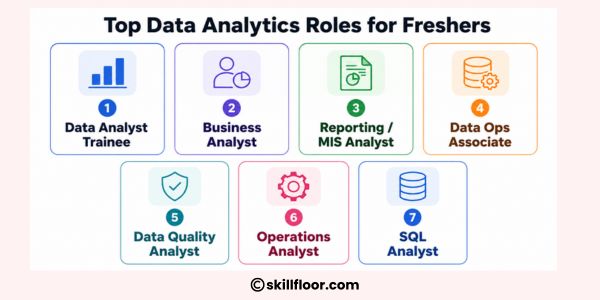
6. Operations Analyst: An Operations Analyst focuses on analysing business processes and improving efficiency using data-driven insights and reporting tools.
Key Responsibilities
-
Analyse operational data to identify inefficiencies and process improvement opportunities
-
Prepare performance reports for daily, weekly, and monthly operations tracking
-
Work with cross-functional teams to improve workflow and productivity
-
Support decision-making by providing actionable operational insights
Salary
-
Fresher salaries typically range from ₹3.5 to 6 LPA depending on industry and operational scope.
-
Large organisations may offer up to ₹6.5 LPA for skilled candidates.
7. SQL Analyst: A SQL Analyst focuses on extracting, managing, and analysing data from databases using SQL for business reporting needs.
Key Responsibilities
-
Write SQL queries to extract and analyse large datasets efficiently.
-
Create structured reports from database systems for business teams.
-
Optimise queries for better performance and faster data retrieval.
-
Support analytics teams with accurate data extraction and validation.
Salary
-
Fresher salaries typically range from ₹4.5 to 7 LPA depending on SQL expertise and company type.
-
Strong SQL and database skills can help candidates reach up to ₹7.5 LPA.
High-Value Skills That Can Increase Your Data Analytics Salary in India
In data analytics, your salary is directly influenced by the technical and analytical skills you bring to the table. Employers pay significantly higher packages to candidates who, after completing a Data Analytics course, can work with real datasets, build insights, and use modern tools efficiently. Strong skill combinations can increase fresher salary offers by ₹1–3 LPA, depending on company type and role complexity.
|
Skill |
Why It Matters |
Salary Impact |
|
SQL |
Essential for querying, filtering, and analysing all business datasets across companies |
Mandatory skill; determines basic eligibility for data analyst roles |
|
Python (Pandas, NumPy) |
Handles large datasets and enables advanced data cleaning and analysis workflows |
Adds ₹1–2 LPA to fresher salary packages |
|
Power BI / Tableau |
Converts raw data into visual dashboards for business decision-making |
Adds ₹0.8–1.5 LPA depending on tool expertise |
|
Statistics Fundamentals |
Helps interpret data insights correctly for business decisions and reporting accuracy |
Improves chances of higher-paying analytical roles |
|
AI / GenAI Tools |
Speeds up analysis, automates tasks, and improves productivity in modern workflows |
Adds ₹0.5–1.5 LPA in AI-driven companies |
|
Excel (Advanced) |
Used for reporting, pivot tables, dashboards, and quick business analysis in most companies |
Still essential; improves shortlisting and adds ₹0.3–1 LPA advantage |
|
Data Cleaning & Preparation |
Ensures datasets are accurate, structured, and ready for analysis before business reporting |
Strongly improves job readiness and increases chances of higher salary offers |
How Data Analytics Careers Scale from Fresher to High-Income Roles
A data analytics career grows step by step based on skill development, hands-on experience, and ability to solve business problems. Each stage brings higher responsibility, better exposure to tools, and improved salary growth opportunities.
1. Entry-Level Analyst
At this stage, freshers focus on learning tools, understanding data structures, and performing basic reporting tasks under supervision while building a strong foundation in the fundamentals of Data Analytics.
-
Works mainly on data cleaning, Excel reports, and basic dashboard creation tasks.
-
Learns SQL, Excel, and BI tools through real project exposure.
-
Supports senior analysts in daily reporting and data preparation activities.
-
Salary typically ranges from ₹4–7.5 LPA depending on the company and skills.
-
Growth depends on building strong technical fundamentals and consistency.
2. Skilled Analyst
At this level, analysts work independently on projects and begin contributing directly to business insights and decision-making.
-
Handles end-to-end reporting and basic analytics projects without supervision.
-
Uses SQL, Python, and BI tools to solve real business problems.
-
Starts interpreting data trends and presenting insights to stakeholders.
-
Salary typically increases to ₹8–12 LPA based on performance and skills.
-
Gains recognition as a reliable contributor within analytics teams.
3. Senior Analyst / Lead Level
Professionals at this stage manage complex analytics tasks, mentor juniors, and influence business decisions with insights.
-
Leads advanced analytics projects and supports strategic decision-making.
-
Mentors junior analysts and reviews data quality and reporting accuracy.
-
Works closely with business teams to define key performance metrics.
-
Salary typically ranges from ₹12–18 LPA depending on the company and domain.
-
Strong domain expertise becomes more important than tool knowledge alone.
4. Advanced Roles
At this stage, professionals move into leadership or specialised technical roles such as analytics management or data science.
-
Focus shifts from execution to strategy, leadership, and business impact.
-
Leads teams or builds advanced analytics systems and data strategies.
-
Works on high-level problem-solving and organisational decision-making.
-
Salary commonly exceeds ₹20–30 LPA in top companies and metro markets.
-
Includes roles like Analytics Manager, Data Scientist, and Data Architect.
What No One Tells You About the Fresher Salary Trap in Data Analytics
Many freshers accept lower initial offers due to a lack of negotiation awareness, even though analytics hiring is highly skilled and demand-driven. Industry hiring trends show that candidates who negotiate with proof of skills often secure significantly better starting packages.
Why Salary Negotiation Matters
-
Nearly 60% of freshers accept their first job offer without negotiation, leading to underpaid roles. A Data Analytics course, such as the Skillfloor Data Analytics course, helps candidates understand industry standards and negotiate better salary packages confidently.
-
Candidates who negotiate with projects and certifications can secure 10–25% higher salary offers in many analytics companies.
-
Entry-level data analytics salaries vary widely from ₹3.5–8 LPA based on skill strength and interview performance.
-
Hiring managers expect negotiation in analytics roles and often revise offers for strong, skill-backed candidates.
-
Freshers with portfolio projects are 1.5x more likely to receive higher compensation than theory-only profiles.
-
Early salary decisions impact long-term earnings growth across promotions and future job switches significantly.
-
Lack of market awareness often results in accepting below-average offers compared to industry benchmark salaries.
FAQs
1. What is the average salary for a fresher data analyst in India?
The average fresher data analyst salary in India typically ranges from ₹3.5 to 6 LPA, depending on skills, company type, and location.
2. Can freshers get ₹8–10 LPA in data analytics?
Yes, strong candidates with SQL, Python, and Power BI skills, and project experience can secure ₹7–10 LPA in product-based companies.
3. Which skills increase data analytics salary the most?
SQL, Python, Power BI, statistics, and real-world project experience have the biggest impact on increasing fresher salary offers.
4. Which cities pay the highest salaries for data analysts in India?
Bangalore and Hyderabad generally offer 15–18% higher salaries compared to other cities due to high-tech company concentration.
5. Do certifications help in getting a higher salary?
Yes, certifications improve credibility and can help candidates secure better interview opportunities and higher starting salary packages.
Data analytics offers strong career opportunities, but your salary depends on skills, preparation, and how you present your value. The difference between low and high offers comes from practical knowledge, certifications, and real project experience. Companies are actively hiring freshers, but they prefer job-ready candidates over theory-only profiles. Your first salary is not just a number; it sets the base for future growth. With the right skills and confidence, you can move into higher salary brackets quickly. The key is to prepare well before your first interview and understand your market value.
Note: The references used for salary data and industry trends in this article have been taken from Glassdoor, AmbitionBox, NASSCOM, and Indeed India.
Data Analytics Course | Artificial Intelligence Course | Data Science Courses | Digital Marketing Course
Digital Marketing Courses in Other Locations in India
Ahmedabad | Aurangabad | Bangalore | Bhilai | Bhopal | Bhubaneshwar | Chandigarh | Chennai | Cochin | Coimbatore | Dehra Dun | Delhi | Faridabad | Ghaziabad | Gorakhpur | Guntur | Gurgaon | Guwahati | Hyderabad | Jaipur | Kanpur | Khammam | Kolkata | Lucknow | Madurai | Mumbai | Mysore | Nagpur | Noida | Patna | Pondicherry | Pune | Ranchi | Shimoga | Surat | Thane | Thiruvananthapuram | Tiruchirappalli | Tirupati | Vadodara | Visakhapatnam | Warangal | Jalandhar | Jodhpur | Indore | Durgapur | Jamshedpur | Dhanbad | Kota | Karnal | Udaipur | Amritsar | calicut | Nashik | Ludhiana | varanasi | thrissur | Mangalore | Raipur |