












































How to Get a Job in Data Science: Skills & Roadmap
Want a data science job? Follow this step-by-step roadmap to learn key skills, build projects, and understand the path from beginner to a data science career.

India's data science market is growing at an annual growth rate of over 33%, and the numbers behind that growth are hard to ignore. NASSCOM estimates a talent shortage of over 200,000 data professionals across all role levels in 2026. India is expected to require over 1 million data science and analytics professionals by the end of 2026, and the data economy powering that demand is projected to reach $70 billion, a gap that is not closing fast enough.
And yet, hiring managers consistently say the same thing: most applicants are not job-ready.
Not because they lack intelligence. Not because data science is out of reach. But because most people trying to break in have no structured path, they jump from one resource to another, build no real portfolio, and apply without knowing what employers actually look for.
Here's the uncomfortable truth: the demand is real, the salaries are strong (₹6 LPA to ₹9 LPA for freshers, with top companies and IIT/NIT-tier candidates starting above ₹12 LPA), and the market is only growing. But so is the competition. Every month that passes without a clear roadmap is a month someone else with the same potential gets the shortlist call you were waiting for.


This guide exists to close that gap. Not with a vague list of tools to "explore," but with a clear, connected path from zero knowledge to job-ready.
What Data Science Actually Means
Data science combines data analysis, statistics, and technology to uncover insights and solve real-world problems. In 2026, businesses rely on data-driven strategies to improve decisions, customer experiences, and operational efficiency. With growing data volumes, data science skills are becoming essential across industries.
-
The amount of digital data created worldwide is expected to grow significantly, increasing the demand for skilled data science professionals.
-
Data scientists combine programming, statistics, and business knowledge to create valuable data-driven solutions.
-
Data preparation accounts for about 80% of the work of data scientists.
-
Data science helps companies predict trends, understand customers, and improve business performance.
-
Machine learning and analytics skills are becoming essential across industries using large datasets.
-
Strong data scientists focus on problem-solving, communication, and insights beyond technical expertise.
Essential Data Science Skills You Need to Build a Successful Career
Data science combines technical skills, analytical thinking, and business knowledge to turn raw data into useful insights. In 2026, Data Science skills are essential as companies rely more on data-driven decisions and automation.
1. Mathematics and Statistics: Mathematics and statistics help data scientists understand patterns, analyse information, and create reliable predictions from data.
Key Areas to Focus On
-
Trend Identification: Statistical knowledge helps professionals identify trends and make accurate data-driven decisions.
-
Data Processing: Around 80% of data science work involves collecting, cleaning, and analysing data effectively.
-
Machine Learning Foundation: Probability concepts support machine learning models and improve prediction accuracy.
-
Analytical Thinking: Strong mathematical understanding helps explain model results and improve problem-solving abilities.
2. Python Programming and Technical Knowledge: Python helps data scientists process data, automate tasks, and develop machine learning solutions efficiently.
Key Areas to Focus On
-
Programming Skills: Python enables professionals to create solutions for analytics and automation tasks.
-
Data Handling: Libraries like Pandas and NumPy help manage and analyse large datasets.
-
Visualisation Support: Python tools help convert complex data into clear visual representations.
-
Model Development: Coding knowledge helps build, test, and improve machine learning models.
3. Data Analysis and Machine Learning: Data analysis and machine learning help professionals discover patterns, predict outcomes, and solve business challenges.
Key Areas to Focus On
-
Pattern Discovery: Machine learning helps identify hidden patterns and generate useful predictions.
-
Decision Making: Predictive analytics helps companies improve strategies and reduce business risks.
-
Data Interpretation: Analysis skills help transform raw information into meaningful insights.

-
Model Evaluation: Understanding metrics helps create accurate and reliable machine learning models.


4. Data Visualisation and Communication: Data visualisation helps data scientists present complex findings clearly and support better decision-making.
Key Areas to Focus On
-
Insight Sharing: Visualisation helps explain findings in a simple and understandable format.
-
Dashboard Creation: Tools like Tableau and Power BI help create interactive business reports.
-
Business Communication: Clear communication helps teams understand data-based recommendations.
-
Storytelling Skills: Data storytelling connects insights with actions to solve business problems.
5. SQL and Database Management: SQL helps data scientists access, organise, and manage large amounts of structured information stored in databases.
Key Areas to Focus On
-
Data Retrieval: SQL allows professionals to extract useful information from large datasets quickly.
-
Data Organisation: SQL helps structure and arrange data for easier analysis.
-
Database Management: SQL supports storing, updating, and maintaining accurate business information.
-
Data Analysis: SQL helps professionals find trends and generate valuable insights.
6. Exploratory Data Analysis (EDA): EDA helps data scientists understand datasets, identify patterns, and prepare information before creating models.
Key Areas to Focus On
-
Data Understanding: EDA helps professionals explore datasets and identify important relationships.
-
Error Detection: It helps find missing values, errors, and unusual data patterns.
-
Data Preparation: EDA improves dataset quality before applying machine learning techniques.
-
Insight Generation: EDA helps transform raw data into useful business insights.
7. Problem-Solving and Business Understanding: Problem-solving helps data scientists connect technical knowledge with real-world business requirements.
Key Areas to Focus On
-
Business Decisions: Data insights help companies improve strategies and achieve better outcomes.
-
Critical Thinking: Strong reasoning helps identify problems and select effective solutions.
-
Industry Understanding: Business knowledge improves the relevance of data-driven recommendations.
-
Practical Application: Real projects help apply data science concepts to industry challenges.
Tools Employers Expect Data Science Freshers to Know
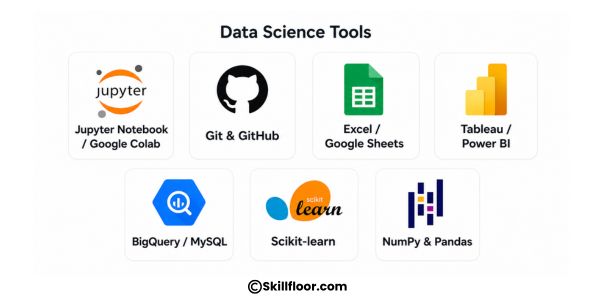
Data science tools help professionals apply their technical knowledge to real-world projects and workflows. Employers look for candidates who understand essential tools used for analysis, collaboration, visualisation, and deployment.
-
Jupyter Notebook / Google Colab: These platforms help data scientists write, test, and present code with analysis results in an interactive environment.
-
Git and GitHub: Git and GitHub help manage code versions, collaborate with teams, and maintain professional project repositories.
-
Excel / Google Sheets: Excel and Google Sheets support quick data analysis, reporting, calculations, and business communication across different teams.
-
Tableau / Power BI: These visualisation tools help create interactive dashboards and present data insights clearly to business stakeholders.
-
BigQuery / MySQL: These database platforms help professionals store, query, and analyse large datasets for practical data projects.
-
Scikit-learn: Scikit-learn provides machine learning algorithms for building, training, and evaluating predictive models efficiently.
-
NumPy and Pandas: These Python libraries help clean, transform, manipulate, and analyse datasets for data science workflows.
Roadmap to Becoming a Job-Ready Data Scientist
Building a successful career in data science requires a clear learning path. Rather than learning random topics, follow a structured roadmap that helps you develop technical skills, gain practical experience, and prepare for industry roles. A well-designed data science course supports this journey through hands-on learning and real-world projects.
Follow this roadmap to become a job-ready data scientist:
-
Learn the Fundamentals: Build a strong foundation in Python, SQL, statistics, mathematics, and data analysis.
-
Master Machine Learning: Learn core machine learning algorithms, model development, and evaluation techniques.
-
Work on Real-World Projects: Apply your knowledge by solving practical business problems using real datasets.
-
Learn Industry Tools: Gain hands-on experience with tools such as Pandas, NumPy, Scikit-learn, Power BI, Tableau, and Git.
-
Gain Practical Experience: Complete internships, live projects, or client-based assignments to understand industry workflows.
-
Prepare for Your Career: Build your resume, improve interview skills, and stay updated with the latest trends and technologies.
A structured Data Science course helps learners follow this roadmap with expert guidance, practical projects, internships, and industry-focused training, making them better prepared for data science careers.
Data Science Fresher Job Roles and Salary Overview (2026)
Data science offers various career paths for freshers, each requiring different technical and analytical skills. Understanding Data Science salary ranges and career opportunities helps beginners choose the right direction and prepare effectively.
|
Job Role |
Role Overview & Skills Required |
Fresher Salary Range (India) |
|
Data Analyst |
Entry-level role focused on querying databases, creating dashboards, and generating business reports using SQL, Excel, and Python. |
₹3 LPA – ₹8 LPA |
|
Junior Data Scientist |
Works on data analysis, machine learning models, and predictive solutions with strong statistics and Python knowledge. |
₹6–₹10 LPA |
|
Business Intelligence Analyst |
Converts data into dashboards and reports to support business decisions using tools like Tableau and Power BI. |
₹4 LPA – ₹9 LPA |
|
Machine Learning Engineer (Junior) |
Builds and improves machine learning models while focusing on Python, algorithms, and model deployment. |
₹5 LPA – ₹9 LPA |
|
Data Science Intern |
Provides real-world experience by working on datasets, analytics projects, and machine learning tasks. |
₹10K – ₹50K/month |
|
Data Engineer (Fresher) |
Manages data pipelines, databases, and data systems required for analytics and machine learning projects. |
₹4 LPA – ₹10 LPA |
|
AI Engineer (Junior) |
Develops AI-based solutions using machine learning, deep learning, and programming skills. |
₹5 LPA – ₹12 LPA |
Cloud Basics Every Data Science Fresher Should Know
Cloud knowledge helps data scientists work with real-world data storage, processing, and deployment environments. In 2026, companies increasingly use cloud platforms like AWS, Google Cloud, and Azure for managing data workflows and machine learning solutions.
1. Cloud Storage
Cloud storage helps professionals store and access large datasets without depending on local systems.
-
AWS S3: Used for storing, retrieving, and managing data files in cloud-based environments.
-
Google Cloud Storage: Helps manage large datasets required for analytics and machine learning projects.
2. Managed Notebook Platforms
Managed notebooks provide ready-to-use environments for developing and testing data science projects.
-
AWS SageMaker: Helps build, train, and deploy machine learning models using cloud resources.
-
Google Vertex AI: Provides tools for developing machine learning workflows at scale.
3. Model Deployment Basics
Understanding deployment helps data scientists move trained models into real applications.
-
API Integration: Allows machine learning models to connect with websites and business applications.
-
Production Workflows: Helps teams understand how models are maintained after development.
4. Cloud Data Warehouses
Cloud data warehouses help professionals analyse large datasets efficiently using scalable infrastructure.
-
BigQuery: A cloud-based platform that helps query and analyse large datasets using SQL.
-
Data Processing: Enables faster analysis of business information stored across cloud systems.
5. Cloud Practice and Projects
Hands-on cloud projects help freshers gain practical experience and improve job readiness.
-
Free Cloud Resources: Platforms offer free tiers to practise real-world cloud workflows.
-
Portfolio Projects: Cloud-based projects help candidates stand out during job applications.
Certifications That Add Value for Data Science Freshers
Certifications help freshers validate their knowledge, show structured learning, and strengthen their resumes for Data Science jobs. While certifications cannot replace practical skills, the right ones can improve credibility and demonstrate commitment to employers.
Key Benefits of These Certifications
-
Google Data Analytics Professional Certificate: Provides a strong foundation in data analysis, including spreadsheets, SQL, visualisation, and data-driven problem-solving.
-
IBM Data Science Professional Certificate: Covers essential data science concepts like Python, data analysis, machine learning, and real-world projects.
-
Microsoft Certified: Azure Data Scientist Associate: Helps learners understand cloud-based machine learning workflows and data science solutions using Azure services.
-
Tableau Desktop Specialist: Builds skills in creating dashboards, visualising data, and presenting insights for business decisions.
-
Skillfloor Data Science Certification: Offers practical data science learning with industry-focused training, hands-on projects, and guidance to build job-ready skills.
FAQs
1. How can I get a job in data science as a fresher?
Learn Python, SQL, statistics, machine learning, and data analysis. Build projects and create a strong portfolio to improve job chances.
2. What skills are needed for a data science career?
Key skills include Python, statistics, machine learning, SQL, data visualisation, problem-solving, and business knowledge.
3. Is data science a good career in 2026?
Yes, data science is a growing field with strong demand as companies use data for decision-making.
4. Can beginners learn data science?
Yes, beginners can learn data science with programming basics, analytics skills, projects, and consistent practice.
5. Which language is best for data science?
Python is widely used because of tools like Pandas, NumPy, and Scikit-learn.
6. What tools should a data science fresher know?
Freshers should learn Python, SQL, Excel, Jupyter, GitHub, Tableau, Power BI, NumPy, Pandas, and Scikit-learn.
Building a career in data science requires a combination of technical skills, practical experience, and a clear learning roadmap. By developing skills in Python, SQL, statistics, machine learning, data visualisation, cloud basics, and real-world projects, freshers can improve their chances of getting hired. With the growing demand for data professionals, focusing on hands-on practice, building a strong portfolio, and understanding industry requirements can help beginners become job-ready. Continuous learning and improving problem-solving skills can create better opportunities and help build a successful long-term career in data science.
Sources & references:
-
Freshers Earn 6 - 10 LPA - https://resources.instahyre.com/blog/data-scientist-salary-in-india/
-
80% of the work of data scientists -
https://www.forbes.com/sites/gilpress/2016/03/23/data-preparation-most-time-consuming-least-enjoyable-data-science-task-survey-says/
Digital Marketing Courses in Other Locations in India
Ahmedabad | Aurangabad | Bangalore | Bhilai | Bhopal | Bhubaneshwar | Chandigarh | Chennai | Cochin | Coimbatore | Dehra Dun | Delhi | Faridabad | Ghaziabad | Gorakhpur | Guntur | Gurgaon | Guwahati | Hyderabad | Jaipur | Kanpur | Khammam | Kolkata | Lucknow | Madurai | Mumbai | Mysore | Nagpur | Noida | Patna | Pondicherry | Pune | Ranchi | Shimoga | Surat | Thane | Thiruvananthapuram | Tiruchirappalli | Tirupati | Vadodara | Visakhapatnam | Warangal | Jalandhar | Jodhpur | Indore | Durgapur | Jamshedpur | Dhanbad | Kota | Karnal | Udaipur | Amritsar | calicut | Nashik | Ludhiana | varanasi | thrissur | Mangalore | Raipur |