











































How to Become a Business Analyst: A Complete Roadmap
Learn how to become a Business Analyst with this complete roadmap. Discover key skills, tools, certifications, projects, and steps to build a successful career.

Have you ever wondered how businesses identify problems, improve processes, and make smarter decisions? A Business Analyst plays a key role in helping organizations achieve these goals by analyzing business needs, gathering requirements, and recommending effective solutions.
Acting as a bridge between stakeholders and technical teams, Business Analysts help ensure that projects align with business objectives and deliver real value. As organizations increasingly rely on data-driven decision-making and digital transformation, the demand for skilled Business Analysts continues to grow across industries.
A career in business analysis offers strong job opportunities, competitive salaries, and long-term growth potential. Whether you're a student, a recent graduate, or a professional looking to switch careers, this roadmap will guide you through the essential skills, tools, qualifications, and steps needed to become a successful Business Analyst.
Who is a Business Analyst and What Do They Do?
A business analyst is a professional who bridges the gap between business needs and technology solutions. They study how an organization operates, identify problems or inefficiencies, and translate business goals into clear specifications that developers, stakeholders, and management can all act on, making them a critical link between people who understand the "why" and people who build the "how."


-
Analyzes Business Requirements: Gathers and understands stakeholders' needs to identify business challenges, opportunities, and project goals.
-
Documents and Communicates Requirements: Creates clear documentation, such as business requirement documents and process workflows, to ensure all teams understand project expectations.
-
Improves Business Processes: Evaluates existing processes, identifies inefficiencies, and recommends solutions that improve productivity and operational performance.
-
Collaborates with Stakeholders and Teams: Acts as a bridge between business stakeholders and technical teams, ensuring proposed solutions align with organizational objectives and user needs.
-
Validates and Tests Solutions: Participates in User Acceptance Testing (UAT) to ensure the delivered solution meets documented requirements and solves the original business problem.
Essential Skills Required to Become a Business Analyst
Technical Skills
-
Data Analysis and Interpretation: A Business Analyst must be able to analyze data to identify trends, patterns, and insights. This helps in understanding business performance and supporting data-driven decision-making.
-
SQL and Database Knowledge: SQL is used to extract and manage data from databases. A Business Analyst should understand how to query data to validate requirements and generate meaningful business insights.
-
Excel and Reporting Tools: Excel is widely used for organizing, analyzing, and reporting data. It helps Business Analysts perform calculations, create reports, and summarize information for stakeholders.
-
Data Visualization Tools (Power BI/Tableau): Visualization tools help convert raw data into interactive dashboards and reports. This makes it easier to communicate insights clearly to business teams and decision-makers.
-
Understanding of SDLC and Agile Frameworks: Knowledge of SDLC and Agile helps Business Analysts understand how software projects are developed. This improves collaboration with development teams and ensures smooth delivery of requirements.
Non-Technical Skills
-
Analytical and Critical Thinking: A Business Analyst must be able to break down complex problems, analyze data logically, and apply Business Analytics techniques to identify trends and insights. This helps identify root causes and recommend practical solutions.
-
Communication Skills: Strong communication skills are essential for interacting with stakeholders and clearly documenting requirements. It ensures that all teams understand project needs without confusion.
-
Stakeholder Management: A Business Analyst works with multiple teams and individuals. Managing expectations and maintaining good relationships is important for successful project delivery.
-
Attention to Detail: Small mistakes in requirements can lead to big project issues. A Business Analyst must carefully review all information to ensure accuracy and consistency.
-
Problem-Solving Ability: Business Analysts often deal with changing or unclear requirements. Strong problem-solving skills help in finding effective and practical solutions quickly.
Educational Requirements for a Business Analyst Career
A career in business analysis is open to graduates from various educational backgrounds. While degrees in business, management, IT, computer science, or related fields are commonly preferred, many professionals also enter the field through certifications.
You can pursue a Business Analyst career if you:
-
Have a degree in business, management, IT, or a related field
-
Are a graduate from any discipline with strong analytical skills
-
Want to bridge the gap between business and technology
-
Are willing to learn business analysis tools and techniques
-
Have an interest in problem-solving and data-driven decision-making
Business Analyst Roadmap: Step-by-Step Guide
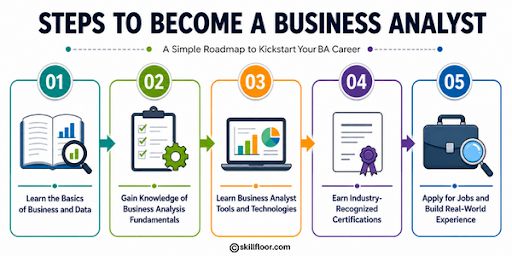
1. Learn the Basics of Business and Data: Start by building a strong foundation in how businesses operate and how decisions are made using data. Understanding organizational structures and basic data concepts is essential before diving into any business analysis tool or technique.
-
Study Business Fundamentals: Learn core concepts like business models, organizational structures, value chains, and how different departments interact.
-
Get Comfortable with Data Basics: Practice working with spreadsheets and simple statistics daily, as most business analyst decisions are backed by data interpretation.
-
Understand a Specific Industry: Learn how a domain like finance, healthcare, retail, or tech operates, as most business analyst roles require sector-specific knowledge.

-
Use Online Resources: Practice business and data skills using free online platforms and self-paced courses to build hands-on understanding.


2. Gain Knowledge of Business Analysis Fundamentals: Once you understand business basics, begin learning the core principles of business analysis. This step helps you understand how requirements are gathered, documented, and translated into solutions.
-
Learn Requirements Engineering: Study how to elicit, analyze, document, and validate requirements through interviews, workshops, and surveys.
-
Understand Business Analyst Documentation: Familiarize yourself with business requirement documents, functional specifications, user stories, and use cases.
-
Study Business Analysis Frameworks: Get introduced to industry frameworks like BABOK (Business Analysis Body of Knowledge) that guide organizations in structured business analysis practices.
-
Take Beginner Courses: Enroll in a structured, beginner-friendly business analysis course that introduces Business Analytics Components, requirement documentation, industry best practices, and real-world case studies to develop practical business analysis skills.
3. Learn Business Analyst Tools and Technologies: Hands-on experience with real business analysis tools is what separates a theoretical learner from a job-ready analyst. This step focuses on getting comfortable with the tools used every day in a business analysis role.
-
Practice with Data Tools: Get hands-on experience with Excel, SQL, and visualization platforms like Power BI or Tableau to analyze and present findings.
-
Use Process Mapping Tools: Learn to create workflow diagrams using tools like Microsoft Visio or Lucidchart to identify inefficiencies and design improved processes.
-
Explore Project Management Tools: Practice using tools like JIRA and Confluence to manage requirements, track tasks, and collaborate with teams.
-
Build a Mock Project: Create a personal practice project using sample business requirement documents, user stories, and process maps to safely build and test your documentation skills.
4. Earn Industry-Recognized Certifications: Certifications validate your knowledge and skills to potential employers. They demonstrate that you are serious about business analysis and have met a recognized standard of expertise in the field.
-
ECBA (Entry Certificate in Business Analysis): This entry-level certification covers core business analysis concepts and is widely recognized by employers as a great starting point for beginners.
-
CCBA (Certification of Capability in Business Analysis): This certification helps you demonstrate hands-on competency once you have some practical experience.
-
CBAP (Certified Business Analysis Professional): Once you gain experience, aim for this certification, which is highly valued for senior analyst roles.
-
Specialized Certifications: Credentials such as PMI-PBA and Agile/Scrum certifications help showcase expertise in specific business analysis methodologies and domains.
5. Apply for Jobs and Build Real-World Experience: With skills and certifications in place, it is time to enter the job market. Gaining real-world experience through internships, entry-level roles, or freelance projects will accelerate your growth as a business analyst.
-
Build a Strong Portfolio: Document your mock projects, process maps, and requirement documents to showcase your practical skills to potential employers.
-
Apply for Entry-Level Roles: Look for positions like Junior Business Analyst, Business Process Analyst, or Data Analyst to get your first foot in the door of the industry.
-
Practice Stakeholder Scenarios: Role-play requirement-gathering interviews or workshops to sharpen your communication and facilitation skills.
-
Network with Professionals: Attend business analysis meetups, join LinkedIn groups, and connect with industry professionals to discover job opportunities and stay updated on trends.
Training programs like Skillfloor focus on practical learning, helping students gain real-world business analysis experience, master industry tools, and become job-ready for Business Analyst careers.
Salary Expectations for Business Analysts
Business Analyst salaries in India vary based on experience, industry, location, and skill set. Professionals with expertise in data analysis, Agile methodologies, and business intelligence tools often command higher salaries. The figures below reflect current industry trends and data from leading salary platforms, including Payscale, Glassdoor, AmbitionBox, and LinkedIn Salary Insights (2025–2026).
|
Experience Level |
Average Salary (INR LPA) |
Typical Roles / Notes |
|
Entry-Level (0–2 years) |
₹4 – ₹8 LPA |
Junior Business Analyst, Business Analyst Intern, Associate Analyst; focused on requirement gathering, documentation, and supporting senior analysts. |
|
Mid-Level (2–5 years) |
₹8 – ₹15 LPA |
Business Analyst, Functional Analyst, Product Analyst; responsible for stakeholder management, process improvement, and data-driven decision-making. |
|
Senior-Level (5–10 years) |
₹15 – ₹25 LPA |
Senior Business Analyst, Lead Business Analyst; managing complex projects, mentoring teams, and driving business transformation initiatives. |
|
Lead / Managerial Roles (10+ years) |
₹25 – ₹40+ LPA |
Business Analysis Manager, Product Manager, Program Manager; overseeing strategic initiatives, business operations, and cross-functional teams. |
|
Specialized Roles |
₹18 – ₹45+ LPA |
Product Analyst, Data Analyst, Business Consultant, Agile Business Analyst; salaries vary based on domain expertise, certifications, and industry demand. |
Future Scope of Business Analysts
The future scope of business analysts is highly promising as organizations continue to focus on improving business processes, implementing new technologies, and enhancing operational efficiency. Business analysts play a crucial role in identifying business needs, optimizing workflows, and ensuring that projects align with organizational goals, making them valuable across industries.
According to the U.S. Bureau of Labor Statistics, employment for management analysts—a category that includes many business analysis functions—is projected to grow 9% from 2024 to 2034, faster than the average for all occupations. This growing demand highlights the increasing need for professionals who can analyze business requirements, solve organizational challenges, and support strategic decision-making.
FAQ’s:
1. Is Business Analyst a Good Career in 2026?
Yes, Business Analyst is one of the most in-demand, well-paying, and future-proof careers in 2026, offering strong growth opportunities across industries and domains.
2. Can I Become a Business Analyst Without an IT Background?
Yes. Many business analysts come from business, finance, marketing, operations, and other non-technical backgrounds. Strong analytical, communication, and problem-solving skills are often more important than a technical degree.
3. Which Tools Should a Beginner Business Analyst Learn?
Beginners should focus on Excel, SQL, Jira, Confluence, Power BI, Tableau, Visio, and Figma. These tools help with data analysis, documentation, reporting, process mapping, and stakeholder collaboration.
4. How Long Does It Take to Become a Business Analyst?
The timeline varies based on your background and learning path. With focused training, practical projects, and relevant certifications, many professionals can prepare for entry-level business analyst roles within 6–12 months.
5. Can I Become a Business Analyst Without Experience?
Yes, you can become a business analyst without experience by building relevant skills, gaining certifications, and showcasing practical knowledge through projects and a strong portfolio.
Business analysis is a promising career that helps organizations improve processes and solve business problems effectively. With the right skills, tools, and certifications, anyone can start a career in this field even without prior experience. The demand for business analysts is continuously growing across industries, offering strong job opportunities and career growth. By following a clear roadmap and continuous learning, you can build a successful and long-term career as a business analyst.
Sources & references:
1. Average Business Analyst salary in India
https://www.payscale.com/research/IN/Job=Business_Analyst_(Unspecified_Type)/Salary
2. Scrum Guide
https://scrumguides.org/scrum-guide.html
3. Jira Software Guide
https://www.atlassian.com/software/jira/guides/getting-started/introduction
Digital Marketing Courses in Other Locations in India
Ahmedabad | Aurangabad | Bangalore | Bhilai | Bhopal | Bhubaneshwar | Chandigarh | Chennai | Cochin | Coimbatore | Dehra Dun | Delhi | Faridabad | Ghaziabad | Gorakhpur | Guntur | Gurgaon | Guwahati | Hyderabad | Jaipur | Kanpur | Khammam | Kolkata | Lucknow | Madurai | Mumbai | Mysore | Nagpur | Noida | Patna | Pondicherry | Pune | Ranchi | Shimoga | Surat | Thane | Thiruvananthapuram | Tiruchirappalli | Tirupati | Vadodara | Visakhapatnam | Warangal | Jalandhar | Jodhpur | Indore | Durgapur | Jamshedpur | Dhanbad | Kota | Karnal | Udaipur | Amritsar | calicut | Nashik | Ludhiana | varanasi | thrissur | Mangalore | Raipur |