




































SOC Analyst Jobs in Bangalore: Complete Career Guide for 2026
Explore SOC Analyst jobs in Bangalore with this 2026 career guide. Learn about skills, salary, tools, certifications, and how freshers can start their careers.

Cybersecurity is growing increasingly vital as businesses shift their operations online. IT companies, banks, startups, and technology firms in Bangalore require skilled professionals to safeguard networks, systems, and customer data.
The rising significance of cybersecurity is opening up opportunities for SOC Analyst jobs in Bangalore. Freshers and seasoned IT professionals alike can pursue this career by building skills in networking, security monitoring, threat detection, and incident response.
A SOC Analyst keeps watch over security alerts, examines system logs, looks into suspicious activities, and assists with incident response. Familiarity with SIEM tools such as Splunk, IBM QRadar, Microsoft Sentinel, and Wireshark boost practical cybersecurity capabilities.
Gaining hands-on experience through cybersecurity labs, log analysis, simulated security incidents, and threat investigation helps candidates grasp real-world SOC operations. Merging technical knowledge with practical skills enhances job readiness.


Why Are SOC Analyst Jobs in Bangalore in Demand in 2026?
Bangalore is home to many IT companies, multinational corporations, banks, startups, and technology service providers. These organizations handle large amounts of important business data, so cybersecurity is a vital part of their operations.
As cyber threats grow more advanced, organizations need professionals who can keep watching their IT infrastructure, spot suspicious activities, investigate security incidents, and respond to possible attacks.
According to recent Indeed data reported in October 2026, jobseeker interest in SOC Analyst roles in India increased by 225% over the latest 12-month period. This indicates growing interest in SOC careers, although candidate interest does not necessarily mean an equivalent increase in vacancies.
Companies across different industries are looking for professionals with knowledge of:
-
Security Information and Event Management (SIEM).
-
Network security and firewall monitoring.
-
Threat detection and incident response.
-
Endpoint Detection and Response (EDR).
-
Vulnerability assessment.
-
Cloud security and security monitoring.
Bangalore provides opportunities via IT service providers, cybersecurity consulting firms, managed security service providers (MSSPs), and enterprise security teams.
What Is a SOC Analyst? Understanding the Role and Responsibilities
A SOC Analyst is a cybersecurity professional who keeps an eye on an organization's IT environment, spots possible security threats, looks into suspicious activity, and helps stop cyberattacks.
SOC Analysts use security tools and technologies to find threats before they do major damage.
Most organizations run SOC teams all day and night so that security monitoring never stops.
Key Responsibilities of a SOC Analyst
The daily responsibilities of a SOC Analyst typically include:
-
Monitoring security alerts generated by SIEM and security monitoring tools.
-
Investigating suspicious login attempts and unusual network activities.
-
Analyzing firewall, endpoint, server, and application logs.
-
Identifying phishing emails, malware infections, and unauthorized access attempts.
-
Performing initial incident triage and threat analysis.
-
Escalating confirmed security incidents to senior analysts.
-
Documenting investigation findings and maintaining incident reports.
-
Supporting incident response and threat mitigation activities.
SOC Analysts play an important role in SOC in cybersecurity, helping companies protect their systems, detect cyber threats, and prevent security attacks through continuous monitoring.
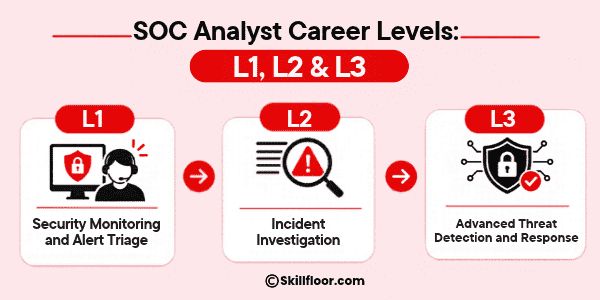
Different Levels of SOC Analyst Roles: L1, L2, and L3
Before applying for SOC Analyst jobs in Bangalore, candidates should understand the different levels of SOC operations.


Most traditional SOC teams divide responsibilities into three levels.
1. SOC Analyst L1 – Security Monitoring and Alert Triage
SOC Analyst L1 is an entry-level job where freshers monitor security alerts, look into suspicious activities, spot possible threats, and report serious problems to senior analysts.
Responsibilities include:
-
Monitoring security alerts.
-
Performing initial alert investigation.
-
Identifying false positives and suspicious activities.
-
Checking IP addresses, URLs, and file hashes.
-
Following predefined incident response procedures.
-
Escalating complex incidents to L2 analysts.
2. SOC Analyst L2 – Incident Investigation
SOC Analyst L2 looks into security incidents, examines system logs, finds what caused threats, and acts to stop more damage.
Responsibilities include:
-
Investigating confirmed security incidents.
-
Performing advanced log analysis.
-
Identifying attack patterns and indicators of compromise.
-
Investigating malware and phishing incidents.
-
Supporting containment and remediation activities.
-
Coordinating with L3 and incident response teams.
3. SOC Analyst L3 – Advanced Threat Detection and Response
SOC Analyst L3 deals with major cyberattacks, finds hidden threats, guides junior analysts, and helps companies improve their overall security.
Responsibilities include:
-
Advanced threat hunting.
-
Malware and forensic investigations.
-
Developing detection rules.
-
Improving security monitoring processes.
-
Conducting root cause analysis.
-
Supporting advanced incident response activities.
Freshers should usually aim for L1 roles, while experienced cybersecurity experts can look into L2 and L3 jobs based on their abilities.
Essential Skills Required for SOC Analyst Jobs in Bangalore
Technical skills are one of the most important things employers look at when they hire SOC Analysts.
Candidates should build a strong base in networking, operating systems, cybersecurity concepts, and security monitoring tools.
1. Networking Fundamentals
Knowing about networking matters because many cybersecurity incidents involve suspicious network communication.
You should understand:
-
TCP/IP, UDP, and common network ports
-
DNS, DHCP, HTTP, and HTTPS
-
VPN, proxy servers, and firewalls
-
IDS/IPS and basic network packet analysis
Learning how network traffic works helps SOC Analysts spot suspicious connections and look into possible attacks.
2. Windows and Linux Operating Systems
SOC Analysts use Windows and Linux to review system logs, keep an eye on user activities, spot unusual behaviour, and look into possible security threats.
Important topics include:
-
Windows Event Viewer and authentication logs
-
Active Directory and user account management
-
Linux commands and system log analysis
-
User permissions, process, and service monitoring
Having hands-on knowledge of operating systems makes it easier to look into unauthorized access, suspicious processes, and security incidents at the system level.
3. SIEM Tools
SIEM is short for Security Information and Event Management. These platforms gather and study security logs from various sources to spot suspicious activities and create alerts.
Popular SIEM tools include:
-
Splunk
-
IBM QRadar
-
LogRhythm
SOC Analysts rely on SIEM platforms to look into alerts, connect related events, spot attack patterns, and keep an eye on security incidents.
Getting hands-on practice with at least one SIEM platform can make you better prepared for entry-level SOC roles.
4. Threat Detection and Incident Response
Candidates should learn about common cyberattacks and understand how to identify, investigate, and respond to security threats, such as:
-
Phishing and password theft
-
Ransomware and malware attacks
-
Brute-force attacks and unauthorized access
-
Denial-of-Service (DoS) and Distributed Denial-of-Service (DDoS) attacks
You should also know the incident response lifecycle, which includes preparation, detection, analysis, containment, eradication, and recovery.
5. Basic Scripting and Automation
Not every entry-level SOC job requires programming, but knowing some basic scripting is helpful.
Start with:
-
Python fundamentals
-
PowerShell basics
-
Bash commands
-
Basic log parsing
These skills can help you look at security data and automate repeated investigation tasks.
Best Certifications for SOC Analysts in 2026
Cybersecurity certifications help candidates gain technical knowledge, strengthen their resumes, and demonstrate their skills to employers, while also gaining practical experience for SOC Analyst roles.
Here are some certifications worth considering:
1. CompTIA Security+
A cybersecurity certification that is good for beginners, covering network security, threats, risk management, identity management, and security operations.
2. Microsoft Certified: Security Operations Analyst Associate (SC-200)
This certification focuses on investigating threats and responding to them using Microsoft Sentinel, Microsoft Defender, and related security tools.
3. Cisco Certified CyberOps Associate
A certification that fits candidates who are interested in security monitoring, threat analysis, and incident response.
4. CompTIA CySA+
A more advanced choice that covers security analytics, vulnerability management, threat detection, and incident response.
5. Certified SOC Analyst (CSA)
A certification centered on the role, covering SOC operations, security monitoring, SIEM concepts, and incident handling.
Pick a certification based on what you know now, your career goals, and your budget. Always visit the official certification provider's website to check the latest exam details.
SOC Analyst Salary in Bangalore in 2026
In Bangalore, the salary of a SOC Analyst depends on experience, technical skills, certifications, and what the company requires. Candidates who know SIEM in a practical way may get better salary opportunities.
|
Experience Level |
Estimated Annual Salary |
Salary Source |
|
Fresher (0–1 year) |
₹3–5 LPA |
|
|
Junior SOC Analyst (1–3 years) |
₹4–7 LPA |
|
|
SOC Analyst L2 (3–5 years) |
₹6–10 LPA |
|
|
Senior SOC Analyst (5+ years) |
₹9–15+ LPA |
Note: Salary ranges are indicative estimates for blog guidance, not figures directly verified by each linked platform. Actual salaries vary by company, skills, experience, and job responsibilities. Check the latest listings before publishing.
Factors That Influence SOC Analyst Salaries
-
Hands-on experience with SIEM platforms.
-
Knowledge of incident investigation.
-
Experience with cloud security and endpoint protection.
-
Relevant cybersecurity certifications.
-
Practical networking and operating system knowledge.
Job seekers who have hands-on experience with tools like Microsoft Sentinel, Splunk, and CrowdStrike could have an advantage for positions that need those particular technologies.
How Can Freshers Get SOC Analyst Jobs in Bangalore?
Freshers can begin a SOC Analyst career by learning the basics of cybersecurity, getting hands-on experience, understanding SIEM tools, building projects, and getting ready for interviews.
Step 1: Learn Cybersecurity Fundamentals
Get to know basic cybersecurity concepts, common cyberattacks, authentication, network security, and information security so you build a solid base for SOC Analyst roles.
Step 2: Develop Networking and Operating System Skills
Learn TCP/IP, DNS, firewalls, Windows Event Viewer, Linux commands, and system logs so you can understand network activity and spot suspicious behaviour.
Step 3: Get Practical Training in SIEM Tools
Get familiar with tools such as Splunk and Microsoft Sentinel. Training providers such as Skillfloor can help candidates build practical cybersecurity knowledge through structured training and hands-on learning.
Step 4: Practice Through Cybersecurity Labs and Projects
Use platforms such as TryHackMe and CyberDefenders to practise log analysis, phishing investigation, brute-force detection, and basic security alert monitoring.
Step 5: Build Your Resume and Apply for Jobs
Show off your technical skills, certifications, and practical projects. Apply through job portals for entry-level roles such as SOC Analyst L1 and Junior SOC Analyst.
Top Companies and Industries to Explore for SOC Analyst Jobs in Bangalore
Bangalore provides opportunities for SOC Analysts in various industries. Both freshers and experienced professionals can look into these five sectors:
-
IT Services and Consulting: IT companies employ SOC Analysts to watch over networks, look into security alerts, and keep business systems safe from cyber threats.
-
Banking and Financial Services: Banks employ cybersecurity professionals to keep customer information, financial transactions, and online banking systems safe from security attacks.
-
Product-Based Technology Companies: Technology companies require SOC Analysts to watch cloud systems, applications, endpoints, and internal networks for suspicious activities.
-
Managed Security Service Providers (MSSPs): MSSPs employ SOC professionals to deliver security monitoring, threat detection, and incident response services to many clients.
-
Cybersecurity Companies: Specialized cybersecurity companies provide opportunities in security monitoring, threat analysis, vulnerability management, and incident investigation.
SOC Analyst Interview Preparation: Important Topics to Study
Being shortlisted is just the first step. Applicants also need to show their technical understanding during interviews.
Prepare for questions covering the following topics:
1. Networking questions
-
What is the difference between TCP and UDP?
-
What is DNS?
-
What is the difference between HTTP and HTTPS?
-
What is a firewall?
-
What are common network ports?
2. SIEM questions
-
What is SIEM?
-
How does a SIEM platform work?
-
What is log correlation?
-
What is a false positive?
-
How do you investigate a security alert?
3. Cybersecurity questions
-
What is phishing?
-
What is ransomware?
-
What is an indicator of compromise (IOC)?
-
What is brute-force authentication?
-
What is the MITRE ATT&CK framework?
90-Day Roadmap to Become a SOC Analyst
|
Timeline |
Learning Focus |
Tasks to Complete |
|
Days 1–10 |
Cybersecurity Basics |
Learn cybersecurity fundamentals, common cyberattacks, and security concepts. |
|
Days 11–20 |
Networking |
Understand TCP/IP, DNS, HTTP, HTTPS, ports, and firewalls. |
|
Days 21–30 |
Windows and Linux |
Practice basic commands, check system logs, and understand user activities. |
|
Days 31–40 |
SIEM Tools |
Learn Splunk or Microsoft Sentinel and understand how SIEM tools work. |
|
Days 41–50 |
Log Monitoring |
Practice log analysis, security alert monitoring, and threat detection. |
|
Days 51–60 |
Cyberattack Investigation |
Study phishing, malware, brute-force attacks, and suspicious login activities. |
|
Days 61–70 |
Hands-on Practice |
Complete beginner SOC labs using TryHackMe and CyberDefenders. |
|
Days 71–80 |
Projects and Resume |
Complete basic SOC projects and highlight your technical skills and practical experience. |
|
Days 81–90 |
Interview Preparation |
Practice SOC Analyst interview questions and apply for SOC Analyst L1 and Junior SOC Analyst jobs. |
By following this 90-day roadmap, you can build basic cybersecurity knowledge, gain hands-on experience with SIEM tools, and prepare to apply for entry-level SOC Analyst roles.
Career Growth Opportunities After Becoming a SOC Analyst
SOC Analyst roles can lead to several career opportunities within the cybersecurity industry.
With experience and continuous learning, professionals can move into roles such as:
-
Senior SOC Analyst
-
Security Engineer
-
Incident Response Analyst
-
Threat Hunter
-
Digital Forensics Analyst
-
Cloud Security Analyst
-
Security Operations Manager
-
Cybersecurity Consultant
These career paths give you a chance to build advanced technical skills, handle bigger responsibilities, and move up into higher-level cybersecurity roles.
Frequently Asked Questions About SOC Analyst Jobs in Bangalore
Q1. Can freshers get SOC Analyst jobs in Bangalore?
Yes. Freshers can apply for SOC Analyst L1 and Junior SOC Analyst roles. Basic networking, cybersecurity knowledge, and SIEM tool experience can improve their chances.
Q2. What is the starting salary of a SOC Analyst in Bangalore?
Freshers can expect an estimated salary of ₹3–5 LPA. The actual salary depends on the company, technical skills, certifications, and practical experience.
Q3. Is coding mandatory for SOC Analysts?
No. Advanced coding is not required for most entry-level SOC roles. However, basic Python, PowerShell, and scripting knowledge can help with security investigations.
Q4. Which SIEM tools should beginners learn?
Beginners can start with Splunk or Microsoft Sentinel. They should practise log monitoring, alert investigation, event analysis, and basic threat detection.
Q5. How long does it take to become a SOC Analyst?
With regular learning and hands-on practice, candidates can build entry-level skills in around 3–6 months. The time may vary based on their IT knowledge and learning pace.
SOC Analyst jobs in Bangalore present an exciting career opportunity for both freshers and experienced professionals looking to enter or advance in the cybersecurity industry.
Building a successful career in this field requires more than just obtaining certifications or understanding theoretical concepts. Candidates must have a solid foundation in networking, a good grasp of operating systems, practical experience with Security Information and Event Management (SIEM) tools, incident investigation skills, and the ability to analyze real-world security threats.
To get started, focus on developing your technical skills, practice with cybersecurity labs, engage in practical projects, and prepare for scenario-based interviews.
Whether you are a fresher seeking your first job in cybersecurity or an IT professional looking to transition into this field, 2026 can be a pivotal time to enhance your skills and explore opportunities within Bangalore’s cybersecurity ecosystem.
Take the first step today: strengthen your cybersecurity knowledge, gain hands-on experience in a Security Operations Center (SOC), and prepare for your next opportunity as a SOC Analyst.
Digital Marketing Courses in Other Locations in India
Ahmedabad | Aurangabad | Bangalore | Bhilai | Bhopal | Bhubaneshwar | Chandigarh | Chennai | Cochin | Coimbatore | Dehra Dun | Delhi | Faridabad | Ghaziabad | Gorakhpur | Guntur | Gurgaon | Guwahati | Hyderabad | Jaipur | Kanpur | Khammam | Kolkata | Lucknow | Madurai | Mumbai | Mysore | Nagpur | Noida | Patna | Pondicherry | Pune | Ranchi | Shimoga | Surat | Thane | Thiruvananthapuram | Tiruchirappalli | Tirupati | Vadodara | Visakhapatnam | Warangal | Jalandhar | Jodhpur | Indore | Durgapur | Jamshedpur | Dhanbad | Kota | Karnal | Udaipur | Amritsar | calicut | Nashik | Ludhiana | varanasi | thrissur | Mangalore | Raipur |