





























How to Become a Google Ads Specialist: Complete Beginner's Guide
Learn how to become a Google Ads specialist from scratch. Discover the key skills, certification, practical steps, and career tips you need to get started today.
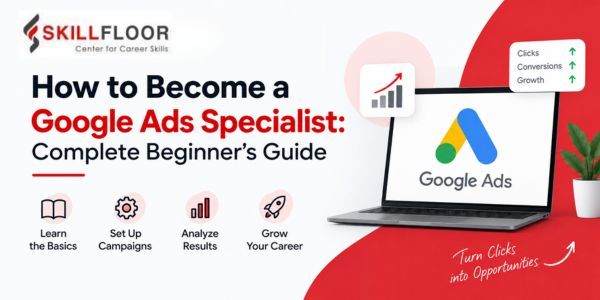
Google Ads is becoming an essential skill for professionals aiming to excel in online advertising, as digital marketing continues to grow rapidly. By leveraging audience targeting, understanding search intent, and employing data-driven strategies, advertisers can connect with potential customers at the right moment.
The demand for qualified Google Ads Specialists is increasing across various industries as businesses place greater emphasis on paid advertising. By mastering key areas such as keyword research, campaign optimization, conversion tracking, and performance analysis, professionals can create effective advertising campaigns and unlock new career opportunities in digital marketing.
The best part is that you can begin learning Google Ads without a degree in marketing or years of expertise. Beginners can acquire the skills necessary to run campaigns and establish a lucrative career as a Google Ads Specialist with organised instruction, practical experience, and ongoing development.
What Is a Google Ads Specialist?
An expert in digital marketing, a Google Ads Specialist is in charge of organising, developing, overseeing, and refining Google Ads advertising campaigns. Their main objective is to maximise the return on advertising expenditure (ROAS) while producing qualified visitors, leads, and sales.


A Google Ads Specialist makes strategic choices based on customer behaviour, campaign effectiveness, and corporate goals rather than just running advertisements.
Typical Responsibilities
A Google Ads Specialist performs several important tasks, including:
-
Conducting keyword research
-
Creating Search, Display, Shopping, Video, and Performance Max campaigns
-
Writing compelling ad copy
-
Setting campaign budgets and bidding strategies
-
Monitoring campaign performance
-
Improving Quality Score
-
Tracking conversions
-
Optimizing campaigns for better ROI
In short, they guarantee that every advertising investment is carefully handled, maximising campaign performance, cutting down on wasteful spending, and producing quantifiable outcomes through wise data-driven advertising choices.
Why Choose Google Ads as a Career?
Since businesses depend upon paid advertising to generate immediate traffic and revenue, Google Ads has emerged as one of the most sought-after digital marketing skills.
Here are some compelling reasons to pursue this career.
-
High Industry Demand: Google Ads specialists are employed by businesses in a variety of sectors to oversee campaigns, maximise results, and successfully reach consumers using focused digital advertising techniques.
-
Attractive Salary Opportunities: With prospects for advancement in senior roles, consulting, performance marketing, and leadership roles in digital advertising, Google Ads Specialists can make good compensation.
-
Freelancing Opportunities: Professionals can choose clients, manage several accounts, work remotely, and generate flexible revenue options through freelancing with Google Ads knowledge.
-
Opportunity to Work with Global Clients: Professionals with Google Ads abilities can collaborate with clients worldwide, opening doors for remote projects and international advertising campaigns.
-
Continuous Learning: Google Ads is a dynamic job choice since it offers ongoing learning opportunities through new products, AI tools, strategies, and campaign changes.
Essential Skills Required to Become a Google Ads Specialist
Acquiring knowledge of the platform is insufficient. Technical proficiency is combined with critical thinking and communication skills in successful specialists.
Technical Skills
1. Keyword Research
Understanding keyword research makes it easier for experts to find pertinent search terms, assess user intent, and choose lucrative keywords that increase campaign visibility and conversions.
Key areas to learn:
-
Finding high-intent and relevant keywords
-
Understanding keyword match types
-
Analyzing search volume and competition
-
Creating effective negative keyword lists



2. Campaign Setup and Management
Google Ads specialists need to be proficient in setting up settings, managing budgets, creating structured campaigns, and improving ad effectiveness.
Key areas to learn:
-
Creating different campaign types
-
Setting budgets and bidding strategies
-
Organizing campaigns and ad groups
-
Managing targeting settings effectively
3. Ad Copywriting
Creating attractive marketing content increases click-through rates, draws in users, and motivates prospective clients to perform desired activities.
Key areas to learn:
-
Creating attention-grabbing headlines
-
Writing persuasive descriptions
-
Using strong calls-to-action
-
Testing multiple ad variations
4. Conversion Tracking
By precisely tracking leads, sales, and significant user actions, conversion tracking allows experts to assess the success of campaigns.
Key areas to learn:
-
Setting up conversion goals
-
Tracking website actions
-
Understanding conversion data
-
Measuring campaign effectiveness
5. Data Analysis and Optimization
Experts can find possibilities, boost performance, cut expenses, and make well-informed advertising decisions by analysing campaign data.
Key areas to learn:
-
Understanding important metrics
-
Analyzing campaign reports
-
Identifying optimization opportunities
-
Improving return on ad spend
6. Google Analytics and Reporting
Proficiency in analytics and reporting enables experts to comprehend user behaviour, assess outcomes, and effectively convey campaign performance.
Key areas to learn:
-
Using Google Analytics reports
-
Tracking user journeys
-
Creating performance dashboards
-
Presenting insights clearly
Soft Skills
1. Analytical Thinking
Google Ads Specialists can solve advertising problems, analyse campaign data, spot trends, and make strategic choices based on performance insights by applying analytical thinking.
2. Communication Skills
Proficient communication abilities enable professionals to effectively explain tactics, exchange campaign data, comprehend client needs, and uphold professional relationships.
3. Attention to Detail
Specialists can detect campaign faults, track changes in performance, optimize settings, and ensure accuracy in advertising operations by paying close attention to details.
4. Problem-Solving Skills
Experts with problem-solving abilities may assess campaign problems, test fixes, and put plans into action that enhance the effectiveness and performance of advertising.
5. Time Management
Professionals that are adept at time management are better able to manage several campaigns, set priorities, finish optimisation tasks, and fulfil project deadlines.
6. Continuous Learning Mindset
Experts may stay current with Google Ads features, market trends, automation tools, and changing advertising tactics by adopting a continuous learning approach.
How Does Google Ads Work?
Google Ads assists companies in connecting with potential consumers who are looking for goods, services, or business-related information. Advertisers specify a budget, select keywords, make ads, and participate in Google's ad auction. Google then selects which advertisements to display based on a number of criteria, including bid, predicted performance, relevancy, and ad quality.
1. Choose Relevant Keywords
Choose the keywords that prospective clients use to find the goods, services, or solutions your company offers online.
2. Create Your Ads
Create attention-grabbing headlines and descriptions that align with search intent, emphasise advantages, and entice prospective clients to click on your ads.
3. Set Your Budget and Bidding Strategy
Choose a bidding strategy based on objectives such as clicks, leads, conversions, or sales, and set a daily budget.
4. Google Runs an Ad Auction
Every time a user searches, Google holds an auction to choose which qualified advertisements show up based on quality, relevancy, and bids.
5. Google Ranks and Displays Ads
To decide where appropriate ads show up in search results, Google considers bids, landing page experience, relevancy, and ad quality.
6. Track Results and Optimize Campaigns
Optimise keywords, advertisements, targeting, bids, and budgets for improved performance after routinely monitoring clicks, conversions, cost per click, and ROAS.
How to Become a Google Ads Specialist: Step-by-Step
Now let's look at a practical roadmap you can follow as a beginner.
Step 1: Learn Digital Marketing Fundamentals
Understand the fundamentals of digital marketing before delving extensively into Google Ads.
Understand:
-
Target audiences
-
Customer personas
-
Marketing funnels
-
Customer journeys
-
Search intent
-
Landing pages
-
Calls to action
-
Conversion funnels
This foundation will assist you not only in using the platform but also in understanding the purpose of your campaign.
Step 2: Learn the Google Ads Platform
After you've understood the principles, begin investigating Google Ads.
Learn about the main campaign types and the account structure.
Common campaign formats include:
-
Search
-
Display
-
Shopping
-
Video
-
App
-
Performance Max
Because search campaigns offer a clear way to understand keywords, search intent, advertisements, and conversions, they are sometimes the easiest for beginners to begin with.
Step 3: Master Keyword Research
Make a list of potential keywords for a virtual business.
For example, imagine you're promoting an online Google Ads course.
You might research searches related to:
-
Google Ads course
-
Google Ads training
-
Google Ads certification course
-
PPC course
Arrange keywords according to their relevance and search purpose, and look for negative keywords to avoid wasting your advertising budget on pointless searches.
Step 4: Learn How to Create Campaigns
Understanding targeting, budgets, keywords, bidding, and conversion goals can help you create well-organised Google Ads campaigns.
Think about:
-
Campaign Objective
-
Target Audience
-
Location & Budget
-
Ad Groups & Keywords
-
Ads & Assets
-
Bidding & Conversion Goals
If your first campaign is not perfect, don't stress. Understanding how the various components interact is the aim of practice.
Step 5: Learn Ad Copywriting
Make persuasive ad versions that convey value, align with user intent, emphasise advantages, and motivate prospective buyers to take action.
Test different:
-
Headlines
-
Benefits
-
Calls to Action
-
Offers
-
Value Propositions
-
Ad Variations
The goal is to understand how various messages might be appealing to various search intents.
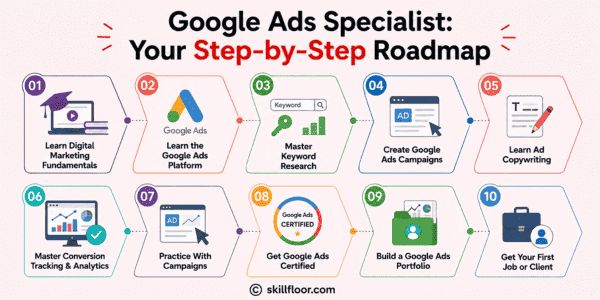
Step 6: Learn Conversion Tracking and Analytics
Learn how to measure results after you have a strong understanding on campaign creation.
You should be able to determine which activities are important to the company and link campaign effectiveness to those results.
One of the things that distinguishes a professional who can make data-driven decisions from someone who can just "run ads" is this.
Step 7: Practice With Real or Sample Campaigns
While knowledge is important, real-world experience is what fosters confidence. Practice developing campaigns, evaluating outcomes, and choosing optimisation strategies based on practical situations.
Make sample campaigns for virtual companies, including restaurants, clothing stores, real estate businesses, medical offices, or software companies, if you don't currently have any clients.
Create every campaign from the ground up, taking into account the budget, conversion targets, ad text, targeting strategy, keyword strategy, structure, and optimisation strategy.
Step 8: Get Google Ads Certified
Obtaining a certification might be a helpful approach to prove that you have researched Google's advertising strategies and products. Becoming google ads certified can also demonstrate your understanding of the platform and its core concepts.
However, certification should be viewed as a foundation—not proof that you can successfully manage large advertising budgets.
Your practical skills, strategic thinking, communication, and capacity to analyse results are also of importance to employers and clients.
Step 9: Build a Google Ads Portfolio
Even if you don't have any professional client experience, having a solid portfolio allows you to demonstrate your practical talents, strategic thinking, and knowledge of Google Ads.
Your portfolio could include:
-
Sample Campaign Structures
-
Keyword Research
-
Ad Copy Examples
-
Campaign Strategies
-
Performance Reports
-
Optimization Recommendations
Describe the business challenge, your plan, the steps you took, and the results for each project. Employers or clients can see how you handle actual Google Ads campaigns because of this.
Step 10: Get Your First Job or Client
After you've developed your skills and portfolio, begin searching for jobs that will allow you to obtain real-world experience and boost your self-assurance in running Google Ads campaigns.
You can explore:
-
Digital Marketing Agencies
-
In-House Marketing Teams
-
Internships
-
Freelance Platforms
-
Professional Networking
-
Local Businesses
Don't concentrate just on getting a large salary right away. Getting real experience, establishing your reputation, and attaining quantifiable outcomes should be your top priorities.
How Long Does It Take to Become a Google Ads Specialist?
Since everyone learns at a different pace, there is no set schedule.
A beginner can acquire fundamental knowledge rather rapidly if they practise frequently and study diligently. Since campaign optimization necessitates experience with various industries, audiences, budgets, and corporate objectives, it takes longer to become truly proficient.
A practical progression could look like this:
Month 1: Learn digital marketing and Google Ads fundamentals.
Month 2: Practice keyword research, campaign creation, ad copywriting, and reporting through structured training such as Skillfloor.
Month 3: Build portfolio projects and work toward certification.
After that: Get practical experience and gradually take on increasingly challenging campaign management tasks.
It's crucial to take your time getting the job title. Make an effort to develop your ability to make wise advertising choices.
How Much Can a Google Ads Specialist Earn?
In India, a Google Ads Specialist's pay varies depending on their experience, region, employer, specialisation, campaign size, and capacity to produce quantifiable outcomes.
|
Experience Level |
Typical Annual Salary |
Common Job Titles |
Typical Responsibilities |
|
Entry Level (0–2 years) |
₹3–5 LPA |
Junior PPC Specialist, Google Ads Executive, Digital Marketing Executive |
Keyword research, campaign setup, ad creation, basic reporting, and campaign monitoring |
|
Early Career (2–3 years) |
₹4–7 LPA |
Google Ads Specialist, PPC Specialist |
Campaign optimization, bid management, conversion tracking, A/B testing, and performance analysis |
|
Mid-Level (3–5 years) |
₹6–11 LPA |
Senior PPC Specialist, Performance Marketing Specialist |
Managing larger budgets, developing strategies, optimizing ROAS, and analyzing complex campaign data |
|
Senior Level (5–7 years) |
₹9–15 LPA |
Senior Google Ads Specialist, Paid Media Manager |
Managing multiple accounts, advanced optimization, forecasting, reporting, and mentoring junior specialists |
|
Lead/Manager (7+ years) |
₹12–20+ LPA |
PPC Manager, Paid Media Lead, Performance Marketing Manager |
Managing teams, large advertising budgets, client strategy, business growth, and performance planning |
|
Freelance/Consultant |
Varies significantly |
Google Ads Consultant, PPC Freelancer |
Managing client campaigns, strategy, optimization, reporting, and consulting |
These numbers are not guaranteed; they are merely indicative. Google Ads Specialists in India presently make an average base pay of about ₹5 lakh annually, according to Glassdoor, though salary ranges vary greatly depending on experience and employer.
Salary Resources
For readers who want to explore current Google Ads Specialist salary in India, these platforms can provide additional salary estimates and market information:
Note: Experience, geography, employer, specialisation, and campaign management duties can all have a substantial impact on salary estimates. For instance, according to current Glassdoor statistics, the typical base pay for Google Ads Specialists in India is approximately ₹5 lakh annually, although AmbitionBox's published salary data indicates a more expansive range of ₹2.2–₹9 lakh.
Best Ways to Learn Google Ads
A strong learning strategy combines theory with practice.
-
Official Google Resources: To learn about platform capabilities, campaign settings, policies, and modern advertising best practices, start with Google's official sites.
-
Hands-On Practice: Create sample campaigns and routinely test out various keywords, advertisements, targeting choices, budgets, and bidding techniques.
-
Campaign Analysis: Examine campaign performance data to find opportunities, pinpoint shortcomings, and get experience making well-informed optimisation choices.
-
Industry Resources: Keep up with Google Ads features, trends, tactics, and updates by subscribing to reliable PPC publications and marketing gurus.
-
Structured Courses: For organised courses, hands-on projects, expert assistance, and guided learning, think about enrolling in a Google Ads and digital marketing course.
-
Continuous Learning: Google Ads is always changing with new features, tools, automation, and advertising tactics, so keep up with the latest developments and practice.
Common Google Ads Mistakes Beginners Should Avoid
1. Focusing Only on Clicks
Conversions, leads, sales, revenue, and overall business performance are more important than click-through rates.
2. Ignoring Negative Keywords
To avoid wasting advertising money and unqualified traffic, review search terms frequently and add irrelevant phrases as negative keywords.
3. Poor Conversion Tracking
Inaccurate conversion tracking might yield false information, which makes it challenging to assess campaign effectiveness or make wise advertising choices.
4. Making Changes Without Data
Before modifying budgets, bids, or targeting, examine significant performance trends and refrain from making significant campaign adjustments in response to transient swings.
5. Ignoring Landing Pages
Make sure landing pages are consistent with your ads, include pertinent content, load quickly, and facilitate conversion.
6. Optimizing for the Wrong Goal
Instead of focusing only on traffic, set optimisation goals based on business objectives like qualified leads, purchases, revenue, or profitable customer acquisition.
Google Ads Specialist Career Roadmap
If you're starting from zero, follow this simple path:
Learn → Practice → Get Certified → Build a Portfolio → Gain Experience → Get Your First Job/Client → Analyze Results → Specialize → Advance
As you gain experience, you can specialize in areas such as:
-
Search advertising
-
E-commerce advertising
-
Lead generation
-
Performance marketing
-
YouTube advertising
-
Local advertising
-
Conversion optimization
-
Google Analytics & Measurement
Specialization can help you differentiate yourself in a competitive market.
Frequently Asked Questions
1. Can I become a Google Ads Specialist with no experience?
Yes. Learn the fundamentals, practice with sample campaigns, complete certification, build a portfolio, and gradually gain real-world experience managing campaigns.
2. Do I need a degree to become a Google Ads Specialist?
No. A degree isn't mandatory. Practical Google Ads knowledge, analytical thinking, communication skills, certifications, and demonstrable campaign experience can help.
3. Is Google Ads difficult to learn?
Google Ads basics are relatively easy to understand, but becoming proficient requires consistent practice, data analysis, strategic thinking, and continuous campaign optimization.
4. Is Google Ads certification enough to get a job?
Certification can strengthen your profile, but employers also value practical experience, campaign knowledge, analytical abilities, communication skills, and demonstrated results.
5. Can I work as a freelance Google Ads Specialist?
Yes. After developing sufficient skills, you can offer Google Ads services independently. Build a portfolio, define your services, and gradually acquire clients.
6. What is the most important skill for a Google Ads Specialist?
Analytical thinking is essential, but successful specialists also need platform knowledge, keyword research, copywriting, conversion tracking, strategy, and optimization skills.
Becoming a Google Ads Specialist requires more than simply completing a course or obtaining certification.
It involves understanding how advertising works, creating campaigns, analyzing data, identifying issues, testing solutions, and connecting advertising efforts to real business outcomes.
If you're a complete beginner, don't try to learn everything at once.
Start by learning the basics, practicing campaign creation, understanding conversion tracking, and building a portfolio. It's also crucial to learn how search campaigns operate and to gain practical experience over time.
Digital Marketing Courses in Other Locations in India
Ahmedabad | Aurangabad | Bangalore | Bhilai | Bhopal | Bhubaneshwar | Chandigarh | Chennai | Cochin | Coimbatore | Dehra Dun | Delhi | Faridabad | Ghaziabad | Gorakhpur | Guntur | Gurgaon | Guwahati | Hyderabad | Jaipur | Kanpur | Khammam | Kolkata | Lucknow | Madurai | Mumbai | Mysore | Nagpur | Noida | Patna | Pondicherry | Pune | Ranchi | Shimoga | Surat | Thane | Thiruvananthapuram | Tiruchirappalli | Tirupati | Vadodara | Visakhapatnam | Warangal | Jalandhar | Jodhpur | Indore | Durgapur | Jamshedpur | Dhanbad | Kota | Karnal | Udaipur | Amritsar | calicut | Nashik | Ludhiana | varanasi | thrissur | Mangalore | Raipur |