











































Certified Machine Learning Associate Certification
Kickstart your ML journey with the Certified Machine Learning Associate Certification, mastering key all concepts and building practical expertise for success.

Don't pass up the AI trend! The future of internet services, healthcare, and business is being shaped by machine learning (ML). Beginners may stand out, acquire useful abilities, and grasp the fundamentals with the help of the Certified Machine Learning Specialist certification. It's an easy, methodical way to get started with machine learning.
Whether you are a professional, student, or changing careers, this credential lends you credibility and self-assurance. You will gain an understanding of how to use data to solve issues, practice real-world situations, and grasp important ML principles. By finishing it, you demonstrate to potential employers that you are prepared for entry-level machine learning positions and begin your journey into the field of artificial intelligence.
What is the Certified Machine Learning Associate Certification?
Beginners and experts in their early careers benefit greatly from the CMLA certification. It covers machine learning fundamentals, assisting students in comprehending the essential ideas, resources, and basic procedures required to confidently tackle real-world issues.
Applications in the actual world are the main focus of this certification. You gain knowledge on how to arrange data, use standard techniques, and assess outcomes. By finishing it, you acquire fundamental abilities that can serve as a springboard for more complex AI learning or assist in launching your career in machine learning.


Key highlights:
-
Beginner-friendly but industry-relevant.
-
Covers practical skills along with theoretical knowledge.
-
Prepares candidates to implement simple ML models using popular tools.
-
Helps build confidence to solve real-world problems with data.
-
Provides a foundation for advanced ML and AI learning paths.
Why Pursue a Certified Machine Learning Associate Certification?
Certifications show your commitment to learning and your practical application of information, making them more than simply a piece of paper. To show your skills to potential employers and to provide you with an advantage in the cutthroat tech industry of today, the importance of machine learning certification is essential.
Beginners who get the CMLA certification gain confidence, acquire technologies that are relevant to the industry, and comprehend real-world machine learning processes. You gain both theoretical and practical skills from it, preparing you for more complex AI courses and for the workforce. This is what makes the CMLA certification unique:
-
Validates your understanding of core ML concepts and algorithms.
-
Opens doors to entry-level roles like ML Associate, Data Analyst, and Junior ML Engineer.
-
Builds confidence for further specialization in AI, Deep Learning, or Data Science.
-
Enhances problem-solving skills with hands-on experience using real datasets.
-
Strengthens your resume and professional credibility in the tech industry.
Who Should Pursue This Certification?
For professionals and students looking for a career boost in the AI field, credibility, and fundamental machine learning skills, the Certified Machine Learning Associate is the perfect choice.
Ideal Candidates Include:
-
Early-Career Professionals: Looking for a reputable machine learning certification in order to build reputation and transition into AI or data-driven positions.
-
Students & Graduates: Looking for organized instruction in machine learning ideas in order to acquire useful skills and increase employability in tech-related professions.
-
Career Switchers: Experts from other fields who wish to confidently transition into positions in data science, AI, or machine learning.
-
Self-Learners: Theoretical ML experts who require industry-accepted certifications and validation to demonstrate their practical abilities.
-
Tech Enthusiasts: Curious minds ready to learn about the fundamentals of AI and ML, obtain practical experience, and improve their job prospects.
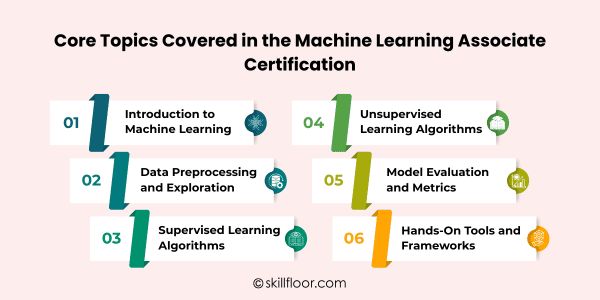
Core Topics Covered in the Machine Learning Associate Certification
The fundamentals of machine learning are covered by the CMLA certification, providing students with a solid theoretical and practical basis. Here is a thorough examination of the six main subjects:
1. Introduction to Machine Learning
Computers may be taught to learn from data and make judgments or predictions without explicit programming thanks to machine learning. It serves as the basis for real-world applications of AI.
What’s Covered:
-
Definition of ML, AI, and Deep Learning
-
Types of ML: Supervised, Unsupervised, Reinforcement

-
Differences between AI, ML, and Deep Learning
-
Real-world applications of ML across industries
-
Understanding workflows and pipelines in ML projects


2. Data Preprocessing and Exploration
For models to be accurate, clear, structured data must be prepared. This subject shows how to examine, purify, and arrange data so that algorithms may learn efficiently and generate accurate results.
What’s Covered:
-
Handling missing data, duplicates, and outliers
-
Feature selection and dimensionality reduction
-
Data scaling and normalization techniques
-
Exploratory data analysis (EDA) using charts and graphs
-
Understanding correlations and patterns in datasets
3. Supervised Learning Algorithms
Using labeled data, supervised learning generates predictions. This subject presents strategies for data classification and outcome prediction that are easy for beginners to understand.
What’s Covered:
-
Linear and Logistic Regression
-
Decision Trees and Random Forests basics
-
k-Nearest Neighbors (k-NN)
-
Classification vs Regression problems
-
Training, testing, and validating supervised models
4. Unsupervised Learning Algorithms
In unlabeled data, unsupervised learning identifies patterns. In order to facilitate analysis and decision-making, this groups or clusters related data items.
What’s Covered:
-
Clustering techniques: K-Means, Hierarchical Clustering
-
Dimensionality reduction methods (PCA)
-
Market segmentation and customer grouping
-
Anomaly detection in datasets
-
Understanding patterns without labeled data
5. Model Evaluation and Metrics
Accuracy and dependability are ensured by assessing model performance. This subject describes typical metrics and techniques to evaluate the performance of your machine learning model.
What’s Covered:
-
Accuracy, Precision, Recall, F1-Score
-
Confusion matrix and ROC-AUC analysis
-
Overfitting and underfitting issues
-
Cross-validation techniques
-
Choosing the right metric for your problem
6. Hands-On Tools and Frameworks
Use of tools and libraries in a practical setting is crucial. In order to create models and workflows, this chapter covers Python code and well-known machine learning packages.
What’s Covered:
-
Python programming basics for ML
-
Using libraries: scikit-learn, Pandas, NumPy
-
Data visualization with Matplotlib and Seaborn
-
Implementing ML pipelines step by step
-
Optional: TensorFlow or Keras for deep learning basics
Key Skills You’ll Learn Through the CMLA Certification
Gaining the CMLA certification gives you the practical skills you need to effectively address machine learning problems in the real world, boosting your confidence and readiness for obstacles in the field:
1. Effective Data Visualization
To identify trends, correlations, and patterns in data and improve your analysis and decision-making, learn how to produce understandable and informative charts and graphs.
2. Feature Engineering
Gain the ability to turn unstructured data into useful features that will enhance model performance and guarantee that machine learning solutions produce reliable outcomes.
3. Understanding ML Pipelines
Learn how to create complete workflows that include data collection, preprocessing, modeling, and evaluation to guarantee that machine learning projects are carried out effectively and methodically.
4. Exploring Real-World Datasets
Get practical experience managing a variety of data difficulties across businesses by learning how to work with big and complicated datasets.
5. Intro to Automation
Recognize how to automate repetitive machine learning operations with AutoML tools and techniques to construct models more quickly while saving time and preserving high-quality forecasts.
6. Critical Thinking for Model Selection
Develop the capacity to assess issues, pick the best algorithm, and make decisions that will yield the greatest results in real-world machine learning projects.
The Journey: How the Certification Works
The Certified Machine Learning Associate program is intended to lead beginners through a methodical, hands-on journey toward acknowledged industry credibility.
Key Steps in the Journey:
-
Eligibility Requirements: The certification is accessible to committed learners from all backgrounds because it is open to novices with no prior ML knowledge.
-
Structured Learning Path: In-depth courses guarantee that students acquire both conceptual knowledge and practical understanding by combining theory and practical tasks.
-
Core Topics Covered: Comprises basic algorithms, feature engineering, data preprocessing, model validation, and practical experience with well-known machine learning tools.
-
Assessment & Examination: A targeted, hands-on test assesses comprehension, problem-solving abilities, and the capacity to deploy machine learning concepts in practical settings.
-
Certification Awarded: After passing, students are granted an industry-recognized accreditation, which boosts their credibility and provides access to entry-level machine learning positions.
-
Practical Roadmap: Gives applicants a clear learning path so they may acquire skills in a logical order and advance in their AI careers with confidence.
Similar to a road map for navigating the jungle of machine learning, Skillfloor makes sure you are guided step-by-step and acquire the necessary abilities in the correct sequence for success in the real world.
Key Benefits of Earning the CMLA Certification
Professionals holding the Certified Machine Learning Associate (CMLA) Certification are equipped with fundamental machine learning skills, credibility, and employment options in the quickly expanding artificial intelligence sector.
Benefits Include:
-
Industry Recognition: Validates your understanding of machine learning, lending your abilities legitimacy and helping you stand out to prospective employers.
-
Career Advancement: Provides access to entry-level machine learning jobs, data analyst jobs, and chances to move into employment centered around artificial intelligence.
-
Structured Learning: Offers a guided curriculum that covers fundamental machine learning techniques, data preprocessing, model evaluation, and practical experience.
-
Skill Confidence: Gives you a practical understanding that enables you to successfully apply machine learning techniques in real-world tasks.
-
Higher Employability: Shows dedication and proficiency, improving your chances of being considered for a position in the competitive ML and AI job markets.
-
Foundation for Growth: Ensures ongoing professional and skill development by laying the foundation for advanced machine learning certifications or specific AI programs.
Real-world Applications and Case Studies
The CMLA Certification introduces students to practical machine learning applications in a variety of industries, demonstrating how fundamental knowledge leads to significant solutions.
-
Healthcare: Machine learning speeds up medication discovery, helps diagnose diseases, and provides individualized treatments for better patient outcomes.
-
Finance: ML improves financial decision-making by facilitating algorithmic trading, fraud detection, and credit risk assessment.
-
E-commerce: By offering tailored product recommendations, recommender systems increase client engagement and revenue.
-
Autonomous Vehicles: Machine learning enables self-driving cars to make decisions in real time and travel safely.
-
Natural Language Processing (NLP): Chatbots, sentiment analysis, and automated customer service across several industries are all made possible by machine learning.
-
Predictive Maintenance & Manufacturing: Machine learning provides quality control, forecasts equipment faults, and maximizes production efficiency.
Career Opportunities After CMLA Certification
Having a Certified Machine Learning Associate (CMLA) credential helps you launch your AI career with confidence by providing access to a variety of entry-level positions in analytics, data science, and machine learning:
-
Machine Learning Associate
-
Data Analyst
-
Junior ML Engineer
-
ML Engineer
-
Business Intelligence Analyst
-
Data Scientist Trainee
Furthermore, it serves as a solid basis for more complex certifications in AI engineering, NLP, and deep learning, which will help you grow in this in-demand domain.
Earning the Certified Machine Learning Associate (CMLA) certification is more than just adding a credential to your resume. It's about developing practical abilities, self-assurance, and a clear route into the fascinating field of artificial intelligence and machine learning. You'll gain knowledge about working with data, creating basic models, and resolving significant issues. Regardless of your background—student, professional, or transitioning—this certification equips you with the skills you need to make an impression and begin using machine learning in practical settings. Make the move now to advance your abilities and create new chances in a rapidly evolving sector.
Digital Marketing Courses in Other Locations in India
Ahmedabad | Aurangabad | Bangalore | Bhilai | Bhopal | Bhubaneshwar | Chandigarh | Chennai | Cochin | Coimbatore | Dehra Dun | Delhi | Faridabad | Ghaziabad | Gorakhpur | Guntur | Gurgaon | Guwahati | Hyderabad | Jaipur | Kanpur | Khammam | Kolkata | Lucknow | Madurai | Mumbai | Mysore | Nagpur | Noida | Patna | Pondicherry | Pune | Ranchi | Shimoga | Surat | Thane | Thiruvananthapuram | Tiruchirappalli | Tirupati | Vadodara | Visakhapatnam | Warangal | Jalandhar | Jodhpur | Indore | Durgapur | Jamshedpur | Dhanbad | Kota | Karnal | Udaipur | Amritsar | calicut | Nashik | Ludhiana | varanasi | thrissur | Mangalore | Raipur |