





















Career Change from Non-IT to IT via Data Science
Make a successful shift from non-IT to IT with Data Science. Discover essential skills, step-by-step roadmap, and strategies to excel in today’s digital world.
Have you ever been stuck in repetitive work where advancement seems to be impossible? It's not just you. The same frustration is felt by millions of non-IT workers who long for a career that challenges them, pays more, and guarantees a satisfying, future-proof path.
Then there is the IT industry, which is fast-paced, profitable, and full of prospects. However, the idea of entering this environment can feel like standing at the edge of a cliff and not knowing if the parachute would open for someone without an IT background.
Here’s the secret: Data Science is the parachute.
It serves as a bridge for aspiring professionals without years of coding experience who wish to transition from non-technical positions into the rapidly expanding IT sector.


Understanding Data Science in Simple Terms
The fundamental goal of data science is to derive insights from data. Consider it as transforming unprocessed data, records, and information into meaningful stories that support organizations in making more informed decisions.
Some key components of data science include:
-
Data analysis: Recognizing anomalies, trends, and patterns.
-
Statistics: Making predictions with mathematical tools.
-
Machine learning: Providing computers the ability to identify patterns and make choices.
-
Data visualization: Displaying insights for simple interpretation via charts, dashboards, or graphs.
-
Data Cleaning & Preprocessing: Addressing mistakes, formatting problems, and missing numbers to ensure raw data is correct, consistent, and prepared for analysis.
-
Big Data & Cloud Technologies: Effectively managing and processing massive datasets with cloud platforms like AWS, Azure, or Google Cloud, or with technologies like Hadoop and Spark.
Practically speaking, a data scientist in a business might examine customer behavior to increase engagement or examine sales data to forecast which goods would perform best in the upcoming quarter.
Why Data Science Is Your Gateway to IT
The figures are accurate. Data science roles have increased by more than 35% over the previous five years, and this trend isn't slowing down, according to LinkedIn's 2024 Emerging Jobs Report. Professionals who can analyze data and transform it into meaningful insights are in high demand across all industries, including banking, healthcare, e-commerce, and logistics.
What makes Data Science perfect for non-IT professionals?
-
Domain Knowledge Matters: You have an advantage when analyzing actual data because of your background in marketing, finance, or operations.
-
Lower Barrier to Entry: You don't have to be an expert programmer right away, in contrast to traditional software positions. Applied, useful talents are more important.
-
High Growth & Demand: Businesses are willing to pay top dollar for expertise, and data-driven decision-making is no longer negotiable.
-
Versatility Across Industries: Data science skills are useful in retail, healthcare, finance, and logistics, allowing for interest-based career changes.
-
Opportunities for Creative Problem-Solving: Data science efficiently addresses real-world business issues by fusing creativity and analytical thinking.
Consider it this way: taking a data science course can help you realize the full potential of your non-IT background, which is actually your secret weapon.
Enrolling in a data science course at Skillfloor is an intelligent decision if you are ready to unlock your full potential and transition into the IT field. Their hands-on, practical approach helps non-IT professionals acquire the essential skills needed to succeed in data science.
Why Data Science is Ideal for Non-IT Professionals
Data science is about using data to solve problems in the real world, not only coding and algorithms. Professionals from a variety of fields, such as marketing, finance, healthcare, operations, or even the humanities, can thus contribute their domain knowledge while picking up technological skills.
As businesses adopt data-driven decision-making, the need for data science professionals is growing quickly. In the upcoming years, careers in data science are predicted to expand by more than 30%. Discover more about data science career insights and the growth of the data science market.
Making the switch to data science gives job changers flexibility. You can work on freelancing projects, start learning while maintaining your current career, or look for internships in your field. With this strategy, you can develop a solid portfolio, obtain real-world experience, and progressively get ready to transition into IT full-time.
Common Myths About Career Transition to IT
Common misunderstandings prevent many non-IT professionals from studying data science. Let's clarify a few:
1. “I need to be a coding expert.”
Data science includes programming, but you don't have to be a software engineer. To begin developing skills, it is sufficient to learn the fundamentals of Python or R for data analysis.
2. “Only math or engineering graduates can succeed.”
More than a formal engineering degree, data science demands logical reasoning and problem-solving skills. Professionals can succeed if they have great analytical or domain skills.


3. “It takes years to switch.”
With the correct plan, you can use projects and structured learning to get employable skills in 6–12 months.
4. “I need expensive degrees or certifications.”
Without expensive degrees or credentials, skills can be efficiently developed through free resources, practical projects, and inexpensive online courses.
5. “Data science is only for tech companies.”
Almost every business uses data-driven insights, including banking, healthcare, education, retail, sports, and more.
6. “I have no prior experience, so I’ll never get a job.”
Practical skills and portfolios are more valuable to employers than past experience. Internships, competitions, and projects all successfully show practical skills.
You can confidently begin your journey into a fulfilling IT career by realizing the truth behind these myths.
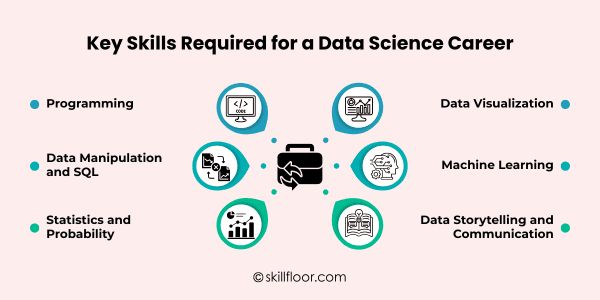
Key Skills Required for a Data Science Career
It takes a combination of technical and analytical skills to make the shift to data science. This is an easy-to-follow road map:
-
Programming: Start with R or Python. For data management and visualization, concentrate on libraries such as Matplotlib, NumPy, and Pandas.
-
Data Manipulation and SQL: Learn how to effectively extract, clean, and analyze data from databases.
-
Statistics and Probability: To make data-driven decisions, comprehend probability, mean, median, standard deviation, and hypothesis testing.
-
Data Visualization: Make clear charts and interactive dashboards using programs like Tableau, Power BI, or Seaborn.
-
Machine Learning Basics: Discover regression, clustering, classification, and supervised and unsupervised methods for predictive analytics.
-
Data Storytelling and Communication: Convert insights into practical business suggestions and effectively convey findings to stakeholders who are not technical.
Not every skill needs to be mastered right away. Develop your data science skills gradually by starting small and concentrating on learning through real-world tasks.
From Non-IT to Data Science: A Simple Roadmap
Step 1: Embrace the Mindset Shift
Changing one's perspective is the most important step before learning technical skills.
-
Give up viewing your lack of IT experience as a drawback.
-
Start viewing it as a distinct viewpoint that might make your data insights priceless.
-
Recognize that growth occurs throughout the difficult initial months.
Never forget that every expert was once a beginner. You'll see results more quickly if you embrace learning sooner.
Step 2: Build the Right Foundation
You don’t need to master everything at once. Focus on core Data Science skills:
a. Statistics & Mathematics
Descriptive statistics: mean, median, variance
Probability basics and distributions
Hypothesis testing
b. Programming
Python is widely recommended for beginners
Learn libraries like Pandas, NumPy, and Matplotlib
c. Data Handling
SQL for databases
Excel for quick analysis
Understanding data cleaning and preprocessing
d. Visualization & Storytelling
Tableau or Power BI for visual representation
Learn to tell a story with data, not just numbers
Learn basic fundamentals before moving on to more complex machine learning. Employers initially place a higher priority on problem-solving and clarity than on complicated algorithms.
Step 3: Apply Skills Through Real Projects
Without practice, theory is meaningless. Create a portfolio of actual, concrete projects:
-
Analyze marketing campaign data to optimize ROI
-
Predict sales trends using historical data
-
Create dashboards to visualize business KPIs
Even little tasks show off your skills and approach to problem-solving. Personal blogs, GitHub, and Kaggle are great platforms for showcasing your work.
Step 4: Leverage Transferable Skills
Your non-IT experience isn’t just background noise — it’s gold.
-
Communication & Storytelling: Introducing insights in a business setting
-
Domain Expertise: Having a deeper understanding of business issues than recent graduates
-
Critical Thinking: Making strategic judgments and examining trends
Employers increasingly value this combination: technical skills + real-world business understanding.
Step 5: Networking & Positioning Yourself
Sometimes getting a job requires more than just skills; it also requires connections and visibility.
-
Join LinkedIn groups, attend webinars, and meetups
-
Share your projects and insights online
-
Seek mentors or peers who have transitioned successfully
You want to be the professional with both domain knowledge and data skills that people remember when chances present themselves.
Step 6: Stay Consistent and Patient
It takes time to change careers, and it's simple to become discouraged. However, consistency wins:
-
Dedicate 1–2 hours daily to learning and practicing
-
Track progress with projects and milestones
-
Celebrate small wins to maintain motivation
Challenges You May Face & How to Overcome Them
Transitioning to IT is rewarding but not without challenges:
-
Steep Learning Curve: It can be difficult to learn about machine learning, statistics, and programming. Ask for help in communities, practice modest initiatives, and learn gradually.
-
Staying Motivated: Learning online can be lonely. Participate in study groups, establish goals, acknowledge minor victories, and routinely monitor your progress.
-
Facing Rejection: Applications for jobs may be rejected at first. Continue to apply, improve your portfolio, and view every encounter as a teaching moment.
-
Information Overload: A huge amount of stuff is available online. Prioritize fundamental abilities, concentrate on structured learning pathways, and refrain from switching between too many resources.
-
Imposter Syndrome: Being "not good enough" is a typical feeling. Continue creating useful tasks and compare your development to your own prior work rather than that of others.
-
Adapting to changing tools: Data science techniques and advances evolve quickly. Keep yourself informed by routinely practicing with new tools and subscribing to blogs, newsletters, and online groups.
When learning data science, dedication and consistency are significantly more important than speed. Long-term success and steady advancement will result from practice, small, consistent efforts, and constant improvement.
Although transitioning from a non-IT position to a career in data science may initially seem difficult, every little step matters. Combining your prior expertise with new abilities can lead to opportunities you never would have thought possible. Build projects, make connections with people, take each day as it comes, and continue to learn slowly. You can change your job, have fulfilling work, and participate in the fascinating field of information technology if you have patience, perseverance, and an open mind.
Digital Marketing Courses in Other Locations in India
Ahmedabad | Aurangabad | Bangalore | Bhilai | Bhopal | Bhubaneshwar | Chandigarh | Chennai | Cochin | Coimbatore | Dehra Dun | Delhi | Faridabad | Ghaziabad | Gorakhpur | Guntur | Gurgaon | Guwahati | Hyderabad | Jaipur | Kanpur | Khammam | Kolkata | Lucknow | Madurai | Mumbai | Mysore | Nagpur | Noida | Patna | Pondicherry | Pune | Ranchi | Shimoga | Surat | Thane | Thiruvananthapuram | Tiruchirappalli | Tirupati | Vadodara | Visakhapatnam | Warangal | Jalandhar | Jodhpur | Indore | Durgapur | Jamshedpur | Dhanbad | Kota | Karnal | Udaipur | Amritsar | calicut | Nashik | Ludhiana | varanasi | thrissur | Mangalore | Raipur |