










































What Is Linear Regression in Machine Learning? Full Guide
Linear regression is a simple supervised learning method used to find and model relationship between dependent and independent variables in machine learning.
If you are starting your machine learning journey, chances are you have already come across the term Linear Regression. It appears in courses, tutorials, interview questions, and almost every beginner roadmap because it introduces one of the core ideas behind machine learning — finding patterns in data to make predictions.
From predicting house prices and sales revenue to estimating salaries and market trends, linear regression helps machines understand relationships between variables using historical data. Despite the rapid growth of AI and deep learning, it remains one of the most important foundations of machine learning because of its simplicity, speed, and real-world usefulness.
In this guide, you will understand what linear regression in machine learning is, how it works, its types, applications, advantages, limitations, and why it still matters in 2026.
Why Is Linear Regression Important in Machine Learning?
Linear regression is important because it builds the foundation of how predictive models learn patterns from data. While many beginners want to jump directly into advanced topics like deep learning, neural networks, and AI models, building a strong foundation first makes learning easier in the long run.


Today, machine learning is no longer limited to technology companies.
According to industry hiring trends, over 60% of entry-level data science job descriptions still include regression techniques as a required foundational skill, making it one of the most important concepts for beginners.
Note: Insights on the importance of linear regression and foundational data science skills are based on current job-market trends and job listing analysis from Indeed.
Core machine learning ideas you learn from linear regression:
-
Relationship between variables
-
Prediction models
-
Training data and model learning
-
Feature importance
-
Error reduction
-
Model evaluation
-
Data interpretation
Many advanced machine learning algorithms were later built on these same ideas, including:
-
Decision Trees
-
Random Forest
-
Gradient Boosting
-
Neural Networks
-
Deep Learning models
Skipping linear regression is similar to learning advanced mathematics without understanding basic algebra first. For this reason, it often becomes the first practical machine learning concept beginners learn before moving toward more complex AI systems.
What Are Independent and Dependent Variables?
Before understanding linear regression in detail, it is important to know two basic concepts that form the foundation of predictive modeling.
1. Independent Variable
The independent variable is the input used to make predictions. It is the factor that influences the outcome.
Examples:
-
Study hours
-
Temperature
-
Years of experience
-
Advertising spend



2. Dependent Variable
The dependent variable is the output that the model tries to predict. It depends on changes in the input variables.
Examples:
-
Exam score
-
Salary
-
Product sales
-
Revenue
These basic concepts form the foundation of machine learning models and predictive systems. Platforms like Skillfloor help learners build a practical understanding of these core machine learning concepts through structured learning.
How Does Linear Regression Work?
Linear regression in machine learning works by creating what is known as a best-fit line through a set of data points. This line captures the underlying pattern between input and output variables. The model learns from past data and applies that learning to future predictions.
The basic equation used in linear regression is:
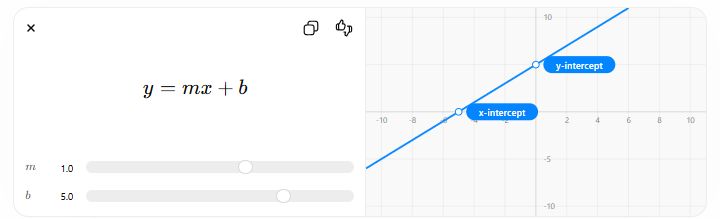
Where:
-
y = Predicted output value
-
x = Input value
-
m = Slope of the line
-
b = Intercept point
The slope represents how much the output changes when the input changes. For example, if every additional year of experience increases salary by ₹1 LPA, the slope captures that increase.
To understand this better, suppose a company has the following salary data:
|
Years of Experience |
Salary |
|
1 Year |
₹3 LPA |
|
2 Years |
₹4 LPA |
|
3 Years |
₹5 LPA |
|
4 Years |
₹6 LPA |
|
5 Years |
₹7 LPA |
The model studies the data and identifies that salary gradually increases as experience increases. Based on this relationship, if a new employee has 6 years of experience, the model can estimate an expected salary using previous patterns in the data.
The goal of linear regression is not to make perfect predictions every time. Instead, it focuses on finding the trend that best represents the data and uses that trend to predict future outcomes.
To improve prediction accuracy, the model continuously adjusts the line and minimizes the difference between predicted values and actual values. This process is called Ordinary Least Squares (OLS), which helps create the best possible prediction line.
In simple terms, linear regression learns from historical data, identifies relationships, and uses those patterns to make predictions for new data.
Types of Linear Regression in Machine Learning
Not every prediction problem is the same. Some outcomes depend on a single factor, while others are influenced by multiple variables working together. Because of this, different types of linear regression are used in machine learning depending on the nature of the problem.
1. Simple Linear Regression
Simple linear regression uses one independent variable and one dependent variable to make predictions. It focuses on understanding the relationship between a single input and an output.
Example:
Predicting salary based on years of experience
Input: Years of Experience
Output: Salary
In this case, the model forms a straight-line relationship between experience and salary. As experience increases, the model predicts how salary is likely to change based on historical data patterns.
2. Multiple Linear Regression
Multiple linear regression uses two or more independent variables to make predictions. Since most real-world problems depend on several factors, this type of regression is widely used in practical applications.
Example:
Predicting house prices using:
-
Property size
-
Number of rooms
-
Property location
-
Property age
-
Nearby facilities
Instead of relying on a single factor, the model analyzes multiple variables together and identifies how each factor contributes to the final prediction.
Most real-world prediction problems use multiple linear regression because outcomes are rarely influenced by only one variable. Different types of linear models in machine learning are used depending on data complexity.
Real-World Applications of Linear Regression in Machine Learning
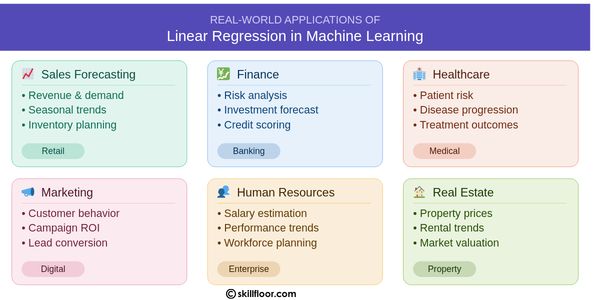
Linear regression is widely used across industries because many real-world problems involve predicting numerical outcomes using historical data. It helps organizations move from assumptions to data-driven decision-making by identifying patterns in past information. Studies in analytics and business intelligence report that predictive modeling techniques like regression are used in 70–80% of traditional business forecasting tasks, especially in finance, marketing, and operations.
Sales Forecasting
Businesses use linear regression to estimate:
-
Future revenue
-
Product demand
-
Seasonal sales trends
This helps companies plan inventory, budgeting, and marketing strategies more effectively.
Finance
Financial institutions rely on regression-based models for:
-
Risk analysis
-
Investment forecasting
-
Market behavior prediction
It helps in understanding how financial factors influence future outcomes.
Healthcare
In healthcare systems, linear regression is used for:
-
Patient risk assessment
-
Disease progression analysis
-
Treatment effectiveness evaluation
It supports better resource planning and decision-making.
Marketing
Marketing teams use regression models for:
-
Customer behavior analysis
-
Campaign performance evaluation
-
Lead conversion prediction
This improves targeting and overall campaign efficiency.
Human Resources
Organizations apply linear regression for:
-
Salary estimation
-
Employee performance analysis
-
Workforce planning
It helps HR teams make structured, data-driven decisions.
Real Estate
Real estate companies use regression to predict:
-
Property prices
-
Rental trends
-
Market value changes
This helps buyers, sellers, and agents make informed pricing decisions.
In real-world machine learning projects, linear regression is often used as a baseline model before testing more advanced algorithms. Data scientists use it to quickly understand variable relationships and identify whether data patterns are predictable.
Linear Regression in a Practical Scenario
Imagine an e-commerce company wants to predict next month’s revenue. Instead of relying on assumptions, it uses historical data such as:
-
Website traffic
-
Advertising spend
-
Seasonal demand patterns
-
Customer activity
-
Past sales performance
The model analyzes this data and identifies key relationships:
-
Higher advertising spend generally increases revenue
-
Seasonal periods drive higher demand
-
Website traffic strongly impacts sales
Using these patterns, a multiple linear regression model estimates future revenue and also highlights which factors contribute most to sales performance.
This shifts decision-making from guesswork to data-driven insights, making business planning more accurate and reliable.
Advantages of Linear Regression
Linear regression remains one of the most widely used machine learning techniques because of its simplicity, efficiency, and practical usefulness in real-world applications.
It is often the first algorithm learners understand and continues to be used in business environments where interpretability is important. This makes it a key part of many machine learning in regression approaches used in real-world predictive systems.
-
Easy to Understand - Linear regression is simple compared to complex machine learning models. It explains relationships between variables in a straightforward way, making it ideal for beginners.
-
Fast Training Process - It requires very low computational power and trains quickly, even on large datasets. This makes it suitable for real-time and large-scale applications.
-
Highly Interpretable - One of its biggest advantages is interpretability. Businesses can clearly understand how input variables affect the output, which helps in better decision-making.
-
Easy to Implement - Most machine learning libraries support linear regression with minimal code, making it easy to apply in practical projects.
-
Strong Beginner Foundation - Linear regression introduces core machine learning concepts like prediction, error reduction, and model training, making it a strong starting point for learners.
-
Useful for Real-World Business Applications - Despite its simplicity, linear regression is widely used in industries for forecasting, planning, and trend analysis where relationships between variables are relatively linear.
Limitations of Linear Regression
Although linear regression is one of the simplest and most widely used machine learning algorithms, it has certain limitations that make it unsuitable for some real-world problems. Understanding these limitations is important before applying them to any dataset.
-
Assumes a Linear Relationship - Linear regression works only when there is a straight-line relationship between input and output variables. In many real-world situations, data relationships are more complex and do not follow a linear pattern.
-
Highly Sensitive to Outliers - The model is strongly affected by extreme values (outliers). Even a single unusual data point can distort the best-fit line and reduce overall prediction accuracy.
-
Limited for Complex Problems - Linear regression does not perform well when the dataset has complex patterns or interactions between variables.
In such cases, more powerful algorithms are required, such as:
-
Decision Trees
-
Random Forest
-
Neural Networks
Poor Performance on Non-Linear Data - If the relationship between variables is curved or irregular, linear regression cannot capture it effectively, which leads to weaker predictions and reduced model performance.
Skills Needed to Learn Linear Regression
To understand and apply linear regression effectively, beginners need a mix of programming, analytical thinking, and data-handling skills. These skills help in building models and interpreting results in real-world scenarios.
Core Skills
|
Skill |
Why It Matters |
|
Python |
Used for building and running machine learning models |
|
Statistics |
Helps understand relationships between variables and data behavior |
|
SQL |
Useful for extracting and managing datasets |
|
Data Visualization |
Helps identify patterns, trends, and outliers in data |
|
Builds foundational understanding of how models learn from data |
Along with these tools, practical learning is equally important. Working on small datasets and simple projects helps build understanding much faster than only studying theory or formulas.
Career Scope for Linear Regression in 2026
The demand for data-driven decision-making is growing rapidly across industries. According to NASSCOM estimates, India may face a shortage of over 230,000 data science professionals by 2026, highlighting a significant gap between industry demand and skilled talent. Reports also suggest that the demand-supply gap for data science and machine learning roles ranges between 60% to 73%, depending on the sector.
This gap does not exist because of a lack of degrees, but because companies need professionals who can apply machine learning concepts in real business situations. To understand how predictive models work in real business scenarios, linear regression in data science provides a strong foundation for practical machine learning applications.
Linear regression is often one of the first concepts tested in interviews. It is not asked because it is complex, but because it shows whether a candidate truly understands how machine learning works from the ground up.
Many learners with advanced certifications still struggle with basic concepts like residuals, error interpretation, and model behavior. This clearly shows the gap between theoretical knowledge and practical understanding. Building a strong foundation in linear regression helps bridge this gap and strengthens overall data science skills.
Common Beginner Mistakes While Learning Linear Regression
Beginners often make predictable mistakes while learning linear regression.
These mistakes usually happen not because the concept is difficult, but because learners focus on coding or formulas without properly understanding the data behind the model.
Common Mistakes Include:
-
Memorizing formulas without understanding how or why they work
-
Ignoring data cleaning and using datasets without checking quality
-
Skipping data visualization, which often hides patterns and outliers
-
Using irrelevant or poorly chosen variables for prediction
-
Focusing only on writing code instead of interpreting results
Linear regression is not just about building a model in Python. It is about understanding how data behaves, how variables are related, and how those relationships affect predictions.
A strong understanding of the data is often more important than the complexity of the algorithm itself. Without this, even correct code can produce misleading results.
Frequently Asked Questions (FAQs)
1. Is Linear Regression only for math-heavy roles?
No. You don’t need advanced math to use linear regression. The concept is more important than manual calculations because tools like Python handle the computations. What matters is understanding how to interpret results.
2. What is the difference between Linear Regression and Logistic Regression?
Linear regression predicts continuous numerical values such as price, salary, or temperature. Logistic regression is used for classification problems, such as yes/no or true/false outcomes.
3. How long does it take to learn Linear Regression?
The basic concept can be understood in a few hours. However, applying it to real datasets, including cleaning, training, and evaluation, requires consistent practice over a few weeks.
4. Can a beginner learn Linear Regression without a statistics background?
Yes. It is one of the most beginner-friendly machine learning concepts. Statistics help deepen understanding, but it is not required to start.
5. Is Linear Regression still relevant in 2026?
Yes. Many industries still use linear regression because it is simple, fast, and highly interpretable, especially for structured business data.
6. Which Python library is used for Linear Regression?
The most commonly used library is Scikit-learn, which provides built-in tools to train and test regression models efficiently.
Linear regression in machine learning may look simple, but it is one of the most important foundations of predictive analytics.
It is not just about formulas or drawing lines; it is about understanding how data behaves, how variables are connected, and how those relationships can be used to make predictions.
Many advanced machine learning concepts are built on the same ideas introduced in linear regression. That is why it remains a key starting point for anyone learning data science or machine learning in 2026.
Building a strong understanding of linear regression helps you approach advanced models with clarity instead of confusion, making your overall learning journey much stronger and more structured.
Digital Marketing Courses in Other Locations in India
Ahmedabad | Aurangabad | Bangalore | Bhilai | Bhopal | Bhubaneshwar | Chandigarh | Chennai | Cochin | Coimbatore | Dehra Dun | Delhi | Faridabad | Ghaziabad | Gorakhpur | Guntur | Gurgaon | Guwahati | Hyderabad | Jaipur | Kanpur | Khammam | Kolkata | Lucknow | Madurai | Mumbai | Mysore | Nagpur | Noida | Patna | Pondicherry | Pune | Ranchi | Shimoga | Surat | Thane | Thiruvananthapuram | Tiruchirappalli | Tirupati | Vadodara | Visakhapatnam | Warangal | Jalandhar | Jodhpur | Indore | Durgapur | Jamshedpur | Dhanbad | Kota | Karnal | Udaipur | Amritsar | calicut | Nashik | Ludhiana | varanasi | thrissur | Mangalore | Raipur |