







































What is Search Intent and Why is it Important for SEO?
Learn what search intent is and why it matters for SEO. Discover how understanding what users want helps create better content and also improve Google rankings.
Search intent is the goal behind a user's search query: what they want to find, learn, or do. It matters because Google ranks content based on how well it satisfies that goal, not just keyword usage. According to BrightEdge, organic search drives around 53% of all website traffic, making it one of the most important channels for businesses to reach potential customers. However, ranking is no longer only about using the right keywords. Search engines now focus on understanding user expectations, context, and the reason behind each search. Users may want to learn something, compare products or services, find a specific website, or take an action. Search Intent in SEO helps businesses understand these goals and create content that matches what users are actually looking for.
Google prioritizes content that satisfies user intent by delivering relevant information and a better search experience. By understanding search purpose, businesses and content creators can create valuable content, improve user engagement, and increase the chances of achieving better organic search performance.
What is Search Intent in SEO?
Search Intent in SEO refers to the underlying reason or goal behind a user's search query. It explains what users expect to find when they enter a particular keyword into a search engine. Instead of only matching keywords, search engines analyze the meaning behind queries to understand whether users are looking for information, a specific website, comparisons, or a solution to complete an action.
For example:


-
Someone searching "What is SEO?" is looking for educational information.
-
Someone searching "Skillfloor digital marketing course" is trying to find a specific website or brand.
-
Someone searching "best SEO tools" is comparing available options before making a decision.
-
Someone searching "buy SEO course online" has a transactional intent and is ready to take action.
Understanding Search Intent helps you create SEO content that matches user expectations. A user looking for information needs educational content such as guides or tutorials, while someone ready to make a decision needs comparison pages, service pages, or product-focused content. Matching content with user intent improves content relevance, enhances user experience, and supports better SEO performance.
Why Search Intent Matters in 2026
Choosing the right keywords is only one part of SEO. If your content does not match what users expect to find, even a well-optimized page can struggle to perform in search results. As search engines continue to improve their understanding of context, natural language, and user behavior, Search Intent has become more important than ever for creating content that satisfies both users and search engines.
Google processes more than 8.5 billion searches every day worldwide, making it important for search engines to understand the meaning and purpose behind queries rather than only matching keywords.
Key Benefits of Understanding Search Intent
-
Improves content relevance: Matching your content with user intent ensures it answers the user's question, solves a problem, or provides the information they are actively searching for.
-
Aligns with modern search algorithms: Search engines evaluate whether a page satisfies the purpose behind a query. Content that accurately matches Search Intent is more likely to be considered relevant and visible in search results.
-
Enhances user engagement: When visitors find useful information that meets their expectations, they are more likely to stay longer, explore additional pages, and interact with your website.
-
Increases conversion opportunities: Users with commercial or transactional intent are often closer to making a decision. Delivering relevant information at the right stage helps encourage meaningful actions.
-
Supports long-term SEO success: As search behavior continues to evolve, understanding Search Intent helps businesses create content that remains relevant, adapts to changing user expectations, and performs consistently over time.
-
Strengthens content planning: Understanding user intent helps marketers identify valuable topics, organize content strategies, and create pages that support both audience needs and business goals.
Types of Search Intent in SEO
Search queries can have different purposes depending on what users want to achieve. Some searches are made to gain knowledge, some are focused on finding a specific brand or page, while others involve evaluating options or completing an action. Understanding these categories helps marketers create content that matches the purpose of each query.
|
Search Intent |
User Goal |
Example Search |
|
Informational |
Find knowledge or answers about a topic |
What is SEO? |
|
Navigational |
Reach a specific website or page |
Skillfloor digital marketing course |
|
Commercial Investigation |
Research and evaluate available options |
Best SEO tools |
|
Transactional |
Complete a specific action |
Buy an SEO course online |
1. Informational Intent
Informational Intent applies when users are looking for answers, explanations, or guidance on a topic. These searches commonly include phrases such as "what is," "how to," or "why." At this stage, the goal is to gain knowledge or solve a problem rather than make a purchase. Content that answers the user's question clearly, provides accurate information, and covers the topic in depth is most effective for satisfying this type of search.
2. Navigational Intent
Navigational Intent occurs when users already know the website, brand, or page they want to visit and use Google to reach it quickly. For example, someone searching "Skillfloor digital marketing course" is likely trying to access the official website rather than explore general information. Clear navigation, optimized brand pages, and well-structured landing pages help users reach their destination with minimal effort.
3. Commercial Investigation Intent
Commercial Investigation Intent represents users who are researching different products, services, or solutions before making a final decision. They compare features, pricing, reviews, and alternatives to identify the option that best suits their needs. Detailed comparison articles, buyer's guides, and unbiased reviews help users evaluate their choices confidently before moving to the next stage.
4. Transactional Intent
Transactional Intent indicates that users have completed most of their research and are ready to take action. Whether they want to purchase a product, enroll in a course, request a service, or download a resource, they expect quick access to essential information, transparent pricing, and a clear call to action. A streamlined user experience with relevant details and simple navigation helps users complete their goal efficiently.
How Search Engines Understand User Intent
Search engines no longer rely only on matching keywords with web pages. Modern search algorithms analyze the meaning behind a query and evaluate which content provides the most useful response for that specific search.
Google uses multiple factors to understand the context of a search, including the wording of the query, content quality, page relevance, and how users interact with search results. These signals help search engines determine which pages are most likely to satisfy user expectations.
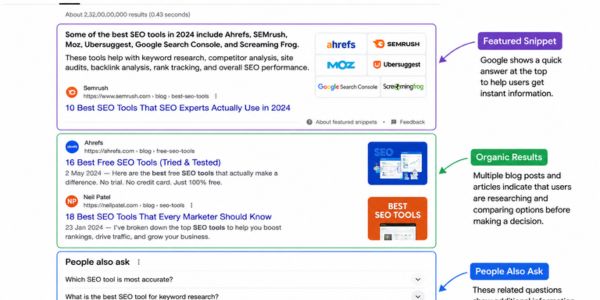


For example, when users search for "best SEO tools", Google identifies that they are likely researching available solutions and displays content such as comparison articles, reviews, and detailed guides. For a query like "buy SEO course online", Google understands that users are looking for a page where they can take action and therefore prioritizes course or service pages.
Google continuously refines search results based on content quality, relevance, and user satisfaction signals to provide results that better match search intent. These ranking signals help search engines identify which pages provide the most valuable and relevant information for users.
How to Identify Search Intent for a Keyword
Before creating content, it is important to identify the Search Intent behind your target keyword. This helps you understand what users are looking for and what signals Google uses to rank relevant pages for that query. By analyzing these factors, you can create content that better matches user expectations and search engine requirements.
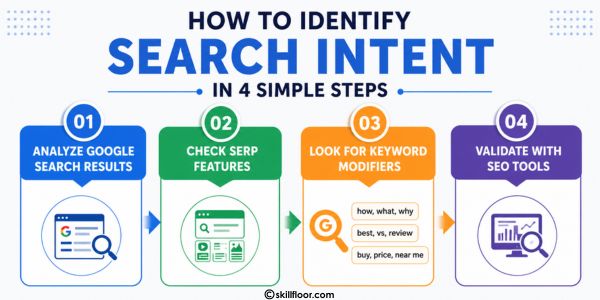
1. Analyze the Search Results
The first step to identifying Search Intent is reviewing the top-ranking pages on Google. These results show what search engines consider relevant for a particular query. Analyze the type of pages ranking, the topics they cover, and the information they provide to understand the purpose behind the search.
2. Look for SERP Features
Search results often include features such as Featured Snippets, People Also Ask, Videos, Shopping Results, and Local Packs. These elements provide insights into the type of information users are seeking and how Google presents results for different queries.
3. Pay Attention to Keyword Modifiers
The words used in a search query can provide clues about the user's goal. Terms like "what," "how," and "why" usually indicate informational searches, while words like "best," "compare," "buy," or "price" can suggest commercial or transactional intent.
4. Validate Intent with SEO Tools
SEO tools such as Google Search Console, Ahrefs, and Semrush can help analyze keyword data, related searches, and user behavior. These insights support your research and help confirm the intent behind a keyword.
How to Optimize Content for Search Intent
Once the Search Intent is identified, the next step is to create content that satisfies the user's goal. Optimization focuses on structuring content properly, providing relevant information, and improving the overall user experience. Effective content strategies, such as those used in digital marketing, focus on matching content with user needs and search intent.
Choose the Right Content Format
Different search intents require different content formats. Selecting the appropriate format helps your content match what users expect to find.
|
Search Intent |
Recommended Content Format |
|
Informational |
Blog posts, guides, tutorials, FAQs |
|
Navigational |
Homepage, brand pages, service pages |
|
Commercial Investigation |
Comparison articles, reviews, and buying guides |
|
Transactional |
Product pages, course pages, landing pages |
1. Answer User Questions Clearly
Provide direct and useful answers to user queries. Clear explanations help visitors find relevant information quickly and encourage them to engage with the content.
2. Create Relevant and Complete Content
Add useful examples, comparisons, visuals, and supporting information where required. Comprehensive content improves value and helps users find solutions in one place.
3. Maintain Content Relevance
Keep content updated according to changes in user behavior, search trends, and industry information. Relevant and updated content has a better chance of satisfying both users and search engines.
How Helpful Content Supports Search Intent
Optimizing content for Search Intent goes beyond matching the right keywords or choosing the right content format. To perform well in search results, every page should provide accurate, relevant, and trustworthy information that directly satisfies the user's search query.
High-quality content demonstrates expertise, offers original insights, and presents information in a clear and well-structured way. Rather than repeating information available on other websites, focus on adding unique value through practical examples, updated information, and clear explanations. Creating helpful, reliable content strengthens content quality, improves the overall user experience, and increases the likelihood of satisfying both users and search engines.
A strong page should accurately reflect its title, remain focused on the topic, avoid unnecessary repetition, and provide enough depth to answer the user's query. Clear headings, readable formatting, relevant visuals, and credible supporting information make content easier to understand and more valuable to users.
Regularly updating content also helps maintain accuracy, relevance, and usefulness as user expectations and search behavior evolve. When Search Intent, content quality, and user experience work together, your content is more likely to build trust, improve engagement, and support long-term SEO performance.
Common Mistakes to Avoid When Optimizing for Search Intent
Even well-written content can struggle to perform if it doesn't align with Search Intent. Many marketers focus on keywords and on-page SEO but overlook the user's actual goal behind a search. Avoiding the following mistakes can help you create content that better matches user expectations and improve long-term SEO performance.
-
Targeting keywords without understanding intent: Choosing keywords based only on search volume can result in content that doesn't answer what users are actually looking for. Applying content-focused SEO principles helps marketers create pages that better match user expectations and search intent.
-
Ignoring Google's search results: The pages already ranking provide valuable insights into the type of content, format, and intent Google considers most relevant for a keyword.
-
Mixing multiple search intents on one page: Trying to educate, compare products, and promote a service within the same page can confuse users and reduce the page's relevance for a specific search intent.
-
Using misleading titles: Your title should accurately reflect the content. Misleading or clickbait headlines may attract clicks initially but often disappoint users when the page doesn't meet their expectations.
-
Failing to update content: Search behavior and search results evolve, which can change the intent behind certain keywords. Regularly reviewing and updating your content helps keep it relevant and aligned with current user expectations.
Understanding these common mistakes makes it easier to create focused, relevant content that satisfies both users and search engines. When each page is built around a clear purpose, it is more likely to improve user engagement and support long-term SEO success.
Search Intent vs. Keywords
Keywords and Search Intent are closely connected, but they serve different purposes in SEO. Keywords help identify the terms users type into search engines, while Search Intent explains the reason behind those searches. Understanding the difference between them helps marketers create content that targets the right queries and matches what users actually expect to find.
|
Keywords |
Search Intent |
|
Identifies what users are searching for |
Explains why users are searching |
|
Based on specific words and phrases used in search queries |
Based on the user's goal, expectations, and stage in the search journey |
|
Helps discover relevant search terms and opportunities |
Helps decide the right content format, structure, and approach |
|
Supports keyword research and targeting |
Supports content optimization and a user-focused SEO strategy |
|
A keyword can remain the same over time |
Search intent can change as user behavior and search trends evolve |
Keyword research helps you understand the language users use when searching, but Search Intent helps you understand what type of content will satisfy that search. Using advanced keyword research methods can help marketers identify user requirements more accurately and create content that aligns with search intent. For example, the keyword "SEO course" could represent different goals: someone may want to learn about SEO, compare different courses, or enroll in a program.
By combining keyword research with search intent analysis, businesses can create more relevant content, improve user experience, and support long-term SEO performance.
Frequently Asked Questions (FAQs)
1. How do I know if my content matches the right Search Intent?
You can check this by comparing your content with the pages currently ranking on Google. If the top results are guides, comparisons, or landing pages, your content should follow a similar format while providing better value.
2. Can a high-volume keyword still fail to rank if the search intent is wrong?
Yes. A keyword with high search volume may not perform well if the content does not satisfy what users are looking for. Search engines prioritize pages that provide the right information in the format users expect.
3. Should every keyword have a separate page based on Search Intent?
Not always. Related keywords with the same intent can be covered on one page, while keywords with different goals usually require separate content to avoid confusing users and search engines.
4. How does Search Intent help in content planning?
Search Intent helps decide what type of content to create, what information to include, and where users are in their search journey. It helps build content that supports both user needs and SEO goals.
5. Can Search Intent be different for the same keyword in different industries?
Yes. The intent behind a keyword can vary depending on the industry, audience, and user expectations. Analyzing the search results for that specific topic helps identify the most relevant intent.
6. How often should Search Intent be reviewed for existing content?
Search Intent should be reviewed when rankings drop, search results change, or user behavior shifts. Updating content based on current search expectations helps maintain relevance over time.
Search Intent in SEO helps businesses create content that matches what users actually want to find. By understanding the purpose behind a search query and aligning content accordingly, marketers can improve relevance, user experience, and overall SEO performance.
Successful SEO is not just about targeting keywords; it is about delivering the right content to the right audience at the right time. Combining keyword research with Search Intent analysis helps create valuable content that supports long-term growth.
With the growth of AI-powered search, user intent has become even more important. Gartner predicted that traditional search engine volume could decline by 25% by 2026 as AI-powered search experiences and virtual assistants become more common. This makes it increasingly important for businesses to create content that directly answers user needs and provides clear value.
Sources & references:
-
Organic search drives 53% of website traffic
https://www.brightedge.com/topic/increase-traffic -
8.5 billion searches every day worldwide
https://www.internetlivestats.com/google-search-statistics/ -
Creating helpful, reliable content
https://developers.google.com/search/docs/fundamentals/creating-helpful-content -
Traditional search engine usage could decline by 25% by 2026 https://www.gartner.com/en/newsroom/press-releases/2024-02-19-gartner-predicts-search-engine-volume-will-drop-25-percent-by-2026-due-to-ai-chatbots-and-other-virtual-agents
Digital Marketing Courses in Other Locations in India
Ahmedabad | Aurangabad | Bangalore | Bhilai | Bhopal | Bhubaneshwar | Chandigarh | Chennai | Cochin | Coimbatore | Dehra Dun | Delhi | Faridabad | Ghaziabad | Gorakhpur | Guntur | Gurgaon | Guwahati | Hyderabad | Jaipur | Kanpur | Khammam | Kolkata | Lucknow | Madurai | Mumbai | Mysore | Nagpur | Noida | Patna | Pondicherry | Pune | Ranchi | Shimoga | Surat | Thane | Thiruvananthapuram | Tiruchirappalli | Tirupati | Vadodara | Visakhapatnam | Warangal | Jalandhar | Jodhpur | Indore | Durgapur | Jamshedpur | Dhanbad | Kota | Karnal | Udaipur | Amritsar | calicut | Nashik | Ludhiana | varanasi | thrissur | Mangalore | Raipur |